Browse Exhibits (18 total)
1930's Crime
This exhibit will go over whether or not crime rates increased or decreased during the great depression. It will go in depth about the Prohibition Act, why it happened and who was affected. I will discuss the efforts made by the Federal Bureau of Investigation (FBI) to stop crime. I will walk you through a couple of major cities where crime was an at record high. There will be a small photo gallery of events and people who were important during the 1930's. Finally, I will end this exhibit will a conclusion page, discussing the crime rates and the reason why it increased or decreased.
Black Spirituals and Spirituality in Post-Slavery South Carolina
This exhibit seeks to diachronically explore themes of spirituality and religious practice amongst African American communities of the American south, with a special interest in the state of South Carolina. What difference did the transition from slavery to freedom make in spiritual/religious observance? What significance did African spirituals have during slavery, reconstruction, and onwards? Through the analysis of primary sources collected in the 1930's, such as personal narratives documented by the Federal Writer's Project, and audio recordings courtesy of Southern Mosaic collection by John and Ruby Lomax; as well as images provided by Documenting the American South, a digital publishing initiative, with additional secondary sources provided by the Library of Congress, this exhibit will discuss the historical impact of Christianity on southern African American groups throughout the 19th and early 20th centuries.
Childhood and the Great Depression
The Great Depression had major effects on every aspect of life in the United States. From the way jobs operated to how powerful the federal government is, things changed dramatically. Often times some parts of life are ignored for the more bombastic and dramatic changes in this time period. For instance, childhood is not a subject that we focus on in many classes. This exhibit is meant to remedy that, in hopes that we can learn how this event changed the way people experienced their childhood. What was childhood like during the Great Depression?
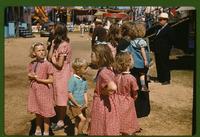
Francesca Reimer - At The Vermont State FairF
In this image analysis and glitching activity, I seek to examine the themes and meanings behind the 1939-1944 Farm Security Administration/Office of War Information photography campaign. Intended to depict American lifestyles and technological advancement, much of this campaign was focused on the work of American citizens throughout the country and US territories. With that in mind, I pose the following question: is it possible to find historical meaning in moments of leisure, as opposed to moments of advancement?
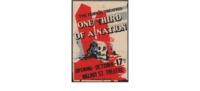
How Fame has Shifted from the 1930s to Today
This project will explore the impact that the federal theater project had on celebrity status in the 1930s. There will be exploration of the shift of technology and the impact it has on fame from the 1930s to today. While there isn't a federally funded theater project nowadays, technology allows for actors and actresses to control their own narrative that promotes their own image rather than being classified as a government employee like the actors with the federal theater project. There will be exploration of the consistent words used regarding the Federal Theater Project from the 1930s, a timeline that shows how the notable actor, Spencer Tracy, rose to stardom without the use of social media that we see nowadays. Finally, there will be a comparison of two movie posters. One movie poster comes from an early Spencer Tracy film, Boom Town, and another from the hit 2013 film, The Wolf of Wall Street.
Image Analysis, Natalie Farrey
The picture annotated comes from the Library of Congress' collection of Farm Secuirty Association photographs.
Photo Citation: Lange, Dorothea. Worn-out Land and Abandoned Cabins near Newport, Oklahoma. Photograph. Library of Congress . Library of Congress. Accessed January 21, 2020. https://www.loc.gov/pictures/item/2017770101/.
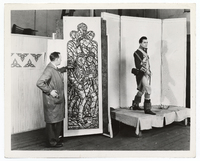
Jessica Burgess Stained Glass In Progress and History replaced
George Pearson Ennis creates a cartoon from a life model. This will be used to create a stained glass window at The US Military Academty in New York.
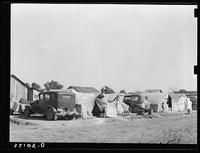
La Odisea: How Mexican-American Migrants Reconciled Their Identities
In the 1920s, half a million Mexicans made their homes across the border, the vast majority of them legally. Mexican immigration diminished to a halt by the 1930s due to the Depression, leaving the Mexican-American citizens in a long odyssey across the American plains, searching for a place to call home as they moved with the harvest. Wherever the migrants travelled, dingy living conditions, mistrust and contempt from fellow migrants, and forced repatriation from local governments dogged them. Their status as migrants "caused many Mexicans to feel isolated from American society." (Bindas, pg. 96) My project aims to examine how migrants' Mexican and American identities interacted throughout the country, whether they ultimately reconciled themselves-- or clashed. I analysed the overall situation of Mexican-Americans-- how they lived, how they interacted with white Americans-- by analysing a variety of Russell Lee's wonderful photos. I then used that information in conjunction with a Storymap that plotted a small sample of locations Mexican-Americans settled. I further explored some more Depression photography with the background of the Storymap. Finally, I reserved the last part for one of the most important aspects of Mexican-American culture: music. The Soundcite tool helped me paint a better picture of the many sounds of migrant America.
Moving On Up!! Movement in the 1930's
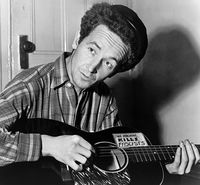
The focus of this exhibit is to showcase the power behind the Culture New Deal to "move" the people of America in a new direction. I believe that the Federal Writer's Project, the Federal Music Project, and the Federal Theatre Project were very crucial to this idea of getting the people out of stagnation. Each one did it in their own unique way, creating many paths for the American people.
This site is structured from Into the Woods (a discussion about the FWP Guides) down to Going Stage Right! (a discussion of the FTP).
Shannon Mulligan: Children's art exhibit
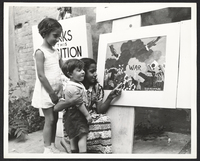
Sol Horn photographs three young children observing a painting that was being shown at an art exibit sponsored by the Federal Arts Project.