Browse Exhibits (40 total)
1930's Crime
This exhibit will go over whether or not crime rates increased or decreased during the great depression. It will go in depth about the Prohibition Act, why it happened and who was affected. I will discuss the efforts made by the Federal Bureau of Investigation (FBI) to stop crime. I will walk you through a couple of major cities where crime was an at record high. There will be a small photo gallery of events and people who were important during the 1930's. Finally, I will end this exhibit will a conclusion page, discussing the crime rates and the reason why it increased or decreased.
An American Tragedy: Scottsboro Trial
The Scottsboro Boys were nine young African American men who were falsely accused of raping two white women aboard a freight train bound for Scottsboro, Alabama in 1931.
"So began one of the most significant legal fights of the twentieth century. The Scottsboro affair divided Americans along racial, political, and geographic lines. It drew the North and South into their sharpest conflict since the Civil War, and yielded two momentous Supreme Court decisions" (PBS 2001).
Through the use of timelines, storymaps, glitching and image annotation activities, I seek to gain a boarder understandng of the organized efforts done by African Americans to end racial discrimination and inequality. With attention to such tragedy, I pose the following question: "In what ways did the Scottsboro Boys influence leaders in the Black comunity as well as the Civil Rights Movement?"
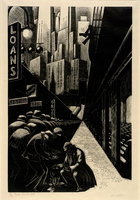
Artistic Expression in the Great Depression
How were personal struggles depicted through artworks during the Great Depression? Exploring art works created in the Geat Depression era reveals how artists and ordinary people expressed the challenges of a changing nation. Sharing these experiences through works of art was a uniting factor, in that many others could identify with these common experiences at the time.
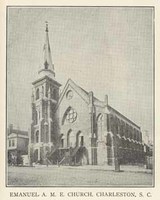
Black Spirituals and Spirituality in Post-Slavery South Carolina
This exhibit seeks to diachronically explore themes of spirituality and religious practice amongst African American communities of the American south, with a special interest in the state of South Carolina. What difference did the transition from slavery to freedom make in spiritual/religious observance? What significance did African spirituals have during slavery, reconstruction, and onwards? Through the analysis of primary sources collected in the 1930's, such as personal narratives documented by the Federal Writer's Project, and audio recordings courtesy of Southern Mosaic collection by John and Ruby Lomax; as well as images provided by Documenting the American South, a digital publishing initiative, with additional secondary sources provided by the Library of Congress, this exhibit will discuss the historical impact of Christianity on southern African American groups throughout the 19th and early 20th centuries.
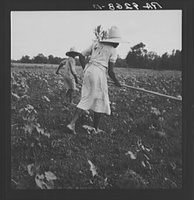
Childhood and the Great Depression
The Great Depression had major effects on every aspect of life in the United States. From the way jobs operated to how powerful the federal government is, things changed dramatically. Often times some parts of life are ignored for the more bombastic and dramatic changes in this time period. For instance, childhood is not a subject that we focus on in many classes. This exhibit is meant to remedy that, in hopes that we can learn how this event changed the way people experienced their childhood. What was childhood like during the Great Depression?
Coping With Great Depression: A Nation's Solace
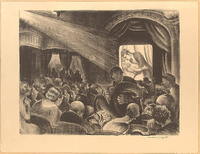
It’s a term that often accompanies discussion of depression – ‘coping mechanism’. It’s the strategy, the fallback, the rope out of what can seem like even the darkest hole. But could any one such thing have really been accessible for an entire nation?
The Great Depression affected every aspect of the average American’s life in the 1930s, and as "individuals, families, and communities faced the painful, frightening, and often bewildering collapse of the economic institutions on which they depended"[1], things must have seemed as though there was little hope in sight. In this exhibit, I want to examine some of the coping methods that emerged in American society, and the different repercussions created by each one. I pinned down three main topics: religion, folklore, and pop culture. I intend to argue that while each resonated for different reasons, all came together as means of escapism for the average American from the strife of the Great Depression.
Sources Used: Dwight, Mabel. “Library of Congress.” Library of Congress, https://www.loc.gov/item/99400809/.

Exploring the New Deal Through the Five Senses
How does exploring the New Deal through the five senses portray the work it took to rebuild America?
Franklin Roosevelt implements the New Deal which was intended to help Americans get back on their feet after the negative effects of the Great Depression. President Roosevelt created many relief programs that were implemented to decrease the unemployment rate as well as bring the lost sense of happiness to the American people. At this time people were homeless, lost, poor and discouraged. When looking at the programs that arose I noticed that all of them related to one or mulitple senses. Looking at the New Deal through your senses can help understand the time period more and make you appreciate the programs that arouse.