Browse Exhibits (40 total)
Francesca Reimer - At The Vermont State FairF
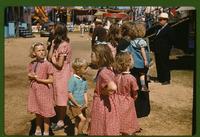
In this image analysis and glitching activity, I seek to examine the themes and meanings behind the 1939-1944 Farm Security Administration/Office of War Information photography campaign. Intended to depict American lifestyles and technological advancement, much of this campaign was focused on the work of American citizens throughout the country and US territories. With that in mind, I pose the following question: is it possible to find historical meaning in moments of leisure, as opposed to moments of advancement?
Heather Dietz Answering the Need for Womanpower
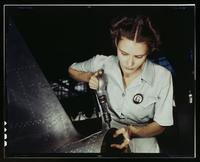
Mrs. Virginia Davis made arrangement for the care of her two children during the day and joined her husband at work in the Naval Air Base, Corpus Christi, Texas. Both are employed under Civil Service in the Assembly and repair department. Mrs. Davis' training will enable her to take the place of her husband should he be called by the armed service
Hopeless Times and Dreams of Flight - Introduction
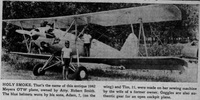
Aviation runs through my family. My grandfather Robert W. Smith, serving as a paratrooper during the aftermath of World War II, descended into the rubble of Japan in 1947 and left behind for his children a copy of his letters to home. Reading these letters makes me smile wide and causes my heart to flutter - sometimes, I recognize the thoughts he composed as my own.
My grandfather opens this collection of letters with a short introduction: "I have given a copy of this to each of my three children, Tim, Robin, and Adam, with the request that at some appropriate time in the future, they let their progeny (and their progeny's progeny) read it, if they will. If I am right-that we are the sum of all who have gone before-then perhaps these letters will satisfy in them at least a little of that which remains unsatisfied in me."
For this course's final project, I will be examining the lives of aviators prior to the onset of World War II and examine what propelled these individuals to the skies, kept them grounded, and the means by which they overcame these challenges. If my grandfather was right in stating that people are "the sum of all who have gone before," then the American spirit - one undeterred by any obstacle - that thrived within these men and drove their dreams of flight into reality exist within us as well.
How Fame has Shifted from the 1930s to Today
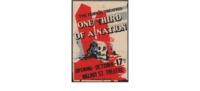
This project will explore the impact that the federal theater project had on celebrity status in the 1930s. There will be exploration of the shift of technology and the impact it has on fame from the 1930s to today. While there isn't a federally funded theater project nowadays, technology allows for actors and actresses to control their own narrative that promotes their own image rather than being classified as a government employee like the actors with the federal theater project. There will be exploration of the consistent words used regarding the Federal Theater Project from the 1930s, a timeline that shows how the notable actor, Spencer Tracy, rose to stardom without the use of social media that we see nowadays. Finally, there will be a comparison of two movie posters. One movie poster comes from an early Spencer Tracy film, Boom Town, and another from the hit 2013 film, The Wolf of Wall Street.
I Too Am America : Shaping American Identity
An investigation into the national identity politics of the the 1930's and the ways in which Black and Brown people where often exluded by people in power.
Image Analysis, Natalie Farrey
The picture annotated comes from the Library of Congress' collection of Farm Secuirty Association photographs.
Photo Citation: Lange, Dorothea. Worn-out Land and Abandoned Cabins near Newport, Oklahoma. Photograph. Library of Congress . Library of Congress. Accessed January 21, 2020. https://www.loc.gov/pictures/item/2017770101/.
Jessica Burgess Stained Glass In Progress and History replaced
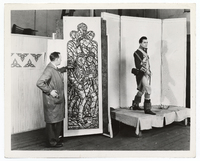
George Pearson Ennis creates a cartoon from a life model. This will be used to create a stained glass window at The US Military Academty in New York.
La Odisea: How Mexican-American Migrants Reconciled Their Identities
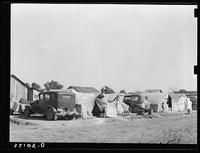
In the 1920s, half a million Mexicans made their homes across the border, the vast majority of them legally. Mexican immigration diminished to a halt by the 1930s due to the Depression, leaving the Mexican-American citizens in a long odyssey across the American plains, searching for a place to call home as they moved with the harvest. Wherever the migrants travelled, dingy living conditions, mistrust and contempt from fellow migrants, and forced repatriation from local governments dogged them. Their status as migrants "caused many Mexicans to feel isolated from American society." (Bindas, pg. 96) My project aims to examine how migrants' Mexican and American identities interacted throughout the country, whether they ultimately reconciled themselves-- or clashed. I analysed the overall situation of Mexican-Americans-- how they lived, how they interacted with white Americans-- by analysing a variety of Russell Lee's wonderful photos. I then used that information in conjunction with a Storymap that plotted a small sample of locations Mexican-Americans settled. I further explored some more Depression photography with the background of the Storymap. Finally, I reserved the last part for one of the most important aspects of Mexican-American culture: music. The Soundcite tool helped me paint a better picture of the many sounds of migrant America.
Migration in the 20th Century
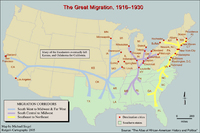
During the 1900's, specifically the 1920's, following the Dust Bowl and serious socio-economic changes in the United States, many challanges were encountered for people migrating westward and towards southern American states such as Texas and New Mexico. How did the Great Depression and the Dust Bowl influence an era of migration? This question derives from the true start of western inhabitance.
Moving On Up!! Movement in the 1930's
The focus of this exhibit is to showcase the power behind the Culture New Deal to "move" the people of America in a new direction. I believe that the Federal Writer's Project, the Federal Music Project, and the Federal Theatre Project were very crucial to this idea of getting the people out of stagnation. Each one did it in their own unique way, creating many paths for the American people.
This site is structured from Into the Woods (a discussion about the FWP Guides) down to Going Stage Right! (a discussion of the FTP).