Image Annotations
At the end of the Civil War, emancipated slaves were faced with myriad hardships, from reuniting families, finding work, and navigating their new citizenship, to creating new lives as a whole (Maffly-Kipp 2001). A large part of this genesis was the formation of religious groups, especially with the new introduction of contact with Northern African Americans, who had been emancipated for decades already by the time that slavery was abolished in the south. Missionaries who came down from the North to preach to newly freed slaves taught from a literate and educated platform, where they emphasized the need for literacy in order to truly engage with Christian faith and the texts on which the religion was based. However, Black Christianity in the South had already been generated by slaves, the majority of whom were never allowed to learn to read. Therefore, it possessed many traits reminiscent of African ritual practice “such as drumming, dancing or moaning,” and religion as a whole was viewed as “a matter of oral tradition and immediate experience and emotion” (Maffly-Kipp 2001).
As time progressed, especially in urban centers, the black middle-class began to form educational networks and “large, formal churches” similar to those run by white Christians of similar social class (Maffly-Kipp 2001). One such example is the AME Church, one of which is featured below on this exhibit page. Despite mirroring the structure of white churches, the evangelical leaders of these churches focused heavily on the continued social injustice and racism which persisted after slavery, and they continued to be prominent forces in the fight for Civil Rights even throughout and beyond the 1960’s.
Maffly-Kipp, Laurie F. “The Church in the Black Southern Community.” The Church in the Southern Black Community: Introduction, 2001, docsouth.unc.edu/church/intro.html.
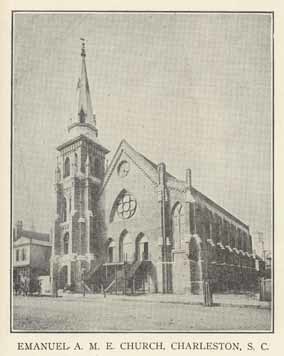
“EMANUEL A. M. E. CHURCH, CHARLESTON, S. C.” Richard R. Wright (Richard Robert), b. 1878. Centennial Encyclopaedia of the African Methodist Episcopal Church. At Philadelphia, Penna., in 1816., Philadelphia: [Book Concern of the A.M.E. Church], docsouth.unc.edu/church/wright/ill299a.html.
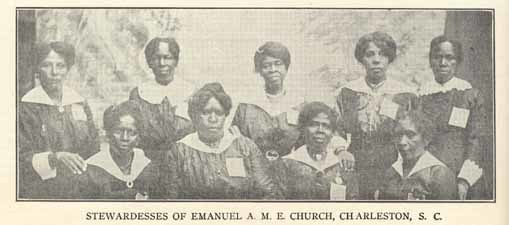
“STEWARDESSES OF EMANUEL A. M. E. CHURCH, CHARLESTON, S. C.” Richard R. Wright (Richard Robert), b. 1878. Centennial Encyclopaedia of the African Methodist Episcopal Church. At Philadelphia, Penna., in 1816., Philadelphia: [Book Concern of the A.M.E. Church], docsouth.unc.edu/church/wright/ill298c.html.