Visualizing Words
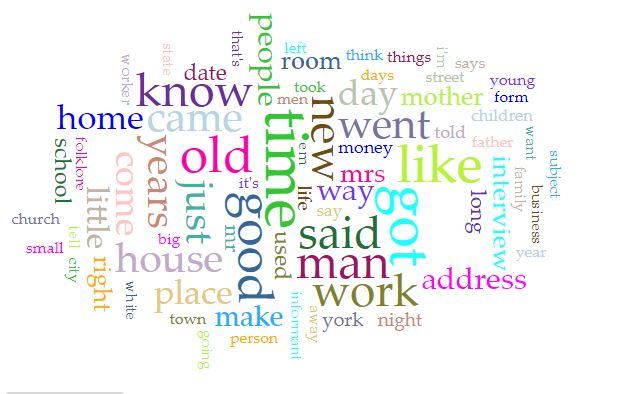
The word cloud was built using a corpus compiled from dozens of different New Deal era sources and interviews. While the word cloud itself is not particularly helpful in analyzing the depictions of African Americans, it does act as a helpful baseline. Across the corpus, there appears to be a focus on age, work, the passage of time, and connections to different people.
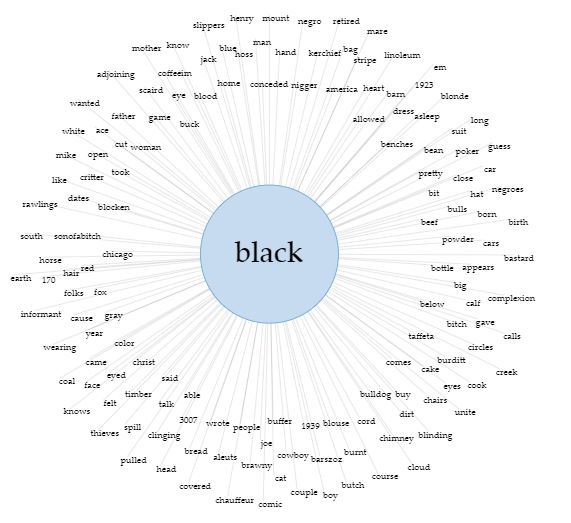
This Voyant visualization tool allows us to examine words that are commonly connected in different phrases. In this instance, I looked at words commonly associated with "black". There are many instances of the word being used as just a color, such as when it's attached to "blouse," "Bulldog," or "chimney." However, it also shown attached to the n-word, "sonofabitch," "thieves," and "bastard." Obviously, these negative phrases aren't the whole story, as the word is also attached to many of the professions occupied by Black Americans during the time period. Still, the abhorrent tone attached to many of these, and the fact that they were used in casual interviews, shows that the depictions of African Americans in certain aspects of Federal One Projects was tinged in hateful ideas or perceptions.
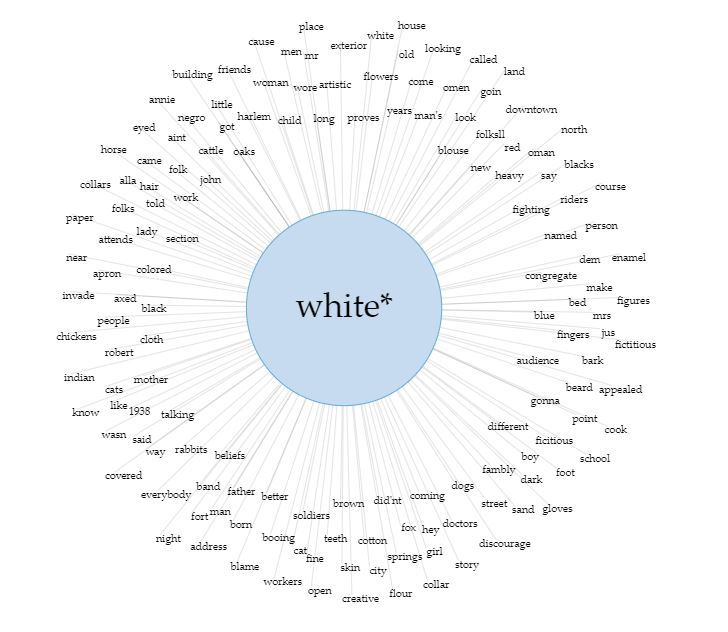
To create a more complete picture, I also examined the links associated with the word "white." There seems to be a more positive set of links, including "audience," "soldiers," and "creative." Although it should be noted that "axed," "invade," and "omen," are also links. Upon closer reading of some sources, it's clear that the tone for depictions of white people is more polarized. For example, "The Whites Invade Harlem," takes a definitively pointed tone towards the actions of White Americans in Harlem.
Works Cited
Hubert, Levi C. The Whites Invade Harlem. New York City, New York, 1938. Pdf. https://www.loc.gov/item/wpalh001416/.