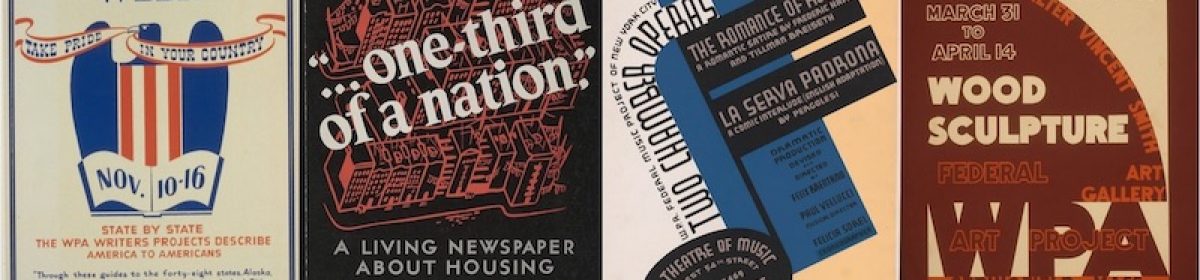
I really liked this opportunity to see the special collections in class. It is definitely not something I would have sought out myself even though I am a theater major. I learned that George Mason has one of the biggest, if not the biggest sourcing of theatrical artifacts from the Federal Theater Project. The archive is important for scholars because it allows them to see the physical documents that people actually saw during the 1930s. It allows scholars to study these objects closer and better draw conclusions from them. Being one-on-one with documents or objects like these offers a new outlook on studying one’s craft. The intimate environment that the Special Collections rules have in place to study these things definitely lends towards a more focused experience. 1 For the general public, especially since George Mason is a public university, it allows them to have access to old historical documents that they cannot access anywhere else in the world. A lot of them are one of a kind so this allows a higher demand for these objects to be seen when people find out about Special Collections. I think, in a lot of ways, archivists are trying to digitize most artifacts because it allows them to be accessible by people all across the nation. If our goal is to educate others, or give them the tools to educate themselves, archives like Special Collections can be a really great resource if people know about it. But, digitized versions can lose some value that a tactile object can bring. So, our speaker talked a lot about how they try to digitize most artifacts but ultimately they do not all bring the same feeling as digitizing a document like a letter or a photograph does. My understanding of the Federal Theater Project changed because it pointed me towards how much documentation was being put out at the time. I forget that these programs had public responses, effects on the people involved, and operations that were happening that the public did not see that often kept them afloat. So, it was very cool to see them all in front of me. I was looking specifically at photographs of Voodoo MacBeth.
2It was interesting to see what the photographers thought was important to catch and what wasn’t. For example, there were a lot more pictures of the audience than the backstage crew or actors preparing for the show to begin. I think that says a lot about how people viewed its impact on Black representation in theater. Overall, the Special Collections visit was a great way to see a resource I didn’t know existed. I hope it will remain in a physical and digital form so people can see it for many years to come.
- GMU Libraries. “Visit Special Collections Research Center.” Special Collections Research Center – George Mason University, George Mason University, 2019, scrc.gmu.edu/visit.php.
- Smith, Wendy. “The Play That Electrified Harlem.” The Library of Congress, Congress.gov, 1996, www.loc.gov/collections/federal-theatre-project-1935-to-1939/articles-and-essays/play-that-electrified-harlem/.
