Looking Back: Mobility and the 1930s

Final Project: http://jessicadoeshistory.com/cnd/exhibits/show/moving-on-up

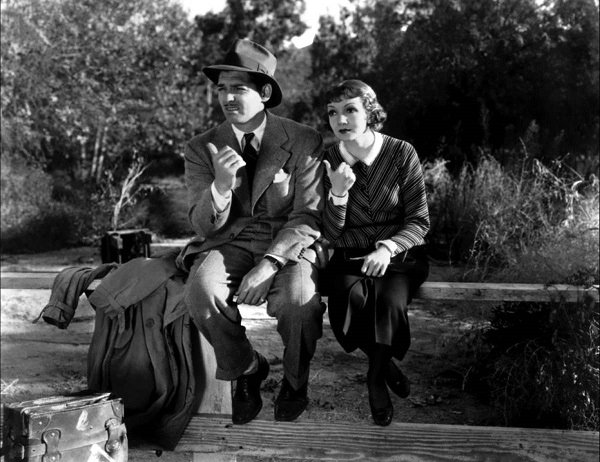
Ever since we started learning about the different departments of the Cultural New Deal, I have been captivated by the idea of mobility. Throughout all of the New Deal, something was moving, something was happening and the people greatly benefitted from it. 1People came together and got things done. What really tipped this off for me was when we watched “It Happened One Night” for homework. There are so many examples of mobility within that movie that even I got excited or had to dance along to the music.

To me, this project was reminiscent of a 5-paragraph essay, so I handled it that way. I focused my argument around mobility being a major theme and result of the New Deal. I wanted to study the Federal Art Project as well, but I mostly just kept it to the Federal Writers Project, the Federal Music Project, and the Federal Theatre Project. Each one of them provided movement in a unique way.

The Federal Writers Project focused on making the American Guides series to help establish what a new America would look like coming out of the Depression. The guides would be a tool to codify what the nation now is and be emblematic of American patriotism. 2 To me, the tours got people moving and exploring and figuring out what America would be like. I focused on the touring aspects of the guides, specifically in Maine, discovering that some of the tours went through wilderness. I conveyed this through a story map, showing how the tours were not cyclical, but more linear, running predominantly in the cardinal directions. Using the map helps clarify the distance and vastness of the land covered.

The Federal Music Project, is, to me, the best project out of the four. I find it simply amazing all the songs they were able to collect and create. The way the FMP got people moving was through the gathering of folk songs. These became emblematic of American roots and where people came from, permitting a mixture of cultures. It provided entertainment for the American people and traveled with them when they eventually joined the war in 1945. It was able to thrive like this because it held no political partisanship. 3 There were not many high-profile figures in the FMP machine, just normal people wanting to make and collect music. For this project, the obvious choice was soundcite. With it, music and words can harmonize and good ideas can be generated. I mostly used it to show emotion that evoked movement or the desire to join in and sing.

The Federal Theater Project, complete opposite of the situation in the FMP, was very high-profile with the risk-taking Hallie Flannagan at the helm. Much of the movement the FTP brought came in the form of theater shows which shook up society. A great example of this is Orson Welles’s “Macbeth,” 4his debut stage play. It was a radical idea having African-Americans in major roles of Shakespeare as well as changing the location of the work. People gave it the connotation of “voodoo” thanks to this. The play got the gears moving for the FTP, bringing in lots of revenue. For this one, I used Omeka’s annotation feature to look at an image from Macbeth. I used it to explain how this was an up-and-coming time for various ethnicities, and African-Americans were finally being brought to the limelight of the stage. The movement here is the lifting up of others.

Much of the technology I used in this project is great. I feel that it can really help bring to light certain aspects of history we might be unable to see from just a cursory glance or reading. We, as digital historians, are able to look deeper into the subject and draw out new ideas to get a new perspective on things. Before this class, I barely knew much about the New Deal, but now I see the real breadwinner programs that helped solidify American culture. Trends like comics and social security still persists to this day, even the idea of popular “pop” music which resonates with the people. Ideas being remixed
5 for future use, like many of the songs Lomax collected are reused by modern day rap and hip-hop artists. 6 I hope to carry all this knowledge with me into future courses here at school.

Final Exhibit

http://jessicadoeshistory.com/cnd/exhibits/show/what-did-the-ex-slave-narrativ

For this final exhibit, I used some of the tools that I’ve found most useful throughout this class which resulted in me using Voyant Tools, TimelineJS, and soundcite. These tools allowed me to interact with the material in an engaging way and I was able to better visualize the historical content from the 1930’s. Not only was I able to learn how to work with different tools on the internet, I was able to both see and hear the content of the 1930’s.

I’m not much of a history person myself, but once I had to learn history along with the online tools, the history aspect became much more interesting. Being able to incorporate history into online tools makes it easier to understand the material. The digital humanities taught me that the content that is being put online is not completely unbiased because the person who created the source or even just the algorithm7has created it in a specific way based in their own personal beliefs and bias8.

Throughout the class I learned that coding is actually pretty fun, even if it is just using shortcode for footnotes. I never thought that I would enjoy using coding so much, but it’s actually really helpful in understanding how websites work and online tools work and can be beneficial to understanding things such as history. With that being said, I truly feel like I have a better grasp on what life was like during the 1930’s. The ex-slave narratives 9alone actually helped me understand how important the New Deal Projects were in America. Americans had a cultural revolution in the 1930’s. The Great Depression 10 was an awful event that impacted Americans all over the country. However, this prompted them to create and develop American culture at a faster rate than ever before. They had folk songs and new projects that encapsulated the lives of Americans. The ex-slave narratives shed light on how different some Americans lives were to one another, yet we’re all blended together to make this country.

I chose to write about the ex-slave narratives because it seemed to impact culture more than others from the Federal Writers Project, or even from the other New Deal projects themselves. It allows those whose voices were unheard for so long to be heard. Racial stigma against African Americans were still prevalent during the 1930’s, but I feel as if the ex-slave narratives helped step overcome racial bias in America because it was giving African Americans a voice, one that had previously been taken away from them.

America has developed its culture over and over again since the 1930’s, but I’d say that one of the most revolutionary times is during the New Deal era because it was not only a cultural revolution, but a technological revolution as well. Audio recordings were used for the ex-slave narratives which allowed us to actually hear what the interviewers as well as the interviewees sounded like. We have access to folk songs and good photographs. Because of the technology, the present day can understand what life was like in the 1930’s we are actually able to witness, visually and audibly, the change in culture during that time.

Final exhibit blog post

My exhibit goes over the social division in America prior to the Great Depression, and how those divisions were considerably withdrawn after the economy collapsed. I wanted to focus the exhibit on how the primary missions of FDR’s New Deal were to rebuild the American economy by creating new jobs for some 15 million unemployed. Through this, social classes were lessened, and minority groups were given more opportunities since discrimination for work could not be so strictly enforced 11. Some projects within the WPA, especially the Federal Writer’s Project and the Federal Theater Project also provided openings for women, and African Americans to be involved in the arts, and to give light to stories of theirs which had been largely repressed and undocumented before 12.

The 1930s were a period of massive change and rebuilding, and seeing American society emerge from the ruins of the Great Depression by bonding people together in their experiences and building a sense of community. Analyzing the events and projects of the 1930s is by no means an easy task, partially since few people are alive today with the memory to recount, and partially because there were so many things taking place at once. One of the many jobs of modern historians when looking back and getting a firm understanding of the 1930s, is to be able to somehow narrow down stories and experiences of the individuals who lived, breathed, and worked during the time. Thankfully, this job is made easier, and much more effective with the use of digital tools. For my exhibit, I chose a simpler approach when using my digital tools to analyze my questions. I built my exhibit heavily off of images and items that the reader could look at or listen to as they were reading simultaneously. I employed image annotations, in order to convey my thoughts on a specific piece and how it related to my question and statements by giving the image it’s own place within the exhibit. I also used the Soundcite tool to build in audio clips of an interview detailing one woman’s personal life history. I feel that this would have made the experience reading my exhibit feel more personal in bringing to life the way that many Americans lived during the early 1900s, especially in comparison to how life was during the Depression. Finally, I took a bit more of a symbolic and artistic approach to representing the conclusions I came to during my research. This was in the form of glitching an image. Being able to glitch an image allowed me to put a spin on what was represented and made it more effective when conveying the idea that many preexisting boundaries of societal discrimination were lessened during the Depression and recovery works.

From an anthropological standpoint as well, it was incredibly interesting to be able to dive into the lives of nearly forgotten people, and not just read interviews, but to hear their stories and see their art as well. One of the most interesting things about American culture and society is that it’s a vibrant blend of so many different cultural backgrounds, which are all somehow transcribed in people’s daily lives. Many people see American as a “melting pot” of cultures nowadays, and I think that was also a very important facet of American culture in the 1930s as well. One of the most invaluable things about the work the WPA did, and the collections of work and projects that are held in the Library of Congress and in the National Archives, is that we are now given the lives and stories and experiences of people who would never have been documented otherwise. That is a massively important contribution to our historical understanding of the American culture and allows us to perhaps understand deeper historical connections between history and present day.            

I will openly admit that coming into this course, I knew virtually nothing about digital humanities or the ethics of research in the digital age. I also knew possibly even less about the New Deal and the 1930s, but several of the articles we read in class made me much more aware of not just the happenings of the 1930s, but the way historians go about their research, and the importance of ethics in the digital age, and verifying the validity of some information 13. Being able to influence my research in the future, and make it more accessible to public consumption, and making it easier to understand is also a significant portion of what I learned in this course. While not employed in my exhibit per se, the Voyant text analysis tools I think will be incredibly helpful in deciphering overarching themes of texts, especially since we are moving towards an age where virtually nothing will be on paper anymore. Digital humanities is an ever-evolving field, and while the history we study stays the same, the ways in which we analyze it are continually changing.

References:

“About This Collection:  Born in Slavery: Slave Narratives from the Federal Writers’ Project, 1936-1938:  Digital Collections:  Library of Congress.” The Library of Congress. Accessed December 13, 2019. https://www.loc.gov/collections/slave-narratives-from-the-federal-writers-project-1936-to-1938/about-this-collection/.

Appelbaum, Yoni. “How the Professor Who Fooled Wikipedia Got Caught by Reddit.” The Atlantic. Atlantic Media Company, May 15, 2012. https://www.theatlantic.com/technology/archive/2012/05/how-the-professor-who-fooled-wikipedia-got-caught-by-reddit/257134/.

“Working Together.” Living New Deal. Accessed December 13, 2019. https://livingnewdeal.org/working-together/.

“23. The Great Depression.” THE AMERICAN YAWP, June 7, 2013. http://www.americanyawp.com/text/23-the-great-depression/.

Final Project

The Federal Theatre Project was not as glamorous, or as long-lasting, as some of its other New Deal programs. However, during the short four-year period that it existed, the FTP made waves. My historical question was: what impact did the Federal Theatre Project have on the culture of the United States?

Even before the onset of the Great Depression, theatre was struggling. Movies had grown in popularity, and traditional theatre found itself more and more pushed to the side to make way for cinema. “Unable to compete with the motion picture industry, actors, stagehands, technicians, musicians, and vaudeville performers found themselves displaced by technology even before the depression” 14. Naturally, this forced theatre workers to look for employment elsewhere, and the onset of the Depression made this search all the more difficult.

The president at the time, FDR, started the New Deal in an attempt to ease the unemployment throughout the country, and also revitalize the arts. Through this New Deal, many different projects sprang up to deal with the issue, and one of them was the Federal Theatre Project. Some of the other projects, such as the Federal Arts Project and the Federal Music Project, gained success and a positive reputation. The FMP especially. The president and first lady “sponsored a series of nine concerts… in the White House between 1934 and 1942” 15. However, unlike the other projects, the Federal Theatre Project did not succeed as a project in the long run, and it is considered “the least successful of all the projects in this artistic/political endeavor” 16.

Even thought the Federal Theatre Project was ultimately considered unsuccessful, the project still made an impact. It put theatre workers and actors to work again, and it produced many different plays and productions. One of the most notable productions of the FTP was the play Macbeth, which was altered to have a 19th century Haitian background, and an all-black cast. The play was very successful in drawing an audience, and it “ran for 10 sold-out weeks at the Lafayette” 17. The success of the play encouraged an interest in more African American versions of classical tales.

I chose to focus my final project on the Federal Theatre Project because the subject of theatre interested me. As a child, I had always enjoyed being a part of my local school and church play productions, and, later on, I developed an interest in musicals and opera. I was lucky enough to see renditions of “Les Miserables” and “Phantom of the Opera” in person in Washington DC, and I was awed by them. Since then, I have always had an interest in theatre.

For my exhibit, my first skill page is a couple of image annotations. The images are photos taken at the outside of theatres in which the “Voodoo Macbeth” was shown. They depict the large crowds and enthusiasm of the people at the play. The second skill page is a timeline of the Federal Theatre Project, and it lists the major events of the FTP. The third skill page is a storymap that illustrates a few of the major cities that the popular “Voodoo Macbeth” toured. These three skill pages help to illustrate the impact that the FTP had through visual means.

The history of the 1930’s is interesting, and many different things happen within that decade. It was a time of great change. I’ve found that the digital humanities is a useful tool for studying history, as it allows for a more in-depth and personal view of peoples’ lives through time. There is value in that, and I intend to look for more digital humanities projects when I do historical research again.

Exhibit: http://jessicadoeshistory.com/cnd/exhibits/show/the-ftp

The Student Brain Unpacked (Final Blogpost)

http://jessicadoeshistory.com/cnd/exhibits/show/the-federal-theater-project-s-

To begin, let me say that I think this exhibit was challenging in many ways.  I think that to create an essay with so much citation work behind it using three different methods and analyzing each at every step is no small feat. I knew heading into it that it would be a lot of work, but I didn’t really know. However, if I wasn’t so passionate about my topic, I would not have stuck with it with the diligence that I did. But, I soon learned that a lot of the deeper information surrounding the FTP was not available to me. 

A huge obstacle I encountered was using just the resources we were provided. There’s only one on the Federal Theater Project. I started with the reading that intrigued me the most which was about the all-Black cast of MacBeth

18

. I read for a day before I started the project which I thought set me back but in reality, I do not think I could have completed it without that knowledge. With any government program, there is a lot of secrecy involved and it is our job to be informed digital citizens and understand what websites are summarizing and which websites are telling the truth and then some

19

More than my struggles with researching my project, I learned that the 1930s were far denser than I had been taught in my 7th grade social studies class. There’s a vast history due to its unique placement in between world wars and racial riots are coming to the surface. The 1930s was the brewing pot for revolution in so many ways. 

I also had struggled executing my project. I’m not very technologically inclined and I knew that from the start of this class. The most important thing this class has taught me is to save and record my work. 

This class was one of the comprehensive classes I have taken in my entire life. There’s so much information to be packed into a semester and so many different aspects that are covered in a day that can be covered for a whole semester in an entirely different class. Overall, I kept coming back to the class because I was so interested. The readings were amazing, and I learned so much about a time period that I could not have told you anything about before the class started. All I knew was that it was the start of the Great Depression. The projects were insightful and demanded that I used a different part of my problem-solving brain to deconstruct the technology I was working with in order to process the problem. 

I also learned a lot about the history of research on this campus. A lot of our readings were from George Mason students, professors, programs, and buildings

20

. I had no clue that there was so much one-of-a-kind work being created by our university. This class also reminded me how fun and interesting studying history can be. I am not a history major, nor do I ever intend to be, but I do think history is essential to the world’s understanding of the future, socially and culturally. In this class, we got to go so many fun places and explore history in something that was still around today but had deep roots from almost a century ago. I really enjoyed glitching and the copyright discussions. They were really modern ties in both topics that also had very interesting conclusions to be made about respecting art and the creator

21

. I really loved it when we had discussions in class like on the last day. To me, history is a lot about how we draw conclusions about primary sources that we are given and so it was so cool to see how everyone responds to them in their own way. This class was very resourceful and finishing each assignment left me feeling more accomplished and empowered about studying history.

Final project

My final exhibit is focused on how the perspectives of women have changed throughout the 1930s. I chose this topic because a lot of things happen during this time that allows women to start working and becoming involved in the economy. Several things I will talk about in this post are women in the industry, migrant women, and how they became involved in employment along with many other topics. This post will also include multiple secondary sources that give me background information on my historical question. Lastly, I will go over the digital tools that helped shape my historical question.

The first page of my exhibit, not counting the introduction, is titled “women in the industry”. The digital tool I used on this page was annotated image. This was an important tool for me because I am able to explain my topic to the audience through an image. The picture I chose shows off the women’s skills and how they are capable of doing complex jobs. However, back then it was much more difficult for women to become noticed. During the great depression, women had to try and find jobs because they needed to have enough money to support their families; their husbands could not be the only ones working. The “American Yawp” does a great job of explaining the great depression and how it affected these families. ” the most desperate, the chronically unemployed, encamped on public or marginal lands in “Hoovervilles,” Poor women and young children entered the labor force.” 22.

My second page is focused on migrant women and what their roles were as women during that time. Glitching was the digital tool that I used for this page. I used the famous photo titled “Migrant Women”. In my opinion, this photo was detrimental to this section of my exhibit. I chose glitching because it allows you to look at an image in a way you never thought you could. Through the glitch, I was able to focus on her face which showed great desperation for the future. She looked as if there was no hope left. Many of these families had to migrate to California because of the effects of the dust bowl. They also believed farming in California was more successful which allowed them to make more money. ” This increase in farming activity required an increase in spending that caused many farmers to become financially overextended.” 23.

On the third page of my exhibit, I used text analysis with the digital tool voyant. “Voyant is a web-based tool for text analysis that is designed to combine ease of use with a sophisticated array of visualization methods.” 24.

I analyzed several interviews of women working in New York after the great depression. I wanted to be able to get an idea of what their careers were like before and after the great depression. However, when I looked at the cirrus it was missing some keywords that I thought would show up, such as women and careers. One word that I did find was “Mrs” because they were mainly referred to as their last names. Since the cirrus was not much help I had to try and look closer into the interviews. I was able to find a pattern that was quite unfortunate. I was able to conclude that several of the women struggled to find jobs because they did not hold as much value as men did at the time. A few of them even got into prostitution just to help support their families. At that time we can tell that the perspective of women then was not positive or uplifting. Once the New Deal was established, more jobs became available for women. “the New Deal encouraged a widespread effort among Depression-era Americans to work together to improve their situation and to recognize that America was, a “nation of nations.”. 25.

In conclusion, I learned a lot about the history of the 1930s in this class and the importance of being productive and ethical digital citizens. Before this class, I was uneducated on all the tools we used and learned about. Now I am able to understand the history of the 1930s with a digitized background. I believe that everyone should be educated on the tools we use because they are able to provide a lot of information and increase our knowledge as digitized citizens.

Exhibit link: http://jessicadoeshistory.com/cnd/exhibits/show/perspectives-of-women-in-the-1

Let’s explore the senses

For my final project in this course I asked the historic question of ‘How does exploring the New Deal through the five senses portray the work it took to rebuild America? “. Through research and building an online exhibit I was able to find answers to my question. During the Great Depression “Unemployment peaked at 25 percent in 1932. With no end in sight, and with private firms crippled and charities overwhelmed by the crisis, Americans looked to their government as the last barrier against starvation, hopelessness, and perpetual poverty” (American Yawp). With people unable to work can a sense of hopelessness and unhappiness swept the country. When the New Deal took action many programs were implemented to get people moving again and back to work. 

My first page of my exhibit explores the importance of sound during the New Deal. I explain how President Roosevelt used the radio to broadcast his live “Fireside Chats”.  This took work, people had to get a radio to listen in, be home at a certain time to listen or go somewhere if they did not have one. I incorporated a clip of Roosevelt speaking into this page using soundcite. Being able to hear the sound of Roosevelt’s friendly voice speaking to his people makes you understand how the citizens also began to trust him. The trust is what helped immensely in the success of his New Deal programs.

The next to pages of my exhibit focus on touch. For touch I incorporate the Federal Art Project image and annotated them. This project came about because of the idea that “Investment in art would be ‘in material wealth, contentment and well being’”(Park & Markowitz). I used annotation here because I wanted users to have to physically touch their mouse and click on the annotation so that while they are viewing my exhibit they are using their sense of touch as well. 

I grouped together the last three senses and formed my page on the American Guide Series. I used a map because “Digital mapping and database construction can allow us to reconstruct, preserve, and visualize vestiges of the past “ (posner) I wanted people to move through the map I added and feel as though they were actually taking a trip from the book. Envisioning the new sights they would see, smells and even tastes. I also added in a few sentences about America Eats which was a book that was never fully published  Writers still “ collected amazing stories: interviewing cooks and eaters” and “ transcribing recipes”(America Eats). 

After finishing my project I can conclude that exploring the New Deal through your senses does in fact make the work it took to succeed more prominent. I wanted to be able to” illustrate ideas and movement, not necessarily data points as we’ve been discussing them “.  My point to this whole exhibit was that Americans had lost their way because of the Great Depression. When the New Deal arouse and Americans were given the opportunity to do something about it they jumped right to it. They were put to work. If nobody had made artwork, got a radio or traveled the country the success would not have been so great. They wanted to work to make America better and that is exactly what they did. 

Mulligan, Shannon. Exploring the New Deal Through the Five Senses.http://jessicadoeshistory.com/cnd/exhibits/show/exploring-the-new-deal-through

The Great Depression. Franklin Delano Roosevelt and the “First” New Deal. Retrieved from http://www.americanyawp.com/text/23-the-great-depression/

America Eats. https://whatamericaate.org/about.php

Bond, S. E. Mapping Racism and Assessing the Success of Digital Humanities. (https://sarahemilybond.com/2017/10/20/mapping-racism-and-assessing-the-success-of-the-digital-humanities/)

Posner, M. Humanities Data a Necessary Contradiction. http://miriamposner.com/blog/humanities-data-a-necessary-contradiction/

Park, M & Markowitz, G. New Deal for Public Art. (Dropbox)

The One that Finishes it all – How Sad!!

Link to Final Project: http://jessicadoeshistory.com/cnd/exhibits/show/the-over-throw–of-the-govern

My final project is about the things during the popular front like communism, the Slave Narratives, The Ballad of Americans, and the comic Wonder Woman. Although there were ways that they were subdued or manipulated for them not to show up in our history they did. Not only did they show up but the government was called out for trying to tamper with them. This spread talks about these difficult things in our history and evolved them to what we know now. 

In my final project, one of the things I wanted to include was the Slave Narratives. I’ve discussed them in the most recent blog post I’ve posted; however, I thought it would prove my point even more about things being hidden from us. The fact that they tried to change the story of these people’s lives after all they’ve been through just to make them sound better is scary to me. 26

Then just to included that the narratives were not the only thing intrigued me even more. For my first tool, I chose soundcite. I picked this tool because what could be better than to “hear it from the horse’s mouth” and have the things you’re talking about explaining your point itself. Just like in the last blog post, I think this is great supporting evidence. The second skill I used was picture annotation. This was one of my favorite skill assignments as well as the pictures I used also very clearly shows the viewer real-life examples of what I’m trying to convey to them. The third skill was Voyant tools. When we first did this skill assignment I thought my grade was going to go straight down because it looked like complicated computer programming stuff. However, after seeing how simple it was I loved it!! I loved the different types of graphs it could make and once I became more comfortable with my historical question I wanted to try and implement some clear data. 

When I first came to the class I wasn’t thrilled. History isn’t my favorite subject and before this class, I honestly thought “if it’s in the past leave it there”, not anymore. Now I’m excited to fully understand the New Deal 27. This short decade that I often looked over was filled with so many moving parts I was blown away. Before coming to this class all I knew was that Franklin Roosevelt was a president but I couldn’t tell you when he was one. Now I can tell you that he as president in 1933 and reran and got selected for another term. He also created the Federal Writers Project, the Federal Theatre Project, and the Federal Art Project. Those projects then went and made things of their own. The Federal Theatre Project make The Revolt of the Beavers that 1930’s wasn’t a fan of but the class loved 28 . The Federal Writers Project made the American Guide Series which preserved each states individual history while also helping the nation feel more united If those weren’t enough, he also organized the New Deal which helped so many citizens even if it wasn’t an easy task during the time 29. 

I also took from this class that we preserve history in so many ways with the ever-advancing technology we have access to. We can preserve it through archives like George Masons. We also can preserve it through memes like the “absolute unit” sheep 30  No matter how we preserve our history, the most important thing I took away from this class was that our time and history is precious. Time is forever ticking away and monumental things are happening every day. We should use what we have to our advantage and preserve as much as we can because before we know it those moments could get lost. Even though I’m not a history type of person, I’m very thankful I took this class. Thank you Professor Jess for giving me new perspectives. 

Final Blog Post

This past semester, in this history class, I have attempted to learn about the history of the Great Depression era as well as some of the digital tools used to capture some of that historical knowledge. Coming in with a certain amount of knowledge for the early 1900’s, I expected most of this class to be learning about the IT aspect but there was plenty to learn about the era, like the WPA and New Deal, that I did not expect. I was, personally, pleasantly surprised by the amount of knowledge obtained from this course.


This exhibit felt like a culmination of all the tools we had learned throughout the semester. I chose the timeline and glitching tools initially because they were, for me, the most useful tools of conveying the information we learned this semester. The timeline was great for laying down background information on the Great Depression era by detailing the major events and including the progression of unemployment as well. It allowed me to take the information from the American Yawp chapter on the Great Depression and present it in a way that conveys the important events of the Great Depression. The chapter states multiple important events such as the stock market crash, the Dust Bowl, and FDR’s New Deal. 31 The glitched image was my favorite skill assignment this semester as it surprised me as to how influential it can be. It feels like an abstract painting where you can take away different meanings from it based on how you look at it. As Kramer said in the glitching images reading,’Glitching was an unlikely candidate for historical inquiry’. 32I used an old exhibit from earlier in the semester that I thought conveyed the attitude of the Great Depression as people worked to get back on their feet. The last exhibit for my project took more thought as I eventually chose to use a poster from the WPA collection. I thought the WPA collections hold so much information and images like posters that I could find something pertaining to employment. They have collections on ex-slave narratives and folklore as well as work related posters. 33 I chose a work poster that had a confidence boosting message to it because it felt like it conveyed the idea that finding new jobs was important for the times but that the morale of people and the country was important as well.


I learned plenty about the Federal Projects in the WPA through the various readings this semester. The preface from the Bindas reading offered the most information on the Federal Arts Projects. I was most surprised to learn how much money was actually allocated to these projects that I had not heard of before. FDR gave over 27 million dollars to these projects. 34


I’m a firm believer in ‘those who do not learn from history are doomed to repeat it’ so I believe history always has a significant place in the present day decisions. I think if we were to experience problems like those from the Great Depression then funding the arts’ projects could be a viable answer. Going forward, I am definitely more aware of myself as a digital citizen especially after the class with the fake pirate professor. I know what it takes to be a contributing part of the digital world and feel prepared to do so in the future.

Final Exhibit:

http://jessicadoeshistory.com/cnd/exhibits/show/finalarthursmith

Final Project

This semester I learned a lot. I was able to learn about aspects of the New Deal that I hadn’t covered in my own studies. I was a bit on the fence about the integration of certain aspects of information technology and historical study, (specifically when we learned about glitching35) but I’m glad to say that I understand the possible functions of all the skills we learned. I became very interested in what I feel is an underrepresented group in discussions about the Great Depression, and decided that I would do my final project on women and how their positions within society changed. 

Something that I hadn’t heard before were statistics for female employment during the Depression, and how they changed. 10.5million women were in the workforce in 1930, and that number rose 24% to 13million by the time World War II began. 15% of married women were employed, and 50% of single women were working. In order to show all of these wonderful accomplishments (and a few disappointments), I chose to use image annotation, image glitching, and timeline creation for my project. I used image annotation because I’m a visual learner, and I find that it’s often easier for me to learn and focus when there are images present. It also gives you a sort of ‘hands-on’ way to view information attached to photos36

I chose image glitching because it was the skill I struggled with the most. I honestly didn’t see how it could be useful when we first discussed it in class. However, I’m glad to say that I do understand the purpose now. It literally forces you to look at images from a different perspective, and introduces new ideas in your mind. Glitching is also completely random, so you can’t manipulate it to prove your point. I found it to be an interesting way to look at images of working women. 

Finally, I chose to create a timeline because it was the best way to show the changes within the government and within society in a linear way. I think over the course of the semester, the timeline tools were my favorite. Using the timelines to study the ex-slave narratives was extremely helpful, and it was extremely raw at the same time37. Listening to casual conversation about a period of time that is still so painful, but they’re almost relaxed about, and reducing it to a timeline is incredibly intense. 

I found myself confronting the way that I consumed information on the internet as well. The presentation in class about fact-checking resources was extremely interesting. I’ve always been very careful about the sources I use, but after I learned about Professor Kelly38 and his class that centered around building a fake Wikipedia page, and story to go along with it, I’ve been nervous. I’ve not cited Wikipedia in academic papers for a long time, (probably since elementary school) but I have used it as a resource in casual research before. I’ll definitely double check everything I read on there from now on!

Overall, I learned a lot in this class. I’m a history major, and the 1930’s was my main interest for a long time. I was mostly focused on the Dust Bowl, so learning about other aspects of it was incredibly interesting. I learned a lot of digital skills that I hope to use in my studies in the future, and I had a really wonderful experience learning about the different cultural projects introduced in the New Deal. 

Here is the link to my final project: http://jessicadoeshistory.com/cnd/exhibits/show/the-working-women-of-the-1930-

css.php