http://jessicadoeshistory.com/cnd/exhibits/show/what-did-the-ex-slave-narrativ
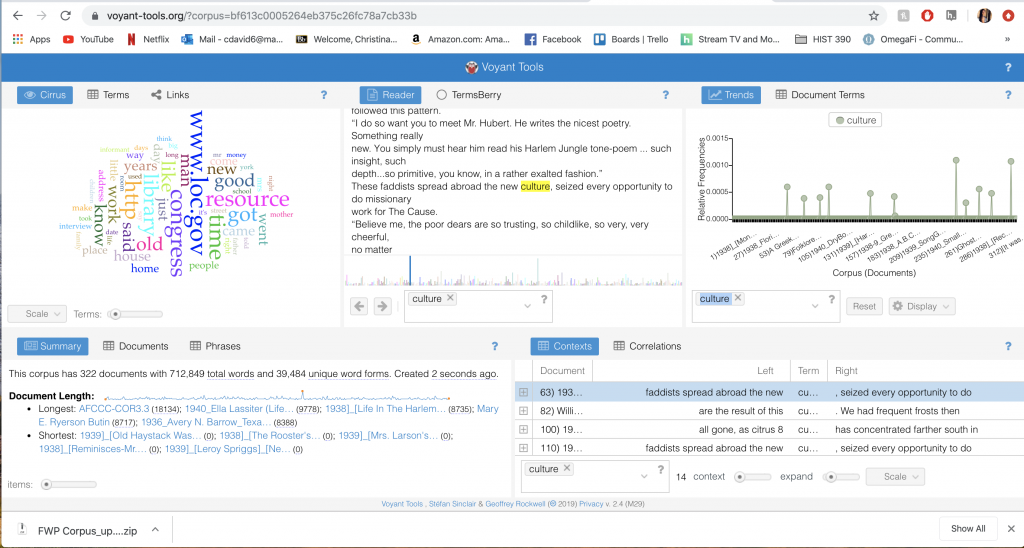
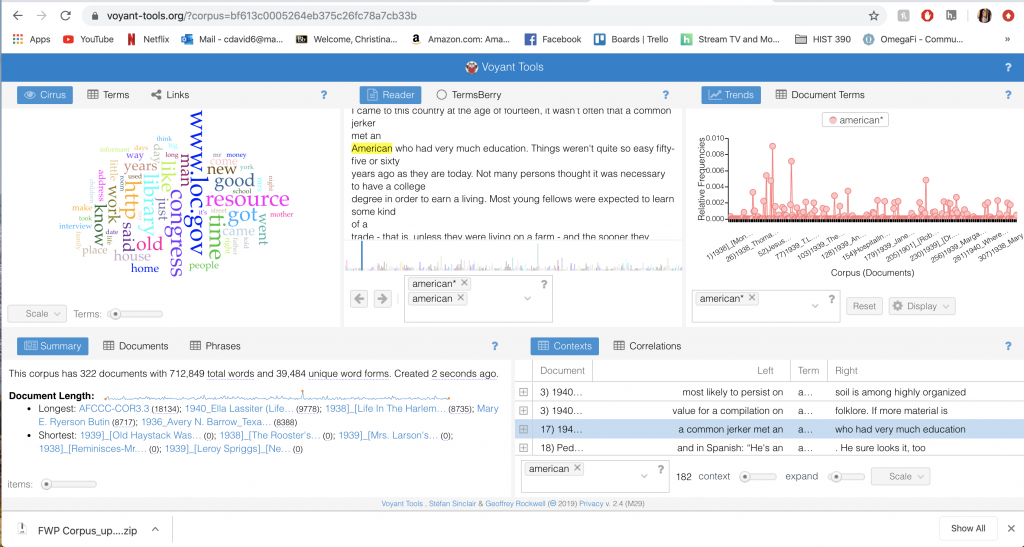
For this final exhibit, I used some of the tools that I’ve found most useful throughout this class which resulted in me using Voyant Tools, TimelineJS, and soundcite. These tools allowed me to interact with the material in an engaging way and I was able to better visualize the historical content from the 1930’s. Not only was I able to learn how to work with different tools on the internet, I was able to both see and hear the content of the 1930’s.
I’m not much of a history person myself, but once I had to learn history along with the online tools, the history aspect became much more interesting. Being able to incorporate history into online tools makes it easier to understand the material. The digital humanities taught me that the content that is being put online is not completely unbiased because the person who created the source or even just the algorithm1has created it in a specific way based in their own personal beliefs and bias2.
Throughout the class I learned that coding is actually pretty fun, even if it is just using shortcode for footnotes. I never thought that I would enjoy using coding so much, but it’s actually really helpful in understanding how websites work and online tools work and can be beneficial to understanding things such as history. With that being said, I truly feel like I have a better grasp on what life was like during the 1930’s. The ex-slave narratives 3alone actually helped me understand how important the New Deal Projects were in America. Americans had a cultural revolution in the 1930’s. The Great Depression 4 was an awful event that impacted Americans all over the country. However, this prompted them to create and develop American culture at a faster rate than ever before. They had folk songs and new projects that encapsulated the lives of Americans. The ex-slave narratives shed light on how different some Americans lives were to one another, yet we’re all blended together to make this country.
I chose to write about the ex-slave narratives because it seemed to impact culture more than others from the Federal Writers Project, or even from the other New Deal projects themselves. It allows those whose voices were unheard for so long to be heard. Racial stigma against African Americans were still prevalent during the 1930’s, but I feel as if the ex-slave narratives helped step overcome racial bias in America because it was giving African Americans a voice, one that had previously been taken away from them.
America has developed its culture over and over again since the 1930’s, but I’d say that one of the most revolutionary times is during the New Deal era because it was not only a cultural revolution, but a technological revolution as well. Audio recordings were used for the ex-slave narratives which allowed us to actually hear what the interviewers as well as the interviewees sounded like. We have access to folk songs and good photographs. Because of the technology, the present day can understand what life was like in the 1930’s we are actually able to witness, visually and audibly, the change in culture during that time.