Mapping, Farrey

Creating this map was a very interesting experience. Reading the book was quite difficult as the print was very small and it just wasn’t what I expected. Most modern guide books have a lot more notable tourist attractions, these books didn’t seem to exactly do that. Yes they went into the history of the town and area, but they give little recommendations on what to do there or what there was to see.

Although this assignment wasn’t exactly what I was expecting it definitely was a very interesting learning experience. I definitely agree with Sarah Bond after doing this project. Mapping these historical locations or any point of historical importance can be extremely useful for preserving and teaching history. If anything, these maps are becoming even more important as some of these locations no longer exist due to various causes.

Mapping and Spatial history are extremely important when developing land, by having access to these primary sources we can be able to tell if the land needs to be assessed by an archeological team first to preserve the history of the land. I believe this important skill can really help us to avoid situations that many European countries often face when building. Often times we hear of European countries accidentally unearthing historical site and destroying some very interesting finds, I believe more interest in spatial history and mapping primary sources could prevent that in the United States.

The projects encased in the Green Book collections are only the tip of what we could accomplish with the plethora of primary sources we have. People could even make these maps with online tools like I had done for this assignment. Of course the maps made by the people on the Green Book Project (as seen above) looked much better compared to mine.

The Green Book version of my tour definitely looks more professional then mine and didn’t take the exact path I did, but both versions could be useful. There was one thing I did notice while looking over the Green Books maps though, there was a lot of segregation going on during the times these were made. Most guide books probably won’t take into account that fact and would most likely cater to white Americans.

Travel must have been so much more difficult for people of color during that time. I never even thought about that possibility until I looked over these maps. It really goes to show how different things were back then. Of course black and white travelers could probably take the same route but they might not have been allowed in the same restaurant or get the same quality of service where they went.

That is another reason I appreciated the opportunity to look at the Green Book project, it opened my eyes to that factor. That is something I never would have noticed without looking at those maps, and I think it’s important to recognize the struggles people went through and learn from them. That way we don’t end up repeating the past.

Citations:

 Bond, Sarah. “Mapping Racism And Assessing the Success of the Digital Humanities.” History From Below, October 20, 2017. https://sarahemilybond.com/2017/10/20/mapping-racism-and-assessing-the-success-of-the-digital-humanities/.

“ILLINOIS A DESCRIPTIVE AND HISTORICAL GUIDE : Free Download, Borrow, and Streaming.” Internet Archive. A.C.MCLURG & CO., January 1, 1970. 

“NavigatingThe Green Book.” Navigating The Green Book. Accessed February 1, 2020. https://publicdomain.nypl.org/greenbook-map/.
Timeline, Natalie Farrey

This timeline was created based on the life of Mr. George Johnson, an ex-slave once owned the president of the confederate states of America, Jefferson Davis. His interview provided a plethora of information about how enslaved people were treated and about music on plantations. However, as illustrated in the timeline, most of what he considered notable life events came after he left the plantation in 1884.

This was very surprising to me since I expected the interview to mostly focus on his life while enslaved not on his life afterwards. On further examination of the timeline you can also see that Mr. Johnson claimed to have left the plantation almost 20 years after the Civil War ended. This raised two questions: was this simply a matter of an elderly man having difficulty remembering dates or was this a matter of history?

I’m sure many slave owners were reluctant to give up their slaves and held on to them as along as possible. Though I can’t remember being taught anything like that in my history classes. I’m still unsure if this is just a simple mistake made by Mr. Johnson himself, or a problem with the way historians teach us this period in history. This question of how accurate the dates given were made the interview a little less useful than I had hoped.

Making a timeline relies on knowing about when an event happened, but Mr. Johnson was frequently unable to provide a date or gave a range for most events that happened in his life. Most of the time I had to calculate and give the most likely year for the timeline. So, in this aspect the interview was not all that useful, but it was extremely useful when it came to understand the person who was telling their life story.

Mr. Johnson spoke so proudly; he was obviously very proud of what he had accomplished in life. You could hear how passionate he was when he spoke about music. This ability to hear his tone and exact words was amazing. Although I’ll admit I had a hard time understanding what he was saying at certain points. I wasn’t the only one either, when reading the “Note on the Language of the Narratives” I discovered that the people conducting the interviews were also not able to understand the people they interviewed a good amount of the time. This is extremely evident in the transcriptions of the interviews that are missing many things Mr. Johnson had said.

Though the fact that they made an effort to preserve these people’s stories speaks a lot to the social history of the U.S. at the time. As stated in the Slave Narrative Collection opening essay, these interviews were collected during the years 1936 through 1938. To me this shows that people are genuinely taking an interest in what these people went through and want to preserve their stories. I think this really shows the United States effort to preserve our history.

Citations:

“A Note on the Language of the Narratives  :  Articles and Essays  :  Born in Slavery: Slave Narratives from the Federal Writers’ Project, 1936-1938  :  Digital Collections  :  Library of Congress.” The Library of Congress. Accessed January 22, 2020. https://www.loc.gov/collections/slave-narratives-from-the-federal-writers-project-1936-to-1938/articles-and-essays/note-on-the-language-of-the-narratives/#note.

“An Introduction to the WPA Slave Narratives  :  Articles and Essays  :  Born in Slavery: Slave Narratives from the Federal Writers’ Project, 1936-1938  :  Digital Collections  :  Library of Congress.” The Library of Congress. Accessed January 22, 2020. https://www.loc.gov/collections/slave-narratives-from-the-federal-writers-project-1936-to-1938/articles-and-essays/introduction-to-the-wpa-slave-narratives/.

Lomax, Alan, Elizabeth Lyttleton Sturz, George Johnson, Lewis Wade Jones, Charles Spurgeon Johnson, and John W Work. Interview with George Johnson, Mound Bayou, Mississippi, Septemberpart 1 of 6. Mound Bayou, Mississippi, 1941. Pdf. https://www.loc.gov/item/afc1941002_afs04777a/.

Lomax, Alan, Elizabeth Lyttleton Sturz, George Johnson, Lewis Wade Jones, Charles Spurgeon Johnson, and John W Work. Interview with George Johnson, Mound Bayou, Mississippi, Septemberpart 2 of 6. Mound Bayou, Mississippi, 1941. Pdf. https://www.loc.gov/item/afc1941002_afs04777b/.

Lomax, Alan, Elizabeth Lyttleton Sturz, George Johnson, Lewis Wade Jones, Charles Spurgeon Johnson, and John W Work. Interview with George Johnson, Mound Bayou, Mississippi, Septemberpart 3 of 6. Mound Bayou, Mississippi, 1941. Pdf. https://www.loc.gov/item/afc1941002_afs04778a/.

Lomax, Alan, Elizabeth Lyttleton Sturz, George Johnson, Lewis Wade Jones, Charles Spurgeon Johnson, and John W Work. Interview with George Johnson, Mound Bayou, Mississippi, Septemberpart 4 of 6. Mound Bayou, Mississippi, 1941. Pdf. https://www.loc.gov/item/afc1941002_afs04778b/.

Lomax, Alan, Elizabeth Lyttleton Sturz, George Johnson, Lewis Wade Jones, Charles Spurgeon Johnson, and John W Work. Interview with George Johnson, Mound Bayou, Mississippi, Septemberpart 5 of 6. Mound Bayou, Mississippi, 1941. Pdf. https://www.loc.gov/item/afc1941002_afs04779a/.

Lomax, Alan, Elizabeth Lyttleton Sturz, George Johnson, Lewis Wade Jones, Charles Spurgeon Johnson, and John W Work. Interview with George Johnson, Mound Bayou, Mississippi, Septemberpart 6 of 6. Mound Bayou, Mississippi, 1941. Pdf. https://www.loc.gov/item/afc1941002_afs04779b/.

Looking Back: Mobility and the 1930s

Final Project: http://jessicadoeshistory.com/cnd/exhibits/show/moving-on-up

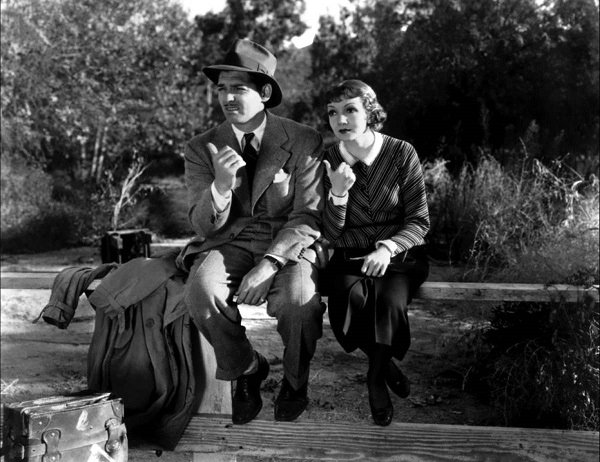
Ever since we started learning about the different departments of the Cultural New Deal, I have been captivated by the idea of mobility. Throughout all of the New Deal, something was moving, something was happening and the people greatly benefitted from it. 1People came together and got things done. What really tipped this off for me was when we watched “It Happened One Night” for homework. There are so many examples of mobility within that movie that even I got excited or had to dance along to the music.

To me, this project was reminiscent of a 5-paragraph essay, so I handled it that way. I focused my argument around mobility being a major theme and result of the New Deal. I wanted to study the Federal Art Project as well, but I mostly just kept it to the Federal Writers Project, the Federal Music Project, and the Federal Theatre Project. Each one of them provided movement in a unique way.

The Federal Writers Project focused on making the American Guides series to help establish what a new America would look like coming out of the Depression. The guides would be a tool to codify what the nation now is and be emblematic of American patriotism. 2 To me, the tours got people moving and exploring and figuring out what America would be like. I focused on the touring aspects of the guides, specifically in Maine, discovering that some of the tours went through wilderness. I conveyed this through a story map, showing how the tours were not cyclical, but more linear, running predominantly in the cardinal directions. Using the map helps clarify the distance and vastness of the land covered.

The Federal Music Project, is, to me, the best project out of the four. I find it simply amazing all the songs they were able to collect and create. The way the FMP got people moving was through the gathering of folk songs. These became emblematic of American roots and where people came from, permitting a mixture of cultures. It provided entertainment for the American people and traveled with them when they eventually joined the war in 1945. It was able to thrive like this because it held no political partisanship. 3 There were not many high-profile figures in the FMP machine, just normal people wanting to make and collect music. For this project, the obvious choice was soundcite. With it, music and words can harmonize and good ideas can be generated. I mostly used it to show emotion that evoked movement or the desire to join in and sing.

The Federal Theater Project, complete opposite of the situation in the FMP, was very high-profile with the risk-taking Hallie Flannagan at the helm. Much of the movement the FTP brought came in the form of theater shows which shook up society. A great example of this is Orson Welles’s “Macbeth,” 4his debut stage play. It was a radical idea having African-Americans in major roles of Shakespeare as well as changing the location of the work. People gave it the connotation of “voodoo” thanks to this. The play got the gears moving for the FTP, bringing in lots of revenue. For this one, I used Omeka’s annotation feature to look at an image from Macbeth. I used it to explain how this was an up-and-coming time for various ethnicities, and African-Americans were finally being brought to the limelight of the stage. The movement here is the lifting up of others.

Much of the technology I used in this project is great. I feel that it can really help bring to light certain aspects of history we might be unable to see from just a cursory glance or reading. We, as digital historians, are able to look deeper into the subject and draw out new ideas to get a new perspective on things. Before this class, I barely knew much about the New Deal, but now I see the real breadwinner programs that helped solidify American culture. Trends like comics and social security still persists to this day, even the idea of popular “pop” music which resonates with the people. Ideas being remixed
5 for future use, like many of the songs Lomax collected are reused by modern day rap and hip-hop artists. 6 I hope to carry all this knowledge with me into future courses here at school.

Final Blog Post

Throughout the semester, I have learned a lot about the 1930s and Franklin D. Roosevelt’s New Deal than I had previously knew. I also had learned things about information technology that I didn’t know was possible or that I didn’t know how to do. To start at the beginning, I would say that this semester I went into this class knowing how to do the bare minimum when it came to I.T. and I can confidently say I know how to do a lot more and can see myself using this from time to time on a various amounts of projects.

For my exhibit I used the following digital tools to explore the Federal Theatre Project: Story mapping, image annotation, and image glitching. I chose these skills because I felt as if they can help paint a bigger picture in terms of why certain elements were used or why the location of the plays was important. I used the story mapping tool to gauge readers on the location and time each production of the play went on. The image annotation skill was used to show why certain parts of the set designs were used and what it meant when it was used during the play and how it could relate to the state of society at the time. Lastly, the image glitching skill was used to try and convey the current state of society and what the people felt like was going with the men in power.

I chose the Federal Theatre Project because I wanted to look at something that conveyed a message that resonated with people. In the 1930’s people were interested in only certain themes in plays, thus the “living newspaper” series of plays went into production. The Library of Congress mentions that, “playwrights and audiences were keenly interested in plays with social and economic themes” 7 thus came about the play Power. I focus on this play because of how it looks at the economic struggle people face in the Tennessee Valley. In this case, digital tools transform the sources I use by allowing me to examine them in a new light that wasn’t possible years ago; in my opinion, digital tools add another level of analysis to sources and a way to create new digital art with some of these sources. Kramer said, “moving the artifact away from its original form brings us closer to the stakes up for grabs in its originating historical moment: revising the “text” helped us better access the context” 8 which I find to be true given that once an image becomes glitched it uncovers a new layer of questioning.

Through this class, I learned a lot of the history of the 1930s like the Federal One Projects and what they did for the people at the time. The projects help employ thousands of people that lost their jobs to the Great Depression and provided the rest of society with something to look forwards to during the dark times. The legacies of the Federal One projects is that they were able to leave behind various artwork including painting and murals along with statues and monuments. Another thing I learned is that the Works Progress Administration (WPA) published a lot of these projects; anything from the Federal One Projects to ex-slave narratives, Farm Security Administration photography collection, WPA posters, and many more. 9

In conclusion, I have gotten a lot out of this class from learning how to embed programs into blogs and websites to the extensive history of the New Deal and what it accomplished during the 1930s. I feel as if this should be a class everyone should take at some point in their college careers as one can benefit a lot from learning a mixture of I.T functions and the history of a time period at the same time.

Omeka Exhibit: http://jessicadoeshistory.com/cnd/exhibits/show/federal-theatre-project–the-g

Coping With Great Depression: Exhibit

I thought that I had my plans for my final exhibit so organized, until it was time to put them all down. Originally, the only topic that I had planned to focus on was religion and the role that the Depression played in aiding the rise of Conservatism within America, with a focus on which areas of the country remain to some extent still seized in that grip. Studying the greater pop culture movements, and unique art and storytelling mediums, that emerged out of the 1930s and reactions to the Depression made me realize, though: religion was only one fold of a much bigger picture.

The Great Depression was a societal tipping point for America, and had the call for massive social reform of “financial regulation, farm subsidies, public works, mortgage protection, union rights, Social Security, the minimum wage”[1] not been heeded, I don’t believe it an exaggeration to say that it could have been the beginning of the end for America. But even as the people and the government both struggled to find their footing after the upheavals of the stock market crash and the Dust Bowl, it’s not as though everyone was content to just make that existence their lives. They found refuge not just in religion, but in music, stories, film, and one another. Nobody wanted to spend their spare night out or free time stewing in their own misery. They set to work, to improve not only their own lives, but affecting the lives of those around them as well. Country preachers set out to call more sheep to their flocks. Ordinary Americans and displaced migrants used the music of their upbringings to spread the stories of what had happened to them. What was coming out of the film studios and the publishing houses brought about not only entertainment, but impactful social movement, as “when our society was most unstable and insecure, we somehow, as if by a law of compensation, produced the most buoyant popular culture that Americans had ever seen”[2].

What was I doing, thinking I was going to be able to categorize any of that, reducing it down to a cultural spreadsheet and not the lifeblood of a nation? True to the words of Trevor Owens, my data required “choices about what and how to collect and how to encode the information”[3]. The best that I could do was track patterns and pin down locations, although the preservation of that information would likely not have been thought possible at the time of its origin. Digital history is about more than just calling up dates, but examining how the evolution of media goes hand-in-hand with the hindsight of studying these events which happened over 80 years ago in the context of the present day, like finding out exactly how “a folk song collector wound up as the legal co-author of a Jay-Z diss track”[4]. Could the first audiences to watch Snow White in theaters have known that they were witnessing the origins of what is today the biggest entertainment company in the world? Could Bonnie and Clyde have known that their names would become an idea, an archetype, and for some even a goal? Could a Jewish man walking the streets of New York City in 1939 have known how much further reaching his fears of fascism would extend beyond the next decade?

http://jessicadoeshistory.com/cnd/exhibits/show/coping-with-great-depression–

Sources Cited: [1] Boyle, Kevin. “The President Proposes . . .” The New York Times, The New York Times, 5 Apr. 2013, https://www.nytimes.com/2013/04/07/books/review/fear-itself-by-ira-katznelson.html.

[2] Dickstein, Morris. “Facing the Music.” The American Scholar, 11 Dec. 2014, https://theamericanscholar.org/facing-the-music/.

[3] Owens, Trevor. “Defining Data for Humanists: Text, Artifact, Information or Evidence?” Journal of Digital Humanities, 15 Dec. 2011, http://journalofdigitalhumanities.org/1-1/defining-data-for-humanists-by-trevor-owens/.

[4] Hein, Ethan. “Jay-Z and Alan Lomax.” The Ethan Hein Blog, 7 Feb. 2015, http://www.ethanhein.com/wp/2011/jay-z-and-alan-lomax/.

Folk Music and Square Dancing

Folk music in general began in this time period, or at least the recording of folk music did. In some FSA camps, the workers would bring their culture, like instruments and music, to help lighten the mood 10 after a long day at work. One of these unique forms of music, was known as square dancing, which, in a way, incorporated the sound of the dancing 11 with the music to create it’s beat. Not only that, but square dancing requires it’s dancers to dance with pretty much everyone, which can be representative of the theme of togetherness in the Great Depression.

This source was recorded by the Federal Music Project, within a Farm Security Administration camp. You can see how these two federal projects work together, as the workers in the camps would bring their unique flavor of music for the music project to record. The Federal Music project in general liked to focus on bring America together, usually through folk music. 12 However, there were critics of this, but president Roosevelt felt that this music would help unite America in it’s time of need, so he continued it. 13 It sort of, in a way, again connects to the theme of togetherness that these two federal projects would work together to better the culture and people of America. As times got harder, people began realizing that it’s easier to help one another rather than work for oneself.

By embedding the audio, an analysis in a way comes to life. Before, one could only imagine what a song, or person would sound like. By embedding the audio, we can now witness history as we read, by listening to the past and not just hearing about it. By listening to the audio, we can develop our own opinions about the piece instead of just reading about the opinions of the author of the article we read. In doing this, we allow for those reading to create their own view of history while also viewing our own, so they can compare what they think to what we think. This is how history is shaped, by historians comparing each other’s thoughts on pieces of history. Thus, by embedding the audio in the piece, we make the process a whole lot more convenient for the historians reading our articles.

Hispano Music

In the Hispano Music and Culture of the Northern Rio Grande: The Juan B. Rael Collection through the Library of Congress, there are many song recordings and song transcriptions. During the 1930’s, Hispano music consisted of Waltzes and Religious hymns. Religious music was the most popular and through different variations of song lyrics, the ongoing themes were about ending suffering or asking for forgiveness. Waltzes were created for weddings and were considered to be celebratory. Religious hymns are referred to as “Alabados” 11 and are typically worship songs that were most popular in New Mexico and Colorado. The featured Alabado is typically performed during a Holy communion and translates to “The Lord Gave us his body”. Religion plays an immense role during this time period and offers insight on the different thoughts Latino immigrants had during this time period. Although most Alabados are worship hymns, a majaroity of them are about ending suffering and asking God to be able to go to heaven. Aside from Alabados, waltzes offered an entirely different perspective because they were more upbeat and played during festive time periods. Valse De Cadena 14 was a waltz in which dancers would often switch partners all while holding on to each other to form a chain. Most waltzes are instrumental and rarely offer any lyrics. This Valse De Cadena was performed by a dad Mr. Anaya and his two daughters. Mr. Anaya learned to play instruments on his own by listening and watching from afar.

Music in the 1930’s was more religious, and if it was upbeat, there were rarely any words but more instrumental values. While analyzing these songs, it reminded me of Benjamin Filene’s piece on Mastering the Cult of Authenticity where he states that “folk culture challenged the status quo: it challenged dissatisfaction with the emptiness of mass culture”. 15 That statement felt to have followed my journey while diving into this collection because of the uniqueness in the creation of each piece. Most pieces were created by individual families as opposed to one main artist. In Morris Dickstein’s How song, dance, and movies build us out of the Great Depression, he discusses how “The engine of the arts in the ‘30s was not escapism, as we sometimes imagine, but speed, energy and movement at a time of economic stagnation and social malaise.” 16 Dickstein states that emerging in the arts helped Americans reflect, while giving them to opportunity to engage and find their inner voice of creativity. Overall, being able to experience music through text is revolutionary because it gives you a concise experience. While reading, forming conclusions and ideas is normal, however being able to actually listen to what an author is trying to convey makes this a great experience. This is a great way to convey meaning and transport an audience back in time.

Are Slave Narratives Useful?

Back in 1937 President Roosevelt created the Federal Writers Project. He told the people working in the FWP to interview every former slave they could, before they all died, to capture our countries history better. Although it was not a simple task, in her book titled Long Past Slavery: Representing Race in the Federal Writers Project Catherine Stewart states: “Competing visions of the past and conflicting views on black identity and black citizenship offered different prisms for interpreting the remembrances of former slaves.” Some ex-slaves were scared to tell the full truth in these interviews, some thought they would receive some benefits if they did not tell the full truth, and the interviewers would even change the story to make the government not sound so bad. 17 In this blog post, I want to investigate that idea more based on two narratives one by Charlie Smith and the other by Fountain Hughes. 

Charlie Smith and Fountain Hughes seemed to have similar lives. They were both interviewed in their late 100’s and they both went into slavery when they were in their early teens. In Charlie Smith’s interview, there seems to be nothing wrong with his life. He was bought by a man who raised him as one of his own children. Later in life he worked as a mason, then a state officer and helped hunt the man who killed President Garfield. Then he moved to Florida and lived out the rest of his days there. Fountain Hughes went into slavery at the same time as Charlie but stayed with his family. Although he does not go much into his childhood, when he does talk about it he contradicts himself 18a little. He talks about how the masters treated them well and how he did not have shoes until he was twelve, then at the end of his explanation he says “Yes, many time I’ve stump my toes, and blood run out them. That didn’t make them buy me no shoes.”19

Another instance in Fountains interview he says that they were treated like cattle and as soon as he finishes his sentence it seems the interviewer, Hermond Norwood, changes the topic20. Later on in the interview Hughes then talks about the bidding21 process. In his explanation of the bidding process he says “But if you was bad and mean and they didn’t want to beat you and knock you around, they’d sell you”. Right after he’s done explaining how the bidding works Norwood asks him if he was ever sold and Hughes seems to hesitate but said no that he was never sold because he was too young to sell. 22

Throughout the interview it seems that Hughes wants to talk about what happened in his life as a slave but is heisting to say something or when he starts to the Norwood asks him another question. In Charlie Smith’s interview he never has these moments; however, he only says the same things in his interview. Smith brings up that his dad treated him like his own and that he helped him on the farm, then when his dad died he was free, later in life worked as a state officer, and lastly moved to Florida. Smith never hesitates or dive more into it like Hughes did.

As I mentioned, in the beginning, many slaves were scared to say something to the interviewers in fear of backlash. Many writers wanted to shape the way the stories were told. 23 That could be what is going on in these two cases; however, Charlie has a better way of hiding it. At the end of Hughes interview Norwood asks if he goes to church. Then Hughes says “Ill tell you why I don’t go to church” then stops. Norwood asks him: “You rather not have this on? Hm? You rather not tell me or you rather not have this on when you tell me?” and Hughes replays: “It don’t make any difference. I ain’t going to say nothing wrong. I ain’t going to [tape cuts out] If I, I, I, I say…” and it ends there.24 I’m not sure if he was referring to the church or his life in general, either way I feel that shows that Hughes could not say all that he wanted to.

I think using audio in blog posts really shows the reader what your talking about instead of having to explain everything. I know that in this argument it would be hard for me to explain the point Im making if the reader never listened to the audio and interpreted it for themselves. Either way it is hard to close this argument fully since we cant talk to Fountain Hughes or Charlie Smith themselves. Finding a different interview similar to Charlie Smith’s defiantly shed a bright light onto this topic for me.

Skill 7 Blog 9

For centuries music has been an autobiographical tool to remember. It has been used to pass on information, gather support, or to lament the passage of time and what once was. This was particularly apparent when perusing the Library of Congress Archives. All of the music I listened to was a part of the California Gold collection, an anthology of folk music from Northern California from the 1930s, which highlighted the migrant experience.

During this time period music became a powerful political statement that captured the ideas of the Popular Front. This was a coalition of left leaning organizations that was under girded by the communist party, socialists and independent leftists. When this political movement eventually crumbled and dissolved its underlining tenets remained embedded in the literature, movies, and music of the time. This Cultural Front was led by “black, left, and labor dissenters-who-organized in a newly conducive climate”19
and eventually led the country into the long civil rights era.

A majority of folk music from this time is a direct reflection of the lives those people lived, the hope they had, the hardships they faced, the religions they clung to20 , and their homesickness. The dust bowl drove a lot of people west in hopes of work and that was reflected in the music that was recorded. A number of songs ” depicting California as a veritable promised land21 22
enticed workers and the mythology surrounding the west became a part of the popular culture.

Having these more personal moments shared through music had a unifying cultural effect because it underscored that many people were experiencing the same things. Although it was well known that impacts of the great Depression were widespread, hearing it sung to you has a different effect. In this way folk music was both a mirror, reflecting the shared trials of life, and a magnifying glass, broadcasting the widespread problems of inequality, dislocation, and joblessness.

Beyond immortalizing the pain of a generation, music was also used to bolster the spirits of the people. Migrants living in labor camps were able to recount stories of their homes, and commune with others. In current popular culture you can see direct link to how music way used back then. At times music is a tool with which to disrupt the system, while at other times music becomes a little bit of oblivion to make life a bit more tolerable.

Folk Music and the Dust Bowl

Charles Todd and Robert Sonkin’s records from the Arvin migrant camp in California are invaluable to understanding folk music in a transient environment. I chose to pull my sound from the “Voices of the Dust Bowl” project through the Library of Congress. Music, and folk music has always been very fascinating for me, because folk music is very regional. It’s a good way to see the uniqueness of different areas around the country. The music may only be slightly different between say, West Virginia and Oklahoma, but they are different.

The recording is called “Come Sit By My Side, Little Darlin24and it was sung by Nathan Judd, and recorded by Charles Todd and Robert Sonkin in 1940. The location was the Arvin FSA Camp in California. Arvin was a camp for refugees from the Dustbowl, mostly people from Oklahoma (20% of migrants were Okies)25. Charles Todd and Robert Sonkin made a variety of records at Arvin. They took photos, made recordings of music, and recorded interviews. These records are invaluable, because they give us awesome primary sources for folk music examples, and it becomes easier to pick out cultural influences.

Migration reached an all time high during the Great Depression. Unemployment was high, and so were foreclosure rates. People moved away from their home bases in search of work. Many went to California, specifically the Arvin camp. The Arvin camp had people from all over the Midwest and Southwest living there, which meant you got a large spread of folk music with different cultural significance and influences. The collection of recordings that Todd and Sonkin made gives access to many different influences.

In our reading “Sounds of the New Deal: The Federal Music Project in the West”, music is shown to be motivating, and spirit lifting. “It makes me feel as if life is not yet over for me.”26 Music provides an outlet.

css.php