Throughout the semester, I have learned a lot about the 1930s and Franklin D. Roosevelt’s New Deal than I had previously knew. I also had learned things about information technology that I didn’t know was possible or that I didn’t know how to do. To start at the beginning, I would say that this semester I went into this class knowing how to do the bare minimum when it came to I.T. and I can confidently say I know how to do a lot more and can see myself using this from time to time on a various amounts of projects.
For my exhibit I used the following digital tools to explore the Federal Theatre Project: Story mapping, image annotation, and image glitching. I chose these skills because I felt as if they can help paint a bigger picture in terms of why certain elements were used or why the location of the plays was important. I used the story mapping tool to gauge readers on the location and time each production of the play went on. The image annotation skill was used to show why certain parts of the set designs were used and what it meant when it was used during the play and how it could relate to the state of society at the time. Lastly, the image glitching skill was used to try and convey the current state of society and what the people felt like was going with the men in power.
I chose the Federal Theatre Project because I wanted to look at something that conveyed a message that resonated with people. In the 1930’s people were interested in only certain themes in plays, thus the “living newspaper” series of plays went into production. The Library of Congress mentions that, “playwrights and audiences were keenly interested in plays with social and economic themes” 1 thus came about the play Power. I focus on this play because of how it looks at the economic struggle people face in the Tennessee Valley. In this case, digital tools transform the sources I use by allowing me to examine them in a new light that wasn’t possible years ago; in my opinion, digital tools add another level of analysis to sources and a way to create new digital art with some of these sources. Kramer said, “moving the artifact away from its original form brings us closer to the stakes up for grabs in its originating historical moment: revising the “text” helped us better access the context” 2 which I find to be true given that once an image becomes glitched it uncovers a new layer of questioning.
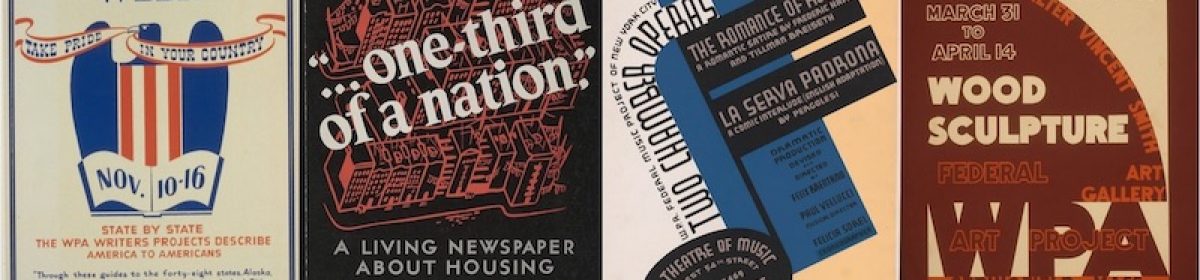
Through this class, I learned a lot of the history of the 1930s like the Federal One Projects and what they did for the people at the time. The projects help employ thousands of people that lost their jobs to the Great Depression and provided the rest of society with something to look forwards to during the dark times. The legacies of the Federal One projects is that they were able to leave behind various artwork including painting and murals along with statues and monuments. Another thing I learned is that the Works Progress Administration (WPA) published a lot of these projects; anything from the Federal One Projects to ex-slave narratives, Farm Security Administration photography collection, WPA posters, and many more. 3
In conclusion, I have gotten a lot out of this class from learning how to embed programs into blogs and websites to the extensive history of the New Deal and what it accomplished during the 1930s. I feel as if this should be a class everyone should take at some point in their college careers as one can benefit a lot from learning a mixture of I.T functions and the history of a time period at the same time.
Omeka Exhibit: http://jessicadoeshistory.com/cnd/exhibits/show/federal-theatre-project–the-g
- Library of Congress. “Federal Theatre: Melodrama, Social Protest, and Genius : Articles and Essays : Federal Theatre Project, 1935 to 1939 : Digital Collections : Library of Congress.” The Library of Congress. Accessed December 11, 2019. https://www.loc.gov/collections/federal-theatre-project-1935-to-1939/articles-and-essays/federal-theatre-melodrama-social-protest-and-genius/.
- Kramer, Michael, and Michael J. “Glitching History: Using Image Deformance to Rethink Agency and Authenticity in the 1960s American Folk Music Revival.” Current Research in Digital History, August 2018. http://crdh.rrchnm.org/essays/v01-08-glitching-history/.
- Library of Congress. “WPA Publications in the Library Collections : Amassing American ‘Stuff’: The Library of Congress and the Federal Arts Project of the 1930s : Articles and Essays : Federal Theatre Project, 1935 to 1939 : Digital Collections : Library of Congress.” The Library of Congress. Accessed December 11, 2019. https://www.loc.gov/collections/federal-theatre-project-1935-to-1939/articles-and-essays/amassing-american-stuff/wpa-publications-in-the-library-collections/.
