Final Blog Post

Throughout the semester, I have learned a lot about the 1930s and Franklin D. Roosevelt’s New Deal than I had previously knew. I also had learned things about information technology that I didn’t know was possible or that I didn’t know how to do. To start at the beginning, I would say that this semester I went into this class knowing how to do the bare minimum when it came to I.T. and I can confidently say I know how to do a lot more and can see myself using this from time to time on a various amounts of projects.

For my exhibit I used the following digital tools to explore the Federal Theatre Project: Story mapping, image annotation, and image glitching. I chose these skills because I felt as if they can help paint a bigger picture in terms of why certain elements were used or why the location of the plays was important. I used the story mapping tool to gauge readers on the location and time each production of the play went on. The image annotation skill was used to show why certain parts of the set designs were used and what it meant when it was used during the play and how it could relate to the state of society at the time. Lastly, the image glitching skill was used to try and convey the current state of society and what the people felt like was going with the men in power.

I chose the Federal Theatre Project because I wanted to look at something that conveyed a message that resonated with people. In the 1930’s people were interested in only certain themes in plays, thus the “living newspaper” series of plays went into production. The Library of Congress mentions that, “playwrights and audiences were keenly interested in plays with social and economic themes” 1 thus came about the play Power. I focus on this play because of how it looks at the economic struggle people face in the Tennessee Valley. In this case, digital tools transform the sources I use by allowing me to examine them in a new light that wasn’t possible years ago; in my opinion, digital tools add another level of analysis to sources and a way to create new digital art with some of these sources. Kramer said, “moving the artifact away from its original form brings us closer to the stakes up for grabs in its originating historical moment: revising the “text” helped us better access the context” 2 which I find to be true given that once an image becomes glitched it uncovers a new layer of questioning.

Through this class, I learned a lot of the history of the 1930s like the Federal One Projects and what they did for the people at the time. The projects help employ thousands of people that lost their jobs to the Great Depression and provided the rest of society with something to look forwards to during the dark times. The legacies of the Federal One projects is that they were able to leave behind various artwork including painting and murals along with statues and monuments. Another thing I learned is that the Works Progress Administration (WPA) published a lot of these projects; anything from the Federal One Projects to ex-slave narratives, Farm Security Administration photography collection, WPA posters, and many more. 3

In conclusion, I have gotten a lot out of this class from learning how to embed programs into blogs and websites to the extensive history of the New Deal and what it accomplished during the 1930s. I feel as if this should be a class everyone should take at some point in their college careers as one can benefit a lot from learning a mixture of I.T functions and the history of a time period at the same time.

Omeka Exhibit: http://jessicadoeshistory.com/cnd/exhibits/show/federal-theatre-project–the-g
Dust Bowl Stories

During the 1930s, the Midwest had experience severe storms in the form of sleet, hail, or dust. Through an interview, one notes the sheer power of these dust storms during these times and what damage they caused to the locals. The source came from an interview conducted by Charles Todd and Robert Sonkin who worked for the Farm Security Administration who interviewed a man by the name Charlie Spurlock. Charlie had gone into detail about how they survive out in the Midwest with these storms going on. He recalls the type of storm 4 it was that tore through his town and ravaged on for 14 hours; he also talks about the damage 5 it caused to the buildings and surrounding objects as well. The FSA fits into the bigger picture by recording and taking photographic evidence of the conditions of how people were living in rural areas. Everyone was affected by the Great Depression and the FSA went around to see how people were living by taking photographs and conducting interviews with some of the people. These interviews not only give us an insight on these conditions, but they also allow us to hear about the struggles they have to deal during those times.

The great thing about audio clips is that they add another level of analysis to what a person is reading. A good reason for adding audio clips by embedding or by adding the audio file to the page is that it gives clarity to what a writer is saying. Audio clips allows a reader to get a glimpse into what was really going on during that time period; not only that, but it also becomes a sort of immersive experience as you listen to the words of the interview in this case or the audio of a song in another case while reading the writers words. You can practically imagine the writer’s words come to life as you listen to the audio thus giving you a more memorable experience. In this scenario, listening to an audio clip rather than reading about the damage caused by dust storms is that if you listen closely, it is as if you can see the interviewee describing what these storms did to the town with hand motions.

Historical Question and Text Analysis

Text analysis has been proven to help a person be able to decipher what they need from a length of text in order to help them with their current research. In this project, I used test analysis to help me research and narrow down my historical question. My historical question was, “How did the Great Depression affect outlawing in the Midwest?” and I went into this research thinking that it would be interviews discussing how outlaws would be going around and stealing goods from families who are better off  or that you would see an exponential increase in theft in the Midwest but that wasn’t the case. To conduct this research, I looked at interviews conducted in the Midwest which just happened to take place in majority of Texas with an outlier of one taking place in Utah. I used search words such as “outlaw” and “Midwest” which narrowed it down a bit for me to conduct my research.

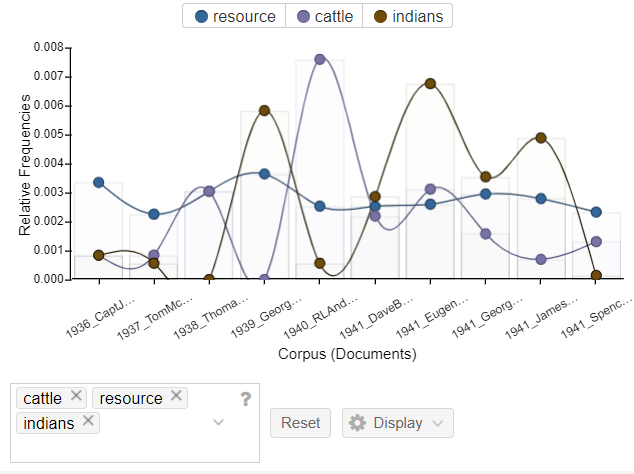
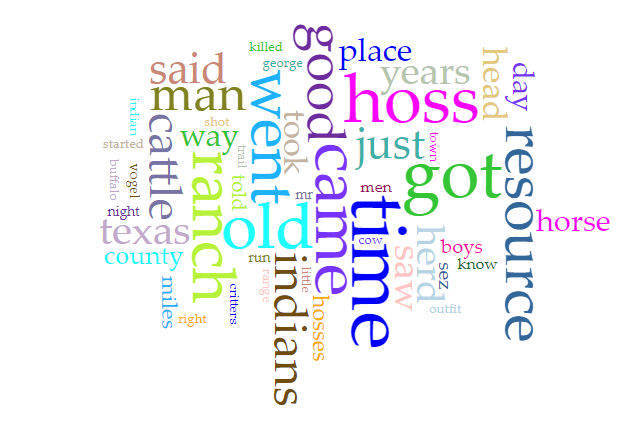
Afterwards, to conduct the test analysis I used Voyant Tools. 5 My experience with this tool was somewhat challenging as there were some features that were not functioning for a while in addition to that there were some confusing to understand as well. Over the course of me using Voyant Tools and using close reading, I was able to change my assumptions and ideas I had about what these interviews would be about. In the graph below, are the words that I saw were more important in these interviews.

I was able to see pair my close and distant reading with new keyword searches and the results showed that throughout the documents, cattle and Indians were used quite a bit as that was what the interviewee was discussing. The final conclusion I can make about my historical question is that outlawing can look differently than what we are used to talking about such as train robbing, petty crime, theft, etc. from other people when it could be as simple as American Indians trying to fight back on their territory and take what could possibly be theirs. Text analysis, distant, and close reading were all useful to me as they helped me find new paths to explore my question from a different angle.

Image Glitching

Before I dig in to how the glitching process went for me, let me explain my photo choice. I chose this photo because I wanted to find a photo that showed at least one person expressing an emotion. I chose this picture because it doesn’t just show one person, it shows three children each with their own emotion being conveyed. During the 1930s nearly every family (if not all families) were affected by the great depression and this photo depicts the children of a family with clothes that look somewhat old and no shoes. The photo also shows that the family lives on a farm in the middle of the dust bowl so you can see that there’s no crops coming growing thus the family can’t provide for themselves.

            From a historical standpoint, I began to ask how badly did the great depression affect every American family. I ask this because you see photos from that time period and you can see candid photos of families going through rough times and dealing with poverty and on the other hand see families still have smiles and look happy as if nothing has changed for them. Hung and Popp state that to explore our historical question one should “look for interesting correlations between factors” and “constantly ask yourself: Why then? Why there?” 6 . These methods allow us to dig deeper into the photos and extract more information than what the photographer intended to share with the world. I personally found the “interesting correlation” method to be more useful for the reason that the “ask yourself” method can get you so far when analyzing a photo.

            This method of finding interesting correlations between what I see and what I read is more useful because it gives more insight into the picture since you can then connect the reading to the photograph in ways you couldn’t do by just simply asking “why then? why there?” I was able to draw that my original analysis is mostly correct as the Farm Security Administration or FSA had published the photo to show what families in rural area were going through.

After being able to analyze the picture can the fun part which was glitching the photo. The idea of taking an image and essentially “glitching” it was a newfound idea to me. It was a fun assignment, but it did come with its difficulties such as trying to do the whole “glitching” process on windows processor. Overcoming that challenge took some time but in the end the original photo and the glitched one are ones to enjoy.  

http://jessicadoeshistory.com/cnd/items/show/172

http://jessicadoeshistory.com/cnd/exhibits/show/zion-rowe–3-children-sitting-

The Importance of Text Searching and Digital Projects

Text searching has come a long way when it comes to doing something scholarly such as a research for a paper or something simplistic such as finding out a recipe to make cheesecake without eggs. Tony Guidone’s presentation had gave me insight to how I can change the way I conduct my text search. Tony’s presentation had showed me that by searching for keywords in long bodies of text that it speeds up the acquisition of key information. Personally, it changed the way I interacted with information in the sense that it allowed me to skim over articles and webpages faster; however, Tony also mentioned how not everything is digitized and that it is important to understand this notion because there will be times where we will have to apply that skill of text searching to the real world.

The idea of digital projects making social change is a comprehensive argument that I side with because I do feel like that it can make significant social change. I say this, because digital projects have the ability to change what we know about the past and how we can apply it to our future and the present. Digital projects have the unique ability to give us this never before seen perspective that we potentially did not have in the past. These projects can not only change the way we look at history but also give fresh idea to old technology that we can now study and replicate to modernize it for the current generation.

Digital media as a whole has benefits and cost to being used. Some of the benefits being that digital media gives us this fresh perspective to look into history and judge through different lenses. A cost to using digital media is that not everyone can use it to conduct text searches; As Ian Milligan stated, “In short, this means that while an end-user can view the image file, there is no text layer that would allow one to simply copy and paste textual characters.” 7 This statement goes to show that not everyone can use it to their benefit which can be a detriment to their research if they need to use that source.

Blog Post 1

During the past week, I had learned that technology is constantly evolving; nothing is considered as a new idea in today’s society because it has all already been done in earlier years in a different form such as how a radiophone dance from the roaring 20s has been modernized into what we now know as a silent disco. Technology has become such an integral part of history due to the New Deal under FDR as it paved the way for new ideas and gave birth to a new era of technological advances. I have also learned that because of this connection history and technology have a mutual connection since certain parts in history can be traced to some advancement in history. Throughout the semester, I hope to lean about how technology impacted the humanities throughout the 30s and hopefully through part of the 40s; more specifically, how technology helped progress projects covered under the new deal and how it helps us better understand the 1930s in today’s time. I’m also looking forward to learning more about these programs that the New Deal created such as the Federal Art Project and the Federal Music Project and how technology played a role in allowing these programs to thrive in the time period they were created in.

The project I was assigned to review is called “By the People”. The digital exhibit showcases different campaigns ranging from the civil war to women’s suffrage that allows you to explore the supporting documents that go with that campaign. At first, I couldn’t comprehend what I was looking at, but with further investigation I was able to better grasp the concept of the website. The layout of the website allows you to explore different subjects written by the people and for the people; once you dive further into a campaign you can see the multitude of documents that go with that specific campaign. The website itself was easy to navigate and can be accessed by anyone that would want to read about the campaigns and understand what occurred during that time period. I found it to be very insightful not only for the sheer amount of documents that the campaign includes but also because of the experiences that they went through then that we can read about now to better understand the movements that made society what it is now.

Sources:

(n.d.). By The People beta. Retrieved from https://crowd.loc.gov/campaigns-topics/

Miriam. (2014, February 1). How did they make that? Retrieved from http://miriamposner.com/blog/how-did-they-make-that/

css.php