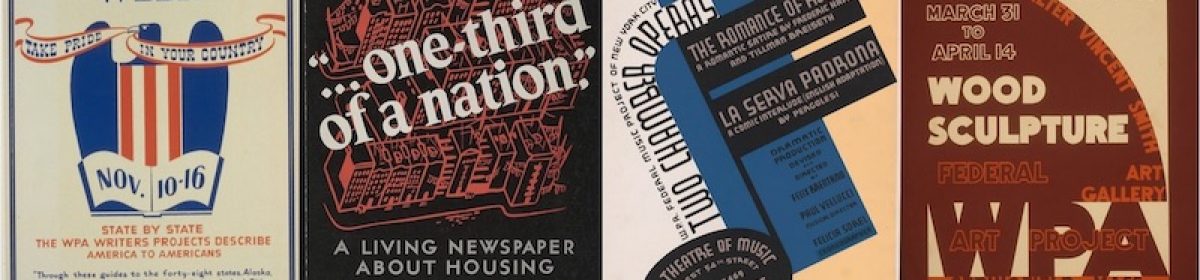
Industrial and Rural Life: 1930s

Throughout the 1930s there was a lot of adversity. Adversity for small-time farmers just trying to survive, city-folk who were constantly looking for work in a dying economy, and adversity for the government to overcome the many travesties of the Great Depression. There were issues that affected all walks of American and global life, such as the stock market crash in 1929. 1 As a result of the stock market crash, not only were American farmers and industrial workers hit with a catastrophic economic decline, but also most countries in the world. For industrial workers, one of the problems was that factories could not provide adequate wages for their employees so they could not acquire laborers. This led to a deep decline in industrial production and deflation in prices, high unemployment rates, mass panic and a sharp increase in poverty and homelessness. On Voyant, I targeted the term “Homeless” and found that “Subway Stuff” mentioned homelessness on the subway trains at night which is still happening today. 2. Throughout my research on Voyant, I noticed a heavier correlation with the terms “men”, “jobs”, and “work” than the terms “woman”, “job” and “work” within the articles pertaining industrial living but the opposite correlation between them when looking at rural living related articles.

This was interesting because the way of life that this correlation portrays is not only that it was much harder for women to obtain jobs in the 1930s but also today when women face much more adversity and negative stereotyping than men obtaining jobs and in the workplace. It was also interesting because it made me think about if the socio-cultural way of rural living is a more advanced in the way of gender equality. By comparing these terms on Voyant and reading the articles, I was able to draw conclusions to the fact that rural living is more advanced in gender norms and equality in not only everyday life, but also in working environments.

Coming from a background of rural living and farm life myself and noticing this opposite correlation among rural living, I looked more deeply at these articles to find information. In the article “A Farming Preacher”, 3 the man interviewed mentioned working together and providing on the farm every day with his wife, and the children doing their share; feeding the animals, cleaning the house and doing laundry once they were home from school. By adding the term “farm” to the list of target words, I confirmed that in the articles pertaining to rural living there was a stronger correlation between the terms “women” and “work” meaning that in rural lifestyle the ideals of equal opportunity and ‘everyone does their share’ were more prominent.

Skill assignment 5- Text Analysis

For my text analysis project, I decided to use my own collection of ten documents, and compare it against the class corpus. My historical question is “What was the experience of working women like in New York City during the 1930’s, and how was their employment affected by the economic downturn?” The role of women in the economy has always been very interesting to me, especially women in the workforce in the early twentieth century. It wasn’t common for middle and upper class women to be employed, and it was extremely rare to see a woman in a public sort of job, like a doctor, or a reporter. I wanted to see if I could find a spread of interviews with working class women, in order to get a better idea of the jobs they had before the stock market crash, and how their careers changed as the depression continued.

A photo we talked about in class that really piqued my interest in this topic was the Migrant Mother with her children. Even though I narrowed my search down to specifically women from New York City, the female farmers who fled the Midwest during the dust bowl also had the unique experience of having to completely change their lives, and their livelihoods. Dorothea Lange wrote about her interaction with the woman in the photo’s, and it reminded me of the interviews that the Federal Writers Project conducted all over the country. “She said that they had been living on frozen vegetables from the surrounding fields, and birds that the children killed. She had just sold the tires from her car to buy food.”4

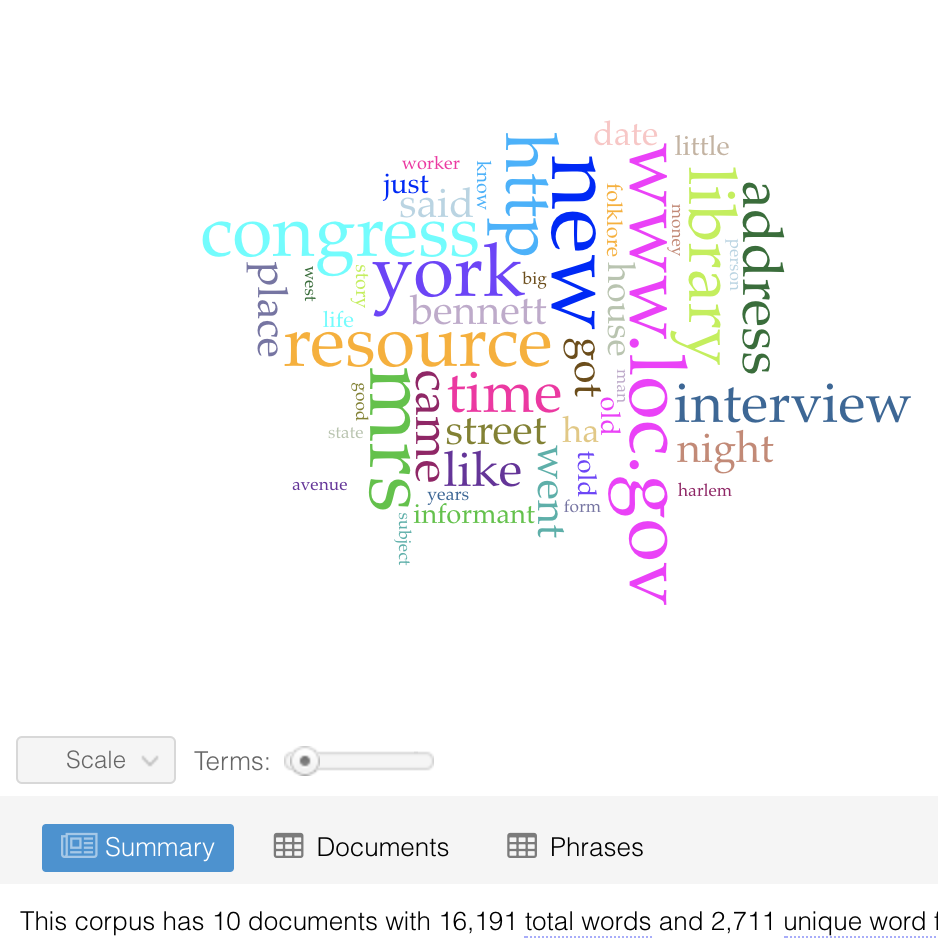
My corpus focused on my own question, so the cirrus word cloud was different for my corpus was different than the class corpus. However, it was not nearly as different as I thought it would be. The word “man” appears in the class corpus 1220 times. The word “woman” does not appear enough times to even be included in the cirrus. The same is said for my own cirrus, the word woman is not included in the word cloud. I found this very strange since all of my documents were interviews with working women in New York City. When I went back and read my interviews, I found that the word woman hardly appeared and instead the subjects were just referred to as “Mrs” or by their first names. One woman in my corpus documents was only referred to as Big Bess, and she had been prostituting herself out of her apartment prior to the depression. A surprising statement from the interviewer was included in the interview, and it’s only surprising because of the language used. “Women of minority races and economically bankrupt groups have always been exploited by materially stronger groups.” 5 That sounds like a sentence right out of a 2019 text analysis, rather than a statement by an interviewer in 1938. Big Bess no longer wanted to work as a prostitute by the time of this interview, but felt stuck. “I’m getting sick and tired of this life, but what can I do? I don’t know any other kind of work and even if I did, where would I find it? Besides, once you get accustomed to seventy-five or a hundred dollars a week, it’s pretty hard trying to get by on fifteen or eighteen.”6

Because my corpus was tailored to my specific question, I wasn’t able to find much information in the class corpus that pertained to my inquiries. This showed me that even if you have a large spread of information, it doesn’t necessarily mean that it’s useful to you specifically. Voyant helped me to locate different terms, but in the end the information the terms were attached to didn’t really help me too much.

The cirrus for my own corpus of 10 documents.
The cirrus for the class corpus of 322 documents.

Close vs Distant Reading

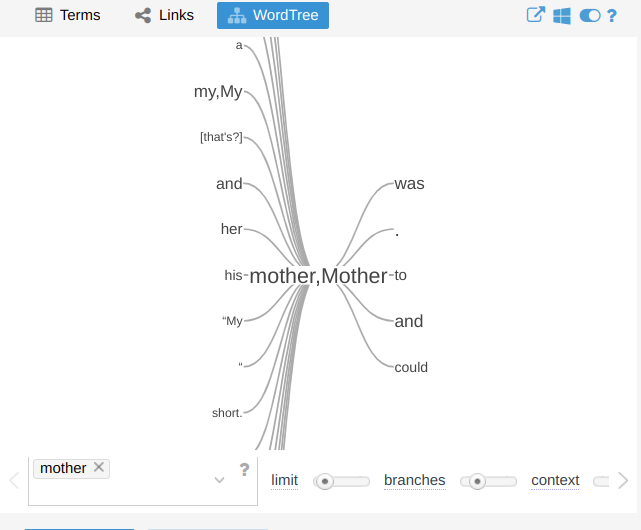
Using the text analysis tool Voyant was both helpful and confusing. When I created my own corpus I essentially used a keyword search 7 in the “American Life Histories” 8 collection. My historical question was “ How did the role of Motherhood change in the New Deal Era?” I entered the word “motherhood” in the search field and it yielded no results. So from there I tried “mother”, here I was more successful. I found around 15 documents and I decided to use them as my corpus. 

From there I turned to the Voyant tool to look at our class created corpus for the Federal Writers Project collection. When I first uploaded the corpus I was just interested in playing with the word art tools.

Using Miriam Posner’s 9 tutorial was really helpful as a starting point. I especially liked the section “What the heck are we looking at?” and she was correct it is initially overwhelming. But as I continued to use the Voyant tools I understood them a little more.

I found the trends tool the most helpful. I repeated the process of using the terms “mother” and “motherhood” to investigate the documents. I found that the documents with the most mentions were the ones that I had contributed to the corpus. There were other options that I was able to look through though, just not very many.   I think that in this case the corpus was just too varied in what each of us was looking for. I found that in looking for an answer to my historical question my corpus was a better fit. 

As I read through them I found a somewhat surprising answer to my question. Motherhood hasn’t really changed much since the New Deal Era. Mothers seem to be the main caregivers, responsible for the children and the family in general in all the domestic type duties. They were the ones that made sure that traditions were carried on and that knowledge was passed down from previous generations. Mother’s have always been the bedrock of the family. 

Blog 6

Using Voyant for this skill assignment was a slightly bizarre experience for me. It required altering my research question several times and altering the conceit of my question all together. Initially my question sought to figure out how leisure and play activates impacted by the Great Depression in different parts of the country. However I didn’t grasp the different layers that I needed to understand in order to properly answer that question.

 Considering the way that Voyent processes information, scanning through the texts that contained the word “play” was not all together helpful because the context would be removed and I would need to close read through hundreds of texts. I also realized that one of my previous search terms, leisure, was only helpful when searching through the library of congress archive because it was a categorization term rather than a word that was naturally occurring in the text.

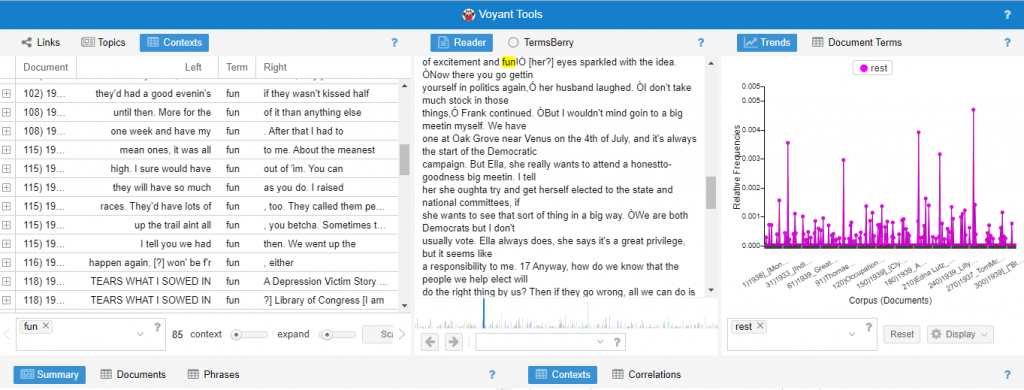
Looking for ‘fun’ in context

With all of this information as my foundation, I chose to approach my question from a different angle and simplified my question all together. My question essentially became ‘How did people have fun during the Great Depression’. I used the words ‘fun’ and ‘relax’ and analyzed them through the context tool. This allowed me time find every instance that these words were used while also seeing the context and way in which it was used. The tools allowed me to do a quick scan of the information and in the adjoining view look at the reader view and skim through several paragraphs of the source. I found this to be more helpful than any of the visualization tools.

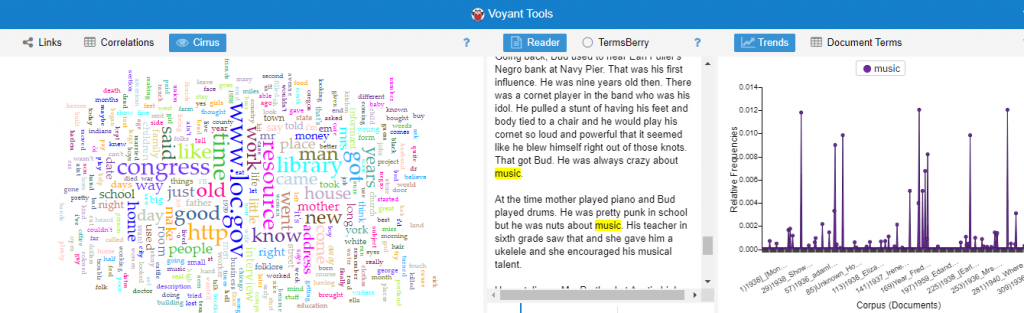
A bulk of the sources seemed to indicate that music, jazz music in particular where popular as vehicles for fun. Then I backtracked, looked at the sound cloud, selected the word ‘music’ and was able to see its use across a multitude of sources. From that point I was then able to select specific interviews to read more closely to form my opinions and conclusions.

Using Music as my search term from the word cloud

Ultimately my my simplified question ended up with a simplified answer. For fun, most people turned towards music, jazz in particular to forget about the worries for short periods of time. Delving deeper into the sources also brings in information about which cities where predominate in the jazz scene and who was playing the music.

Although I think there is merit to distant reading, I think my preference will always be for close reading. “Personal recollection has a significance of its own” 10 and i think that is best understood on a singular level rather as an aggregated data point.

Voyant is at its most useful when being used to analyze words absent of context (key word searching, graphs, word clouds, etc) and then allowing the user to re-contextualize the information rather than attempting to superimpose any particular question on the analysis. Miriam Posner mentions that discern significant differences among text and those difference being deemed meaningful 11 are not the same things. Whether or not text analysis is actually helpful depends directly on information one is attempting to transform.

Average American Life Before the Great Depression

My historical question is in the title, “How did the average American live before the great depression?”. This seemed like a fairly easy question to answer, as many of the interviews I read focused on their life growing up, rather than life during the depression, or during the time of the interview. The initial ideas I had for this question, were that the interviewees would talk much about their family, their struggles, like familial deaths, and their high points, like marriage and raising a child. Pretty much, I was hoping that they would focus on the very highs, and the very lows of their life. I assumed that there would be talk about traditions, sprinklings of bigotry here and there due to the time period, and a focus on the good parts of their lives before the depression.

Since this was a very general question, my idea was to use most of not all of the sources gathered in the corpus. However, there would obviously be a lot of words inside the hundreds of interviews that needed to be taken out to better see the juicy bits. First, I filtered out words pertaining to the meta data, like the website URL, words “Library of Congress” and the like. Then I focused less on the most common words, as they were mostly, “Got, Like, and Said”, which are worthless not understanding the full context. I focused more on the words said a few hundred times, rather than those said thousands of times, as they were usually more telling of what the interview was about. Words like “father, mother, school, and children” helped me understand the focus of the interviews better.

Using Voyant tools wasn’t too hard, as we already went over it in class and thanks to Miriam Posner’s tutorial on it. 12 I found the “Document terms” particularly useful, as it showed the exact number of times a certain term was used throughout the corpus. This helped me see the less than average terms better than in the cirrus tool which only really showed the most common terms. My main decision I made was to focus on not the most common terms, but the less than common terms which might have been buried under very common words. That way, I could find more context within words rather than general terms used in that time period.

I focused not on the most common that had thousands (Very common words) but rather terms that had hundreds of examples so I could gain more context for each.
Using the cirrus, it helped visualize the number of times a term was used.

My question stayed generally the same throughout the text analysis, as the terms I gathered focused on family and the struggles they may have faced.  My assumptions that they would focus on traditions held in their family was a bit wrong, as many people seem to have talked about a very general idea of their childhood or life before the depression, rather than many specifics. This makes sense as the Federal Writer’s Project focuses on capturing as much of history as possible, rather than much specific details. 13   Interestingly enough, it was more common for people to talk about their mother rather than their father, which shows me that mothers might be more important to these people’s lives than their fathers.  With what I did with close reading, I found that the interviewees would commonly talk about general ideas about growing up, such as people they kind of maybe knew rather than any specific traditions or cultural backgrounds they had.

The final conclusion I have with my question is that many people remembered the past with a certain level of nostalgia or fondness of their past.  They focused more on their mothers rather than fathers as well, which is interesting.  They would talk about the people that were close to their family, and what they thought about them.  Overall, life before the depression seemed simple, however it comes from a place of nostalgia so it might not be very reliable.  Pertaining to close and distant reading, I conclude that both have advantages and disadvantages that can help and hinder one another.  You can get a good general idea from distant reading; however, you should supplement it with close reading so that you can get a good idea of what’s going on.

Skill #5/ Blog #6

Initially when I began this assignment, my historical question was “how did folklore and superstitions from different cultures evolve in the US?” When I first came up with the question, I was unsure how it would be answered, or even if it could be answered with the documents available. As for why I chose the topic, I have always had a fascination for stories, customs, and beliefs regarding the supernatural. When I saw the categories of folklore and superstitions in the Amercian Life History collection, I knew I had found a subject that I would enjoy diving into. This was the reason why I ultimately chose to work with my own corpus. While the other items in the class corpus covered a wide range of topics, my own corpus dealt almost exclusively with folklore and stories regarding superstitious customs and the supernatural.

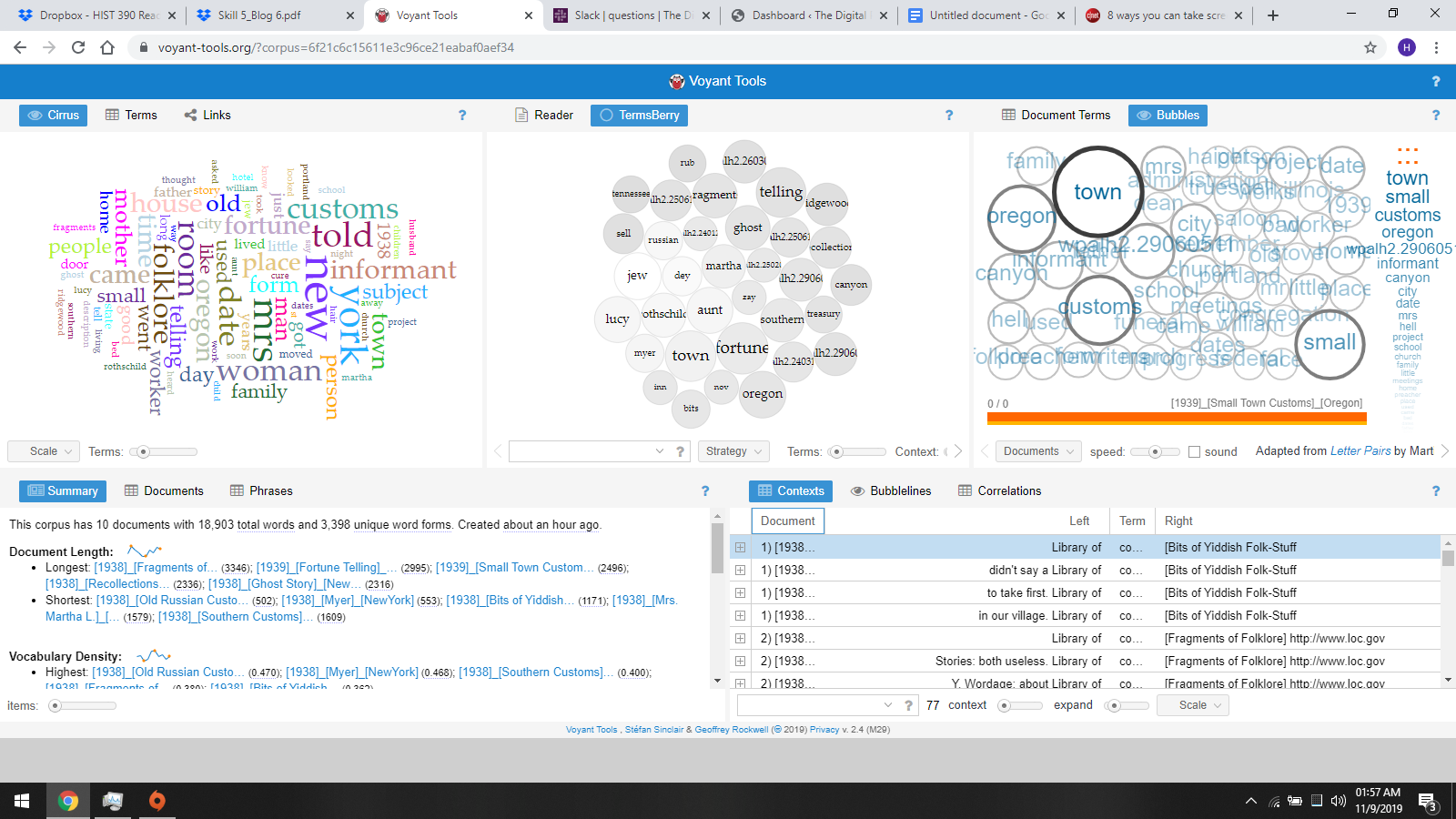
My experience with Voyant Tools was interesting. Once certain keywords are added to the stopwords, the tools become potentially useful for identifying and exploring word patterns and trends. I experimented with many different features, but my favorite feature was the Cirrus one. It arranged the words in a manner that was visually engaging, with a unique arrangement and colors, as well as useful for finding trends. My second favorite feature was TermsBerry because it also arranged common words in a visually engaging manner. With TermsBerry, the words were arranged in bubbles. The third favorite feature was the Links feature. It linked various related words together in a sort of web that you could drag and move around.

As I used the different features in Voyant, I began to realize that there is an answer to my historical question, or at least a part of an answer. Unfortunately, I did not discover any information from my corpus about how folklore and superstition evolved, but I might have learned more about its place during the 1930s. Throughout the different tools I used, some of the most recurring words were ‘family’, ‘home’, and ‘mother’. This inspired me to think about the role of folklore and superstition, and I realized that folklore and superstitions are learned and passed down through family. They require a base, such as a family, in order to survive. In the text, “Southern Customs”, an example of this is given. The speaker detailed several of the superstitious remedies for illnesses that were passed down through her mother’s family14. Also in the test “Myer”, there is another example of this occurring. The speaker detailed a story told to him by his father about a strange, potentially supernatural, event that occurred to him, and he also talked about some of the superstitions that his grandfather taught him as a child15.

Through the use of Voyant tools, I came up with a new question to consider the topic of folklore and superstition with. Through the use of close reading of the texts, I discovered an answer. While I was not able to answer my original question, I was able to answer a different one. Folklore and superstitions were passed down through families, and it is through families that they survive.


Blog 6

My historical question was “How did unemployment affect the people and writers of America during the Great Depression?”. This question came to me because I thought of the economic struggles that people faced during the Great Depression and then wondered about how it affected those people both socially and within their families. I had assumed that the families of America struggled to make ends meet and this forced them have dreary and downtrodden lives. I had also assumed that the writers of America would turn the pen and paper to deal with their struggles and would result in many writings about such struggles. As stated in the American Yawp chapter on the Great Depression, many families lost their jobs and subsequently their incomes with forced them into places such as ‘Hoovervilles’. 16 I selected my sources by looking for text that related to money or unemployment. I searched for the terms; money, unemployment, struggles, jobs, and family.


I found the Voyant Tool to be slightly confusing and overwhelming as it takes a large number of files and words and visualizes them in many different ways. It took a little bit to understand what I was looking at. The Voyant website states that the tools are meant to portray text in new visualizing ways that help a reader look at the text differently. I believe in the end it did help me with that. 17 I found the visualizations of the more commonly used words in the texts like the cirrus and links tools, which I have attached below as my two visualizations, to be the most useful in understanding what the text was telling me. They showed how the interviews had a common theme throughout with topics like their struggles and how life changed. It showed that all these people were affected by the Great Depression. I fumbled around with the other tools present but I struggled to find any significant meaning from those which is why I chose the ones I did.


Uploading the corpus showed me that unemployment did affect families and writers in their wallets, but it also had significant impact on their social lives and mental health. These were no topics I considered when first constructing my historical question. Pairing the findings help me paint a larger picture of the effect of the Great Depression on the American people, not just with what little ideas I had constructed before the close reading.

I concluded that my historical question was narrow in that it didn’t take into account the other problems that faced people and specifically writers during the Great Depression. I also concluded that distant reading helps with taking a large number of texts and analyzing them across the board and understanding them better.

Black Interviewees

For my analysis, I wanted to capture the priorities of black people during the Depression. I asked myself, “What did black interviewees want to talk about? What did black writers seek in their interviews?”, basing my question off Maryemma Graham’s statement that “the largest single impact on black writing before the civil rights movement was really the WPA, not the Harlem Renaissance.” I was not able to glean as much as I wanted from the side of the writers, but within their interviews remained a healthy cache of information about the experience of black folk. 18

In my initial research, I began with specific black authors– namely Zora Neale Hurston and Ralph Ellison– whom I knew were in the Writers’ Project. I slimmed down my scope to smaller interviewers, authors that were not black but had excellently interviewed black people. I ended up with a decent corpus featuring all sorts of writers interviewing black men and women about their experiences.

In squaring my interviews up to the broad sources, I hoped to compare and contrast what black interviewees wished to discuss and what general interviewees wished to discuss. Thanks to Voyant’s extensive customisation options, it was quite simple to sift useless observations out of the results (dialect words, common words).

Something that truly fascinated me was that in the broader corpus, there were far more references to time and time periods. ‘Time’ and ‘year’ are two of the most prevalent words throughout the broad corpus– contrasted to the very few times ‘time’ or ‘year’ crops up in the work of the black writers. I was surprised how intuitively Voyant enabled this comparison, and how many avenues existed for me to deduce it. In closely examining my corpus, the interviewees would either talk about their general experiences (without mentioning dates) or specific events in their lives.

I also noticed that by far the biggest topic in my corpus was race. ‘Negro’ and ‘white’ were the most mentioned words, and according to Voyant, the most correlated with one another. However, within those documents, they were used just as signifiers (‘this man was a negro’) and seldom spoken of in a politicised manner. ‘White’, however, is more often used in politicised contexts (which is also where ‘negro’ and ‘black’ are most politicised). Racial terms are not included at all in the broader corpus.

I discovered that change was not a theme in black discourse. As the collective minds of American Yawp put it, “The Negro was born in depression. [The Great Depression] didn’t mean too much to him… Black workers were generally the last hired when businesses expanded production and the first fired when businesses experienced downturns.”  The African-Americans of the 30s did not have the fiery rhetoric of their descendants in the 60s, and were often focused on their own lives, the joys and strifes laying there.

19

.

Historical Question and Text Analysis

Text analysis has been proven to help a person be able to decipher what they need from a length of text in order to help them with their current research. In this project, I used test analysis to help me research and narrow down my historical question. My historical question was, “How did the Great Depression affect outlawing in the Midwest?” and I went into this research thinking that it would be interviews discussing how outlaws would be going around and stealing goods from families who are better off  or that you would see an exponential increase in theft in the Midwest but that wasn’t the case. To conduct this research, I looked at interviews conducted in the Midwest which just happened to take place in majority of Texas with an outlier of one taking place in Utah. I used search words such as “outlaw” and “Midwest” which narrowed it down a bit for me to conduct my research.

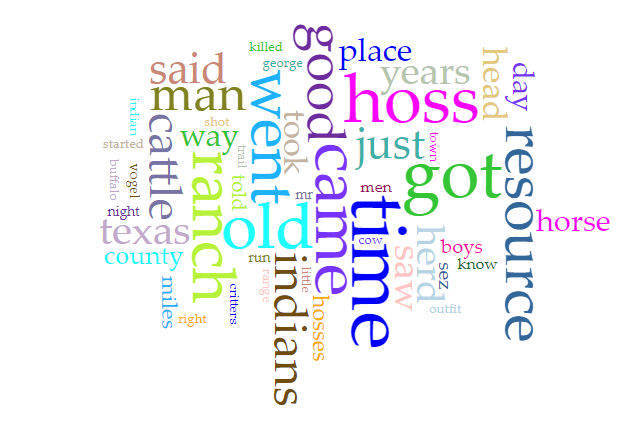
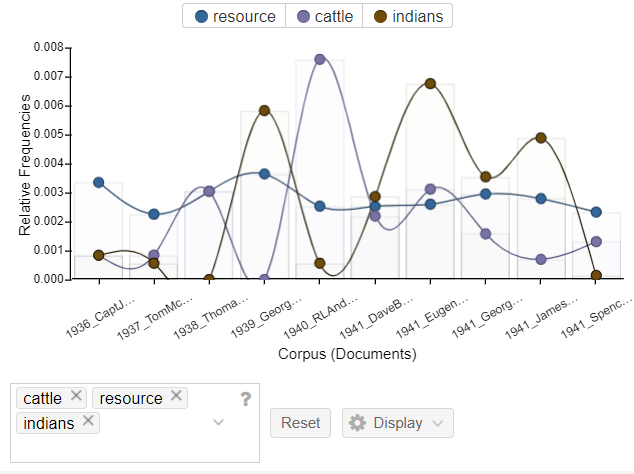
Afterwards, to conduct the test analysis I used Voyant Tools. 20 My experience with this tool was somewhat challenging as there were some features that were not functioning for a while in addition to that there were some confusing to understand as well. Over the course of me using Voyant Tools and using close reading, I was able to change my assumptions and ideas I had about what these interviews would be about. In the graph below, are the words that I saw were more important in these interviews.

I was able to see pair my close and distant reading with new keyword searches and the results showed that throughout the documents, cattle and Indians were used quite a bit as that was what the interviewee was discussing. The final conclusion I can make about my historical question is that outlawing can look differently than what we are used to talking about such as train robbing, petty crime, theft, etc. from other people when it could be as simple as American Indians trying to fight back on their territory and take what could possibly be theirs. Text analysis, distant, and close reading were all useful to me as they helped me find new paths to explore my question from a different angle.

Blog Post #6

“How did the Federal Writers Project encapsulate and preserve the American culture?”

This is the question I want to answer and the reason being is that the New Deal projects helped shape American culture, some of which has lasted to the modern era. I believed that the answer to my question would have something to do with the ex-slave narratives that were recorded for the FWP along with the artwork and theater projects that were created during that time.

In order to find the answer, I looked through the Library of Congress with the search term “Federal Writers Project” to see what basic information I could find. I was actually able to find a source or two that related to the topic of American culture. But in order to narrow down my search, I refined the search words to “Culture and Folklore.” In doing this, I was able to find more sources related to my question21.

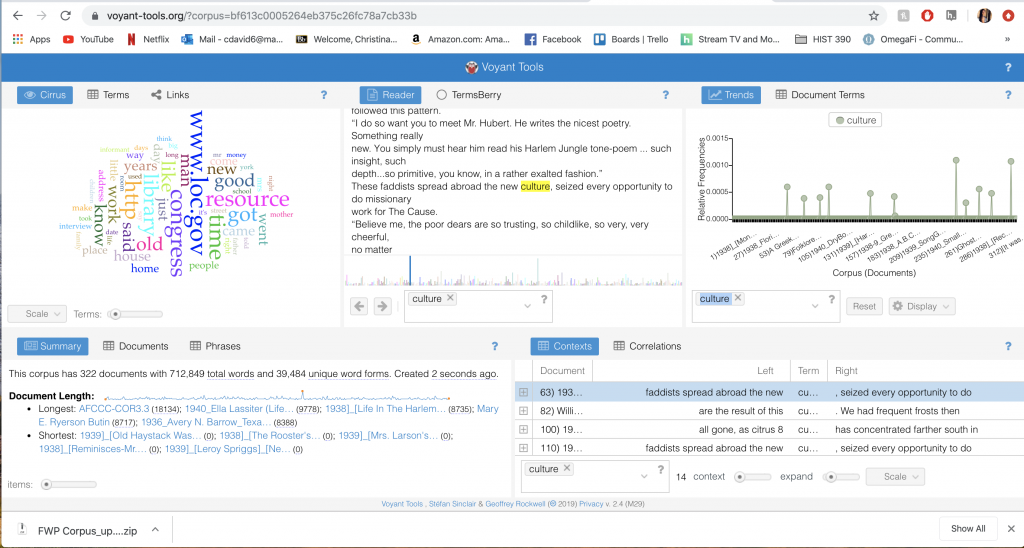
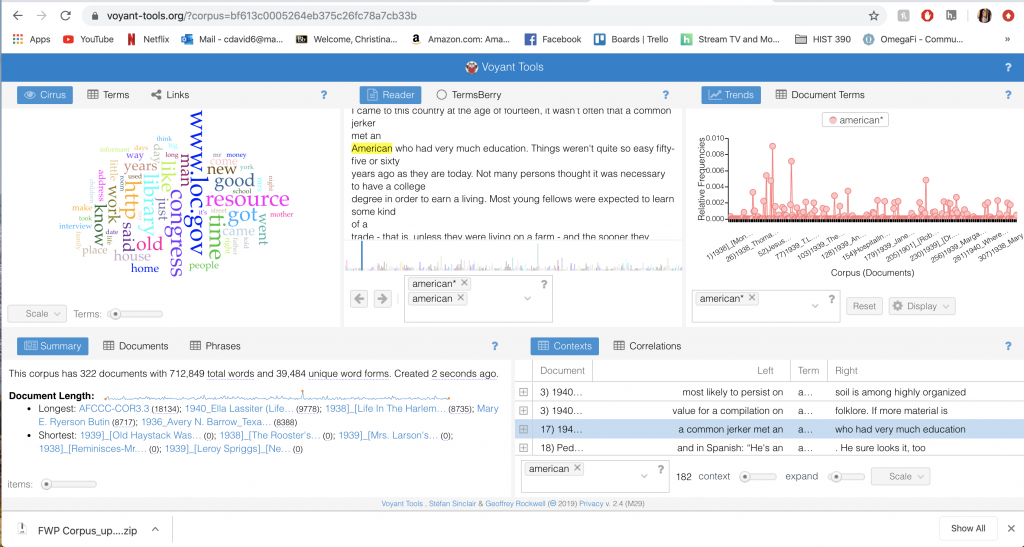
As for my experience with “Voyant Tools22” it was slightly confusing and took a little bit to get used to. Using the tool that allowed me to see specific words in context was extremely helpful because then I could see exactly what was happening in the text. In using this tool, I looked up the words “culture” and “American.”

Key term search with the word “culture”
Key term search with the word “American”

When using this website, I also decided to use the entire class corpus in order to widen my search results and to give me a better idea of what impact the FWP had on American culture.

After reading some of the texts that came up with “American,” I was not surprised to find the positive outlook on American culture. Americans were referred to as “hard workers” and having a “spine.” This search does make me want to tweak my question a bit and instead ask, “How did the Federal Writers Project change the way that Americans are perceived?” or “How did the FWP help create American culture?” Many of the search results seemed very opinionated and I would like to find out what specifically caused the perception of Americans to be this way.

Overall, this close reading helped me realize that the FWP helped sort of “create” American culture and instead of asking how it preserved American culture, I should be wondering how it helped create American culture. Analyzing the text helped me identify which topics are more prevalent in the corpus and what questions could be answered based on the information given. Reading and analyzing the corpus was definitely beneficial to reshaping my question and allowed me to better grasp what effect the Federal Writers Project had on America.

css.php