Blog Post # 6

When formulating my historical question, it was my goal to discuss the impact that African slaves had on American history, specifically amongst those in the Black community. My historical question was “What influence did slavery have on Black culture and identity” ?


My initial ideas regarding my answer was that African slaves lead the way for many historically prominent Black figures today. Due to the adversity faced by our ancestors, who were then forced against their will to endure inhumane treatment while trying to survive in harsh living conditions, it was up to the next generation to pick up the pieces. Which would eventually cause us to create a name for ourselves, enabling the entire Black community to form an identity like none other, only enhancing our already rich and diverse culture.

When selecting my sources, I went through the Slave Narratives from the Federal Writers’ Project, where I searched for keywords through the manuscripts like “negro culture”, “slavery”, and “negro spirituals”.

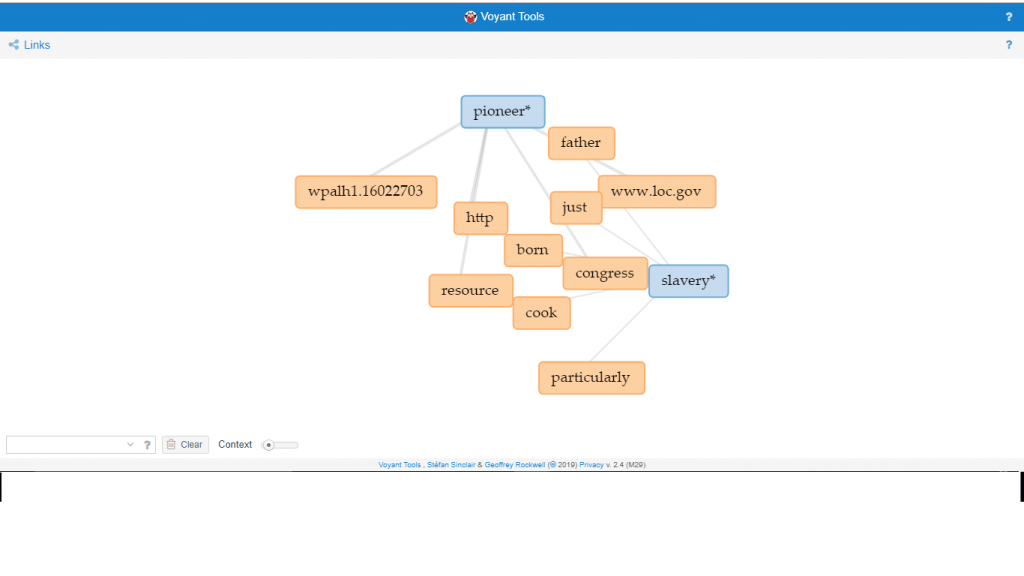
Using Voyant Tools was quite difficult. I did not understand how any of the different tools worked or what they were trying to tell me. Though, with much practice I am now able to navigate my way through the site with ease. As I have become familiar with how each tool interprets the text from documents within the corpus. The one tool I found particularly useful was the “Links” feature. It allowed me to search for terms like “pioneer”, “negro”, and “slavery”, which connected to people, places, job titles, and more. I chose to compare my corpus of ten documents to that of the class to see the difference ( if any) between a corpus on a larger scale and one on a smaller-scale, when searching for the relevance of the key terms previously mentioned.
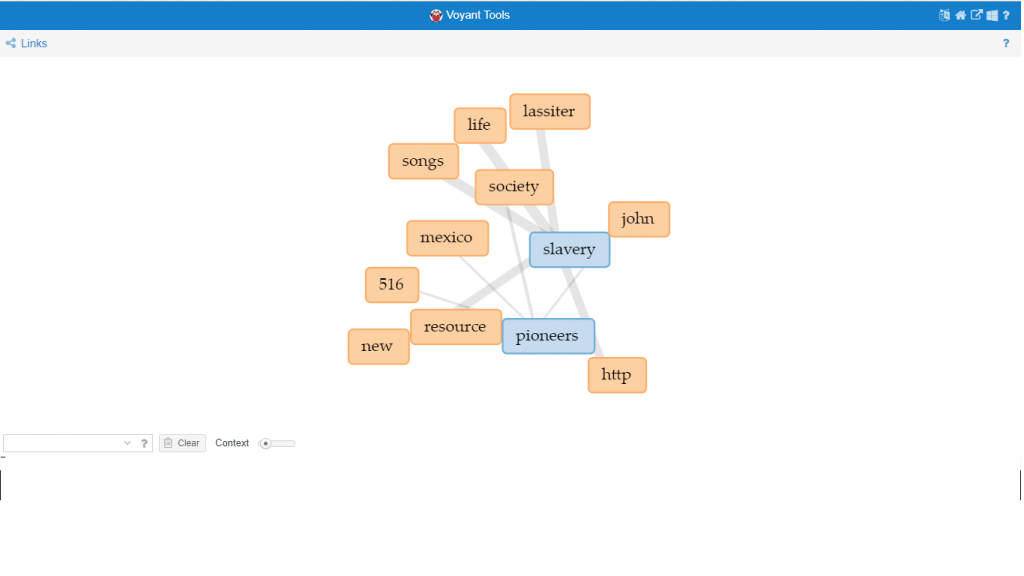
“Link” Tool from corpus on Larger- scale
“Link” tool from Smaller- scale corpus

I would say that performing text analysis on the corpus broaden my ideas and assumptions based on my historical question. Pairing my findings with close reading enabled me to explore these ideas. The Reader and Trends tools helped me to locate the various words that were connected to the keywords in the Links tool, making it easier for me to contextualize the relevant documents in both my corpus and that of the class.

To conclude, I can say that close reading is quite helpful when analyzing text. Being able to understand how and why specific words correlate with one another within a text or outside of another is important as a reader. Through the use of Voyant Tools, I was able to draw that the influence of slavery on Black culture and identity shaped many Black trailblazers and pioneers. Many who sought to receive an education that their ancestors could not, guaranteeing them success and a brighter future; not only for themselves but for the generations to come. It is because of their sacrifices that we have been able to establish our true identities. Not the ones that the white man so vaguely gave unto us, but rather the ones we worked so earnestly for.
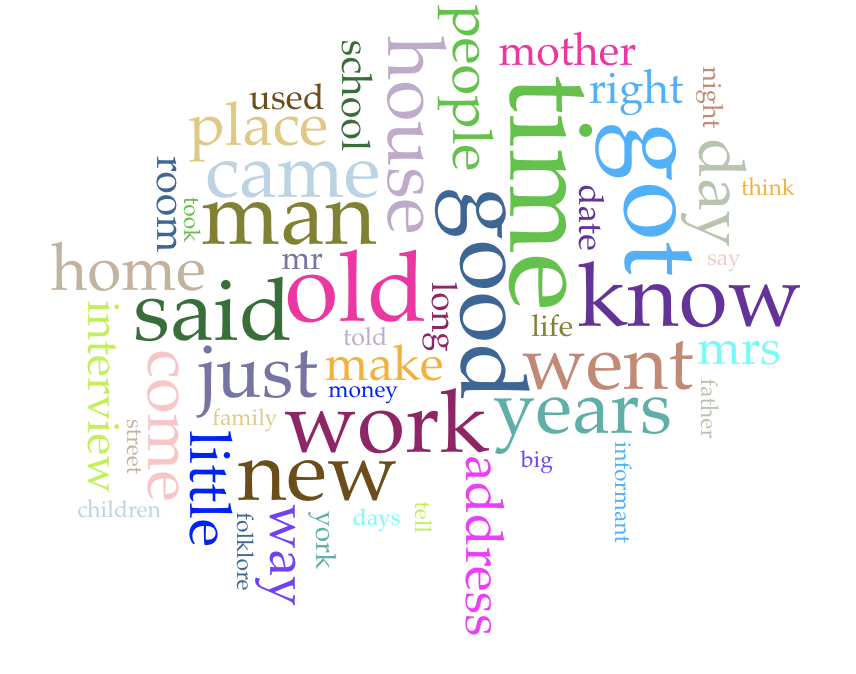
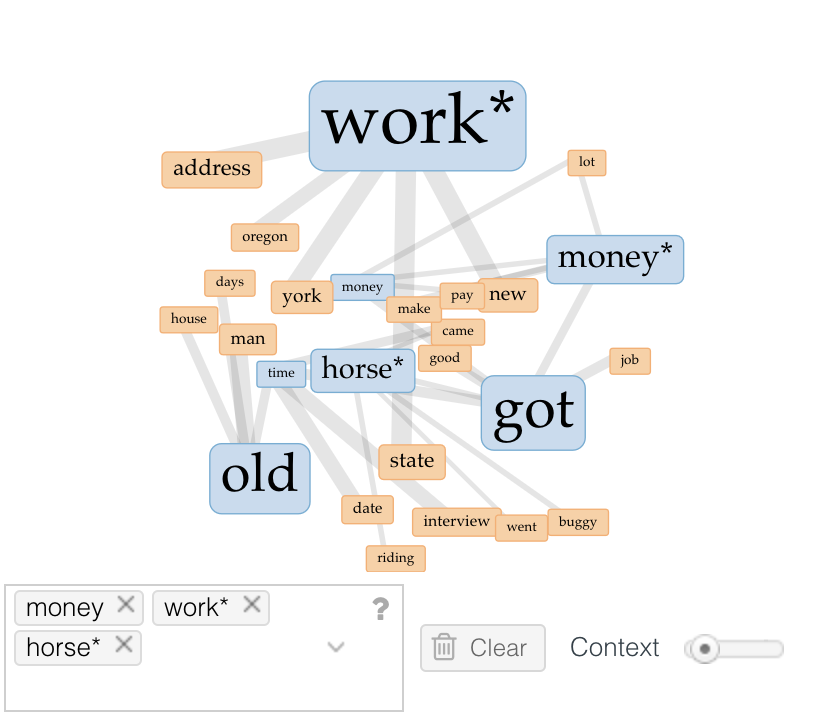
Lives of Farmers prior to and at the tail end of the Great Depression.

My historical inquiry centered on the lives of farmers during the late 1800s into the 1940s, and how they were effected by the Great Depression. Historically, and generally speaking, farmers or anyone making a living working with livestock and agriculture are not high ranking within the social hierarchy. It also a common preconception that farmers often lived simply and frugally, tied to the land around them. Given the well known economic consequences that the Great Depression had on people primarily within the middle class, I wanted to take a look at how farmers who usually lived in the lower middle class or lower class, would have been effected by the Great Depression, or if there was really a change in their lives at all. I was a little conflicted in my initial assumptions about the results I thought I would get- I partially thought that farmers would see little to no change in their lives, or would see some kind of relatively positive change, considering their products would be as plentiful as ever, but in much higher demand for a lower price.

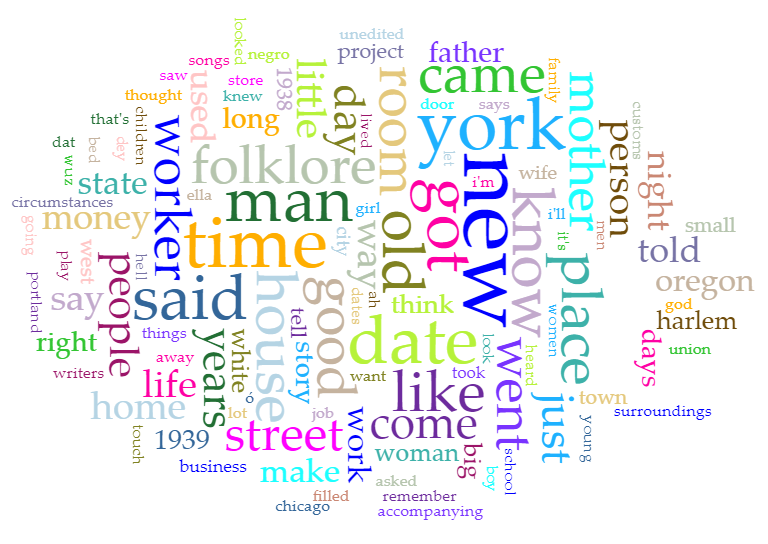
When I uploaded the class corpus to Voyant (https://voyant-tools.org/?corpus=94a81c6e9324e1504a2f633ca4bf1c6f), I made a point of looking at the most prominent words in the initial word cloud it generated, and then weeding those words or terms out in order to dive a little deeper into the text. What I filtered has essentially nothing to do with the documents in the corpus, I simply removed terms such as “http”, “congress”, “www.loc.gov”, which tainted what I was really trying to get at. Following this step, the word cloud presented something much more useful. The “largest”, or most frequently used words were now “time”, “got”, “work”. Looking over at the TermsBerry visualization, I noticed that words like “it’s”, “that’s”, and “I’m” were also populating quite frequently, but not really displaying what I wanted to get at. So, I removed these, and was pleasantly surprised with what was then generated.

After observing the word cloud for a bit, I changed to visualization tool to link the words, and inserted some filters to see how the terms “horse”, “work”,  and “money” factored in.

Seeing the way these words linked was actually really interesting, in a sense that more mundane, yet still positive terms stuck out. I was able to conclude at least that the lives of farmers during the Great Depression were not as heavily or negatively impacted as many others were, but I’m still not highly confident in this answer. I think that if I had dedicated more time, and made this question and analysis into a much bigger project, I would have been able to uncover a significantly bigger amount of information, and some outside research, and more close reading, would be needed. This being said, the tools provided by Voyant are very enlightening and useful.

Blog Post 6

My historical question was “how were crime rates influenced by the Great Depression?”. I chose this topic because I am a criminology major and figured it would be interesting to research. I assumed the answer already due to crime trends I have learned from my other classes. I assumed the answer would be that the rates increased due to high levels of poverty. As I continued researching more, however, I realized I forgot to take into account unreported/undocumented crimes, which would be most likely prevalent in this area due to the high poverty and unemployment; it would most likely become somewhat of a “norm” so to speak.

To find my sources, I used filters such as law or crime assuming that would lead me somewhere. I didn’t have a specific method in how I selected my sources. I selected ones that were different in the sense that I could have a wide variety of perspective and types of crime. I also selected ones I found interesting because I didn’t see a point in not making my research fun.

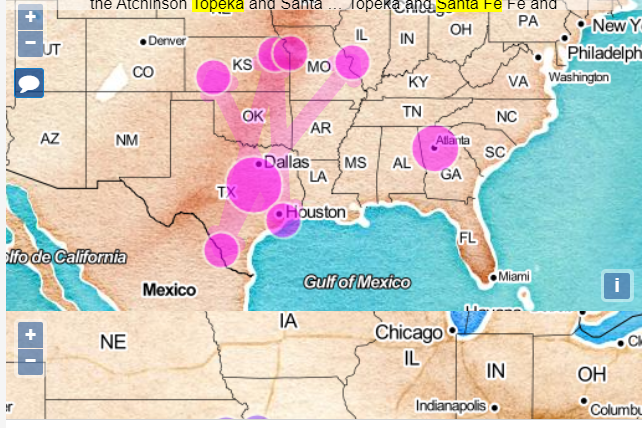
Using Voyant Tools was a bit of a challenge. The help/support page was referenced a lot. However, after my many attempts to figure it out, I did and it was actually really helpful. It helps analyze all these documents and condense the similarities among them. My favorite part was that I could control how many words were displayed in the word cloud feature. Sadly, I could not get the bubbles to work, but I did find another useful tool which was the DreamScape tool which displayed the locations of each document. I chose my own corpus to use for Voyant Tools because the zip folder on Slack was unsupported by the document selector so I was unable to upload the full class corpus to Voyant Tools. If that is an error on my end, I understand because I am not the most tech savvy person. However, I did find it useful to use my own corpus as I felt it was the most relevant to my historical question.

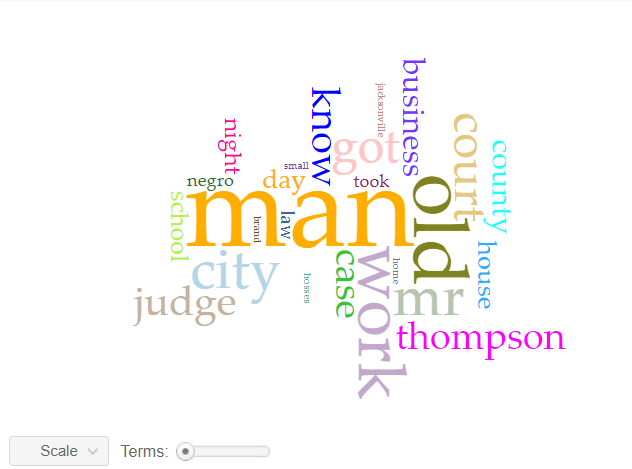
Performing text analysis on my corpus did not change much for me except for maybe my idea of how the crime rates were portrayed. My question also changed to be more racially centered: “Were crime reports racially biased in the Great Depression era?”. I believe crime trends were more racially targeted during the Great Depression. This can be observed using previous knowledge and relating it to the DreamScape tool which shows my corpus is based in the more southern region of the United States where racism was very prevalent. Analyzing the word cloud, the words “man” and “negro” and “court” stand out to me the most. It brings me to the conclusion that crimes were extremely racially biased in the Great Depression era.

Blog #6: Jazz Music in Chicago

My historical question was originally, “Aside from Federal One projects, how did the arts effect the everyday person in Chicago and New York City, two ethnically diverse cities? Additionally, were these art forms more inclusive and/or accessible to minority racial groups oppose to Federal One projects?” However, as I started to do my research and find narratives from the Federal Writers’ Project, I realized that I had to change my question. I found that I was a lot more interested in specifically jazz music, oppose to the overarching arts. My thought process in choosing the second question was trying to figure out how jazz was received in Chicago. I think it’s natural to think about jazz, plays, ballroom parties, etc. in terms of New York, especially coming out of the height of the Harlem Renaissance. I was interested in whether or not jazz had the same kind of prominence in other big, ethnically diverse cities, like Chicago, or was it overshadowed by the uprising of Folk music?

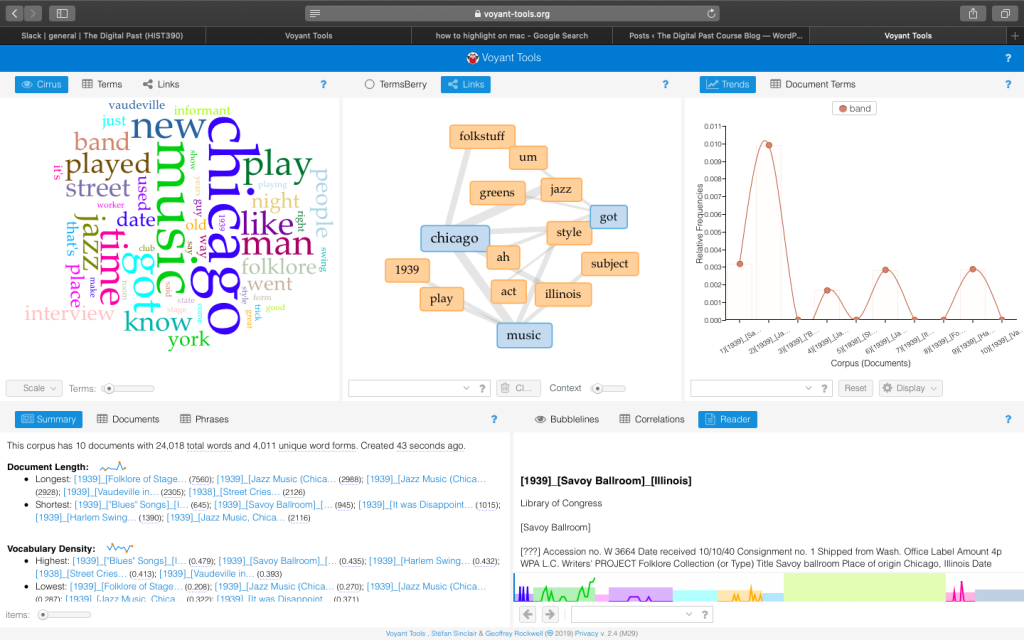
I was worried about finding narratives that would fit my historical question. Most of the narratives seemed to be about the American Slavery experience, not music in their present day. I searched for terms like “music,” “Chicago,” “jazz,” to find the narratives, and made sure they were included in the collection. For the most part, no matter what I searched, I found the same few narratives, but I was able to find enough for the purposes of the Zip drive. Voyant Tools was easy for me to use once I learned how to use some of the visualization mechanisms. I think it was a lot easier to use than some of the other technological sites we’ve used this semester. My favorite tools, and what helped me find answers to my historical question the most, were setting the first block as “Cirrus,” the second block as “Links,” the third block as “Document Terms,” and the bottom right block as “Reader.” In doing this, I could read the narratives and see correlations between words.

Using Voyant Tools, I was shocked to see that there was a correlation between “music” and “California” in the class corpus. I guess I was so caught up in studying my own corpus that I never thought about any other states or cities. In terms of my historical question, I’m unsure if I found an exact answer. However, using the “Links” tool, I realized that in the class corpus, there was a strong connection between “music”and “Chicago,” even amongst 300+ narratives. This doesn’t necessarily mean “jazz,” but I think it would be safe to assume the main music source was jazz. Additionally, if there were 300+ narratives in the class corpus, and “Chicago” and “music” made a match, I think that’s an important fact to identify – the possibility that music in Chicago was more prominent than New York.

I personally liked text analysis. I know in the “Mapping Racism and Accessing the Success of the Digital Humanities” 1 article we read by Sarah Bond quoted a professor calling the Digital Humanities a “bust,” but this aspect of the Digital Humanities I find highly useful (Bond, 2017). No one in my generation, or future generations I would assume, would have the patience to sift through hundreds or thousands of articles to answer a historical question. In Lauren Tilton’s “Dialect and the Construction of Southern Identity in the Ex-Slave Narratives,” 2 she uses text analysis to “show how dialect was not only racialized but also connected to a particular (cultural) geography—the American South” (Tilton, 2019). Tilton could’ve researched this historical question, but her research would’ve probably taken years and would’ve included years of her sifting through documents either on her own or with a team. Thanks to text analysis, she was able to hone in on a specific topic and allow technology to aid her in finding correlations. In my final conclusion, I came up with more of an assumption for my historical question. Yet, I now know that text analysis is a much easier method to approach researching, and will most likely be using it in the future.

Blog Post #6: Text Analysis

My initial question was ‘How were the works of the Federal Writers Project perceived and interpreted by different classes of people (social, racial, economic, etc.)?’ I had a sense of what I might find due to the differences of opinion towards the project that has been heavily discussed in class as well as in the readings. 3 It seemed interesting to view the works from the perspective of the reader and any negative opinions if they did arise. In order to find writings specifically based around the classes I mentioned, I narrowed the results to those dated 1930-1939. I focused on the listed subjects that were covered, and chose some based on my desire to have pieces that could lead to asking more questions, and that could have sparked different reactions in readers who were part of the opposite class of the writer. I opted for pieces in the subjects Beliefs and Customs, Occupations, Dating (Social Norms), Poverty, and Education. Ultimately, I selected those that had the most interesting titles. I learned early into the text analysis that this question was not going to work, as the analysis was done on the writings, and thus would not have represented any thoughts or ideas after they were published.

Voyant Tools was a confusing experience. For total transparency, I was unsure of what exactly I was supposed to be looking for, especially due to the fact that I needed to reshape my question. I began looking for keywords that sparked an interest in what I had originally wanted to ask, and noticed certain words that seemed popular throughout the corpus: man, women, young, and old. These similarities were much more easily seen through the use of the cirrus word cloud and the links tools.

I used the class corpus to reshape my question. I was not finding words from all areas that I wanted to think about, but the presence of the four words led me to think about how different genders might formulate their writings. I decided that I wanted to investigate the ways that men write versus women, and what topics about which they choose to write. After looking into a few pieces from each gender, there were obvious similarities: writing about their life during the time. It seemed as though women wrote in a different voice than men, and men were either interviewed, or wrote about a specific event. For example, Barbara Berry in her piece wrote about those living in Florida, and the writing was heavily descriptive and used a lot of imagery. I noticed, through close reading some of the pieces, the similarities between the FWP and the Slave Narratives, and the heavy use of personal experiences from the writers. 4 I feel that close reading is more beneficial for me as I prefer to build ideas after interacting fully with the piece, and I did not have as clear of a grasp on distant reading as I may have needed to in order to fully understand the assignment.

Ghost Stories from the 1930’s and Voyant Tools

My historical question was “In what ways have ghost stories changed, if at all, and based on these accounts are people more or less careful around ghosts? Why?” and while I was curious about the answer, I had figured that it would probably be similar to the ghost stories we tell today, although I did expect people to care about it less, which ended up being untrue from what I read. 

When I first started looking up words, I wasn’t sure if I was going to find any, but luckily there were a good number of actual ghost stories. I used words like “ghost” “spirit” and “supernatural” with more results than I was expecting, although sometimes I’d get more religious texts with “spirit”, or people would use phrases like “pale as a ghost” which was not what I was looking for. 

It took me a bit to really understand Voyant and which tool would work best for me. Since my topic is pretty niche, I found that the word map wasn’t helpful, but that the graph and the contrast tools helped me compare my corpus with the class’ to find similarities and differences 5.

The amount of times the word “ghost” showed up in my corpus
The amount of times the word “ghost” showed up in the class’ corpus

What I did in this picture was I entered the word “ghost” into both my corpus and the class’ corpus to see how often the word shows up throughout texts. Most of the spikes in the class’ corpus was from the stories I submitted, but there was one that was very high that I hadn’t submitted. It ended up being just a sentence from an interview but because the interview was only one sentence, it made the graph think that because “ghost” was a common word in the interview, simply because there were few other words, that means it must be relevant.

In the end I feel like my historical question doesn’t fit what I found so I’d change it to something more like “How common were ghost stories? How important are they to the communities their told in?” because I found that they were somewhat common throughout many towns and they inspired bonding in certain stories 6. I also found that I enjoyed looking through the different ghost stories and how they ended up being similar to the ones we tell today, despite how different the times are. One of the most interesting things I found was how the debate over whether ghosts are real or not was just as relevant then as it is now, with both skeptics and believers arguing. The biggest difference I think is how today, people mostly talk about evidence being caught on camera, and whether or not it’s faked, but in the 1930’s, catching a ghost on camera would be near impossible so the beliefs were based on personal experience. The conversations have shifted from personal to objective, unaltered proof, which while can be more believable, it discounts a lot of experiences that cannot be seen, such as the emotional energy tied to a place, and credible psychics, however rare they might be.

Cultural Identity In Folklore

My original historical question when approaching this project was, “How is cultural identity shared through folklore?” Initially, when exploring the folklore unit of the FWP Life Histories, I expected to find a large array of stories passed down from different cultures. This expectation was bolstered by the numerous Life Histories categorized by ancestry, and a number of interviewees of different ancestries, aside from “American” and “American Negro.”

My first step in analyzing the texts was to limit the corpus to documents only from the folklore unit of the FWP Life Histories. This entailed modifying the corpus to keep only documents that included the term “folklore” (the interviewers organized them by listing “folklore” under the subject.) This limited the corpus to exactly 100 documents.

Using Voyant was overwhelming at first, but after just experimenting with each tool for a while, I learned how to specifically use them. I found that for the purposes of my historical question, simply uploading the corpus and glancing at the trending terms was relatively useless.

The original results of the Cirrus tool, showing the trending words from the entire corpus, reveal mostly generic words, most of them regarding the form the interviewers filled out. Further inspection was necessary in order to yield results relevant to my question regarding cultural identity.

Applying stopwords globally7 helped to narrow down the results by excluding terms and phrases that were being counted due to the formatting of the documents (i.e “http,” “Library of Congress,” “ww.loc.gov,” ” Ò ,” etc.).

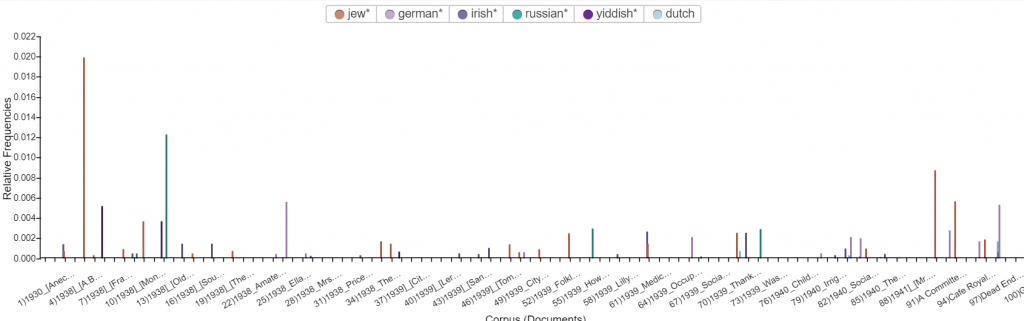
It became evident soon though that my idea of cultural folklore was not what was being expressed through the life histories interviews. Rather than old wives’ tales and bedtime stories reflecting ancestral heritage, I found everyday stories about America that just so happened to be told by subjects of several different ancestries. This revelation was reached by using the trends tool to search for several different ancestries (German, Dutch, Irish, Yiddish, Jewish, Russian). This made it easier to read a select number of documents closely and find that they were pretty typical accounts of day to day life at the time, lives that were simply American lives.

Searching explicitly for the ancestries I had seen through close reading revealed how often they were recorded. Despite my perception that there had been many interviews of subjects of Irish descent, there was a greater amount of interviewees of Jewish descent.

These revelations of how simplistically cultural identity was reflected in day to day life reflects Botkin’s motivations in assembling” ethnically diverse life histories… to foster the tolerance necessary for a democratic, pluralistic community.” 8 Overall, this analysis reveals that while lives are experienced differently based on ancestry and cultural uniquities, there was certainly a common experience for many in America at the time despite diversity, that hopefully was a unifying factor.

Blog Post 6

How did the hope and hard-work of everyday Americans pull us out of the Depression? I asked this question because we have been talking about how the Federal Arts Project was what really helped us out of the Great Depression but I was curious to see how much the everyday working Americans really contributed. My initial thought was that the working class was the main reason we survived the Depression. Without the working class to work all the jobs provided by the Federal Arts Project, the projects would not have succeeded. So, I believe that the sole reason America made it through the Great Depression, was because of its everyday working-class Americans. When selecting my sources, I looked for ones that talked about work and providing for their family. I searched using a few different filters. I began with words such as: work, family, living, and hard. Then choose the type of source I wanted: manuscript. I used these filters and found my ten manuscripts that I believed would help me to answer my historical question.

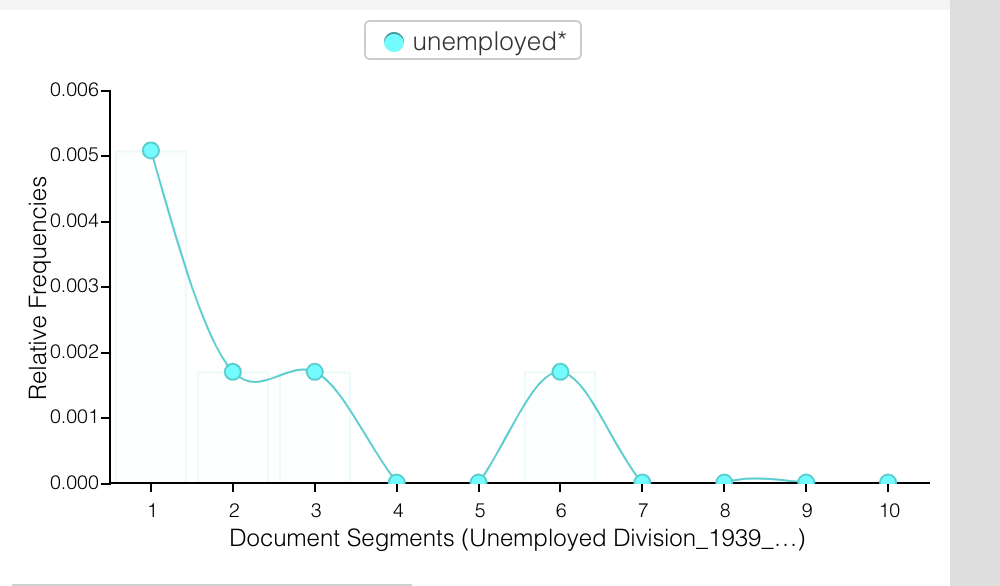
I am still deciding whether I like Voyant tools or not.9 When I first started using it I kept getting frustrated with it. I didn’t know how to do certain things and it was really confusing. Once I sat down, read a bit about it, and played around with it, I began to understand it more. 10 I was able to compare three documents at once which was helpful. After messing around with the program, I began to analyze the texts. When comparing the texts, I could narrow it down by searching for certain words such as: unemployed. This was helpful to search through other people’s documents that they found. After using Voyant Tools and analyzing several different texts, the conclusions I came too were equivalent to my initial ideas. I found that, in fact, it was the hard work of the Americans that fueled the Federal Arts Projects, that then pulled America out of the Great Depression. As far as text analysis goes, it was harder than I had expected. It took me a while to find sources that I could later analyze and it took a while for me to get accustomed to Voyant Tools.


Mining the Eleanor Roosevelt My Day Columns
, regan008.shinyapps.io/mining_my_day/.

Miriamposner. “Miriamposner/Voyant-Workshop.” GitHub, github.com/miriamposner/voyant-workshop/blob/master/investigating-texts-with-voyant.md.

The American Life Histories Collection and Florida

My historical question was, “How did the Great Depression impact farmers in Florida?”. I was for sure expecting to find texts in the “American Life Histories” collection related to Florida and farming. I assumed that I will be able to read scripts from interviews of farmer’s life and working conditions during the Great Depression.

Of course, I first made sure that my research was within the collection. Then I filtered my research by state, and input “Florida”. There were only a few texts related to Florida which made it easy to read through and pick the texts I wanted for my corpus.

I had the chance to use a software called “Voyant Tools”. This is a great solution to analyze huge amounts of data and practice distant reading. It is also great to correlate with close reading thanks to the tools offered on the platform.

I believe that Cirrus tool was the most useful one. It allows me to see the most used words in the corpus. You can also add stop words to delete from it, analyze any words you do not wish to see, and leave space for others which might be more important.

WordTree is a great tool too. Indeed, it highlights different words and also gives a notion of hierarchy between the words.

I first decided to upload the entire corpus. Cirrus tool (see below) gave a huge diversity of words. I had to use the tool Terms. I went back to close reading and picked few words to put in the search bar of Cirrus Show Terms. The most relevant words were: Farm (x591), and Farming (x64); Life*(x749) and Work* (x2773); Child* (x641) and Family* (x616). We can see that the stories are more about the life at the farm than farming. Stories talk about the life of people, their work, and family. The distant reading confirms the trend I noticed from my close reading.

The first analyzation is not enough to bring any answers to my historical question. Because I focus on Florida, I decided to reduce the corpus to all texts from Florida. It is a corpus of 42 documents (as opposed to 323 documents before).

I used Cirrus tool (see below) but added the following stop words: resource, congress, www.loc.gov, http, library, got. The word Florida shows up and this is reassuring. The analysis is working. The following important words appeared: work, good, home, Florida, mother, house, children, people, school, home. They are all related to my historical question.

Using the tool Terms, I compared the Florida corpus within the entire corpus using a proportion scale for each interesting word: Work (22%), Child (26%), Family (25%), Farm (38%), and Farming (44%).

The word “farm” is in a proportion of 38% within the Florida corpus out of the entire corpus. This only means that texts related to farming and farm within the entire corpus are mostly from the Florida texts.

There is definitely a trend for family, child, and work.

Then I ran WordTree (see below). The following words are organized around the word good: farm, strawberry, time, farmer.

“Good” seems to lead to a positive atmosphere related to the farm, the time spent, the life of the farmer, and surprisingly strawberries. It is confirmed by close reading, “as it is, we have good land and good health, plenty of good wholesome food, a roof over our heads, and good children” 11

I was expecting to get a deep understanding of the working conditions of farmers in Florida and a description of their work. Nevertheless, Benjamin Botkin said that he wanted to move “the streets, the stockyards, and the hiring halls into literature.” In other words, we are looking at the everyday life of people. The text analysis reflects it. We are actually not looking at their working conditions but at their own life, feelings, and what later on they believed was relevant to share from this period with the interviewer.

I paired my findings with close readings in order to understand why certain words would come up more than others. I also picked words from close reading to inject them in Voyant to see where it would lead my research.

After using Voyant Tools, I understood that I should modify my historical question. I did not find any useful information around farming within the collection. I should instead focus on “how the life of Florida people was impacted by the Great Depression?”.

Text analysis is important for digital historians in order to better understand the past. It is essential to pair distant and close readings. Indeed, using one or the other alone could lead to non-sense. I found interesting to cross data and come up with an interpretation to answer my historical question.

Blog Post #6

My historical question was: How did the theatre impact the morale of people of color in the late 1930s? Originally, I felt like I could answer my own question with research and in-class readings about how it made theatre more accessible to all, more diverse, and lifted the spirits/served as escapism of the Great Depression

12

. However, after realizing that I wouldn’t find a personal narrative to say that, it made this assignment more difficult. My question was refined, changed, and even entirely overhauled days before the assignment was due but, what I have now, I really like. 

My searching process was very specific. I started with narrowing down the date. Next, I started to do some keyword searching. I searched “black theatre” “black theater” “people of color performance” “colored theatre” “theatre and race” “theater and race” “black actress” “black actor” “federal theater project black” and “black plays”. I came across some really good documents about black actors being interviewed about how their life changed while on Broadway or vaudeville and others about the parties people threw afterwards. To me, it seemed clear that the general disposition was lifted. I picked sources that talked about the personal experiences of black actors. Finding these sources was harder than I thought but when I did find them, it was exactly what I was looking for. 

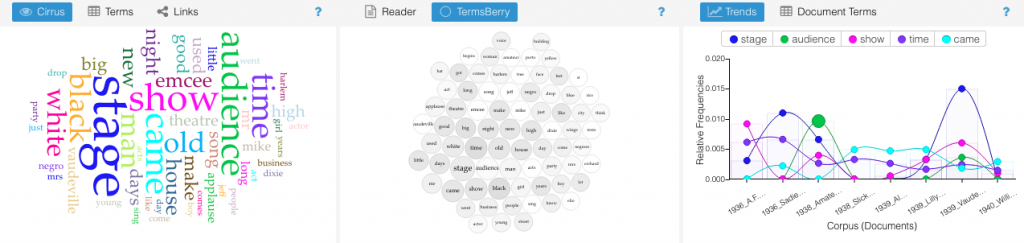
I liked Voyant tools but I don’t think I will need to use it again. It’s very specific for this type of at-a-distance reading. As a theater major, I probably could use it to analyze scripts. But, for what it’s used for, it was really useful. My favorite tools were Cirrus and TermsBerry because they showed exactly what I wanted, frequency. I narrowed down the stopwords that I needed to get rid of that our tutorial so graciously taught us about

13

.

The data from my specific documents

The data from our entire class corpus

I compared my specific documents to the corpus as a whole to better understand how they differed from everyday rhetoric to the niche rhetoric of performance. I did a good job of exploring the different tools that Voyant had to offer. But ultimately, the research I have struggled to answer my question. So I did a little more closer reading to my texts and tried to understand if those readings confirmed my hypothesis. All of my readings centered around how much people of color were happy when talking about being in theatre which confirmed my concerns with my historical question. In the end, I feel like my question was answered. I was shown that people of color had a better outlook on their lives after the Federal Theater Project facilitated them being involved in the theatre. I was definitely searching for specific documents that answered my historical question how I wanted to see it and not how it objectively appeared but, I don’t yet have the corpus to truly delve into the truth of my historical question which, can only be left up to the future.

css.php