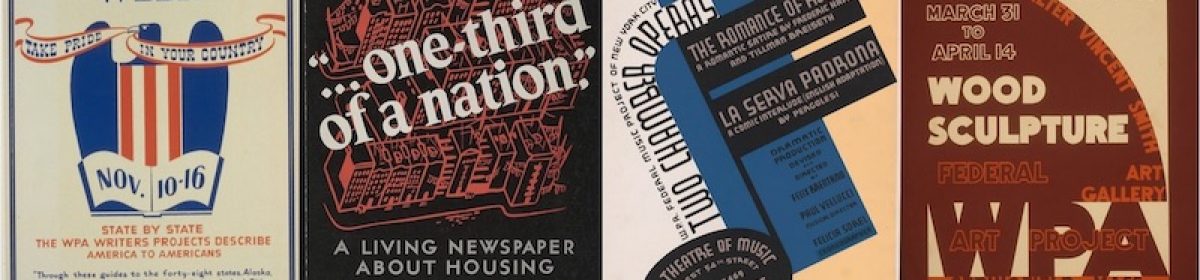
My original historical question when approaching this project was, “How is cultural identity shared through folklore?” Initially, when exploring the folklore unit of the FWP Life Histories, I expected to find a large array of stories passed down from different cultures. This expectation was bolstered by the numerous Life Histories categorized by ancestry, and a number of interviewees of different ancestries, aside from “American” and “American Negro.”
My first step in analyzing the texts was to limit the corpus to documents only from the folklore unit of the FWP Life Histories. This entailed modifying the corpus to keep only documents that included the term “folklore” (the interviewers organized them by listing “folklore” under the subject.) This limited the corpus to exactly 100 documents.
Using Voyant was overwhelming at first, but after just experimenting with each tool for a while, I learned how to specifically use them. I found that for the purposes of my historical question, simply uploading the corpus and glancing at the trending terms was relatively useless.
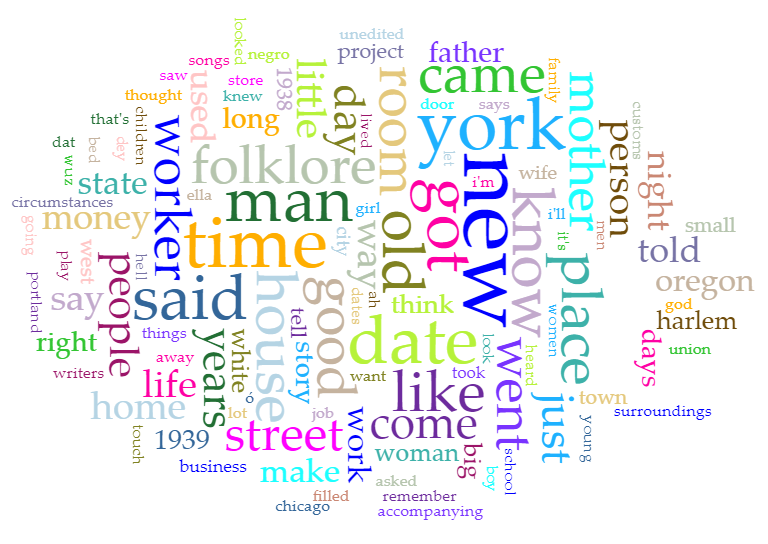
Applying stopwords globally1 helped to narrow down the results by excluding terms and phrases that were being counted due to the formatting of the documents (i.e “http,” “Library of Congress,” “ww.loc.gov,” ” Ò ,” etc.).
It became evident soon though that my idea of cultural folklore was not what was being expressed through the life histories interviews. Rather than old wives’ tales and bedtime stories reflecting ancestral heritage, I found everyday stories about America that just so happened to be told by subjects of several different ancestries. This revelation was reached by using the trends tool to search for several different ancestries (German, Dutch, Irish, Yiddish, Jewish, Russian). This made it easier to read a select number of documents closely and find that they were pretty typical accounts of day to day life at the time, lives that were simply American lives.
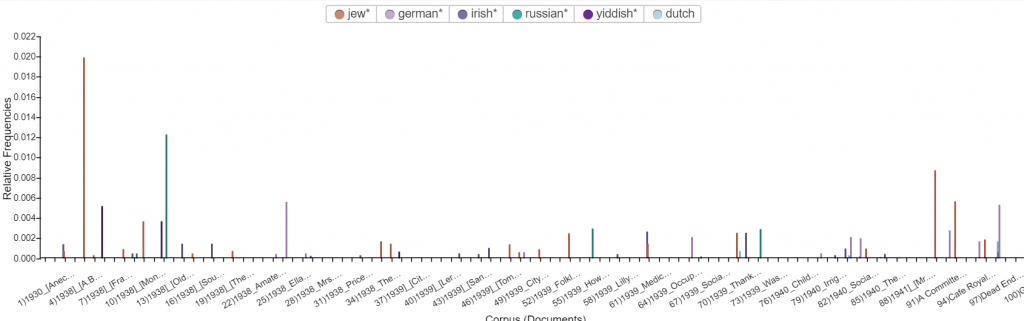
These revelations of how simplistically cultural identity was reflected in day to day life reflects Botkin’s motivations in assembling” ethnically diverse life histories… to foster the tolerance necessary for a democratic, pluralistic community.” 2 Overall, this analysis reveals that while lives are experienced differently based on ancestry and cultural uniquities, there was certainly a common experience for many in America at the time despite diversity, that hopefully was a unifying factor.
- Posner, M. (April 10, 2019). Investigating Texts With Voyant. Retrieved from https://github.com/miriamposner/voyant-workshop/blob/master/investigating-texts-with-voyant.md
- Banks, A. Introduction to FWP American Life Histories. Retrieved from https://www.loc.gov/collections/federal-writers-project/articles-and-essays/introduction/
