Reflection

Exhibit: Artistic Expression in the Great Depression

My exhibit, Artistic Expression in the Great Depression, explored the ways that the struggles of the Great Depression were reflected in creative works at the time, such as plays, music, novels, film, murals, and dance. Using the digital tools we’ve worked with in class helped me to discuss both the purposes and the impact of these works.

When discussing Clare Leighton’s art work, using image annotation helped to talk about the particular portions of the work in their own contexts. It also saved the trouble of explaining and describing where each component of the work could be found. Using Soundcite to provide an immersive experience into Mary Sullivan’s song, “Sunny California”1 helped to put one into the same perspective of someone hearing it at the time, someone who would hear their own story in the song and find comfort in solidarity. I prefer StoryMap over the other tools that we’ve used, as it helps you visualize different types of information at once. Using StoryMap helped me to show the location, description, and medium of several different kinds of creative works. Despite being of very different natures, StoryMap allowed the information for each topic to be shared in the same context, as a moment in history. These tools helped me to really make my point in explaining how the creative works of the 1930’s helped the nation heal.

Of course, I only found myself to be proving what we’d been learning all along this semester. We even read early on in the class, “The arts can be a lifeline as well as a pleasant diversion, a source of optimism and energy as well as peerless insight, especially when so many people are stymied or perplexed by the unexpected changes in their world. As our troubles worsen, as stress morphs into anxiety and depression, we may desperately need the mixture of the real and the fantastic, the sober and the silly, that only the arts can bring us.”2 Now, if not for this class, I wouldn’t understand the concept lying underneath that determination. We were quickly directed towards the concept of escapism; and to understand how a nation suffering hardship across the board needed revitalization and found it in a mix of avoidance and activism. While Federal One Projects sought to begin mending society by creating cultural stimulation,3 seemingly a distraction from the task at hand, they didn’t just provide a diversion from the present circumstance, contrary to initial belief. “The most durable cliche about the arts in the 1930s is that despite the surge of social consciousness among writers, photographers and painters (some of it supported by federal dollars), the arts offered Depression audiences little more than fluffy escapism, which was just what they needed. But that’s not the whole story.”4

What we’ve learned throughout this class and what I’ve tried to show through my exhibit is that by looking closer at those arts projects that were condemned as a silly waste of federal funding, those involved were inspired to use the works for  a bigger purpose; to seek out works that put issues under a floodlight. The nation was not only given back a sense of optimism through the “distraction,” but was motivated by the call to action that lie in so many of the arts projects being examined and produced at the time. It raises the thought of how often we may come into this possible paradox today, in getting caught up in entertainment news rather than considering pressing issues. Or can we justify that today by arguing that perhaps the news that entertains us sometimes points us back in the right direction, to the matters at hand?

Aside from what we’ve learned in this class in historical perspective, I’ve personally found a wealth of knowledge in understanding my relationship with the technological world. While I’ve considered how to navigate digital space carefully and safely, and take precautions in my usage, I hadn’t considered my duty to the digital world. Learning how to be responsible about engaging with suspicious information5 and possible bots6 has opened my mind to a different perception of the Internet. Everyone likes to wonder what the future will look like for technology, but I was slow to realize that all of us will really be the keepers of Internet safety, that we are all responsible for the future of the digital world.

Sunny California

Does politically influenced music polarize or unite? More specifically, was the impact of politically influenced folk music in the 1930’s a polarizing or uniting factor? From slave songs sang in the fields to politically influenced raps heard on the radio, music has been and remained a prevalent form of expression used to convey personal struggles in a way that others can relate to. Mary Sullivan’s “Sunny California” is a story of a migrant worker leaving Texas to find work in California, a story many Americans found solidarity in at the time. It shares the struggles of homeless dust bowl migrants left out in the rain, their optimism washed away with their“rag houses”

“Sunny California” shares a perspective not uncommon to the many destitute migrant workers suffering the economic effects of the Dust Bowl and the Great Depression. Music like Mary’s was a way to relate to another, to share in their struggles and try to find relief through community. Mary’s experience was collected as a field recording at the Shafter FSA Camp in 1941. She shares in the recording that she wrote the song four years prior, when she arrived in California. The Federal Music Project did the important work of collecting these narratives through the form of folk music, to preserve traditional music, and unintentionally stirring a pot of controversy when music was composed for the purpose of expressing political dissent.4 Like today, the country was politically polarized, and was brought together through music that spoke to common experiences.7

Musicians in the 1930’s sought to create ways that they could express their experiences in the changing times, in a way that the masses experiencing the same struggles could identify with and come together either for relief or for change. This hope perseveres today for modern musicians who strive to create music that people can find refuge in and be encouraged to action together. In regards to his most recent album, artist Hozier says, “I wanted to write a song that was hopeful and grounded in solidarity, grounded in love, in what can be achieved though organization, through the common respect of the dignity of people. It was the decision to write something that was not cynical, when it was so easy to write something that kind of rolled its eyes at global politics.”8

This perspective, in conjunction with Mary Sullivan’s, shows that even without placing blame or cynicism, and perhaps most effectively when done this way, politically influenced music can unite people through the expression of shared experiences and struggles. In this way, music can help work towards healing a nation.

A Cross-Sound Tour: Seattle to Bremerton

https://uploads.knightlab.com/storymapjs/fe6c4b15118e1d99ac23a4974bc0e7a6/exploring-the-puget-sound/index.html

I chose to map a tour in Washington from Seattle to Bremerton. Having grown up in Bremerton and made many visits to Seattle, I was interested to see what landmarks and locations were included in the tour and how they differed from the Bremerton and Seattle that I know. I chose to include on my map a lot of the landmarks that I had personal connections to, some of which I was surprised to learn the history of. The long history of the Navy Yard and Fort Ward did not surprise me. My grandfather worked on submarines and aircraft carriers at the Navy Yard and has always been sure to let us know what a heavy influence the shipyard had on the area; it’s no secret that Bremerton is a Navy town. My sixth grade class actually went on a field trip to the bunkers in Fort Ward where we ran around the tunnels with glow sticks and told ghost stories.

I was amused to see in the Guide that they include phonetic references in order to pronounce many of the Native American place names. It is a long running joke that Washingtonians are well-versed in such pronunciation, as they are commonplace in so many significant place names. The inclusion of the pronunciation instructions in the Guide speaks volumes to the egocentric narrative in which American history is written. It is almost comical in light of the chapter included at the beginning of the Guide on cultural diffusion with “the Indians.”

After comparing my map with those of the Green Book9, I was disheartened to find that the closest location on the Green Book map was nearly 600 miles away in Eureka, California. It may be that NYPL Labs has yet to add any Washington locations if there are any, considering the Green Book map is a work in progress. Regardless, facing such severe limitations on travel due to segregation and prejudice makes this trip impossible for some. For Washington specifically, it is especially enlightening considering how widely Native American heritage is acknowledged in the state, and the glaring hypocrisies that arise with making reparations to one culture that Americans mistreated, while another is meant to be barred from establishments within nearly 600 miles.

La Silve, a “tourist home” in Eureka, California. It is 581 miles from Seattle, Washington.

Digital mapping helps to visualize these hypocrisies and the literal miles left to go to address them10. This spatial history process also helped to picture how distance changed over time. For example, in the Seattle to Bremerton tour, a stop is made in Manette, requiring crossing over the Manette Bridge. This bridge was constructed only 10 years before the Guide was published; before that, visitors from the little lumber village would row to Bremerton. Mapping this distance shows how this tour itself has changed over time.

Special Perspectives

Viewing the physical material history and remains of the Federal Theater Project when visiting Special collections was enlightening. For some objects like the costumes and puppets, seeing photos from the plays, most of which we’ve seen only in black and white negatives, do not truly show the detail that went into the making of the play. A deeper understanding of the Federal Theater Project comes with the realization that these objects were made by the seamstresses and stagehands hired by the FTP; this is the skill that the FTP sought to preserve and provide employment for.

Other objects and materials we viewed in Special Collections, like copies of Hallie Flanagan’s notes for the first meeting with the directors of the Federal Theater Project, were also interesting but not as profound. My group viewed an onion paper copy of the notes, which included Flanagan’s renowned moving speech, “Is This the Time and Place?” as well as a manuscript of the discussion among the directors. The information expressed by the source was certainly valuable; we learned the personal beliefs of those who objected the Federal Theater Project, we learned of Flanagan’s motivations in pursuing the FTP. However, this source in particular did not give much more information than a digital copy would.

We learned however, that this source is not one that is likely to be digitized any time soon. When deciding which materials to digitize, it is important for archivists to prioritize items which are fragile or have high research value, while also considering rights or privacy11. While this material could contribute to interesting research, paper stored properly should not be fragile and should last quite a while.

For these reasons, scholars and the general public can both benefit from the process by which archivists store collections, whether it be digitally or physically. For the general public who may wish to interact with these resources purely out of curiosity and interest, they can request to view and handle items of great novelty, such as the puppets, costumes, and printer stamps that we got to interact with. Items such as manuscripts and posters that aren’t quite as interesting to someone without a scholastic interest in the topic, can be stored digitally in a way that is easier for scholars to access and study. This allows for text analysis and distance reading, which can contribute to their research better than closely examining numerous physical copies. Digitizing physical copies of texts such as these allow for modern research to equitably apply to pre-internet resources just as it does to sources “born” digitally12. This process of digitizing records therefore serves the purposes of digital humanities in allowing for democratization of history.

Cultural Identity In Folklore

My original historical question when approaching this project was, “How is cultural identity shared through folklore?” Initially, when exploring the folklore unit of the FWP Life Histories, I expected to find a large array of stories passed down from different cultures. This expectation was bolstered by the numerous Life Histories categorized by ancestry, and a number of interviewees of different ancestries, aside from “American” and “American Negro.”

My first step in analyzing the texts was to limit the corpus to documents only from the folklore unit of the FWP Life Histories. This entailed modifying the corpus to keep only documents that included the term “folklore” (the interviewers organized them by listing “folklore” under the subject.) This limited the corpus to exactly 100 documents.

Using Voyant was overwhelming at first, but after just experimenting with each tool for a while, I learned how to specifically use them. I found that for the purposes of my historical question, simply uploading the corpus and glancing at the trending terms was relatively useless.

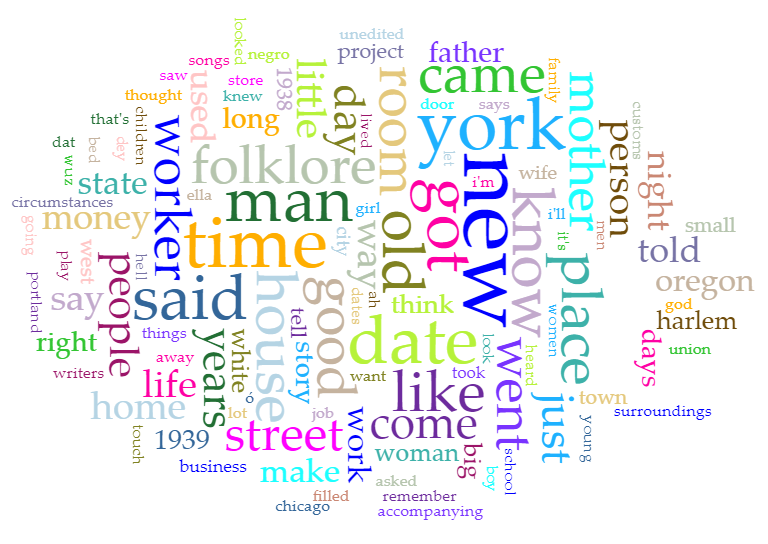
The original results of the Cirrus tool, showing the trending words from the entire corpus, reveal mostly generic words, most of them regarding the form the interviewers filled out. Further inspection was necessary in order to yield results relevant to my question regarding cultural identity.

Applying stopwords globally13 helped to narrow down the results by excluding terms and phrases that were being counted due to the formatting of the documents (i.e “http,” “Library of Congress,” “ww.loc.gov,” ” Ò ,” etc.).

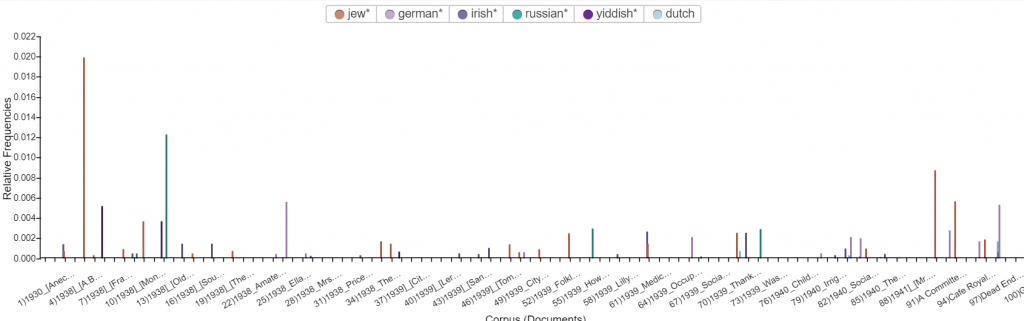
It became evident soon though that my idea of cultural folklore was not what was being expressed through the life histories interviews. Rather than old wives’ tales and bedtime stories reflecting ancestral heritage, I found everyday stories about America that just so happened to be told by subjects of several different ancestries. This revelation was reached by using the trends tool to search for several different ancestries (German, Dutch, Irish, Yiddish, Jewish, Russian). This made it easier to read a select number of documents closely and find that they were pretty typical accounts of day to day life at the time, lives that were simply American lives.

Searching explicitly for the ancestries I had seen through close reading revealed how often they were recorded. Despite my perception that there had been many interviews of subjects of Irish descent, there was a greater amount of interviewees of Jewish descent.

These revelations of how simplistically cultural identity was reflected in day to day life reflects Botkin’s motivations in assembling” ethnically diverse life histories… to foster the tolerance necessary for a democratic, pluralistic community.” 14 Overall, this analysis reveals that while lives are experienced differently based on ancestry and cultural uniquities, there was certainly a common experience for many in America at the time despite diversity, that hopefully was a unifying factor.

Susan A. Quall’s History

https://cdn.knightlab.com/libs/timeline3/latest/embed/index.html?source=1whL2vAVx9xz9tfPdgGcrZQz9S2poboWc6IxYtcaoKug&font=Default&lang=en&initial_zoom=2&height=650

The experiences of enslaved people in some ways feel truly conveyed through these interviews, while in some ways they feel somewhat hidden. I was surprised to hear in many of the interviews that the interviewees were asked to sing. This was surprising in that it does feel like preservation of a culture; many of these songs are considered slave songs and were an important part of that culture. On the other hand, it left seemingly more important testimony about experiences during enslavement left untold. Susan A Quall’s interview did not discuss much of her childhood when she was actually enslaved. She shared a powerful story about how her and her father ran from their home during a Yankee raid that gave a lot of insight to the situation enslaved people were trapped in during the Civil War, and also garnered sympathy simply through the power of storytelling. However, when asked what she did during the time she was enslaved, she left it at simply, “farm work and all that.” Her story does not quite tie in with the idea of the contented slave, in that she touched on some struggles, but one does get the sense from the tone in her voice that she was hesitant to discuss details regarding the hardships of enslavement. While she detailed a harrowing encounter in the escape of the Yankee raid, this event places no imposition on the slavery practitioners; only the damage that was caused from the Union Army that fought against the states to which those slavery practitioners belonged.

Hearing these interviews rather than reading them shed some light on the atmosphere of the interview; for example it was evident that Susan Quall was hesitant to share more than “farm work and all that” with the interviewers from the tone in her voice and pauses on her part surrounding these questions. Of course, the quality of the audio recordings makes it difficult to decipher what both the interviewers and interviewees are saying. This difficulty was reflected in the transcriber’s inability to discern some portions, where in the transcript these portions were replaced with [????].

While Susan Quall shared a few specific dates regarding the events in her life, it is unfortunate that either she did not know the dates of other events or was not asked by the interviewers when the event happened. Throughout listening to other interviews, there also seemed to be a common theme of the interviewees not knowing their own age, either because they didn’t remember or because their date of birth simply had never been shared with them. For some, this was because they did not know their family. This is a sad fact to realize, which is highlighted by the intersections with events of mainstream history. For some interviewees, connecting events in their life with the current events of the time were the only way they could give even a general idea of the time in which the event took place. Looking back at the interviews now, it is relatively easy to gain an understanding of the approximate time in which events in the interviewees personal histories may have occurred through comparison with events of mainstream history.

References

Library of Congress. American Life Histories Introduction. https://www.loc.gov/collections/federal-writers-project/articles-and-essays/introduction/

Tilton, L. Race and Place. http://crdh.rrchnm.org/essays/v02-14-race-and-place/

#2: The Stories Left Untold

I am left with many thoughts after Tony Guidone’s presentation in class, mainly reminding me of one of our tasks for the class, to see history “in it’s context.” His example when giving tips about keyword searches, for example, stressed the importance of considering history this way. He showed us how crucial it can be to consider even the language of the time period we are researching in order to get accurate results. He did this by showing us that when he searched “China,” he was met with few results, but was very successful in finding relevant hits when searching “East Indies” instead. This reminded me as well of Ian Milligan’s point in explaining the illusion we are faced with when using keyword searches; we are under the impression that we are conduction an all-inclusive, all-encompassing, omnipotent search when in reality we are missing every resource that hasn’t been digitized, and more importantly we are inadvertently missing large portions of every resource that hasn’t been digitized to 100% accuracy. This made me aware of how my keyword searching, both academically and recreationally, is affected by that very illusion.

As Milligan pointed out, “false positives,” or hits that aren’t actually relevant but carry the searched keyword, are easily dismissed, but “false positives,” or resources that are relevant but for one of many possible reasons was not retrieved by the keyword search, could have been exactly what we were looking for and may have made a significant difference on our results and conclusions. It is obvious how this dilemma could have disastrous effects in academia, but I can see how it affects even my recreational use of digital engagement. For example, when I search on Instagram the first name of someone I recently met, I could be met with countless results of people with similar names and all combinations of various last names. This bounty of results is almost deceptive though- it’s relatively easy for me to select any result seemingly close and examine further, and it’s quite simple to just dismiss this result and move onto the next if it isn’t who I’m looking for. However, if they are known on Instagram by a nickname I’m not aware of, or if their Instagram username doesn’t include their name at all, my search may harvest an optimistic number of results, but in actuality could not be retrieving that one single person I went through the process to search for. In this instance, keyword searching will have failed me entirely if I haven’t considered various alternative keywords to search.

            Tony Guidone showed us two examples in which digital media projects created the possibility for social change. Digital projects like Mason’s Legacies and the Enslaved Children of George Mason provide the necessary historical context behind primary resources that allow us to compare and contrast views that are controversial and problematic now, but at the time were widely accepted views. This can certainly alter our perspective on historical figures like George Mason, who is known for many accomplishments, but has and is himself a controversial past. Another example of a kind of digital project I’ve witnessed impact social change through providing historical context is a simple but meaningful one: a Twitter thread on the “Untold Stories of 9/11” from the perspectives of peoples of Middle Eastern descent living in the US who faced discrimination and mistreatment as a result of the generalized fear many Americans faced after September 11th. Projects like these enable us to reflect on history and see it from the perspective of individuals whose stories were overlooked at the time. They create social change by encouraging us to change our perspective now and put action into that cliché saying, “don’t let history repeat itself.”

            On that note, digital media has the potential to provide significant detail and context, such as videos and pictures from September 11th that visually and audially portray the emotion of the historical event. In comparison, Tony Guidone showed us the sad reality of digitizing older resources, through the use of German coins. Digital renderings of the coins would not portray the physical observation necessary to realize the different weight of the coins due to the changes in metal uses during the war. This leaves us without crucial historical context in knowing how the German people must have felt using recently minted coins at the time and noticing the change in weight. This dilemma forces us to rely on the publisher of the source to provide minute, explicit details about the original source. Otherwise, we are literally losing parts of history.

Milligan, I. (2013). Illusionary Order: Online Databases, Optical Character Recognition, and Canadian History, 1997–2010. The Canadian Historical Review 94(4), 540-569. University of Toronto Press. Retrieved September 16, 2019, from Project MUSE database.

Mason’s Legacies. Accessed September 9, 2019, from http://masonslegacies.org/

Enslaved Children of George Mason. Accessed September 9, 2019, from https://ecgm.omeka.net/

Blog Post #1

In this first week of class, I’ve come to realize how little I know about such an influential time period in American history. While I obviously learned briefly about the Great Depression in school, it never struck me as something that bears much relevance in American life today. Unbeknownst to me, a lot of the policies and programs that are commonplace in our government today were created as a result of and in response to the problems facing the nation during this time period. At the time, programs like the Social Security Act effectively mitigated poverty for the unemployed and those soon to retire. Today, it’s something somewhat expected and, despite some efforts to discontinue the program, has helped provide benefits to many who face similar problems to those experienced during a period of grievous financial suffering. I hope to learn more throughout the semester about the effects that major changes like this have on our nation today.

 I also hope to expand my understanding of the various methods by which digital history is shared and made accessible. It has been interesting to learn already how technology allows us to share information in so many ways other than just listing it textbook style. Already we have begun to analyze different types of projects that share digital history via media and video. This has shown me how useful digital history is already, and how easily we have come across it and not realized it, taking it for granted. Different digital projects allow the virtually endless possibilities of making information accessible at an unprecedented availability, while allowing the viewer much more ease and interaction than simply reading a book. I expect we will learn a lot more about how to utilize and evaluate these resources.

This process begins with analyzing “Apartheid Heritage,” a domain where one can view a searchable and categorized list of links to resources on the history of Apartheid in South Africa. The categories include, “Nelson Mandela,” “History Mandela Nelson,” “Nelson,” “Mandela,” and “History.” The project allows those looking for information on Apartheid History to easily find reliable resources on the topic. The creator has collected these sources, organized and categorized them, and made them both web accessible and searchable.  

Dana Cochran et al., “The Great Depression,” Matthew Downs, ed., in The American Yawp, eds. Joseph Locke and Ben Wright (Stanford, CA: Stanford University Press, 2018).

Apartheid Heritage. http://apartheidheritages.org/ Retrieved from URL. Accessed August 28th, 2019.

css.php