My historical inquiry centered on the lives of farmers during the late 1800s into the 1940s, and how they were effected by the Great Depression. Historically, and generally speaking, farmers or anyone making a living working with livestock and agriculture are not high ranking within the social hierarchy. It also a common preconception that farmers often lived simply and frugally, tied to the land around them. Given the well known economic consequences that the Great Depression had on people primarily within the middle class, I wanted to take a look at how farmers who usually lived in the lower middle class or lower class, would have been effected by the Great Depression, or if there was really a change in their lives at all. I was a little conflicted in my initial assumptions about the results I thought I would get- I partially thought that farmers would see little to no change in their lives, or would see some kind of relatively positive change, considering their products would be as plentiful as ever, but in much higher demand for a lower price.
When I uploaded the class corpus to Voyant (https://voyant-tools.org/?corpus=94a81c6e9324e1504a2f633ca4bf1c6f), I made a point of looking at the most prominent words in the initial word cloud it generated, and then weeding those words or terms out in order to dive a little deeper into the text. What I filtered has essentially nothing to do with the documents in the corpus, I simply removed terms such as “http”, “congress”, “www.loc.gov”, which tainted what I was really trying to get at. Following this step, the word cloud presented something much more useful. The “largest”, or most frequently used words were now “time”, “got”, “work”. Looking over at the TermsBerry visualization, I noticed that words like “it’s”, “that’s”, and “I’m” were also populating quite frequently, but not really displaying what I wanted to get at. So, I removed these, and was pleasantly surprised with what was then generated.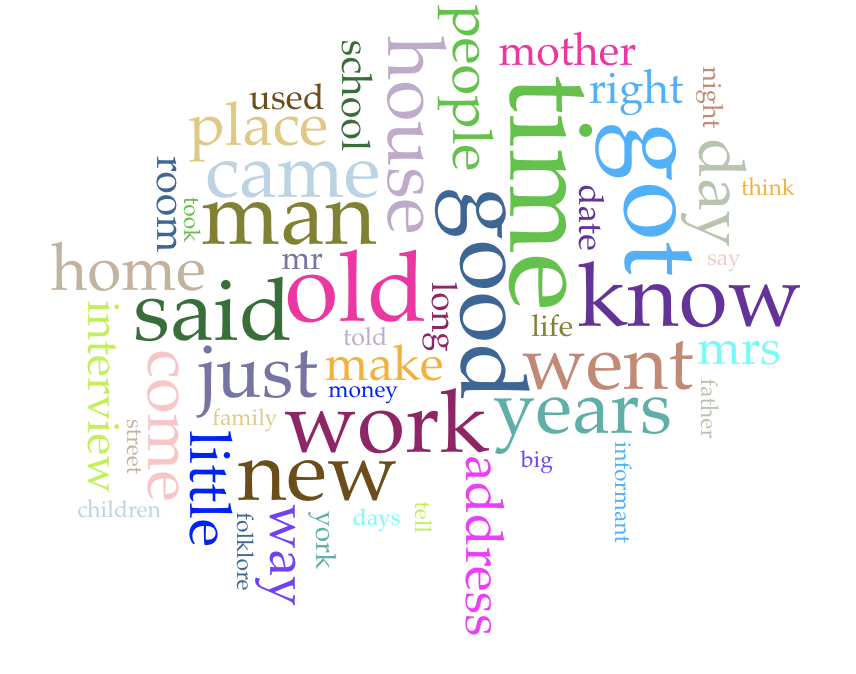
After observing the word cloud for a bit, I changed to visualization tool to link the words, and inserted some filters to see how the terms “horse”, “work”, and “money” factored in. 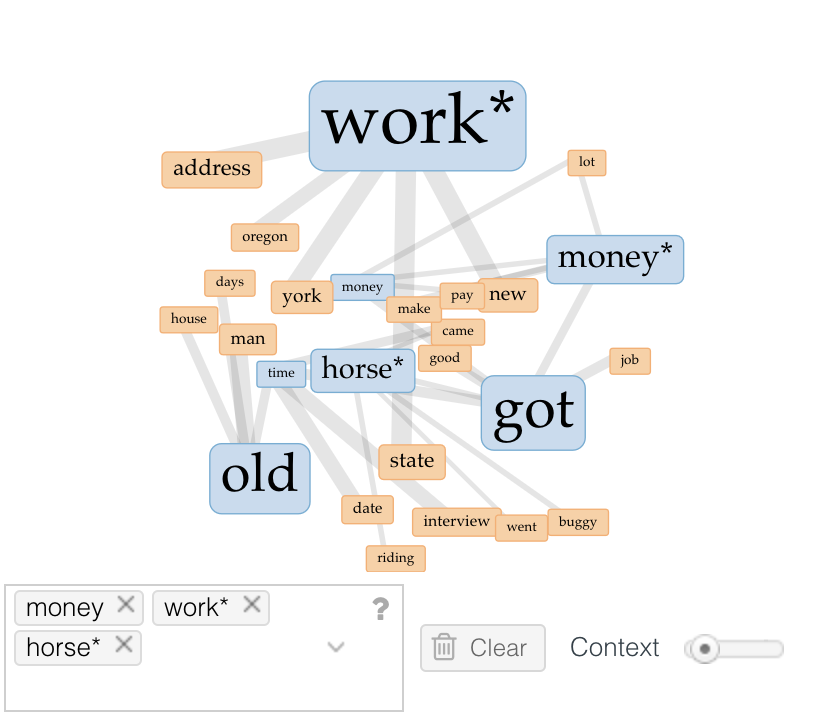
Seeing the way these words linked was actually really interesting, in a sense that more mundane, yet still positive terms stuck out. I was able to conclude at least that the lives of farmers during the Great Depression were not as heavily or negatively impacted as many others were, but I’m still not highly confident in this answer. I think that if I had dedicated more time, and made this question and analysis into a much bigger project, I would have been able to uncover a significantly bigger amount of information, and some outside research, and more close reading, would be needed. This being said, the tools provided by Voyant are very enlightening and useful.
