Final exhibit blog post

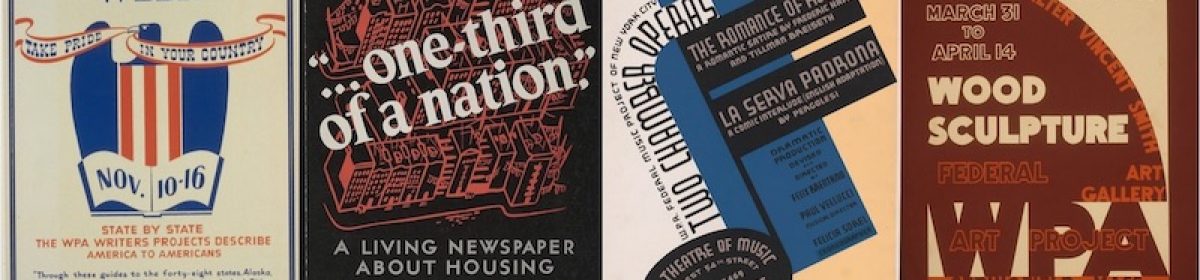
My exhibit goes over the social division in America prior to the Great Depression, and how those divisions were considerably withdrawn after the economy collapsed. I wanted to focus the exhibit on how the primary missions of FDR’s New Deal were to rebuild the American economy by creating new jobs for some 15 million unemployed. Through this, social classes were lessened, and minority groups were given more opportunities since discrimination for work could not be so strictly enforced 1. Some projects within the WPA, especially the Federal Writer’s Project and the Federal Theater Project also provided openings for women, and African Americans to be involved in the arts, and to give light to stories of theirs which had been largely repressed and undocumented before 2.

The 1930s were a period of massive change and rebuilding, and seeing American society emerge from the ruins of the Great Depression by bonding people together in their experiences and building a sense of community. Analyzing the events and projects of the 1930s is by no means an easy task, partially since few people are alive today with the memory to recount, and partially because there were so many things taking place at once. One of the many jobs of modern historians when looking back and getting a firm understanding of the 1930s, is to be able to somehow narrow down stories and experiences of the individuals who lived, breathed, and worked during the time. Thankfully, this job is made easier, and much more effective with the use of digital tools. For my exhibit, I chose a simpler approach when using my digital tools to analyze my questions. I built my exhibit heavily off of images and items that the reader could look at or listen to as they were reading simultaneously. I employed image annotations, in order to convey my thoughts on a specific piece and how it related to my question and statements by giving the image it’s own place within the exhibit. I also used the Soundcite tool to build in audio clips of an interview detailing one woman’s personal life history. I feel that this would have made the experience reading my exhibit feel more personal in bringing to life the way that many Americans lived during the early 1900s, especially in comparison to how life was during the Depression. Finally, I took a bit more of a symbolic and artistic approach to representing the conclusions I came to during my research. This was in the form of glitching an image. Being able to glitch an image allowed me to put a spin on what was represented and made it more effective when conveying the idea that many preexisting boundaries of societal discrimination were lessened during the Depression and recovery works.

From an anthropological standpoint as well, it was incredibly interesting to be able to dive into the lives of nearly forgotten people, and not just read interviews, but to hear their stories and see their art as well. One of the most interesting things about American culture and society is that it’s a vibrant blend of so many different cultural backgrounds, which are all somehow transcribed in people’s daily lives. Many people see American as a “melting pot” of cultures nowadays, and I think that was also a very important facet of American culture in the 1930s as well. One of the most invaluable things about the work the WPA did, and the collections of work and projects that are held in the Library of Congress and in the National Archives, is that we are now given the lives and stories and experiences of people who would never have been documented otherwise. That is a massively important contribution to our historical understanding of the American culture and allows us to perhaps understand deeper historical connections between history and present day.            

I will openly admit that coming into this course, I knew virtually nothing about digital humanities or the ethics of research in the digital age. I also knew possibly even less about the New Deal and the 1930s, but several of the articles we read in class made me much more aware of not just the happenings of the 1930s, but the way historians go about their research, and the importance of ethics in the digital age, and verifying the validity of some information 3. Being able to influence my research in the future, and make it more accessible to public consumption, and making it easier to understand is also a significant portion of what I learned in this course. While not employed in my exhibit per se, the Voyant text analysis tools I think will be incredibly helpful in deciphering overarching themes of texts, especially since we are moving towards an age where virtually nothing will be on paper anymore. Digital humanities is an ever-evolving field, and while the history we study stays the same, the ways in which we analyze it are continually changing.

References:

“About This Collection:  Born in Slavery: Slave Narratives from the Federal Writers’ Project, 1936-1938:  Digital Collections:  Library of Congress.” The Library of Congress. Accessed December 13, 2019. https://www.loc.gov/collections/slave-narratives-from-the-federal-writers-project-1936-to-1938/about-this-collection/.

Appelbaum, Yoni. “How the Professor Who Fooled Wikipedia Got Caught by Reddit.” The Atlantic. Atlantic Media Company, May 15, 2012. https://www.theatlantic.com/technology/archive/2012/05/how-the-professor-who-fooled-wikipedia-got-caught-by-reddit/257134/.

“Working Together.” Living New Deal. Accessed December 13, 2019. https://livingnewdeal.org/working-together/.

“23. The Great Depression.” THE AMERICAN YAWP, June 7, 2013. http://www.americanyawp.com/text/23-the-great-depression/.
The lonesome cowboy of the dustbowl

Every form of art, communication, and documentation has its limits. There are benefits of having a photograph or a in situ document of an event always offers information that is arguably the most important to many historians. However, in the case of more recent history, sources are much more variable than the odd document. Viable sources within the last century or so now include things like more abundant personalized statements, letters, biographies, and video, audio, and radio recordings. Audio recordings in particular offer a special kind of insight into the past. Providing all the necessary surroundings to recreate the same experience, the lack of visual representation allows one to create an environment from their own knowledge and imagination, while maintaining the real presence of the event.

One of the most special, and valuable places that I think historic audio sources come into play, is within the documentation of otherwise all but forgotten people. Some of the most important, and most populous peoples in the early 1900s, were farmers, agricultural workers, and cowboys. In a 1940 recording, called “Untitled cowboy song”, the performer recounts the journey of finding work, in order to gain the hand of a woman in marriage. While it’s unclear if the song documented the performer’s personal story, or if it was simply a draw upon a common cowboy experience, the recording is transporting.

The background of the audio is detailed with the sounds and voices surrounding the performer. The beginnings of the performance, the people surrounding the singer and the person recording the clip, detail normal, daily life. The beauty in having such clips and audio sources available for historic purposes, is that we are given every aspect of the time from which it came. As a historian, being able to immerse yourself in the sounds of the time, and the audible documentation of an event, you’re able to grasp the tone, the feeling, and the real emotion of the event. Given the aura of the 1930s, and the WPA and Federal One recovery projects, audio sources are so very important in being able to bring that time even more alive, and give more meaning to it’s preservation.

Citations:

“Untitled cowboy song”, Voices from the Dust Bowl: The Charles L. Todd and Robert Sonkin Migrant Worker Collection, 1940 to 1941 (533), Library of Congress, https://www.loc.gov/item/toddbib000080/.

Lives of Farmers prior to and at the tail end of the Great Depression.

My historical inquiry centered on the lives of farmers during the late 1800s into the 1940s, and how they were effected by the Great Depression. Historically, and generally speaking, farmers or anyone making a living working with livestock and agriculture are not high ranking within the social hierarchy. It also a common preconception that farmers often lived simply and frugally, tied to the land around them. Given the well known economic consequences that the Great Depression had on people primarily within the middle class, I wanted to take a look at how farmers who usually lived in the lower middle class or lower class, would have been effected by the Great Depression, or if there was really a change in their lives at all. I was a little conflicted in my initial assumptions about the results I thought I would get- I partially thought that farmers would see little to no change in their lives, or would see some kind of relatively positive change, considering their products would be as plentiful as ever, but in much higher demand for a lower price.

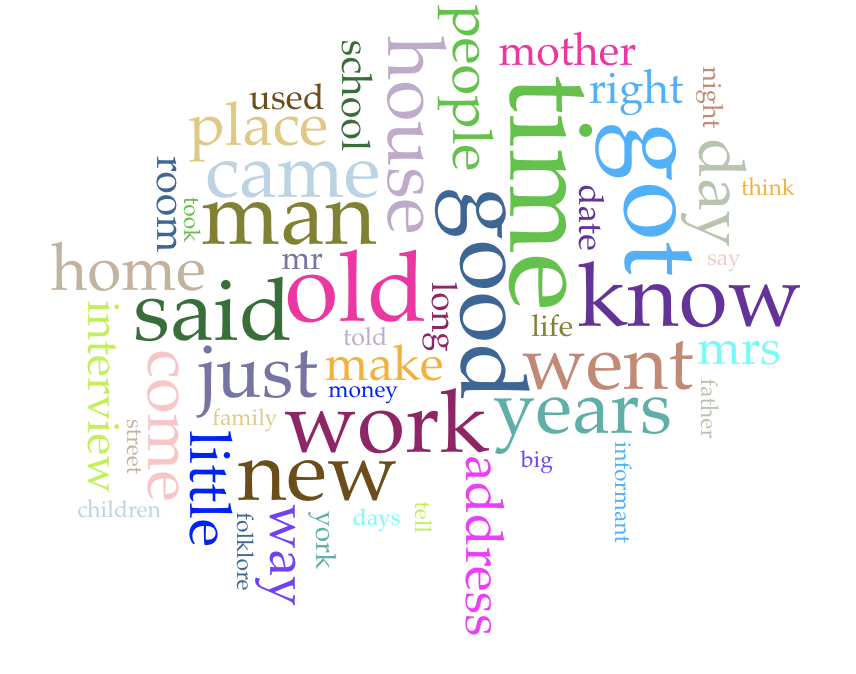
When I uploaded the class corpus to Voyant (https://voyant-tools.org/?corpus=94a81c6e9324e1504a2f633ca4bf1c6f), I made a point of looking at the most prominent words in the initial word cloud it generated, and then weeding those words or terms out in order to dive a little deeper into the text. What I filtered has essentially nothing to do with the documents in the corpus, I simply removed terms such as “http”, “congress”, “www.loc.gov”, which tainted what I was really trying to get at. Following this step, the word cloud presented something much more useful. The “largest”, or most frequently used words were now “time”, “got”, “work”. Looking over at the TermsBerry visualization, I noticed that words like “it’s”, “that’s”, and “I’m” were also populating quite frequently, but not really displaying what I wanted to get at. So, I removed these, and was pleasantly surprised with what was then generated.

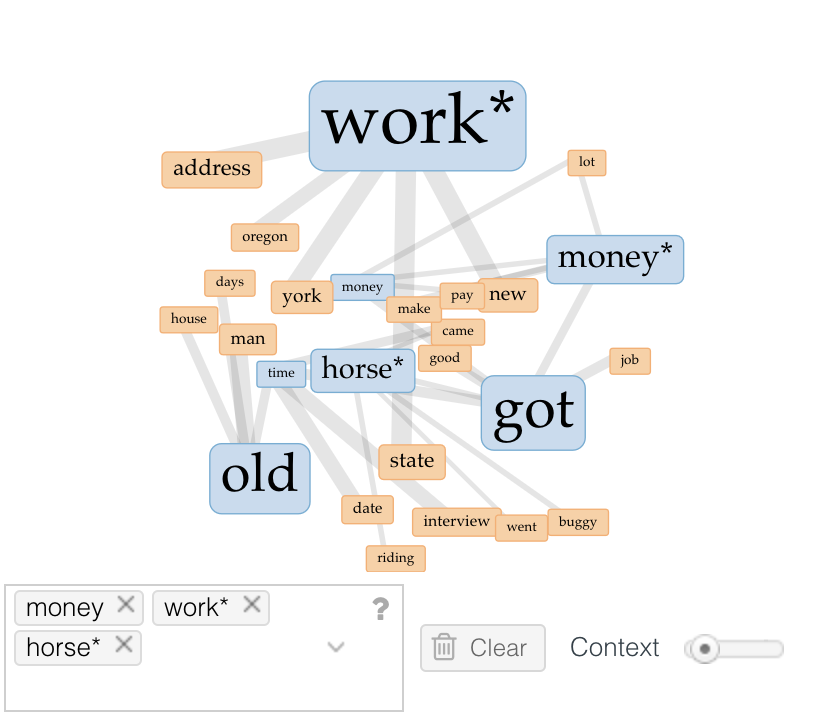
After observing the word cloud for a bit, I changed to visualization tool to link the words, and inserted some filters to see how the terms “horse”, “work”,  and “money” factored in.

Seeing the way these words linked was actually really interesting, in a sense that more mundane, yet still positive terms stuck out. I was able to conclude at least that the lives of farmers during the Great Depression were not as heavily or negatively impacted as many others were, but I’m still not highly confident in this answer. I think that if I had dedicated more time, and made this question and analysis into a much bigger project, I would have been able to uncover a significantly bigger amount of information, and some outside research, and more close reading, would be needed. This being said, the tools provided by Voyant are very enlightening and useful.

A recounting of the incredible life of Ms. Celia Black.

Mr. Ernie E. Sparks interviewed former slave, Ms. Celia Black, in the presence of her daughters, in October of 1974. Born in September of 1859, Celia was 115 years old at the time of the interview- an astonishing fact itself. The way that Ms. Celia Black narrates her experience growing up in an enslaved family seems surprisingly less harsh that I expected at first. She begins her narration with describing how wonderful her birthday was, and recounts the family she was raised with- Mr. and Mrs. Clay, assumed to be white slave owners. Celia describes being “raised in the fields” picking cotton, but doesn’t elaborate much further on the experience itself, other than noting it’s importance in her early life.

My first timeline layer identifies some of the events from her childhood that Ms. Black noted, and while no specific dates other than her birthday were given, it wasn’t too difficult to estimate the rest. Ms. Black’s recollection of her childhood was astonishing, and being able to pull some of these events onto a digital timeline made her experiences feel all the more real. Adding the second layer of other significant events that occurred during Ms. Black’s lifetime was surreal to look at- having known she lived from the time of Lincoln’s presidency, to the resignation of Richard Nixon, and realizing she lived through almost off of the significant conflicts in American history- from the beginning of the Civil War to the end of the Vietnam War. Bringing the two timeline layers together into one seamless product made me realize how valuable personal accounts can be. History so often looks primarily at the larger picture, but having personal accounts, oral or written brings back the personal, real aspect of history- it helps us reaffirm that everything’s that’s happened in history had a real impact on someone’s life.

The most constricting part of the interview was simply the lack of specific dates, but given the age Ms. Black was when the interview took place, the fact that she was able to recall events from her childhood over a century prior makes the interview an invaluable resource. Perhaps it was the recording, or perhaps it was Ms. Black’s age which made a transcript read-along necessary to clarify everything that she was recounting. Even though the transcript was incredibly helpful in accurate understanding, having the audio to listen to brought together two histories would rarely intersect. Listening to the speech patterns of Ms. Black as opposed to those of her daughters was a beautiful comparison in the way that the American dialect has changed over the centuries, regardless of race or geographic location.

Even though the Slave Narratives Project and these series of interviews was begun and completed for the most part in the 1930s and early 1940s, the fact that some interviews were still taking place much later in 1974 is again a testament to the importance of the root of the project- bringing light to a previously untold part of history, and allowing voices that had once been trampled and silences the ability to speak their truths.

Bibliography

“About This Collection  :  Born in Slavery: Slave Narratives from the Federal Writers’ Project, 1936-1938  :  Digital Collections  :  Library of Congress.” The Library of Congress. Accessed October 25, 2019. https://www.loc.gov/collections/slave-narratives-from-the-federal-writers-project-1936-to-1938/about-this-collection/.


“Interview with Celia Black, Tyler, Texas, October 11, 1974.” The Library of Congress, 1974. https://www.loc.gov/item/afc1975009_afs17476/.

Blog Post 4

An algorithm, in essence, is a recipe for an outcome so desired by the person who created the recipe (Cathy O’Neil). Thus, every algorithm, no matter its nature, is subjective to the desires and goals of its creator. Algorithmic criticism has everything to do with morality, and the fight especially within research to make algorithms that will actually draw out a more focused answer to the questions posed, rather than what that most common answer is. Safiya Noble proposes the notion in Algorithms of Oppression, that it is now critical to “think about whether it truly makes sense to outsource all of our knowledge needs to commercial search engines…in lieu of libraries, librarians, teachers, researchers, and other knowledge keepers and resources.” (pg 16). This concept resonates strongly with not just drawing out the more specific knowledge we ask for, rather than the competitive answer that the engine’s algorithm drives to the top, but as well as with the ethics with which this knowledge is derived and shared. The idea of algorithmic criticism is external criticism of the results of what is output by an algorithm, is in its essence, a balance of differing opinions. Given the nature of historical research being one driven by the need to discover the truth (or the closest version of the truth to which we may get), and the biases inflicted upon these truths by the sources and the researchers themselves, it is difficult to truly change the consumption of historic media. It is still important to focus on the ethics and morality which we as historians, employ when we go looking for answers.

Noble’s chapter focusing on the re-imposition of sexism and racism in on the worlds most popular commercial search engine, highlights the longstanding strength of these ideologies, and how their being reinforced by popular majorities, against smaller parties who seek to fight it. The Long Civil Rights Movement, as well as the continuing remnants of the suffragette fights brought a strong, but somehow subtle front to the 1930s- the Civil Rights movement as we knew it to be in the 1960s was finally starting to gain speed in the 1930s, especially with opportunities for work and influence beginning to open more and more with the Federal Theater Project, eventually paving the way for such a wide variety of influential music we hear today. Women continued to fight for their rights, continuing the struggle which had initially beginning in the ‘20s, and still carries a lasting impact today, especially with jobs which had opened during the New Deal and set in place the norm of women being employed in similar spaces as men, such as is seen today. The pressures of racism and sexism however, have still not relented nearly as much as we think, and the output of search engine algorithms in present day, as noted especially in the beginning of Noble’s article, only fuel these pressing notions. Removing such significance from these digital algorithms and search engines, perhaps not so much as within popular and commercial culture, but at least in modes of historical research, can be fueled in some ways by moving back to non-digital sources.

Bibliography:

Noble, Safiya. Algorithms of Oppression: How Search Engines Reinforce Racism . New York, NY: New York University Press, 2018.


O’Neil, Cathy. “The Truth About Algorithms: Cathy O’Neil.” Vimeo, October 17, 2018. https://vimeo.com/295525907.


Ramsay, Stephen. “Algorithmic Criticism.” A Companion to Digital Literary Studies, 2008. http://www.digitalhumanities.org/companion/view?docId=blackwell/9781405148641/9781405148641.xml&chunk.id=ss1-6-7.

Extra Credit Assignment 1

One of the most common human phenomena is the fact that we are social creatures, and the idea that sociality is often a diversion or an escape from reality, is not an idea that has been shy to many cultures. Undoubtedly, using movies, music, and the arts in all it’s various forms has been one of the most effective refuges in American history. The art of metaphorical escapism in the Great Depression 1930’s was largely the most important that art had ever been to that date.  New Deal programs for the arts were some of the most morally-geared and uplifting facets implemented, and “Never before or since have the arts served such a much-needed social function, not even when helping to mobilize the nation in times of war” (Dickstein, 2009). While nothing quite as devastating has occurred in U.S. economic history since the Great Depression, the same can somewhat be said for the implementation and effect of the arts in the same circumstances. The use of the arts in the 1930s paralleled to the 2008 use of movies as an escapist venture is rather similar, in both the federal employment as an economic tactic to boost jobs and, and method to provide the American public with the brief positive environment they so desperately needed. The kinds of arts, particularly movies being produced to serve as a diversion, didn’t begin to noticeably shift until after the 2008 recession. Many movies highlighted during the 1930’s depression highlighted dance, song, and romantic themes, particularly works like It Happened One Night, Bringing Up Baby, Top Hat which emphasized idealistic stories. A parallel is seen in the development of action-driven movies which were released in the midst of the 2008 crisis, such as the beginning of the Iron Man series, in many of which we see a trend of hyper-fictionalized storytelling. The political and economic expose theme of movies had long since been developing since around the time of the Great Depression, with gems such as Ducksoup, and Mr. Smith Goes to Washington, but the trend of the arts becoming a platform for real discussion on the political movements of the time did not begin to take off until very recently, with some of the biggest hits being born not long after the 2008 recession. The ability of the arts to be a multifunctional space for both an escape from the pains of reality, to a forum to bring no-frills issues to light was a door that was cracked open, in a slight but important capacity during the New Deal arts projects years prior.

Bibliography

“Facing the Music.” The American Scholar, September 1, 2009. https://theamericanscholar.org/facing-the-music/#.XZ1kaOdKhZ2.


Guerrasio, Jason. “The 22 Best Political Movies Ever, Ranked.” Business Insider. Business Insider, April 4, 2016. https://www.businessinsider.com/22-best-political-movies-ranked-2016-3#13-frostnixon-2008-10.

Skill Assignment 3!

The image that I selected was a photo of a woman hammering a nail into a board, in a sea of spectators, during a nail driving competition in 1939 (http://jessicadoeshistory.com/cnd/admin/items/show/id/164). The first thing about the photo that caught my eye, was that the main focus of the image was a woman holding a hammer, surrounded primarily by other women. It struck me in particular since hard labor tasks that would involve tools (i.e. a hammer) would have been largely dominated by men during the 1930s. Reading more of the details concerning the photo, I was really intrigued to learn that it was documentation of a nail driving competition, which is essentially a contest to determine who is able to hammer a nail into a board as quickly and as completely as possible 4 5.  The image was documented at a workers camp in Arvin, California. Work camps were meant to be temporary housing for people recruited to work on New Deal projects, so the idea of having fun events and competitions (such as this documented in the photo) in a place that may not have been the happiest environment, places an importance on the efforts undertaken, if not by the New Deal programs then by the workers themselves, to promote morale and positivity as much as they could. This image really drove me to the question, how did the New Deal really affect people’s morale and outlook on the Great Depression? Were there any goals in the New Deal to promotive or help develop a positive mentality going forward, or was this a product of the people themselves?

            There’s always a difference in analyzing an image that’s in its original tangible state, versus analyzing one that’s been digitized, but there’s definitely something to be gained through digital analysis by being able to focus in on certain areas of the image, and being able to analyze how all the smaller parts of the photo form the whole story. Being able to go farther into a detailed look of the expressions, dress, stance, and position of everyone in the photo was a really interesting way to analyze this photo, and it allowed me to get a better feel for the overall emotion of the group in the photo. While having the physical photo is always beneficial, special attention to very specific detail can be done much more easily, or much more efficiently with a digital image. Drawing off of everyone’s expression, man or woman, competitor or spectator, made the image come more alive, and brought a very positive feel to the aura of the image, and I concluded that while the economic barrier was somewhat broken by the federal New Deal, overcoming the barrier of the actual feeling of depression and hopelessness that had been spread by the Great Depression economic crash, was itself very much a product of the people. My exhibit hosts the original digital image, and a glitched version to pair, http://jessicadoeshistory.com/cnd/exhibits/show/camparvinactivity .

Bibliography:

“Ladies Nail Driving Contest.” Grantoberfest. Accessed October 8, 2019. http://grantoberfest.com/ladies-nail-driving-contest/.


“Nail Driving Competition.” York Builders Association. Accessed October 8, 2019. https://yorkbuilders.com/cool_timeline/nail-driving-competition/.


Hemmig, Robert. “Woman Hammering a Nail into a Board with Spectators Looking On.” The Library of Congress. Accessed October 8, 2019. https://www.loc.gov/resource/afc1985001.afc1985001_p017/?r=-0.428,0.145,1.951,0.945,0.

Google- How It Helps Us and How It Hurts us

Modern-age digital searching has certainly revolutionized the way that we are able to gather and process information, largely by making it easier and quicker to access what we are looking for. The formation of databases and keyword/text searching, at least in my personal experience, has made accessing harder-to-find information much easier as well. Within anthropology, certain areas of research or kinds of data can be extremely niched, and text searching within databases has made this less commonly requested information much more readily available. On a non-academic basis, keyword searching has also become almost a secondary action in daily life- going to google a single word or phrase in order to quickly gather some answer to any range of questions.

            I also believe that, with the way which data is digitized, and information is thus much more accessible for consumption by a much broader and varied audience, many things about digital media could lend a hand in social shifts, especially within ways that more trivial and rudimentary information is consumed by the general public, and how specific data can be accessed by people with specific interest. The sharing of this data will also, no doubt, continue to make social changes, primarily in increasing the equality within which information is gathered, and broadening the opportunity for education across the world, given the (relative) ease of access to internet and these digital libraries.

            Based on the popularity of digital media as well, I think that not only are the digital projects and exhibits becoming more popular, but much more important and impactful than they were 10 years ago. With the rise in popularity of technology, and the cultural influence that it’s had so far, a lot goes to show the impact that this has had on society. If a question is asked, most commonly the internet, and thus the increasing variety of digital libraries and databased, are there to answer this question. In this way, digital projects and exhibits of every kind gain a much higher viewing rate than the same answer or project would be if displayed in physical text format. Initially this was because the internet was easier and quicker to access than the physical material information itself, but the rise in the use of digital media has shifted us toward a major social change, in which there is much less desire or need for physical manifestations of information.

            In this way, I think we lose something very meaningful in return for ease and speed in gaining the answers we need and so desire from a database. Information born digital has many perks and quailities which make it a more desirable format, but digital information loses context, loses the meaning with which many older texts were composed, and loses the soul of the information itself- in turn with a risk of data being largely misconstrued.

            Digital media has certainly changed the academia and other uses for good, but there is still something incredibly valuable about finding the physical information itself.

Bibliography

Guidone, Tony. Sept 9, 2019. Guest Lecture on Digital Databases, Keyword Searching, and Information Accessibility.

Blog Post #1

Given the nature of research in the present day an age, and the nature of my undergraduate study in both Anthropology and History, I am by no means unfamiliar with digital sources, databases, and forms of digitized history. However, my deeper knowledge of digital history is pretty limited outside of finding and accessing different resources, and I’m excited to learn more in-depth about the creation and functionality of these digital sources, and again about historical project born digitally. I also am realizing that I’m not nearly as informed on the history of what is often considered “technology”, and I think it would be useful to learn more about this as well.


“Dash Amerikan” is an exhibit about the infamous Kardashian clan researched, compiled, and presented by authors Jordan Buysse, Alicia Caticha, Alyssa Collins, Justin Greenlee, Sarah Mceleney, and Joseph Thompson. The premise of the project is quite interesting- to dig deeper than the superficial nature and presentation of the Kardashians themselves, and to investigate the deeper impact of the family on the modern social climate, in terms of race, gender, family relations, ethnicity, sexuality, and social class, to name just a few impacts. The authors began by scanning and compiling a series of data from tweets, to elements and actions portrayed within the TV show, to the products which each individual Kardashian of Jenner has created. Other data used to support the project also began to range to studies conducted on the ‘consumer appeal of personalities, characters, licensed properties, programs and brands’, i.e. how the reach of the Kardashians has expanded from a soap-opera-like reality show, to an economic and media-based empire which has come to gain global attention and fame.
The degree to which this project reaches historical importance is rather small, given the presently evolving nature of the family and their relatively recent impact on modern culture and society, but would likely become more relevant within a historical lens (obviously) as time progresses. The tools and techniques which were employed to gather, analyze, and present data for the project though are well implemented and highly relevant to this topic of digital history. Data collected for this project were organized into categories based on their cultural relevance and which facet of influence they fell under (i.e. feminism, race, sexuality), and for the purpose of understanding the project’s purpose, were presented in a large body of text. The presentation of the project is what I think could be improved the most. While it’s not ineffective, the Kardashians are known for being a very animated group, and the digital project might be enhanced a bit with inclusions of the tweets they used as data, or images of the Kardashian clan outside of the site header, and the occasional graphic used to separate sections of the article.

Works Cited:

http://dashamerikan.scholarslab.org/

css.php