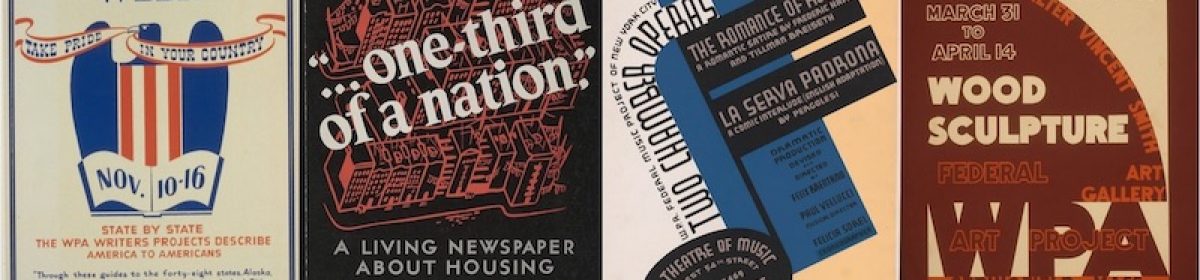
My exhibit goes over the social division in America prior to the Great Depression, and how those divisions were considerably withdrawn after the economy collapsed. I wanted to focus the exhibit on how the primary missions of FDR’s New Deal were to rebuild the American economy by creating new jobs for some 15 million unemployed. Through this, social classes were lessened, and minority groups were given more opportunities since discrimination for work could not be so strictly enforced 1. Some projects within the WPA, especially the Federal Writer’s Project and the Federal Theater Project also provided openings for women, and African Americans to be involved in the arts, and to give light to stories of theirs which had been largely repressed and undocumented before 2.
The 1930s were a period of massive change and rebuilding, and seeing American society emerge from the ruins of the Great Depression by bonding people together in their experiences and building a sense of community. Analyzing the events and projects of the 1930s is by no means an easy task, partially since few people are alive today with the memory to recount, and partially because there were so many things taking place at once. One of the many jobs of modern historians when looking back and getting a firm understanding of the 1930s, is to be able to somehow narrow down stories and experiences of the individuals who lived, breathed, and worked during the time. Thankfully, this job is made easier, and much more effective with the use of digital tools. For my exhibit, I chose a simpler approach when using my digital tools to analyze my questions. I built my exhibit heavily off of images and items that the reader could look at or listen to as they were reading simultaneously. I employed image annotations, in order to convey my thoughts on a specific piece and how it related to my question and statements by giving the image it’s own place within the exhibit. I also used the Soundcite tool to build in audio clips of an interview detailing one woman’s personal life history. I feel that this would have made the experience reading my exhibit feel more personal in bringing to life the way that many Americans lived during the early 1900s, especially in comparison to how life was during the Depression. Finally, I took a bit more of a symbolic and artistic approach to representing the conclusions I came to during my research. This was in the form of glitching an image. Being able to glitch an image allowed me to put a spin on what was represented and made it more effective when conveying the idea that many preexisting boundaries of societal discrimination were lessened during the Depression and recovery works.
From an anthropological standpoint as well, it was incredibly interesting to be able to dive into the lives of nearly forgotten people, and not just read interviews, but to hear their stories and see their art as well. One of the most interesting things about American culture and society is that it’s a vibrant blend of so many different cultural backgrounds, which are all somehow transcribed in people’s daily lives. Many people see American as a “melting pot” of cultures nowadays, and I think that was also a very important facet of American culture in the 1930s as well. One of the most invaluable things about the work the WPA did, and the collections of work and projects that are held in the Library of Congress and in the National Archives, is that we are now given the lives and stories and experiences of people who would never have been documented otherwise. That is a massively important contribution to our historical understanding of the American culture and allows us to perhaps understand deeper historical connections between history and present day.
I will openly admit that coming into this course, I knew virtually nothing about digital humanities or the ethics of research in the digital age. I also knew possibly even less about the New Deal and the 1930s, but several of the articles we read in class made me much more aware of not just the happenings of the 1930s, but the way historians go about their research, and the importance of ethics in the digital age, and verifying the validity of some information 3. Being able to influence my research in the future, and make it more accessible to public consumption, and making it easier to understand is also a significant portion of what I learned in this course. While not employed in my exhibit per se, the Voyant text analysis tools I think will be incredibly helpful in deciphering overarching themes of texts, especially since we are moving towards an age where virtually nothing will be on paper anymore. Digital humanities is an ever-evolving field, and while the history we study stays the same, the ways in which we analyze it are continually changing.
References:
“About This Collection: Born in Slavery: Slave Narratives from the Federal Writers’ Project, 1936-1938: Digital Collections: Library of Congress.” The Library of Congress. Accessed December 13, 2019. https://www.loc.gov/collections/slave-narratives-from-the-federal-writers-project-1936-to-1938/about-this-collection/.
Appelbaum, Yoni. “How the Professor Who Fooled Wikipedia Got Caught by Reddit.” The Atlantic. Atlantic Media Company, May 15, 2012. https://www.theatlantic.com/technology/archive/2012/05/how-the-professor-who-fooled-wikipedia-got-caught-by-reddit/257134/.
“Working Together.” Living New Deal. Accessed December 13, 2019. https://livingnewdeal.org/working-together/.
“23. The Great Depression.” THE AMERICAN YAWP, June 7, 2013. http://www.americanyawp.com/text/23-the-great-depression/.
- https://livingnewdeal.org/working-together/
- https://www.loc.gov/collections/slave-narratives-from-the-federal-writers-project-1936-to-1938/about-this-collection/
- https://www.theatlantic.com/technology/archive/2012/05/how-the-professor-who-fooled-wikipedia-got-caught-by-reddit/257134/
