Distant Reading

The American Life Histories collection, created under the Federal Writer’s Project, serves as a broad corpus of information and firsthand accounts from a time that seems so incredibly different from now. Many questions and ideas can be created when examining the life histories included in the American Life Histories collection.

            While my initial question of “How did the New Deal era effect dating and social customs?” worked for my own ten document corpus that I assembled, it didn’t work as well with the classroom one. I made folders on my laptop for four different years that many of the documents were created in and then ultimately decided on the documents created in the year 1938. From there I input that into Voyant and noticed the major words in the word cloud were: 1- the website for the library of congress and 2- resources. Both which I new weren’t words actually important to the content of the document, so I added them to the list of words to be ignored. Upon analyzing the generated word cloud from the 1938 documents, I noticed there was a sort of family and home life theme.
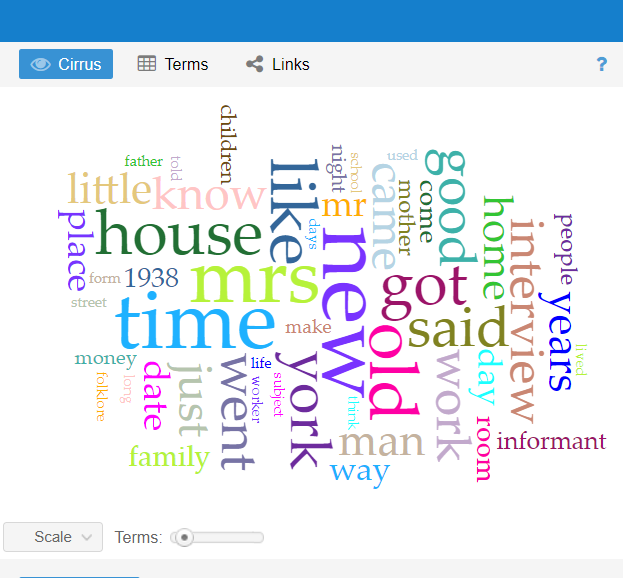
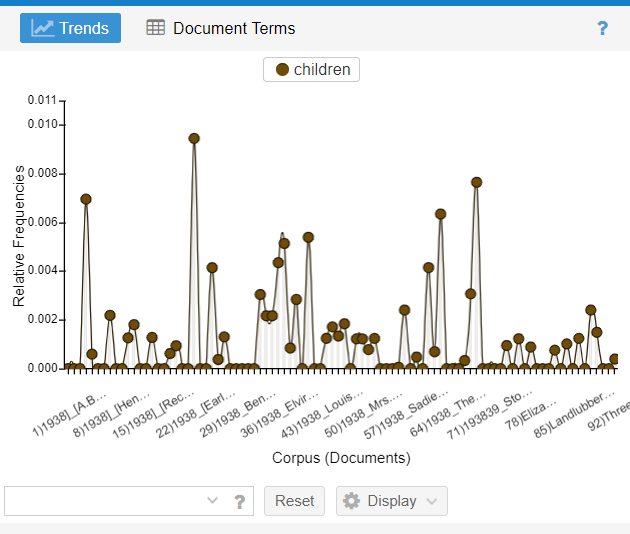
Words such as house, room, Mrs., and family appeared multiple times, thus I thought it would be better to shift my focus to that and changed my historical question to “How did the Great Depression era effect family and home life?”. While classroom lectures had briefly touched on family life during the Dust Bowl and we read about how said families had to move to different places with kids in wagons, as mentioned in 1, there wasn’t an entire lesson focused on how family life changed because of the social and economic factors of the time. In the American Yawp – Chapter V. 2, there is mention of a particular woman’s letter to the first lady about her fear and sadness of bringing a baby into the world they were in at the time (the time of the Great Depression). Both of these came to mind when I was doing a close reading of the document titled Early Railroad Travel, where a father described how he moved his kids from Kansas to Oregon. By doing a closer reading on one of the included documents in the corpus, I was able to conclude that one way families were effected was by the fact that many had to move around for work opportunities. In this way, Voyant was extremely helpful because I was able to pick the specific document because I noticed it was the one that used the word “children” the most.
In conclusion, there’s obviously more research and evaluation that can be done using voyant (and in general) of the corpus. Voyant proved itself to be extremely useful in both a distant and close reading sense. By using Voyant, I was able to draw certain conclusions regarding my own historical question, and I will be utilizing this resource for future projects.
Aviation & the Great Depression

On our first lecture day, Professor Dauterive informed our class that we would be given the freedom to study whatever subject interested us, so long as it was done within the context of the 1930s and the Great Depression. Upon hearing this news, my mind immediately began to race to find a subject that fascinated me, and I was quick to discover it – aviation.

For this assignment, I decided to explore the world of aviation during the Great Depression and ask myself the following questions: What impediments were there to pilots during this time period, and how did pilots manage to find employment in the face of these obstacles?

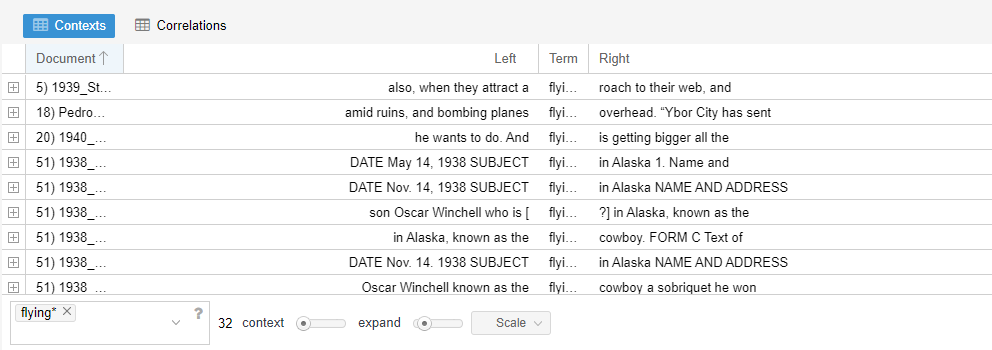
To answer these questions, I began by first deciding upon my corpus. Because the subject of aviation is relatively niche, I thought it best to employ all of the documents uploaded by our class and available in our course’s Dropbox. Following this, I began to search for words related to aviation such as flying and pilot and reading excerpts from the texts in which they were found.

In her essay, Race and Place: Dialect and the Construction of Southern Identity in the Ex-Slave Narratives, Lauren Tilton used topic modeling – the categorizing of words based on their frequent associations with one another – to begin asking questions about common topics within the Ex-Slave Narratives.3 Because I did not have access to a topic modeling program, I had to do categorize my subjects manually.

After reading reading through a number of these excerpts, I was able to determine a number of terms that were commonly associated with aviation during this time period such as teaching, stunt, passenger, and mail. After obtaining these key words, I inserted them into a table to see if I had missed any texts that relate to careers in aviation and its problems.

Having finished this process, I was able to come to several conclusions concerning my initial research questions. To answer my first question, I found that maintaining an airplane for personal use was quite an expensive undertaking, and with the start of the Great Depression, people had less time to fly as a recreation. Additionally, the construction of airports was halted by many communities who feared planes that planes would malfunction and crash into their homes and businesses.

However, there were some occupations which pilots could hold during this period. The most common were serving as a mail carriers, passenger pilots, and flight instructors. The least common job that a pilot held was as a stuntman.

Although this project required a number of days to complete, the task would have been nearly impossible without Voyant Tools. Because this application allowed me to search for key words across my entire corpus and read closely texts relating to my subject of interest, I was able to not only learn about a subject that interested me but do it within a reasonable time frame.

Gang Life of the 1930s

Underground markets and economies have interested me throughout my academic career at George Mason University. I believe that gangs and other black markets have a lot to offer when it comes to a society’s norms and cultures. Gangs represent the misfits of society and specifically during the 1930s people have chosen the gang life due to the economic circumstances created by the Great Depression.

I chose these ten sources from the Library of Congress under the tabs of gang and crime. I chose these two tabs because I felt that they best represented my original historical question: What was gang life like during the 1930s? I found that a lot of the stories were just that, stories. It was difficult to find original transcripts from members of the gangs but a combination of folklore as well as first hand accounts provide an image of how gangs interacted with society.

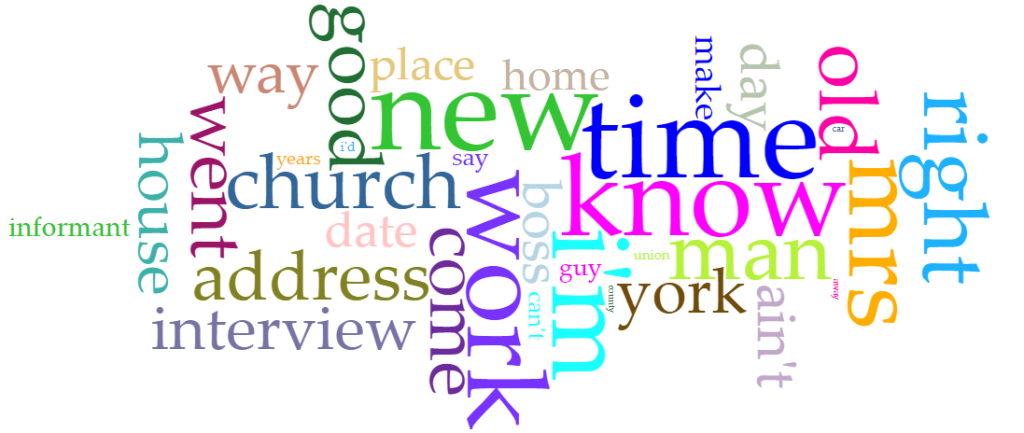
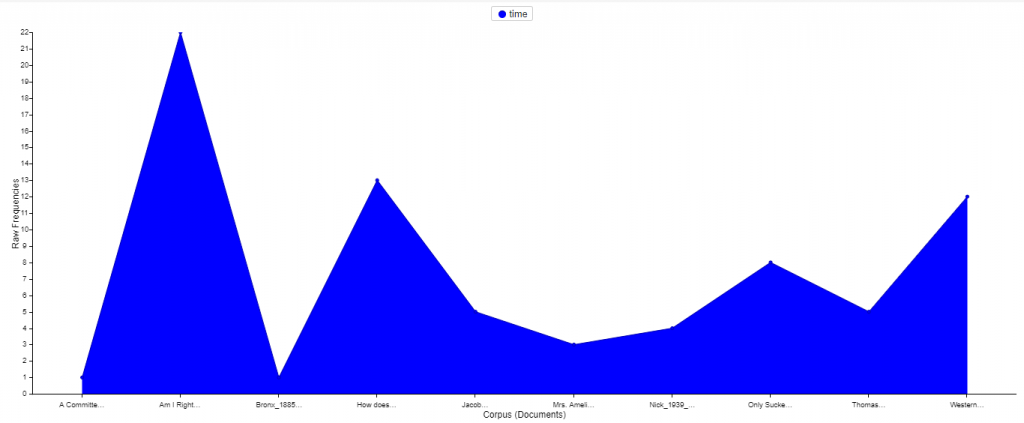
Voyant tools allowed me to understand what common themes occurred in the gangs of the time. While the cirrus above shows the separate terms “new” and “york”, New York was a recurring location that was relevant to the interviews and stories. New York gang life began in the 1920s and 1930s as way to put money into the member’s pockets but also it was merely a hobby for some but not most 4. I chose not to use our class’ corpus files with the location of New York because New York hosts many different cultures and story which may have skewed the results of my voyant tools. For the second chart I chose to focus on the word “time.” Time is a word the continues to pop up in each of the articles, some more than others. The theme here shows that the interviewees had a lot of time on their hands due to the economic turmoil that the country was facing. Because the citizens had so much time, these articles speak to the reality that they may have joined their gangs to pass the time as mentioned earlier where we discussed that gang life was also a hobby for some.

My expectations of the members of the gangs was to show that members join for financial gain. I was not totally wrong in finding this however I was surprised to know that people joined gangs for a sense of community but to also spend their time. The American Yawp’s section III addresses the economic turmoil that specifically hit New York which led to many citizens being out of work5. I concluded that some of these individuals had no where else to turn for money other than gang life. Engaging with the articles in close and distant reading practices allowed me to see overarching themes for my historical question but the close reading specifically allowed me to see how a vague word like “time” can shed light on the reality that people may have used boredom as an excuse for a life of crime.

Living it up in the 1930s

What really captivates me about the past is people’s lifestyles. This desire to get a glimpse at their lives back then led me to my historical question: What were lifestyles like then, and how were they recorded by the Federal writers. I was immediately greeted by a flurry of words. The problem was that they all seemed very simple. Home and work, like and folklore. These words caused me to think a little more about what my historical question could be.

https://voyant-tools.org/?stopList=keywords-f4547f893cb245720fcc371d1768e931&whiteList=&corpus=a0d1dfae2c29f39d7cde744e33a7eb3b&view=Cirrus

My thoughts moved on to consider World War II, so I shortened the class corpus to any document that was recorded between 1939-1945. What I learned was that our corpus stopped in the year 1941 which is when America joined the war. This date could imply that the government turned from focusing on these writings and recordings to focusing more on the war effort.

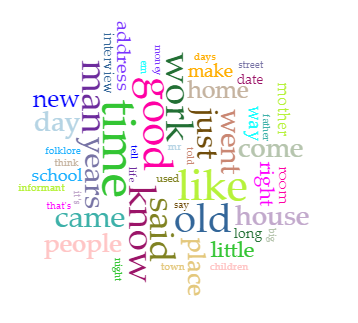
Voyant was pretty helpful in getting me to visualize these lifestyles before America joined the war. In the word cloud (Cirrus Tool) above, the words work, good, old, time, like, house and came recurred very frequently. This gave me the idea that a lot of these people’s lives were more centered around work as that was what the New Deal set out to do, provide jobs and relief for the people in this time of uncertainty. “Like” and “Old” are words very reminiscent of jargon typically used to describe locations (Old) and forming comparisons or statements of “ought to” or “should” do something. These words being prominent showed, to me, that the interviewers were most likely very relaxed when it came to discussing these topics with their interviewees. They carried the valence of narrative and really felt like stories painting the picture of family life in the past. 6

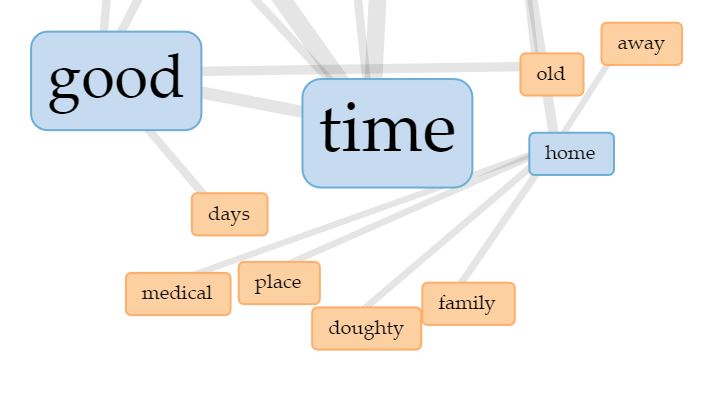
The tool that helped me the most was the Links Tool. It really put these words into perspective by showing how they connected with words in similar documents. Using this, I could closely investigate the documents to see why the algorithm assigned these certain words to link. A good example was “family.” Links linked the word with “medicine,” “home,” and “Doughty” as the Doughty document discussed their life at home. This link conveys a sense of home being a place of healing and security as that was where the family was. A similar thing could be seen with “people” being connected to “folklore” as folklore was the story of the people which they passed down, holding meaning in their culture.

https://voyant-tools.org/?corpus=a0d1dfae2c29f39d7cde744e33a7eb3b&stopList=keywords-f4547f893cb245720fcc371d1768e931&query=time&query=good&query=people&query=came&query=school&query=home&mode=corpus&context=3&view=CollocatesGraph

Distant Reading is a really fun tool for getting a broad sense of what a group of documents could possibly mean. I enjoyed getting to explore the tools and answer my historical question. During the time before America joined the war, they were very focused on home, doing good, working to support their families and trying to keep healthy. 7

Text Analysis – Drug use in the 1930s?

My historical question is “How big of a problem was drugs in the 1930s?” and the things relating to that like how they handled the drugs, what drug was the most popular, etc.  Since I’m a Criminology major with a concentration in Homeland Security I focus a lot of my studies on drugs and how drugs get into the US. So what batter topic to study than how drugs were evolving in the 1930s? 

Based off my knowledge of the Great Depression, before doing research on this topic, I assumed that since the Great Depression was a really hard and upsetting time that drug use would be heavy. I assumed this because the Depression was a very sad time for everyone, so why not take some things that helped “distract” them and give them a high? The government was trying to find things to distract people like theater and folklore. 8 I also thought maybe since the government was trying to find things to help people take their mind off struggles, maybe drugs were a big problem. 9

I found my sources by searching for very basic keywords that have to do with drugs and the usage of them. Keywords such as: Drug, addict, Morphine, Heroin, Snuff box, addicted, dealer, doctor, etc. It was not easy to find sources, but with using different terms and phrases I was able to find my 10. The sources I found said very little about addiction or drug use, which I was surprised to find. They all lightly touch on the subject enough for me to get an understanding but the topics of each source as mostly about other things with the touch of drug use. For example, Drug store clerks stealing some drugs and selling them, Doctors selling drugs on the side, a few war victims being addicted to the pain reliving drugs they were given, etc. 10

I noticed while using Voyant tools that my 10 sources had a lot of similar words and topics which is good. Not just similarities describing drug use but the fact that many of the interviews were actually similar even with different stories, which is something I was worried about. I then made it so that very basic words were not included in the poll, words such as: just, said, says, got, it’s, congress, library, etc. I chose to keep these words out because they did not help my topic at all since, they are just very basic branching words. After that I was left with this:

The first picture shows me that a lot of these sources come from 1939 which could possibly mean that I need to narrow down my topic to that year since it shows up the most. I also concluded that with all the documents in the corpus not a lot of things regarding my topic show up unless you specifically look for my 10 sources, meaning there’s not a lot of talk on the question I’m asking. On the next picture I made a graph of the keywords that I was looking to find my sources to see how much they actually showed up in the corpus. The main ones are Doctor, and Drug. This shows me that majority of my interviews talked about people getting their drugs from a normal doctor. If they became addicted to those drugs or over proscribed I’m not really sure.

Based off all this I think the question I’m asking is to broad, so it would benefit me to narrow it down more. Something like “why were people addicted to drugs in the 1930s?”. Also since there is not a lot of information on just drugs in general maybe it would be a good idea to explore the other topics in my field but ones that possibly relate more to this topic. 

Crime in the 1930’s

Originally, my historical question focused on crime rates and the type of crimes during the New Deal Era. My question was “How did crime alter during the New Deal?” I had some initial ideas to answer this question like that crime rate would be extremely high. I assumed many people were starving and couldn’t afford a place to live. This usually leads to extremely high theft rates and vandalism crimes. Many parents would steal food just to provide for their family or rob someone of their money, so they could buy food or a place for their family to stay. Usually, small petty crime can lead to more complex and violent crime including assault, armed robbery, and murder.

Personally, when searching for sources, I didn’t filter by location or time period. I focused on articles and narratives that mentioned crime or had a person discussing their own experience with crime and violence in their life. I also looked through the details about each narrative and some mentioned topics such as violence or gangs and I thought it was important to include those in my research.

I think Voyant Tools can be extremely helpful for finding connections and ideas among multiple different sources. This was evident when I used the entire corpus, centered around the 1930’s, to find the common themes among all the readings. This included almost every source focusing on family and the importance of keeping together and trying to survive. Even when the government wasn’t helping to feed and house them. 11 I think the cirrus and trends are two very important tools for people to easily find these connections within the readings. It is also helpful to be able to be connected to the reading through the trends tab. I found it more important to use sources that ranged during the 1930’s, so I only used sources that fell between 1930-1939. I wanted to possibly see the progression during this time period.

After using Voyant Tools, I decided to refine my question to “How did crime affect citizens during the 1930’s?” I think it became very obvious after using this tools to see that family was very important and a lot of crime occurred over protecting the family. I found that many articles included topics on informants. This usually includes normal citizens reporting information to higher organizations such as law enforcement. After looking through some narratives, I found there was a lot of theft and people were fighting with native Americans at the time. It is also interesting that school seems to be very important at this time when families were struggling to make money and provide. Especially when the government was helping to put people to work, it seems weird they would send children to school. 12

https://voyant-tools.org/?corpus=e9ad3641cf6f43466080c5057aa8fcc1&stopList=keywords-75d9cdf97459b59cbe07be393ca9cab9&skipToDocId=c0e715c5d1d85c9b09912946a1661f33&view=Reader

https://voyant-tools.org/?corpus=85e8a5c62062ad9394cffb477f1e05f9&stopList=keywords-a855684c102f9afa4aef341b2c4403aa&whiteList=&view=Cirrus

https://voyant-tools.org/?corpus=85e8a5c62062ad9394cffb477f1e05f9&stopList=keywords-a855684c102f9afa4aef341b2c4403aa&query=informant&view=Trends

Lastly, it seems that crime and violence are correlated with this time period. When survival is most important, people are more likely to commit crime to provide for themselves and others. This includes, robbery, theft, and murder etc. I also think text analysis is very important to make connections and correlation among topics.

css.php