Slave Narratives of the 1930s

Understanding slave narratives from first hand accounts is an important step in beginning to understand the atrocities that came with slavery. The 1930s provided a time where the slaves from the nineteenth century had not passed away yet therefore their stories of listen1 were able to be used in understanding the narratives that former slaves had to offer. Understanding slave narratives during the 1930s may not have been as important to the people of the time as it is today. This shows the important work that John and Ruby Lomax were doing during the 1930s and how it impacts the current discourse around the issues of slavery in the twentieth century. Perhaps John Lomax would have released an article regarding the creation of content for the future similar to Ian Milligan’s article where he discusses the creation of content for the “record of tomorrow.”2

The collection of Voices Remembering Slavery: Freed People Tell Their Stories is a unique moment in history where the former American slaves were given the opportunity to share their experiences. It could be argued that the former slaves were activists of their time however it was in a very passive manner. The Civil Rights movement had not began yet but having the ability to share their stories in an attempt to shed light on the realities of slavery is a form of activism because the ultimate goal is to promote equality. The personal story that uncle Billy McCrea shared with John and Ruby Lomax, listen3, provide the listeners with a snippet of a personal experience regarding the transactions of human people during the nineteenth century. This is an important interview to listen to for the modern day understanding of how slavery impacted the lives of those who were fortunate enough to outlive the atrocities of slavery. The Library of Congress describes the slave narrative archives far better than my abilities allow me, “The WPA narratives thus constitute an illuminating and invaluable source of data about antebellum and post-Emancipation Southern life, the institution of slavery, and, most important, the reactions and perspectives of those who had been enslaved.”4
Tourism Mapping

https://storymap.knightlab.com/edit/?id=virginia-beach-to-west-virginia

Tourism in the 1930s was a crucial aspect in the creation of a unified American culture, different from the regionalism that is still evident today. The promotion of tourism and domestic travel allowed for cultures to clash and mix together to even create new cultures with different blends of an individual’s culture. Segregation made this harder for African American communities during this time because of the social constructs that did not allow them to go to certain areas of the country. Experiences would vary depending on the color of the skin of the traveler but also the region from where they came. Regionalism influenced travel because of the culture that the citizens carried with them but also because of the stereotypes involved with these cultures. Stereotypes may negatively impact the desire to travel to a certain region because of the connotations that region. For example, African American citizens may not desire to travel to the Southern regions because of the cultural values of racism that were so evident during the time. We see another direct example of this structural racism in the maps that W.E.B. Dubois provided during the late 1800s where he mapped the residences of African American communities and the population density of the area.5 These negative connotations may not have proved as relevant to the Caucasian travelers because they would not have seen the direct forms of racism that the African Americans did.

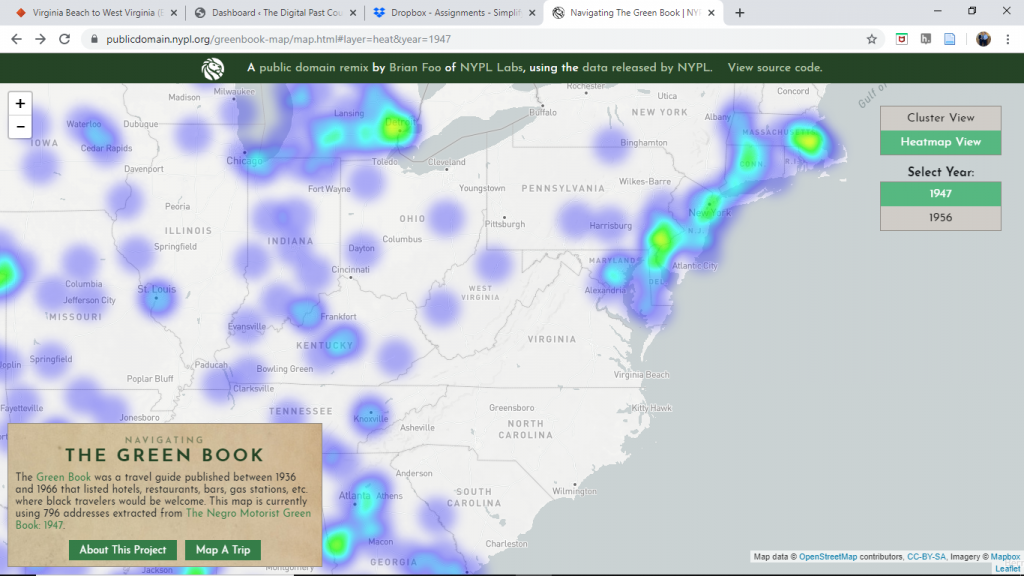
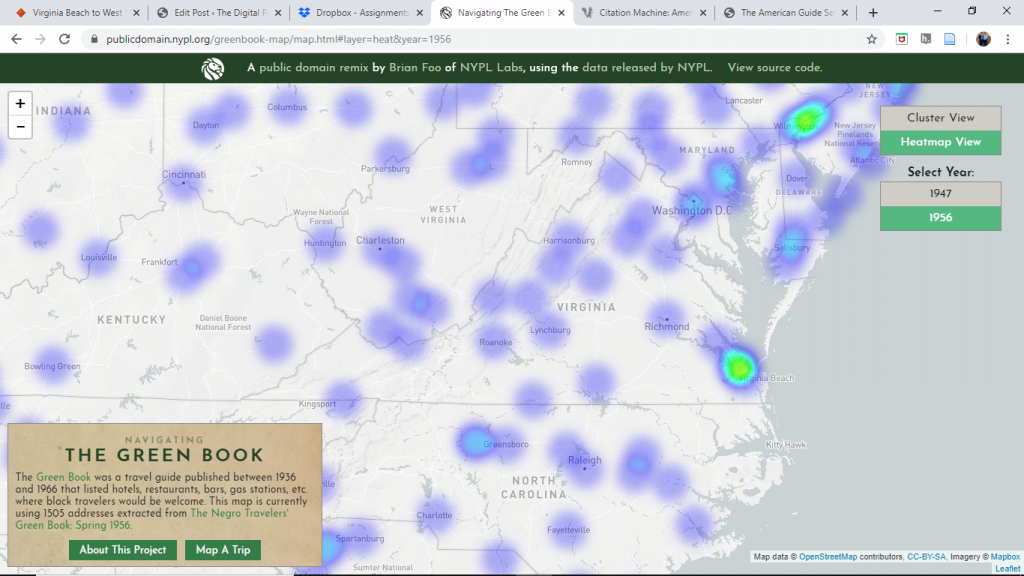
The Green Book shows that the trip that I planned may not have shown too much excitement for the African American population. I expected little heat in the area on the map that represents safety for the travelers however I did not expect to see the absence of safety. The 1947 heat map showed that Virginia did not provide comfortability for the African American travelers at the time. I decided to also include the heat map from the 1950s, although not needed, I believe it shows the transition that America had gone through in the span of a decade. Virginia in the 1950s reflects the transition that the country was going through with the Jim Crow laws. The separate but equal mentality was not ideal for American culture and society however the separation of race could have provided comfort ability for travelers both Caucasian and African American because they could remain within their own cultural bubbles.

In comparison the Green Book, the American Guide provided a list of more physical features of the state rather than a reflection of cultural values that can be see on the Green Book’s maps. From the American Guide exhibit: “it outlines different topics to include in each state guide such as plant and animal life, societies and associations, folk customs and folklore, transportation, natural resources, and many others with the intention of “[increasing] acquaintance with America by Americans…”6 This quote shows the lack of social awareness that went into the creation of this guide. Looking into primary sources of the time may have allowed for the American Guide to provide a more useful guide to traveling that nation similar to the way that the Green Book showed safety for African American travelers.

Special Collections

Archives provide a unique experience for both scholars and the general public. The archives allow for both of these consumers to see and understand material the way that it was intended to be consumed in its originality. Understanding the technology of the past will allow for future researchers to advance in the modes of production of sources regarding the way that we use tools for research, making it easier to access these archives. This can be seen in the example provided in The Artifactual Elements of Born-Digital Records, Part 2 where the author mentions that recreating of library shelving by Thomas Jefferson allows us to see his personal bookshelf but the historical figures of today may leave behind their personal library that can be kept on a hard drive of their computers.7

The influence that archives have on current authors’ and producers’ work shows that archivists should keep an open mind in accepting as much work as possible. The first part of the The Artifactual Elements of Born-Digital Records mentions how previous authors are influenced by the records and archives that they had available to them.8 This shows us that in the modern-day context of archival preservation, historians and archivists should be very liberal and accepting in their decision-making process of historical record preservation. The acceptance of more archival rather than less will allow for further influence on today’s authors that will allow for advancements of culture and education.

The Federal Theater Project was short lived even though the revenue that was generated out weighed the other Works Progress Administration’s projects revenue.9 Understanding the physical preservation of the archives from the Federal Theater Project shows the cultural impact it had on the United States’ citizens. Expansion of culture is important in the context of our class because it promotes the idea of regionalism which shows the many different cultures from all around the country and how they developed throughout the 1930s.

Gang Life of the 1930s

Underground markets and economies have interested me throughout my academic career at George Mason University. I believe that gangs and other black markets have a lot to offer when it comes to a society’s norms and cultures. Gangs represent the misfits of society and specifically during the 1930s people have chosen the gang life due to the economic circumstances created by the Great Depression.

I chose these ten sources from the Library of Congress under the tabs of gang and crime. I chose these two tabs because I felt that they best represented my original historical question: What was gang life like during the 1930s? I found that a lot of the stories were just that, stories. It was difficult to find original transcripts from members of the gangs but a combination of folklore as well as first hand accounts provide an image of how gangs interacted with society.

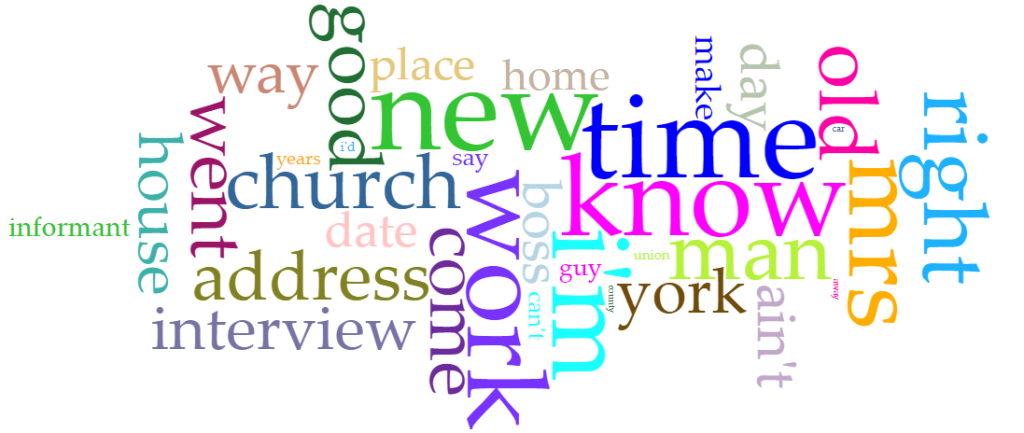
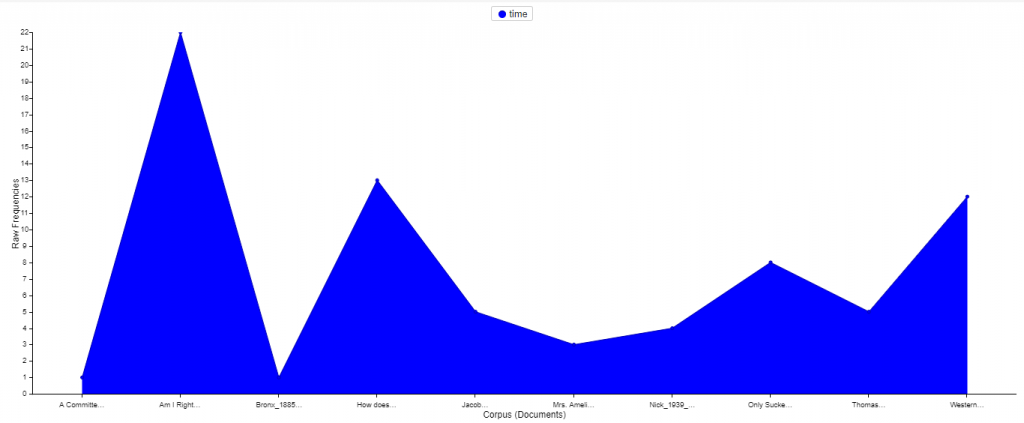
Voyant tools allowed me to understand what common themes occurred in the gangs of the time. While the cirrus above shows the separate terms “new” and “york”, New York was a recurring location that was relevant to the interviews and stories. New York gang life began in the 1920s and 1930s as way to put money into the member’s pockets but also it was merely a hobby for some but not most 10. I chose not to use our class’ corpus files with the location of New York because New York hosts many different cultures and story which may have skewed the results of my voyant tools. For the second chart I chose to focus on the word “time.” Time is a word the continues to pop up in each of the articles, some more than others. The theme here shows that the interviewees had a lot of time on their hands due to the economic turmoil that the country was facing. Because the citizens had so much time, these articles speak to the reality that they may have joined their gangs to pass the time as mentioned earlier where we discussed that gang life was also a hobby for some.

My expectations of the members of the gangs was to show that members join for financial gain. I was not totally wrong in finding this however I was surprised to know that people joined gangs for a sense of community but to also spend their time. The American Yawp’s section III addresses the economic turmoil that specifically hit New York which led to many citizens being out of work11. I concluded that some of these individuals had no where else to turn for money other than gang life. Engaging with the articles in close and distant reading practices allowed me to see overarching themes for my historical question but the close reading specifically allowed me to see how a vague word like “time” can shed light on the reality that people may have used boredom as an excuse for a life of crime.

Uncle Bob Ledbetter

The ability to hear first hand stories from a former enslaved person should be eye opening for those who take the time to listen. Understanding the past is crucial way in preventing atrocities such as slavery from occurring again. The stories that are shared provide the listener with a closer understanding of what life was like for these individuals that encountered struggles and hardships such as the inability to attend formal schooling from Uncle Bob’s accounts12.

The layers here intersect fluently with another because as Bob Ledbetter went through his life experiences, there were other groundbreaking events that were occurring. The timelines shows us that even though Uncle Bob encountered constant struggles, life continued to move in other areas of the world. The mainstream events listed in my timeline show that while America was still in a highly-racist environment, the country focused their attention to other areas like flight with the Wright brothers, the Yankees winning their first World Series, and the creation of the Panama Canal. Historians use these mainstream events to categorize areas of history. These events are separate in history however throughout the life of Uncle Bob Ledbetter, these events are what shaped the society that he lived in at the time.

The interview showed an overall lack of events. Perhaps this reflects the society that he lived in because he only reflected on his personal endeavors. There was little mention of mainstream events but he did mention what was important to him: signing, attending church, getting married, and having the ability to vote. This shows that social history are subjective to the interviewee. Unlce Bob Ledbetter felt that going to church and getting married was for more notable than the New York Yankees winning their first World Series.

This interview is useful for the same reasons that I mentioned in the first portion of this blog. The interview provides first-hand stories for listeners to reflect on when considering the life of people like Bob Ledbetter. Challenges for these interviews relate to the quality of the recording in the interview. The people that are being interviewed are old with little literacy which means there is an abundance of slang that needs to be deciphered through to understand. I assumed the quality of the recordings would not be great and this interview did confirm that. It proved to be quite difficult when trying to record dates that aren’t even mentioned but also simply understanding small phases was difficult due to older technology.

The Library of Congress mentions that people conducting these interviews were not professional researchers as we understand today.13 The people that asked the questions for the interviews were from the Writer’s Project and had jobs such as: actors, directors, painters, etc. By using workers that were not professional researchers, the transcribing process might prove to be difficult because of the different language that is used. Yes, both parties speak English but there are regional dialects14 like we hear in this interview, specifically in the transcription where only question marks are provided.

https://cdn.knightlab.com/libs/timeline3/latest/embed/index.html?source=1xrFjkNqXaqWxmyZHQG6w0W-FZHXy0wTDzrDD9IB3_I0&font=Default&lang=en&initial_zoom=2&height=650

Critical Response to Digital Technologies

Algorithm criticism is an important process to remember when engaging with sets of data. There are questions surrounding algorithms that could impact the data sets that are shown. Who created the algorithm? Why did they choose to do it this way? Who does this algorithm directly effect? These are a few things to consider when attempting to understand why a data set exists the way that it does. In Noble’s Algorithms of Oppression we see that there is a need to understand the power that creates these algorithms 15; while a private entity can create the physical code that is the algorithm, it is dependent upon the consumers and fellow google-searchers to undermine the oppressive nature of online algorithms.

Feminism in the 1930’s proved more relevant than ever after the New Deal. The political and societal understanding of the time was that the men were the sole breadwinners meanwhile the women were to tend to the traditional house duties 16 Feminism here challenged the status quo in an attempt to show the world and the American society that women were indeed capable to provide for their families; they wanted to show that they were beneficial to society outside of the household. Today feminism still promotes the equality of women but in a different sense. No longer are women expected to remain at home to raise children but they are ever present in the workplace. An issue that feminism continues to tackle today is the gender wage gap in which women are being paid less than men even though society says that they are equal and capable of the same jobs.

WPA activists share similarities with modern-day activists in the sense that they are fighting social norms by pushing boundaries. Referring to the American Yawp‘s section XII and my previous paragraph, we see that the feminist were fighting gender norms and stereotypes by forms of protests. The modern day digital activists are challenging society’s modern day stereotypes. For example, a simple google search provides a laundry list of predicted results before even finishing your search entry. These activists want to change these predictions through understanding algorithmic code and there is an attempt to move away from the racist or sexist search tools by changing the way society accepts these results.17

Music’s reflection on society

For this assignment I chose the image of two immigrants from Turkey playing their music together.16 I chose this image because of the importance that music has in society. During the 1930’s there are new forms of music that are being showcased around the country and without international music influences certain genres may not have been able to rise. Documenting people in the 1930’s in America represents the importance of collaboration even if it is music. Playing music together and expanding on other culture’s music to create new forms of sound is a small but necessary step in the creation of a united culture through playing music. I asked the question here, how does musical influence represent the values of society?

During the 1930’s the Great Depression took its toll on American life and what better way to pass time than to play music? Sharing music with one another represents a community’s hobbies that perhaps only exist to pass time during a gray period of history. In an article published by the Los Angeles times, the author mentions that the Great Depression provided times of despair, fear, and an overall lack of morale. 17 Music gave the people of the time an opportunity to ease their minds and to not think of the despair that they are enduring together as a whole nation. In section VI of the American Yawp there is a discussion of “dislocated populations.”18 Dislocated populations also had the same need for prosperity as the Americans of the time. Regardless of why an immigrant chose to come to the United States, each individual citizens suffered through the tumultuous times. The power of music allows for people, both local and dislocated, to join together in collaboration of new music.

Exploring the different types of exhibits allow for users to understand resources (photos, recordings, etc.) within their own contexts. Glitching images provide the user with the opportunity to create a new form of analysis, depending on how the glitch is finalized. Although glitching is a user-created item, it can be a useful process to shed light on issues that may not be welcomed to discuss in the open. The photo from the Berkeley Folk Music Revival shows the audience who to focus on through the glitching process that puts the African-American man in the middle of the photograph rather than the two white musicians.19 My attempt at glitching could argue that the various colors within the picture represent the different sound of the immigrant’s music that influences society’s musical tastes and feelings. 20

Text searching

The presentation provided to us by Tony Guidone was both informative and interesting as he showed us the different ways that online databases can store information for users. Earlier in history it was absolutely necessary to hang on to physical copies of information but now we have the ability to upload and browse different versions of documents online.

The expansion of online databases have allowed for a new form of searching for information and this is through key word searching. Key word searching allows a user to search for information with a consistent theme or genre specific to their research.

The ease of key word searching has allowed me to access and process information at a much higher rate. Similar to what Milligan says in his section regarding The Quantitative Impact of Newspaper Databases, the more resources that a researcher has, the more confident they will be when conducting a project 21. This key word searching provides a researcher with the ability to see the sources for their topic on a broad spectrum but also it speeds up the process; projects that were conducted in traditional libraries will take longer than a project that uses different online databases.

These digital projects that we examined in our first week of class may not spark an immediate social change but there is potential. Digital projects have the ability to bring information to consumers in new and uncomfortable ways. To spark a social change there may need to be a sense of uneasiness to make the consumer desire to see change the way that the website designer does.

As easy as it is to use digital media nowadays, it does have its ups and downs. Digital media allows for online databases to store hundreds of thousands of units of information all on the same website. But having access to that much information can prove to be overwhelming to the consumer if they are not being specific enough to their research. A good resource tool for these online databases is topic modeling. Topic modeling allows a user to track their search topics over time to see how the quantitative data has shifted 22.

css.php