Blog Post 6: Unions & Text Analysis

My original historical question was, “what factors helped shift the public perception of labor unions in the 1930s, and how?” And with “public perception,” I was referring to the working class’ trust in unionization and the efficacy of unions. Initially, I assumed that labor unions were stigmatized negatively in the 1930s because of their lack of success in years prior, and that affected the willingness of the working class to unionize.1

I selected my sources from the American Life Histories collection by refining the search with the subject of “labor unions.” The items I selected for part one were particularly interesting to me because of the passion and candor the interviewees spoke with when referring to unionization; there was actually a document that was a manuscript of a Worker’s Alliance Meeting in New York, and the entire thing was just the prayer that someone led before starting the meeting.

Voyant turned out to be really beneficial for text-analysis and helping me create a more constructive question. I utilized the class corpus by creating a new corpus with only 62 documents that involved the words “union” or “unionization.” Distant reading was useful in this aspect because it allowed me to see the frequency in which unions were talked about throughout the collection. Now that I had a corpus that was composed of manuscripts about labor unions, I wanted to see how people were talking about them.

In the “contexts” section of the site, I was able to search “union good”~15 and “union bad”~15, and this allowed me to find sentences with the words “union” and “good” within 15 words of each other. I got a total of ten results and only 1/10 of those documents used the word “bad” to describe unions in a negative manner. The other nine documents used the word “good” to refer to unions in a positive light. After pairing my findings with close reading, I realized that the documents do not clearly and explicitly present the factors that affect the working class’ perspective on labor unions. So, my original historical question went from, “what factors helped shift the public perception of labor unions in the 1930s, and how?” to “what was the public perception of labor unions in the 1930s?”

To conclude, the manuscripts in my close reading of the 10 documents proved to be useful in emphasizing peoples candid thoughts and passion about labor unions. But most importantly it shed light on how there were discrepancies in attitudes about unionization, that were determined primarily by your status as a working-class individual. For example, the manuscripts showed that while some people had the freedom to unionize, others were fearful of retaliation in the workplace. Also, despite reading Miriam Posner’s blogpost beforehand, I still went into this assignment thinking that Voyant would provide a “straightforward window into a text.”2 But by the end of the assignment, I realized, as Posner argues, that text analysis and Voyant should instead be used “as a way to talk about how we interact with texts and what kind of meaning evades capture by computational tools.”3

Look to the Margins

In the FWP’s records how does the involvement and voice of African-American Women vary through singular vs. familial accounts?

Do African-American Women fall into the abyss of words and accounts as the corpus of FWP focuses on other voices?

I selected my sources by submitting myself to the mercy of the Library of Congress digital algorithms. After I used the African-American filter to ensure I was in the right place I picked the first 5 women’s accounts and the first 5 family/couples accounts. I did this because someone wanting to see the basic African-American women’s account would see these documents. So I purposefully did not use severe discretion with my options.

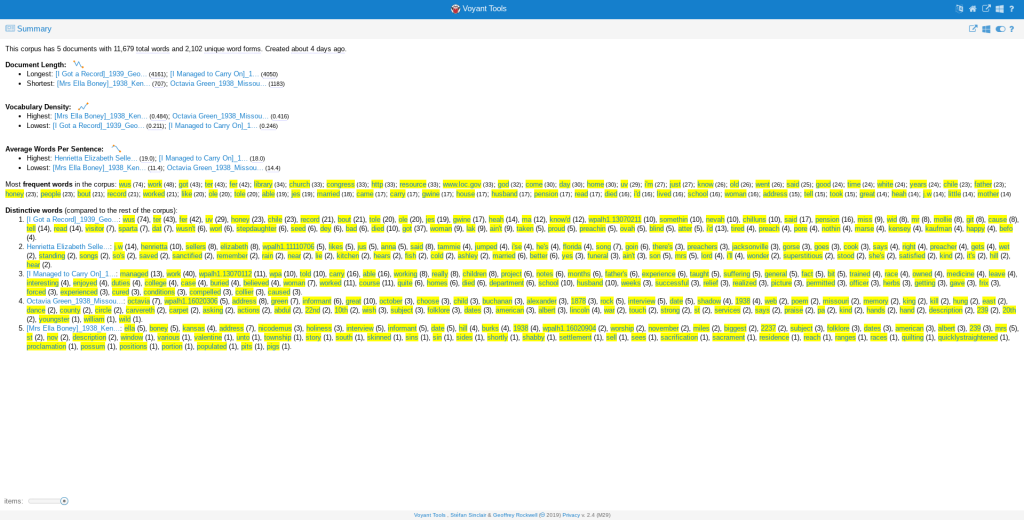
The Voyant tools were incredibly useful in thier scope in their use of distant reading. Uploading the corpus was easy and efficient. Of all the tools the “Distinct Word” and “Vocabulary Density” feature stood out the most. Voyant alligns the documents in terms of most which ones have the most dense vocabulary vs. the least dense vocabulary. The women’s and Familial accounts both have pretty evenly dense vocabulary, and the same ratio is in the document length.

These comparisons show that with this document sample can truly only tease certain questions. However, those questions it teases are lost within the confines of an overflow of text in the broad corpus.

My question is about the voices of African-American Women, and there is no way to that within the confines of this overwhelming amount of documents that the voice of a Minority can be heard. If I am to properly seek an answer to my question my 10 documents need to be the topic of study.

Everyone during the great depression was concerned about work. That concern is reflected in the common word in all data clumps of the word “work.” However, One particular feature that stands out among the comparison are the dialect words.

In the African-American women’s accounts dialect words are a huge component of the culture. One story in particular, [I Got a Record], records not only what she says but how she says it. Dialect history is as much as necessary part of history as any.

In the main corpus many of the dialect words are not present, and thus erases an element of the story. Their culture is lost in a see of words. Their stories are just so unique and different that it does not “fit” with the rest of storylines. For history to be told properly it needs to be organized according to catagory. Rather than an overarching narative filling the space a need for categorized and harmonious naratives are needed. Every topic must have a consideration of race and gender because it changes the perameters.

Historical questions are only as good as the tactics we use. If we wish to look at the broad picture of the entire corpus, then we see the main concerns of the entirety of the people. But with this decision lose certain aspects of it within the quantity of words. Distent reading is good for answering questions of generality, but close reading is necessary to understand the specific categorical naratives.

Depression-Era Religion

My historical question was: “How did the role of religion within American society shape and be shaped by the social climate of the 1930s, and were peoples’ religious beliefs strengthened or weakened by the hardships of the Depression?”

Going into this assignment, I already knew that the late 1920s saw a rise in conservatism, especially with the advent of the radio paving the way for pre-televangelism. This took societal hold even further in the 1930s, and I always assumed that was owed to people seeking a higher power to turn to during the Depression.

When selecting my sources, I knew that I wanted to focus on religion: prayer, church, priests. But when one of my sources wound up being a man speaking of his discussion with a Jew on the rise of fascism in Europe, that got me interested in Judaic aspects as well, instead of keeping the question fully focused on Christian reactions to the Depression.

This got even more interesting with Voyant: ‘church’ and ‘god’ are, perhaps unsurprisingly, the most common terms out of my searches. But ‘jew’ far surpasses ‘priest’, ‘jesus’, and ‘christian’. I can think of an explanation for ‘christian’ being so low – almost all the speakers from the sources that I read ensured to emphasize their denomination of Christianity, while that isn’t as much of an issue in Judaism. But even after I tried to filter for terms like ‘catholic’, ‘protestant’, or ‘evangelical’, the numbers were still much lower.

Out of curiosity, I came back to the source that inspired me to include Judaism, and I searched for the term ‘fascism’. It appears eight times – six of which come from that source. The Jewish man within it speaks of how he fears that only other Jews cared about what was happening to Europe in 1939. I don’t think this is unfounded. American goyim either didn’t seem to care or were convinced that it wouldn’t spread. ‘Fascism’ only overlaps with one document containing the Christianity-related terms that I searched for, and the word is scarce in mention across the rest of the corpus. True, America was dealing with its own problems, but nothing happens in a vacuum.

In this vein, I might choose to revise my question into, “How did religious beliefs and differences affect the concerns of America during the Depression?” Many of the Christian sources speak of attempts to convert more sheep to the flock, or prescribed prayer in the hopes of a divine remedy for domestic strife. Christianity seems to have been confined to two spheres: home and church. Judaism, while more centralized in urban/immigrant-heavy places like New York City, takes to the streets and gathering places like cafes. As someone who comes from both Catholic and Jewish backgrounds, I definitely find it fitting that the Christian sources are actively attempting to solve what they perceive as “problems”, while the Jewish sources pose more questions.

Musicians’ Homes in the 1930s

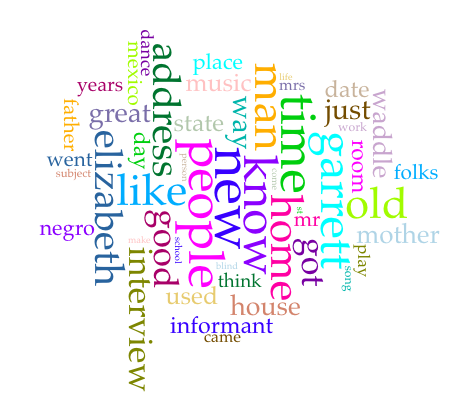
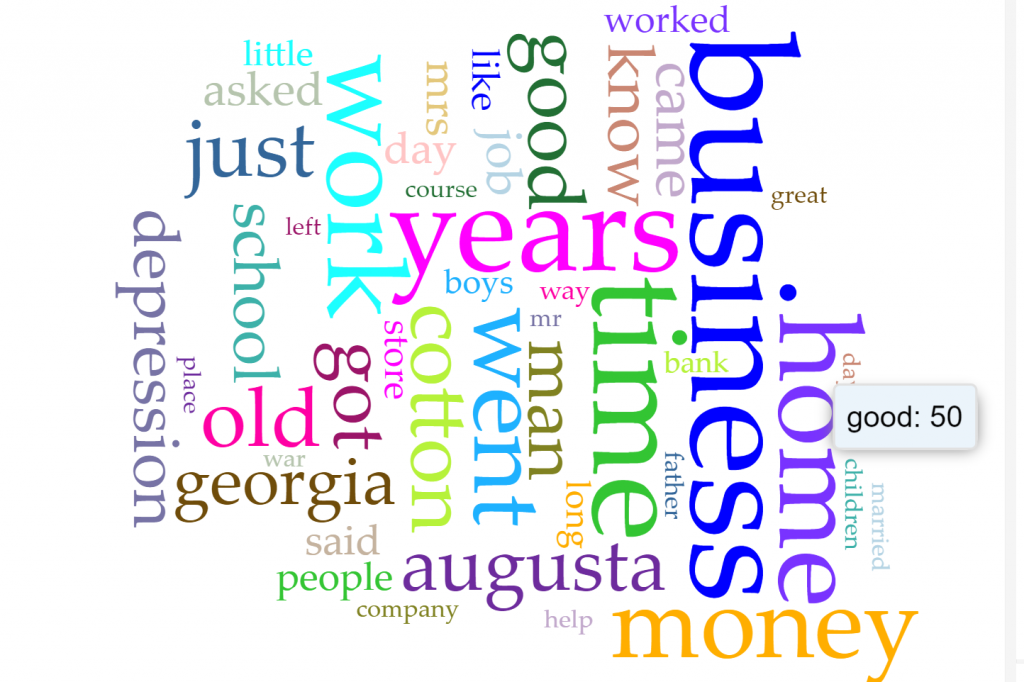
My historical question was: How were the lives of musicians in the 1930s, primarily minorities, impacted by the time period/events? After reading through many interviews that seemed like a great question to answer, however, after using the voyant tool and looking at these interviews through a distant reading scale, I was able to notice things I didn’t before. I was initially able to see what words were most commonly used through the use of the “word cloud, with more frequently occurring words shown in a larger size.”4 The first word that stuck out to me was “home.” It’s a simple word that holds variable meanings depending on who’s using it.

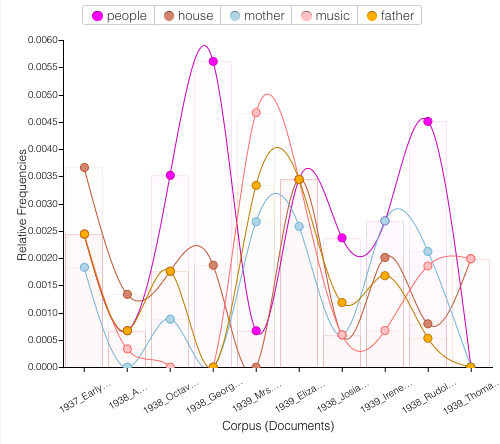
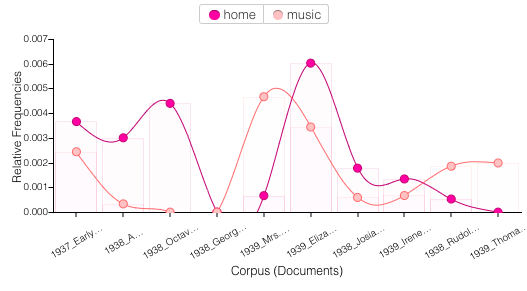
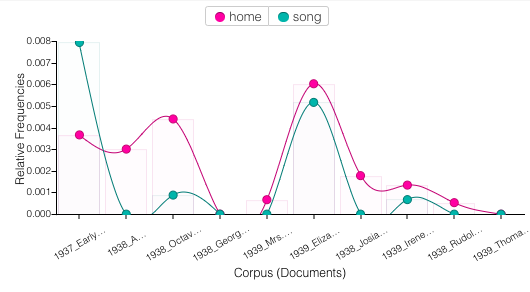
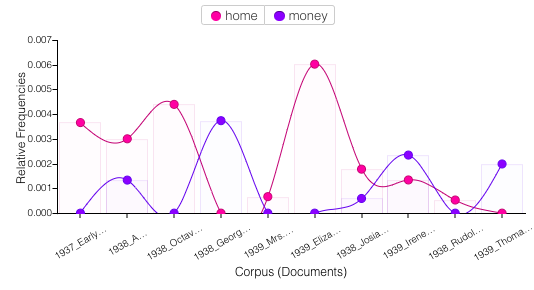
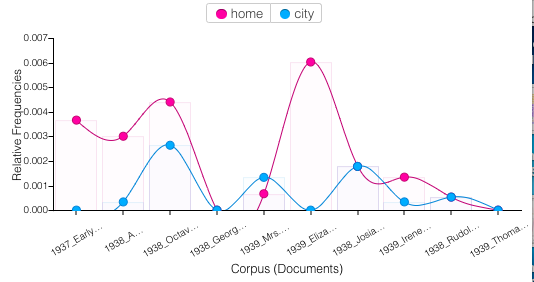
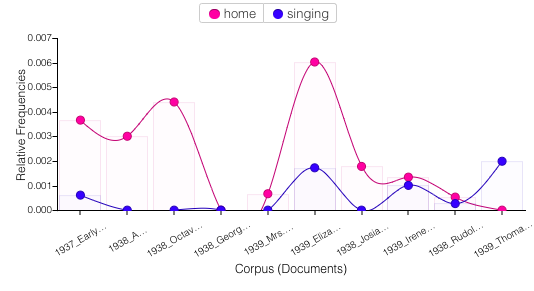
My question shifted from how musicians’ lives were impacted, to what did these musicians consider to be their home? To stay on the theme of musicians I was limited to using only my documents, as the others did not quite apply. This proved to work out better anyways as it allowed me to better compare how words were used in fewer documents. One of the features I relied on was term searching and plotting them on the trend graph. My initial goal was to search between terms I thought would relate to “home” and see if the trends aligned.

While the meaning of “home” clearly means different things to the different people in each interview, there are still some similarities. The greatest similarity between all individuals that were interviewed, is that they used the words “home” or “house” to a similar frequency they did as words used to describe family members. With a few exceptions, physical places weren’t commonly used, so it can be assumed, many of them didn’t associate home with a physical location. This makes sense when considering the migratory nature of the time period, especially with so many musicians being inspired by the events of the dust bowl and great depression.56 Although through distant reading, it can be difficult to tell for certain whether or not this is entirely accurate, it provides a great start to look at these interviews more closely and gain a better understanding.

Text analysis

For this project, I decided to use my own corpus, which is the 10 files that relate directly to my historical question. My historical question is, “How did the aftermath of the Great Depression affect the people who lived during it”. Through this question, I was able to find several files that matched up well with this topic and gave me a great insight into my question. However, I chose to compare it to the class corpus as well to try and be and visualize the similarities and differences between both of the corpus.

The American Yawp gave me great insight into the great depression and how it affected everyone’s lives. They talked about how it affected the market directly by saying, ” The market temporarily stabilized but fears spread over the weekend and the following week frightened investors dumped their portfolios to avoid further losses.”. 7 “The Great Depression” American yawp. http://www.americanyawp.com/text/23-the-great-depression/8. This quote helped me narrow down what I wanted to do for my distant learning even before I had used Voyant tools. The podcast on Hoover, who was president at the beginning of the great depression, talked about what happened to people after the market crashed. “Nearly half of its banks failed, nearly a quarter of its workforce out of a job.”. 9 “The Memory Palace”, Podcast, http://thememorypalace.us/2017/10/hoover/ . This led me to decide what I wanted to look at in my corpus. What I immediately noticed within my corpus was the word business. It was easily the biggest word on the Cirrus image. I was able to find that the word business was mentioned over 100 times in all of my files; this led me to do my distant learning based on this word because all of the other words were smaller and did not hold as much importance. When looking through where the word business fell in my files I found a pattern. Every time the word was mentioned it was either that the person owned a business, worked within a government entered business, or just were apart of a standard business. Several people had lost or closed their business as soon as the stock market crash while others did a few years later. For example, in one of my files titled “Honest and Fairness to the Bitter End”, a man had to close his business in 1936, seven years after the stock market crash. He had mentioned that people have tried to help him keep it open, but nothing was successful. I was surprised that he was even able to keep it open for a whole seven years. Secondly, I saw that many people had mentioned that after the stock market crash the government promised that businesses would resume but most of them never did.

My last step was comparing my 10 files based on my historical question to the large class corpus. First off, there was a larger amount of results in the class corpus because there were 300 more files. I was surprised to see that in the larger corpus I could not even find the word business in the cirrus. I thought I would for sure see the word business but I could not find any information on it. The biggest word in the larger corpus was “resources” and it was mentioned almost 2000 times; compared to the largest word in my corpus which was only mentioned about 100 times. Secondly, the trend graph for both of the corpus was drastically different. The class corpus trend graph was much more congested and harder to visualize. Whereas my corpus trend graph was easier to understand and pick out certain themes. In conclusion, I was able to compare both of the corpus and how we can learn to distant learn from a little information to a larger amount of information.

Citations: “The Great Depression” American yawp. http://www.americanyawp.com/text/23-the-great-depression/

“The Memory Palace”, Podcast, http://thememorypalace.us/2017/10/hoover/.

The class cirrus of the 322 files.
My cirrus of the 10 files I had chosen.

Blog #6: Folklore and Music in Depression Era Chicago, Illinois

My historical question asked what folklore and folk music from 1930’s Chicago could reveal about the social climate of the time. I based this question off of a collection of ten different sources from the FWP corpus, with this specific interest in mind while I compiled them and close-read them in the first part of the assignment. Folklore and folk music have always interested me, as I see them as a crossroads between the fields of history and english, so when I discovered a wealth of documents pertaining to music in particular, all from the same place and time, I was immediately intrigued. I recognize after working through the second half of this assignment that my topic perhaps might be better suited for a paper or presentation, instead of a key-word based assignment using Voyant Tools, however I have tried my best to make it work with the technology at hand by focusing my text analysis specifically on my own smaller corpus of materials rather than the extensive library of files downloaded from Dropbox. Originally, I tried to navigate through the entire zip file provided to us, however this proved extremely frustrating and hindered a lot of the research I wanted to get done.

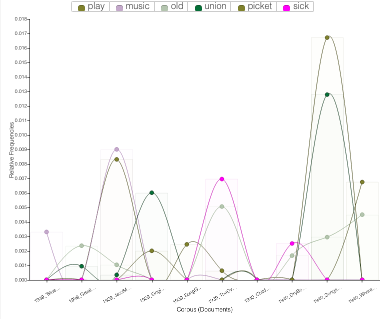
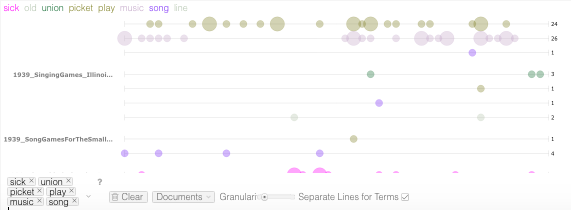
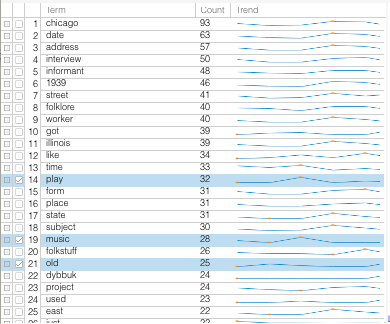
So, having uploaded my own miniature corpus of FWP sources, I began looking up keywords. Some of the suggested terms, ranked by their prevalence throughout the documents provided (and which were not merely derived from the standard headings of each), were: play, union, picket, music, sick, and old. I think that these key words give an interesting summary of the topics, but also of the themes at play in the city. The sources which I compiled covered a variety of subjects, all centered in Depression Era Chicago. From my close readings as I looked deeper into the prevalence of these key words, I learned that during this period, there was a strong push for unionization and workers rights. A surprisingly large percentage of the recorded children’s songs—mostly sung while playing jumprope games or other similar activities in the schoolyard—referenced parents working in factories or organizing picket lines, indicating the reach and social upheaval of the workers’ protests of the time. According to other sources, which recounted the folklore of various pockets of Chicago’s community, illness and disease were also prevalent during this time. In some Jewish communities, it was believed that these illnesses were caused and spread by an entity called a “Dybbuk,” yet it is noted that the Dybbuk only attaches itself to Jewish people, and that the illnesses did spread elsewhere as well. Finally, the last key word that struck me was music. Beyond the song games of Chicago children at the time, there were also multiple sources in this collection which discussed jazz and blues music, suggesting an uptick in their importance and popularity in the city. Especially where the blues genre is concerned, music provided an artistic outlet and an escape from the hardships of daily life, in a context which was not only heavily impacted by the Depression itself, but was also undergoing radical social changes and demonstrations in terms of its industrially-based economic. 

Overall, I felt like this tool was incredibly useful in helping me visualize and articulate my exploration of my historical question. The various ways that key word prevalence was displayed helped me find common threads throughout the majority of my compiled sources, and isolate core themes of the time. Ultimately, I was not surprised by what I found through this tool. The commonalities presented through the charts, lists, and graphs were similar to those that I had noticed while converting, compiling, and close-reading my files in Part I, however the tool greatly helped me understand which points called for the most focus, and how things overlapped. It is a great visual tool for those who, like myself, need a visual representation of the information in addition to written notes.

My final note on my historical question is this: The folklore and music of New Deal Era Chicago is home to a wealth of information. These sources provide us with incredible commentary on political issues, community health, and forms of escapism, even in the places we would least expect, such as the children’s jump rope rhymes. Combined together, this collection paints a vivid, albeit austere, portrait of Chicago between 1939-1941, and allows for a more personal view of the state of the city. The interview and observation based sources effectively capture glimpses of daily life, in a way that formal histories may fail, and because of this I will close with the argument that folklore and song serve a vital purpose in shaping our understanding of a culture, from city to civilization.

(Please note: I’m still having trouble figuring out how to make footnotes, but I promise I am trying)

Works Cited:

Posner, Miriam. “Miriamposner/Voyant-Workshop.” GitHub, github.com/miriamposner/voyant-workshop/blob/master/investigating-texts-with-voyant.md.

American Life Histories: Manuscripts from the Federal Writers’ Project, 1936-1940  :  Digital Collections  :  Library of Congress.” The Library of Congress, www.loc.gov/collections/federal-writers-project/about-this-collection/.

The Lack of Republican Party Criticism

When beginning, my question was this: “What were the major criticisms of the FWP from the Republican side?” This, seemingly at the time, was a good question to ask. It is always interesting to ask, “well what are the counter argumetns to this?” However, I quickly came to realize that while there were going to be detractors and flaws to a government program as always. They may not be coming from the conservatives or Republican Party of the time. I had made a lapse in my knowledge and had forgotten that the Republican Party at the time had actually been going through a switch, much like the Democrat party. This error came when trying to do research for this in Voyant. Overtime I simply could not find anything that had to do with any criticism from the Republican Party.

At first in trying to find some form of criticism I first tried to limit the words that were used using the “stopwords” tool in order to narrow the search. However, ultimately my search came up with nothing. Some of the words that I black listed are what one might expect. As shown in the “before-after” image many of the original words in the first corpus needed to black listed as they were simply not useful or were redundant.

Before
After

It must also be noted that when selecting the sources, I specifically choose sources that had an inherent problem. Sources that perhaps described something going wrong or something negatively. I believed that in these sources there could have been someone who was a supporter of the Republican Party and thus could have stated some negative opinion in the programs. The first 10 sources that I submitted did not “work.” Meaning that I initially thought the reason I was unable to find any Republican criticism was due to my 10 simply not having any. As a result, I created a “Final Corpus” which used some from the original ten that had negative insight and some new ones that I had not previously been exposed to.

In end, I used a distant reading method to first find some criticism on programs 8. Then, I moved into a close reading method in order to analyze that source. However, while there was some criticism in the source there was nothing to indicate it was coming from a republican ideology. Despite not finding something relating to the question I posed, without the tools of black/white listing it is likely I would not have been able to find any criticism. Due to the size of the corpus close reading would not truly bring good analysis on these sources while using close reading would not be feasible. So, by using the Voyant Tools as an in-between (to close and distant reading) I reached a goal of finding some criticism.

As I was getting ready to revise my original question in favor of a new one, I began to understand why there was no Republican criticism. The party had actually began to switch its sides just as the Democrats did. I had actually previously known about this switch but had mistakenly thought it had occurred quickly after the civil war

9

. With this, by complete accident, I had uncovered something quite interesting. Perhaps the reason that I could not find much information on the Republican Party criticism was simply because there wasn’t any, at least not in this. The reason for this being is that maybe the Republican party may not have actually truly disagreed with what the Democrats were doing 10. Of course, there will always be disagreement simply for the sake of disagreement between political parties. But, due to there being little to zero Republican criticisms in these documents shows that they might not have %100 disagreed with what F.D.R was doing.

Without the Voyant Tools, none of this understanding would be possible. Distant reading was far to broad and close reading was too specific. Voyant tools helped me find an in-between point where I could both look at all the documents I had selected and analyze them.

Text Analysis

The Federal Writers’ project was a way for white Americans to document the experiences of others during the Great Depression. This created more jobs and historical documentation of the Great Depression through the lens on many Americans. The texts I chose for my text analysis project were based on Latino immigration. While reading a A Cultural History of the Federal Writers’ Project by Jerrold Hirsch I came across a quote on immigration that says “Only after World War II was immigration apotheosized as quintessential part of the American experience. Historian Oscar Handlin argued ‘Once I thought to write about the history of immigrants in America. Then I discovered the immigrants were American History”11 This quote is a great example on how the Federal Writers’ Project spread through different states and gathered distinctions/similarities of Americans.

My historical question was composed from the quote by Hirsch “How did Immigrants experience life in America during the Great Depression? What do their experiences teach us about America during this time period?”. My assumptions about the life of immigrants during the Great Depression became one that included starvation and poverty. An example of immigration hardships and decline can be found is in the American Yawp “1930 to 1940 the Mexican-born population living in Arizona, California, New Mexico, and Texas fell from 616,998 to 377,433. with jobs suddenly scarce, hostile attitudes intensified, and official policies less than welcoming, immigration plummeted and deportations rose. Over the course of the Depression, more people left the United States than entered it.” 12 While choosing text files, I noticed a pattern of immigrants who had a great come up and then transitioned into struggle during the Great Depression. Regions like Florida and New York had immigrants who worked in factories and were able to purchase multiple properties. However, when Depression hit America, many were faced with the reality that their only options were to try and make ends meet or go back to their countries.

Uploading the class Corpus to Voyant was easy but I refrained from having any specific assumptions on my findings since I knew my classmates historical questions varied from mine. However after it was uploaded, I was fascinated by being able to look at topics aside from my own. It is a great visualization of what others were discussing in this time frame. The set statistics demonstrate important commonly used words, a map of places discussed in the texts and a number of unique words. I used the map tool called Dreamscape, which shows the most commonly listed areas in the documents. This also included places I had used in my text files search. The cirrus tool contains an array of words that also correlate to words I had seen in my texts. Overall, this was a great way to analyze texts and generate more ideas by being able to play with different aspects of the text. This also made me conclude that immigrants journey is only slightly different than Americans during the Great Depression and that their experiences are more similar than different.

Exploring Text Analysis – Christina O’Farrell

The historical question that I was aiming to answer was, “What was it like to be an immigrant in the United States, and what kind of jobs did they have?”. The assumptions I had regarding this question was that it probably wasn’t a super easy adjustment and that immigrants took on “odd jobs”.

I searched “immigrant” and “immigration” when I was trying to find sources for my question. I would look at the “Subject Headings” before opening the PDF and I would look to see if any specific countries were part of the subject headings, which they usually were, along with the word “immigration”. I knew once I found those two headings listed, that it was a good document for me to read and possibly download.

My experience using Voyant Tools was a bit overwhelming at first. When I first uploaded my corpus, it was a bit overwhelming to see the five different displays that popped up on the screen. However, I found that the “cirrus” display which showed the most popular words in the corpus, was very useful. I liked being able to see what words are repeated the most because it gives anyone a general idea of what the document will entail. The best way to describe Voyant is the way Miriam Posner described it. 13 The corpus I chose to upload and explore were ones that were about immigrants. There was about 12 files within it. Many of the ones I uploaded were people who were of Latino/Hispanic descent and I was able to identify that by looking at the last names. I’m Hispanic, myself, so looking for Hispanic surnames in the .txt file name wasn’t too difficult.

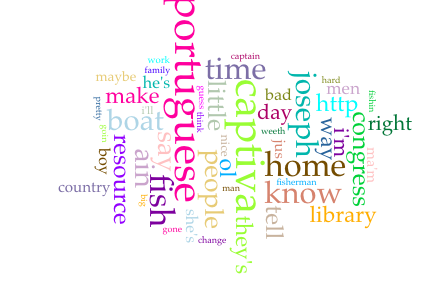
My assumptions changed a good amount by using these text analysis tools. I stated that I figured the immigrants had “odd jobs” when they arrived in the United States, but by using the text analysis tools, many of the reoccurring words on the “cirrus” display proved differently. One example was that one document was about a man named Joseph Captiva, from Havana, and he was a fisherman in Massachusetts 14 Just by using the Voyant Tools, I was able to disprove an assumption I had, which I believe is pretty helpful. Pairing my findings with other reading helped me to contextualize these ideas that I had found.

Joseph Captiva from Havana “cirrus” display.

Final conclusions I made about my historical question was that some immigrants when they came to the States during the late 1800s-1930s were able to acquire somewhat normal jobs. Their families were able to adapt well and refer to the U.S. as their home. I found the word “home” used quite often by using Voyant tools, which is another important thing to point out. Text analysis is a very useful tool that I plan to use again, especially if I’m doing any kind of research project. I think close reading is a lot easier to do versus distant reading, but distant reading requires less time. I view distant reading as “skimming” through stuff, which most people have done before. This assignment definitely helped me to learn useful ways to go over a document.

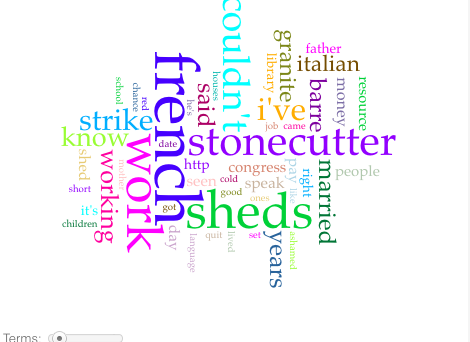
French stonecutter with Italian father’s “cirrus” display.

References

Banks, Ann. “American Life Histories: Manuscripts from the Federal Writers’ Project, 1936 to 1940, Introduction.” Library Of Congress, 1980. https://www.loc.gov/collections/federal-writers-project/articles-and-essays/introduction/

Posner, Miriam. “Investigating texts with Voyant.” Voyant Workshop, 2019. https://github.com/miriamposner/voyant-workshop/blob/master/investigating-texts-with-voyant.md

Depictions of African Americans in the Federal Writers Project

My historical question focused on how the Federal Writer’s Project depicted the experience and culture of African Americans during the 1930s. How did the Federal Writers Project depict African Americans? I did not go into this assignment with any specific ideas regarding the question, but I had two possible trains of thoughts. Both depended on the interview subjects that were chosen as part of the Federal Writer Project. I thought that non-white subjects would discuss a more realistic view of African Americans, with a focus on the specific hardships that were endured. I thought that white subjects may have a different depiction. They may focus more on the cultural and folk contributions of African Americans at the time. Especially regarding the construction of identity in the Southern United States, I thought that there could be a great deal of disparity, with some sources focusing on the dialect and culture, with others discussing the continued oppression experienced by African Americans15 .

Together, the ideas and depictions provided by the different interview subjects would start to build a fuller picture regarding depictions of African Americans in the United States during this time.

For the sources that I contributed to the class’s corpus, I searched for interviews that discussed famous African Americans of the period, such as Langston Hughes, Louis Armstrong, and Jesse Owens. Based on previous readings, I understood the role that culture, escapism, and transportation played during the Great Depression16. It was likely that many of these people may choose to speak about some of the iconic figures of the day as opposed to the negatives of their own life.

I was particularly drawn to the visualization tools that linked and emphasized particular words within the corpus. For example, the word cloud option provided a practical overview of some of the more common themes present within the texts.

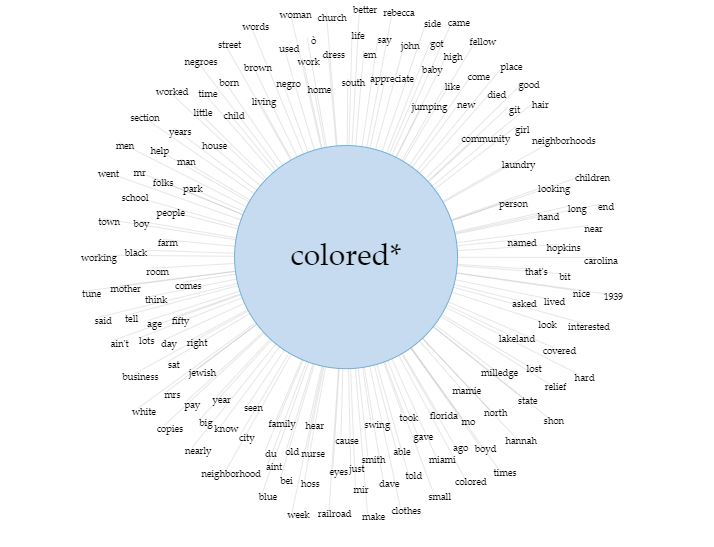
However, this tool is just an overview, and doesn’t show any connections between particular ideas or themes, which is a necessity for my question. So, I used the link tool to observe the common words associated with words such as “negro,” “black,” and “colored.” With the use of these three terms in conjunction, I was able to see some of the more interesting concepts associated with African Americans in the time period.

Many of the links focused on locations, of where different people were centered. While there were links to folklore, culture, and dialect as I expected, I was surprised to see a connection to workers, audience, and the like. With links to the word black, I received the adjective as opposed to the ethnicity, but I was surprised some of the negative and derogatory terms attached to it, such as the n-word, “sonofabitch,” and “bastard.” Without further close reading, its unclear whether these instances are individuals describing the words that were used against them, or something else.

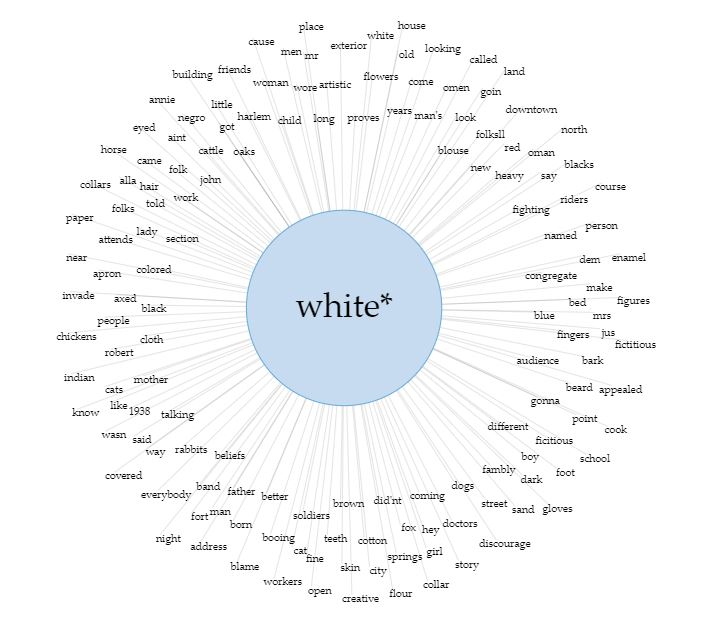
For reference, I also looked at the links for “white,” in an attempt to better understand how white people were better depicted in the project.

I thought it was interested to see the tone of words that were associated with white people, such as “appealed,” “discouraged,” “creatives,” and “friends.” The role of white people in the interviews appears different than African Americans.

The tools helped me to determine that there were a number of ways that African Americans were depicted in the Federal Writers Project. They were shown as audience members, hard workers, mothers, fathers, and children, in addition to bastards or other derogatory terms. This is likely in line with how people of color existed in the 1930s. While they attempted to continue their existence during the economic downturn, they were still faced with prejudice and racist attitudes.

css.php