Final Blog Post

http://jessicadoeshistory.com/cnd/exhibits/show/final-exhibitfr

My final exhibit combines the projects of the New Deal Era such as the Federal Writer’s Project and the Southern Mosaic Project of John and Ruby Lomax to explore the origins and impacts of spirituals and religions following the abolition of slavery at the end of the Civil War. The Library of Congress contains a wealth of primary sources focused on the lives of former slaves, narrated and documented in the 1930’s for folkloric preservation in the national archives, and although the topic itself is not centered on the Great Depression, I felt that it was a topic with incredible depth and complexity, which deserved attention, especially because the work of writers and folklorists in the New Deal allows for its study today. 

I chose to take advantage of the rich personal narratives of the Born In Slavery collection, and began my project with an overlapping timeline containing three different narratives. I chose to highlight biographical milestones, such as freedom from slavery and marriages, but also paid special mind to mentions of religious practice and holiday observance, as I noticed that while these subjects were noted by all three, it occurred in different ways. For example, Adeline Jackson’s testimony made her deep-seated spirituality evident, whereas Frank Adamnson seemed to view church attendance as a way of finding a wife moreso than as a spiritual calling. I feel that it is necessary to compare and contrast these kinds of experiences, especially when the focus of the exhibit is on religion and spirituality in particular. Secondly, I chose to use Soundcite to analyze two examples of traditional spirituals, and to open up a conversation in my exhibit about the important roles that spirituals played during and after slavery.1 Finally, I chose to do annotations of two images from a church congregation in Charleston, South Carolina, to facilitate a discussion of the emergence of Black churches in the American South following emancipation, and their cultural significance.2 All of my primary sources originate in South Carolina, from the songs and images, and even the personal narratives. This was a conscious choice (and a true hassle when it came to selecting sources that would fit my exhibit well), as I wanted to build my observations and conclusions around a specific group, in order to increase my own accuracy, and minimize the amount of generalizations I stood to make about a community to which I do not belong.

When first I entered the class, I had no idea that there was such a heightened initiative and interest in documenting American folklife during the New Deal.3 As I conducted my research and found primary sources for this undertaking, I was truly blown away by the sheer amount of material that was compiled during such a short period of American history, moreover the fact that there was so much pertinent information at my disposal for what I consider to be a somewhat narrowly focused exhibit. The push to immortalize American Folklore and Folklife at this point in history stands out to me at a personal level as well—as an anthropologist, I am impressed with the degree of attention the government and the country at large gave to aspects of culture that so often go neglected by the majority of the public.4

The action taken to preserve and compile folklore during the 1930’s was invaluable, especially as our culture continues to grow more and more homogenous as mainstream media takes over the collective focus of the country. Through the projects of the New Deal, we are able to access firsthand accounts of events from two hundred years ago, recorded in audio files and transcribed by ethnographers. It’s utterly incredible. I have never been interested in digital archiving—or any archiving, for that matter—before taking this class, but thanks to all of our work with the Library of Congress digital collections I have gained a deep appreciation for all of the work that goes into the compilation and digitizing of these sources. Accessibility truly is everything, and this class allowed me to see behind the scenes, and gain an understanding of how this accessibility is made possible.

Skill 7, Blog 9: Voices From the Dust Bowl

I chose to look into the the Voices from the Dust Bowl: The Charles L. Todd and Robert Sonkin Migrant Worker collection, which was compiled between the years 1940-1941 to document the daily life and culture of Farm Security Administration migrant work camp residents in California

5

. While going through the collections audio recordings, it struck me that so many of the migrants they interviewed were from far off. At the end of her rendition of “The Old Apple Tree in the Orchard

6

,” Ruth Elliot is asked listen. Others like her came all the way from Oklahoma, Arkansas, and other regions in the southern and midwestern United States in order to flee the Dust Bowl, and they brought elements of their regional culture with them. At the time of this project, there was an increase of interest in American folklife, which drove many of the projects that were created by FDR. In 1935, Roosevelt budgeted over $27 million dollars for the purpose of “rediscovering and defining American culture” through his federal work projects, and that work continues in this initiative7. Furthermore, there was a public desire for the collection of folk culture, such as folk music, as it became a patriotic rallying point for Americans, and being government sanctioned, was able to flourish

8

,

Ruth’s song listen is a prime example of the types of folklore sought after by federal archivists at this time. Narrated by a girl reminiscing about an apple tree, which her father planted. When he takes a local girl out for a jamboree

9

, and brings her home in the morning, listen. The neighbors found him there and hanged him to death, and so ends the folk song. The light melody of the song is playful, like a nursery rhyme, and it broaches a dark topic in a jaunty manner token to American balladry. Similar themes are seen in the Appalachian ballads collected by folk singer Jean Ritchie only a decade later, with the help of Alan Lomax—particularly “The Hangman Song” or “Hangman”

10 11

. These common themes in folk songs grappled with the hardships of daily life in rural America, engaging with the cultural values of the society—such as proper conduct with the opposite sex, in the case of “The Old Apple Tree In The Orchard,” or loyalty to one’s romantic partner, as seen in “Hangman.” It makes sense that these songs were brought with the migrants to the Californian camps, as they provided a sense of home for those who came halfway across the country in search of work, as well as an entertaining escape from the harsh realities faced by poor Americans during the Depression. 

The ability to embed audio into this blog offers a seamless way to incorporate the quotation of lyrics and brief quotes, as well as the incorporation of full song-length clips, in a way that does not disrupt the reader’s experience, but rather enriches it. In terms of historical analysis, it is especially useful for providing perspective as to the melody and inflection of the music, which would be lost in a transcription of the song’s lyrics, as well as providing necessary context for the tone of the speakers, and other vocal nuances that rarely make it onto the page. On a sentimental note, I believe that one of the great things about 20th century history is how we are able to engage with audio, video, and photographic resources in a way no historians were ever capable of doing before. Through audio, we can hear history with our own ears, and immerse ourselves in it. This not only humanizes the subjects whom we study, but also brings the era itself to life in a unique and vital way. 

Mapping and Spatial History — Skill 6, Blog 7

I feel like I learned a lot from this exercise. Originally, I misread the instructions, and set about making a detailed tour map of Norfolk, VA—my hometown—based on the locations recommended by the page that focused on the city. I quickly learned that the locations were too close together to make a good map, and scrapped that project upon rereading the directions. However, it was really unique to be able to engage with my town’s history. I realized that at the time when the chapter was written, half the city’s suburbs had not even been built yet, as the majority of residential housing further away from the downtown area remained farmland until after World War II, when there was a huge housing boom upon the soldiers’ return from war. 

Instead of mapping Norfolk, I decided to follow Tour 7a. This spans from Virginia Beach, Va, through to Emporia, which is near the border to North Carolina. Although I have never followed the specific tour suggestions, the route from Norfolk, VA to Emporia is a familiar one to me, as it is a decent manner of navigating into both North Carolina and Tennessee. I feel like mapping this tour gave me new insight into history that I once drove through every day. This mapping exercise has really helped me engage with the history of the region I grew up in, and to form a better understanding of where everything is spatially speaking. The primary sources were really insightful—especially the one which focused on Norfolk. A lot of what was said back then rang true for today as well. There are still mansions on the Lafayette river, working class neighborhoods remain worse-off. The class divide in Norfolk is in many ways still as evident as it was when the tour was designed in 1939, and there are still radicalized connotations to that divide despite the end of segregation. Reading through these write-ups was a truly eye opening experience for me in terms of understanding the problems, not just the successes, of a city I spent the majority of my life living in.

These problems were further brought to light when I looked at the Navigating the Green Book project maps from 1947. There were tons of points and heat map swaths of color all over the country—but Virginia and North Carolina were a dead zone. I cannot help but conclude that there was just cause for this blank space. These travel guides were designed for black travelers during the height of segregation, and being a predominantly rural southern region, the locations along the tour I chose to map were surely less than ideal. As pleasant as the white chroniclers make the sleepy little towns and bustling military cities seem, they were only pleasant for a select group. The sights to see might well be equally enjoyable for white and black travelers alike (Confederate statues excluded), but surely finding lodging, places to eat, places to refuel, etc would have been ten times as difficult for black automobile travelers. I think for that reason, the map screenshot I took is blank. It’s a stark reminder that even today, the beauty of the south and the ambience of small town life mask the darker past that built them. And it deserves to pointed out, criticized, and admonished. 

https://uploads.knightlab.com/storymapjs/d56ebb3e141bb0edb0e2e2f71608f8f4/virginia-beach-to-emporia-a-tour-of-virginias-historic-southeast/index.html

Workers of the Writers’ Program of the Work Projects Administration in the State of Virginia. “Tour 7a.” Virginia: a Guide to the Old Dominion, Oxford University Press, 1947.

“NavigatingThe Green Book.” Navigating The Green Book, publicdomain.nypl.org/greenbook-map/index.html.

Blog Post 8

Archives serve valuable roles in society, not only for scholars but also for the general public. They curate collections based around specialized topics, to provide an accessible wealth of resources for the consumer. Rather than functioning in the manner of a museum—which tend to only show the highlights of already-published research—or a library with copies of published books—archives collect primary source materials pertinent to a specific set of topics and preserve them. Often, these items are one-of-a-kind, so preservation and proper curation are of the utmost importance, as is the treatment and organization of the items once they are incorporated into the collections. In order to make things more accessible for the general public, archives often digitize items deemed suitable for electronic viewing and exhibition. 

Archive collections are often divided into series, based on topic. From there, they are further prioritized based on their research value (i.e. whether the topic is pertinent to any studies at the University or organization running the archive, and whether they seem useful to future studies); the identity of the donor (i.e. whether the donor was an important alum or beneficiary of the archive and its parent organization); and how notable the source is (i.e. whether it is a unique collection of primary sources connected to major events or movements, national or local history, etc., or whether it is something smaller-scale like a collection of old personal photographs and documents from the donor’s family history). Collections have to be completely processed before anything can be digitized, and this prioritization comes into play during that processing phase. Afterwards, materials are selected to be digitized. Not everything in any given collection is necessarily useful in a digital format. While some things, like photographs, might be useful in digital form, paper documents are sometimes better examined in physical copies, as it is easier to understand important details such as the scale of the item, details that might be rendered illegible onscreen, and the physical material factors of the item. Manuscripts are usually left un-digitized for these reasons, as people are generally willing to come in to examine them by hand, and acknowledge that it would be easy to miss important details and material factors otherwise. Other examples of items better left un-digitized are three dimensional items, which would not be properly represented through digital photography. While computer screens allow for engagement with a wide variety of sources, there are times when the physical item has more to tell than merely what one is able to see, and for those reasons many things are left un-digitized in the archives for scholars and researchers to interact with in-person. When there are copyright issues involved, digitization usually takes much longer than usual, as it is necessary to obtain permission to upload the information, as opposed to merely storing it in the archive itself.

In class, we had the chance to examine primary sources from the Federal Theater Project in collaboration with the George Mason archives, and in our small group discussions came to a few important conclusions. First, we conducted a brief historical analysis of the items (my group centered on Hamlet stage production flyers from 1939), discussing how the artwork and subjects of the items engaged with themes from our class readings, such as the optimism and escapism that accompanied an otherwise grim point in American life. Beyond the specific example of Hamlet—a play with a twisting plot line, with a grim tone mimicking that of daily existence—we found that the overall initiative of the Federal Theater Project engaged with the ideas behind the movement for public art as a whole, in that it created a point of involvement in American communities as well as providing a low-cost form of entertainment and escapism in a time when that was more than necessary. The ability to observe the physical forms of the items rather than the digital forms gave insights into the manner that the flyers may have been posted or distributed, an idea of scale that would have been lost in digital form, and important scribbled-on details in one of the three otherwise identical flyers which gave the important indication that these flyers came from Chicago, Illinois. After using the archive collections, I felt like I had a much better understanding of the motivations behind the Federal Theater Project, and the work that was produced by it.

Senie, Harriet F., and Sally Webster. Critical Issues in Public Art Content, Context, and Controversy. Smithsonian Inst. Press, 2005.

George Mason University Archives and Special Collections.

Blog #6: Folklore and Music in Depression Era Chicago, Illinois

My historical question asked what folklore and folk music from 1930’s Chicago could reveal about the social climate of the time. I based this question off of a collection of ten different sources from the FWP corpus, with this specific interest in mind while I compiled them and close-read them in the first part of the assignment. Folklore and folk music have always interested me, as I see them as a crossroads between the fields of history and english, so when I discovered a wealth of documents pertaining to music in particular, all from the same place and time, I was immediately intrigued. I recognize after working through the second half of this assignment that my topic perhaps might be better suited for a paper or presentation, instead of a key-word based assignment using Voyant Tools, however I have tried my best to make it work with the technology at hand by focusing my text analysis specifically on my own smaller corpus of materials rather than the extensive library of files downloaded from Dropbox. Originally, I tried to navigate through the entire zip file provided to us, however this proved extremely frustrating and hindered a lot of the research I wanted to get done.

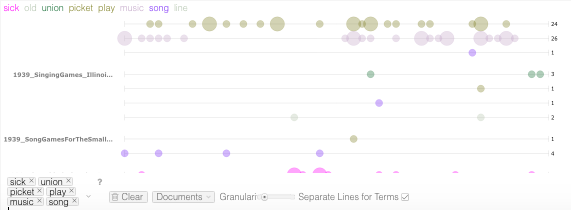
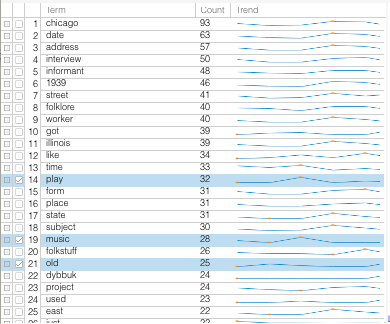
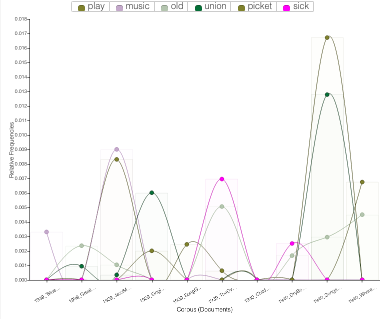
So, having uploaded my own miniature corpus of FWP sources, I began looking up keywords. Some of the suggested terms, ranked by their prevalence throughout the documents provided (and which were not merely derived from the standard headings of each), were: play, union, picket, music, sick, and old. I think that these key words give an interesting summary of the topics, but also of the themes at play in the city. The sources which I compiled covered a variety of subjects, all centered in Depression Era Chicago. From my close readings as I looked deeper into the prevalence of these key words, I learned that during this period, there was a strong push for unionization and workers rights. A surprisingly large percentage of the recorded children’s songs—mostly sung while playing jumprope games or other similar activities in the schoolyard—referenced parents working in factories or organizing picket lines, indicating the reach and social upheaval of the workers’ protests of the time. According to other sources, which recounted the folklore of various pockets of Chicago’s community, illness and disease were also prevalent during this time. In some Jewish communities, it was believed that these illnesses were caused and spread by an entity called a “Dybbuk,” yet it is noted that the Dybbuk only attaches itself to Jewish people, and that the illnesses did spread elsewhere as well. Finally, the last key word that struck me was music. Beyond the song games of Chicago children at the time, there were also multiple sources in this collection which discussed jazz and blues music, suggesting an uptick in their importance and popularity in the city. Especially where the blues genre is concerned, music provided an artistic outlet and an escape from the hardships of daily life, in a context which was not only heavily impacted by the Depression itself, but was also undergoing radical social changes and demonstrations in terms of its industrially-based economic. 

Overall, I felt like this tool was incredibly useful in helping me visualize and articulate my exploration of my historical question. The various ways that key word prevalence was displayed helped me find common threads throughout the majority of my compiled sources, and isolate core themes of the time. Ultimately, I was not surprised by what I found through this tool. The commonalities presented through the charts, lists, and graphs were similar to those that I had noticed while converting, compiling, and close-reading my files in Part I, however the tool greatly helped me understand which points called for the most focus, and how things overlapped. It is a great visual tool for those who, like myself, need a visual representation of the information in addition to written notes.

My final note on my historical question is this: The folklore and music of New Deal Era Chicago is home to a wealth of information. These sources provide us with incredible commentary on political issues, community health, and forms of escapism, even in the places we would least expect, such as the children’s jump rope rhymes. Combined together, this collection paints a vivid, albeit austere, portrait of Chicago between 1939-1941, and allows for a more personal view of the state of the city. The interview and observation based sources effectively capture glimpses of daily life, in a way that formal histories may fail, and because of this I will close with the argument that folklore and song serve a vital purpose in shaping our understanding of a culture, from city to civilization.

(Please note: I’m still having trouble figuring out how to make footnotes, but I promise I am trying)

Works Cited:

Posner, Miriam. “Miriamposner/Voyant-Workshop.” GitHub, github.com/miriamposner/voyant-workshop/blob/master/investigating-texts-with-voyant.md.

American Life Histories: Manuscripts from the Federal Writers’ Project, 1936-1940  :  Digital Collections  :  Library of Congress.” The Library of Congress, www.loc.gov/collections/federal-writers-project/about-this-collection/.

Blog #4: Fountain Hughes Interview

https://cdn.knightlab.com/libs/timeline3/latest/embed/index.html?source=1yuymGrfqyXu8LRDXBN9WrnB4dsk4Ayr4UzD_taeYAsw&font=Default&lang=en&initial_zoom=2&height=650
(note: Embed function was not working for this link)

The interview with Fountain Hughes revealed a lot concerning the experience of slaves post-abolition. Often, the historical narrative is approached with the oversimplified attitude that once slavery was abolished, the freed former slaves and their families were just that: free. Hughes discusses how the early days of his freedom were almost as confining and difficult as his youth in captivity. The freed slaves had nowhere to go, and work was difficult to find. Younger people were not allowed to be financially independent, as people would accuse them of stealing rather than acknowledge that they worked hard to earn their money. He describes hiding out in hidden places like barns or old cars, alongside his brother, because after they were freed (in his words: “turned out, like a lot of cattle”) they had no homes. These details add a new perspective on slavery and freedom. Legally, they might have been free, but socially and economically they were still kept down. This would only continue with the addition of Jim Crow Laws during reconstruction. One thing that was half-mentioned towards the end of the interview, but not actually explained on tape, was a mention of Hughes rejection of church-going. He makes some declarations about how he doesn’t go to church, and doesn’t believe in it, but fails to extrapolate. The interviewer offers to turn off the recorder for him, in case its a sensitive topic, but Hughes replies that it’s nothing offensive. Nevertheless, the recording stops there, and I feel like he might have had something really interesting to say on the matter, especially since throughout the different interviews I looked at, many of the interviewees expressed a stout devotion to Christian spirituality and worship.

This interview has the incredible perspective of a man who was 101 years old at the time of his interview. However, because of this, there were many things he could no longer remember, simply due to his age. One of the flaws of oral history as a primary source is that human memory is fallible—a fact supported by social psychologists and studies on the usefulness of witness testimony. However, that being said, one can learn a great deal about the cultural context of a memory based on how it is recounted. While there might be limitation to objectivity, due to innate human bias and imperfect recollection, the manner in which one remembers an event can relate a great deal about the events being described, the social climate and the speaker’s place in it at the time of the memory, and the way in which the speaker’s opinions have changed in the time since. From an anthropological perspective, oral history is an invaluable primary source because of this—the focus is less on objective truth, and more on the “truth” of the individual. I think that it stands as an similarly important tool for historical research as well, but the difficulties regarding specific facts and objectivity might come into play a bit more.

I think it is incredibly interesting that these interviews were conducted in the 1930’s and early 1940’s, especially because segregation was still in full swing at the time. I wonder whether the devastating socioeconomic impact of the Great Depression may have influenced people to feel increased sympathy for those who had always been at a disadvantage, now that they had experienced incredible poverty as well. But, then again, that might be a bit too idealistic of a concept given the social prejudices of the time. 

Norwood, Hermond, and Fountain Hughes. Interview with Fountain Hughes, Baltimore, Maryland. Baltimore, Maryland, November , 6, 1949. Pdf. https://www.loc.gov/item/afc1950037_afs09990a/.

Blog Post – Image Analysis

I knew that I wanted to use a color photograph for this assignment, so when I went to browse through the collections at our disposal I was immediately drawn to the bright colors present in the image. I was also drawn to the expressions of the children, and what I considered a very classic setting—a state fair. It is a beautiful and simple scene, but full of chaos, and those qualities piqued my interest. I feel like the focus on the children is unique—often we focus on the lives of those who had already reached adulthood by the time the Great Depression hit, but I liked that this photographer chose instead to focus on the children who were born during that time, and who were growing up at a turning point in American history.

One of my lingering questions about the photograph is what the context surrounding the fair was like. The focus on this one moment of festivity might potentially create a harsh contrast at the return to daily life, or perhaps it could not. The children pictured in the photograph are dressed up in clean, matching outfits, likely their Sunday best, and it is obvious that some effort was put into presentation when their family decided to attend the State Fair. I feel that this may harbor some yet-unexplored cultural implications–how important were community events like this to people at the time? How does the importance (or lack thereof) compare to current trends?

Modern American society is heavily digital, and heavily reliant on digital images for everything from research material, to social interaction. I would even dare to hypothesize that just as a family may have put on their best clothes to present themselves at a community event, such as the pictured fair, that modern-day Americans practice the same meticulous self-framing to present themselves well in digital media every single day. As an anthropologist I am naturally curious about the seemingly inherent drive to look good to others, and although my main focus in my image analysis itself operates around the themes of nostalgia and romanticization, I think that it is interesting as well to look at the consistency of American culture’s relation to self-image, which is depicted through the figures in this photograph.

Links:

Omeka Item – http://jessicadoeshistory.com/cnd/items/show/191
Omeka Exhibit – http://jessicadoeshistory.com/cnd/exhibits/show/francesca-reimer—at-the-verm

Works Cited:

“Farm Security Administration/Office of War Information Color Photographs – About This Collection.” About this Collection – Prints & Photographs Online Catalog (Library of Congress). Library of Congress, January 1, 1970. https://www.loc.gov/pictures/collection/fsac/.

Jack. “At the Vermont State Fair, Rutland.” Home. Library of Congress, January 1, 1970. https://www.loc.gov/pictures/item/2017877403/.

Blog Post #2

Text searches allow us to sift through thousands of documents in an instant, to find helpful sources when conducting research. While many of these documents, such as published articles, already exist in a digital format, most primary sources must undergo a process of digitization. Some primary sources have different typesetting styles than modern computers, and others are handwritten primary sources. In these cases they must be manually digitized and typed out by the database creators. Once entered into the database, keywords can be used to find specific details from the collection of primary source material. Text searching easily allows one to track topics and even individuals through the source record. One thing that I feel is lost in digitization of source material is the significance of the physical, visual aspects of the primary source, such as the style of the script used in handwritten ones, or the specific formatting used in the typesetting of historical documents. Although small details, I feel that these are still important for giving contextual clues as to the origins of the information, as well as cultural indicators in terms of stylistic trends. However, in exchange for this loss, we receive both convenience and accessibility, which is equally vital.

In our class on Wednesday, we touched upon the use of open source websites and databases in instances of national tragedy, or civil unrest, such as in response to 9/11, or the Baltimore Uprising in response to the death of Freddy Gray while in police custody. These websites compile information that can be searched to help make sense of shocking and sudden events, in which people are separated from their loved ones, and need a means of checking updates to determine their whereabouts. These websites are examples of digital projects, of one nature or another—website or database—effecting social change. With the Baltimore Uprising 2015 Archive Project, people involved in and/or interested in the cause and legacy of the protests are able to keep alive the knowledge of the injustice dealt upon Gray. They are able to contribute to the preservation of the information circulating about his unlawful death, as well as the response to it, without being censored or silenced. Digital media gives a voice to those who otherwise might be drowned out. Another example of this, although loosely tied to this posting, would be the use of twitter and “live-tweeting” during the Ferguson protests in response to the death of Mike Brown in 2014, a year before the Baltimore Uprising. Protesters were able to give live updates about the situation in Ferguson, and took on the roles of journalists in their own right by recording footage and writing about the events as they transpired, much of which went ignored by popular news outlets. Digital media allowed them to spread news of their situation nationally, as well as world-wide, while it was still transpiring. I think that these examples demonstrate the power of global, online accessibility for the sake of social change. Digital projects, from formal organized websites like the Baltimore Uprising Archive, to informal collections such as the hashtags used to compile tweets from the Ferguson protests, have an incredible reach. While the act of digitizing old sources might take away context or flavor, the creation of new digital projects permits the creation of sources that otherwise would have gone silent. In either case, the need for accessibility is ultimately paramount.

“Preserve The Baltimore Uprising 2015 Archive Project.” Preserve The Baltimore Uprising 2015 Archive Project, The Maryland Historical Society, baltimoreuprising2015.org/about.

Desmond-Harris, Jenée. “Twitter Forced the World to Pay Attention to Ferguson. It Won’t Last.” Vox, Vox Media, 14 Jan. 2015, www.vox.com/2015/1/14/7539649/ferguson-protests-twitter.

Blog Post #1 – Project 33

I really enjoyed our brief dive into how we define technology. I thought it was really interesting to look at how our modern digital tools, such as hard drive folders or ebooks, can be traced back to concrete versions, and their entire history. I think that it is easy to forget the histories of the technology and objects that we use every day. I’m hope to learn more about the history objects in this class, and to redefine my understanding of technology.

I felt like Project #33, which discusses while streamlined and visually appealing, was not terribly engaging. The writing in the front summary/abstract paragraph was written in opaque in a manner that lacked appeal to viewers outside of the historical field who might not be accustomed to reading denser texts, and yet the text in the topics page was almost oversimplified. I think that a stronger introduction and images beyond graphs and charts be utilized to build interest and humanize the hard statistical data. Furthermore, the front webpage appears at first to be the introduction page, but only after reading through the entire study did I realize that a lengthy and detailed introduction existed separately. The webpage would benefit from better organization. I do, however, think that this study was very interesting—one point in particular that stood out to me was the fact that even though fugitive slave advertisements in Richmond rose during the Civil War, hiring and wanted advertisements remained at a fairly separate level. This indicates that even as the war continued and more and more slaves managed to escape to the north, people were still unwilling to hire replacements, rather choosing to continue endorsing the institution of slavery.

Nelson, Robert K. “Mining the Dispatch.” Mining the Dispatch. The University of Richmond. Accessed September 2, 2019.

css.php