Blog 6

Using Voyant for this skill assignment was a slightly bizarre experience for me. It required altering my research question several times and altering the conceit of my question all together. Initially my question sought to figure out how leisure and play activates impacted by the Great Depression in different parts of the country. However I didn’t grasp the different layers that I needed to understand in order to properly answer that question.

 Considering the way that Voyent processes information, scanning through the texts that contained the word “play” was not all together helpful because the context would be removed and I would need to close read through hundreds of texts. I also realized that one of my previous search terms, leisure, was only helpful when searching through the library of congress archive because it was a categorization term rather than a word that was naturally occurring in the text.
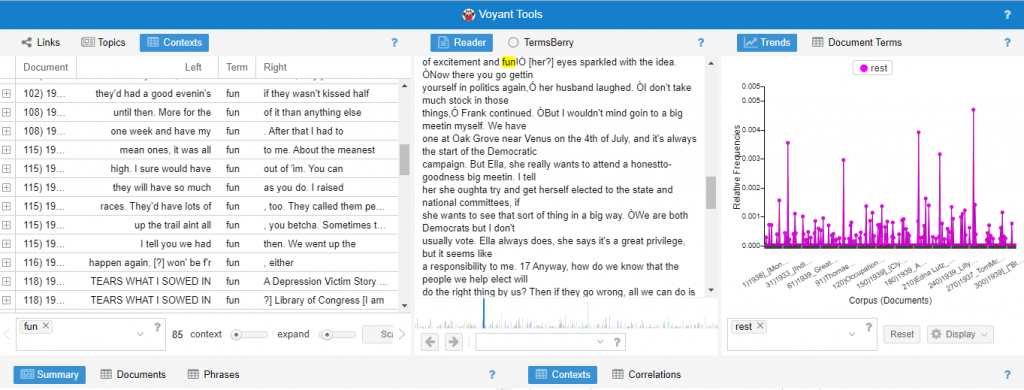
Looking for ‘fun’ in context

With all of this information as my foundation, I chose to approach my question from a different angle and simplified my question all together. My question essentially became ‘How did people have fun during the Great Depression’. I used the words ‘fun’ and ‘relax’ and analyzed them through the context tool. This allowed me time find every instance that these words were used while also seeing the context and way in which it was used. The tools allowed me to do a quick scan of the information and in the adjoining view look at the reader view and skim through several paragraphs of the source. I found this to be more helpful than any of the visualization tools.

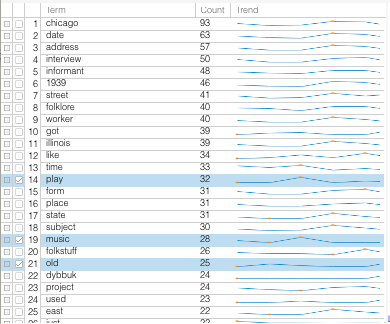
A bulk of the sources seemed to indicate that music, jazz music in particular where popular as vehicles for fun. Then I backtracked, looked at the sound cloud, selected the word ‘music’ and was able to see its use across a multitude of sources. From that point I was then able to select specific interviews to read more closely to form my opinions and conclusions.
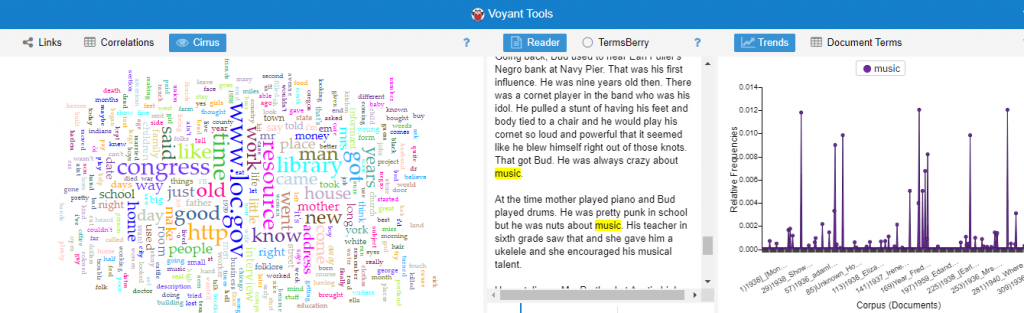
Using Music as my search term from the word cloud

Ultimately my my simplified question ended up with a simplified answer. For fun, most people turned towards music, jazz in particular to forget about the worries for short periods of time. Delving deeper into the sources also brings in information about which cities where predominate in the jazz scene and who was playing the music.

Although I think there is merit to distant reading, I think my preference will always be for close reading. “Personal recollection has a significance of its own” 1 and i think that is best understood on a singular level rather as an aggregated data point.

Voyant is at its most useful when being used to analyze words absent of context (key word searching, graphs, word clouds, etc) and then allowing the user to re-contextualize the information rather than attempting to superimpose any particular question on the analysis. Miriam Posner mentions that discern significant differences among text and those difference being deemed meaningful 2 are not the same things. Whether or not text analysis is actually helpful depends directly on information one is attempting to transform.

Look to the Margins

In the FWP’s records how does the involvement and voice of African-American Women vary through singular vs. familial accounts?

Do African-American Women fall into the abyss of words and accounts as the corpus of FWP focuses on other voices?

I selected my sources by submitting myself to the mercy of the Library of Congress digital algorithms. After I used the African-American filter to ensure I was in the right place I picked the first 5 women’s accounts and the first 5 family/couples accounts. I did this because someone wanting to see the basic African-American women’s account would see these documents. So I purposefully did not use severe discretion with my options.

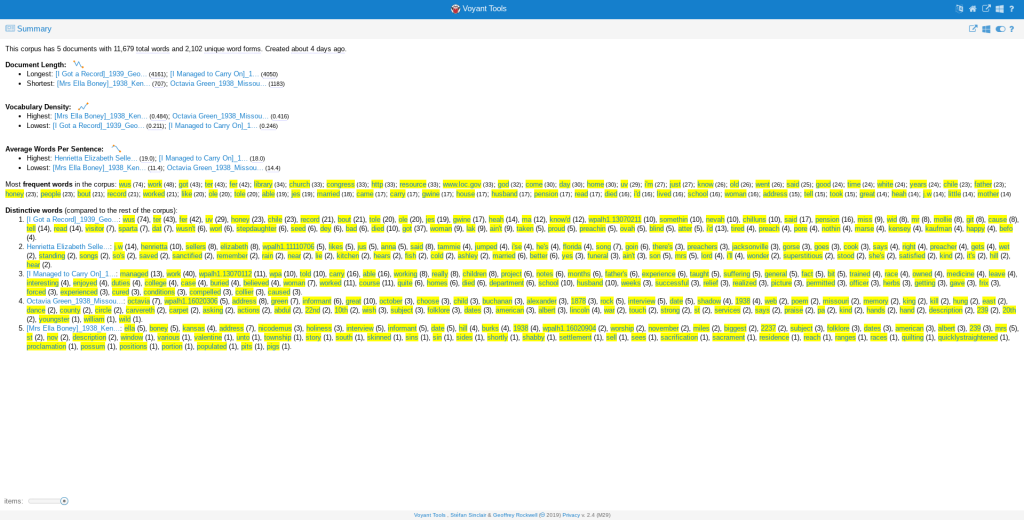
The Voyant tools were incredibly useful in thier scope in their use of distant reading. Uploading the corpus was easy and efficient. Of all the tools the “Distinct Word” and “Vocabulary Density” feature stood out the most. Voyant alligns the documents in terms of most which ones have the most dense vocabulary vs. the least dense vocabulary. The women’s and Familial accounts both have pretty evenly dense vocabulary, and the same ratio is in the document length.

These comparisons show that with this document sample can truly only tease certain questions. However, those questions it teases are lost within the confines of an overflow of text in the broad corpus.

My question is about the voices of African-American Women, and there is no way to that within the confines of this overwhelming amount of documents that the voice of a Minority can be heard. If I am to properly seek an answer to my question my 10 documents need to be the topic of study.

Everyone during the great depression was concerned about work. That concern is reflected in the common word in all data clumps of the word “work.” However, One particular feature that stands out among the comparison are the dialect words.

In the African-American women’s accounts dialect words are a huge component of the culture. One story in particular, [I Got a Record], records not only what she says but how she says it. Dialect history is as much as necessary part of history as any.

In the main corpus many of the dialect words are not present, and thus erases an element of the story. Their culture is lost in a see of words. Their stories are just so unique and different that it does not “fit” with the rest of storylines. For history to be told properly it needs to be organized according to catagory. Rather than an overarching narative filling the space a need for categorized and harmonious naratives are needed. Every topic must have a consideration of race and gender because it changes the perameters.

Historical questions are only as good as the tactics we use. If we wish to look at the broad picture of the entire corpus, then we see the main concerns of the entirety of the people. But with this decision lose certain aspects of it within the quantity of words. Distent reading is good for answering questions of generality, but close reading is necessary to understand the specific categorical naratives.

Blog #6: Folklore and Music in Depression Era Chicago, Illinois

My historical question asked what folklore and folk music from 1930’s Chicago could reveal about the social climate of the time. I based this question off of a collection of ten different sources from the FWP corpus, with this specific interest in mind while I compiled them and close-read them in the first part of the assignment. Folklore and folk music have always interested me, as I see them as a crossroads between the fields of history and english, so when I discovered a wealth of documents pertaining to music in particular, all from the same place and time, I was immediately intrigued. I recognize after working through the second half of this assignment that my topic perhaps might be better suited for a paper or presentation, instead of a key-word based assignment using Voyant Tools, however I have tried my best to make it work with the technology at hand by focusing my text analysis specifically on my own smaller corpus of materials rather than the extensive library of files downloaded from Dropbox. Originally, I tried to navigate through the entire zip file provided to us, however this proved extremely frustrating and hindered a lot of the research I wanted to get done.

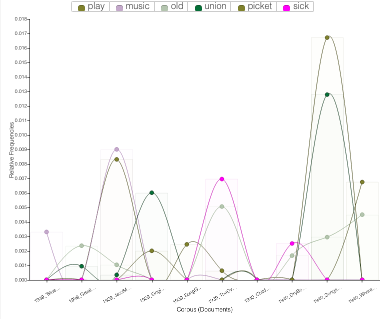
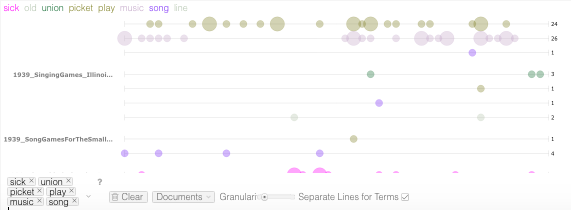
So, having uploaded my own miniature corpus of FWP sources, I began looking up keywords. Some of the suggested terms, ranked by their prevalence throughout the documents provided (and which were not merely derived from the standard headings of each), were: play, union, picket, music, sick, and old. I think that these key words give an interesting summary of the topics, but also of the themes at play in the city. The sources which I compiled covered a variety of subjects, all centered in Depression Era Chicago. From my close readings as I looked deeper into the prevalence of these key words, I learned that during this period, there was a strong push for unionization and workers rights. A surprisingly large percentage of the recorded children’s songs—mostly sung while playing jumprope games or other similar activities in the schoolyard—referenced parents working in factories or organizing picket lines, indicating the reach and social upheaval of the workers’ protests of the time. According to other sources, which recounted the folklore of various pockets of Chicago’s community, illness and disease were also prevalent during this time. In some Jewish communities, it was believed that these illnesses were caused and spread by an entity called a “Dybbuk,” yet it is noted that the Dybbuk only attaches itself to Jewish people, and that the illnesses did spread elsewhere as well. Finally, the last key word that struck me was music. Beyond the song games of Chicago children at the time, there were also multiple sources in this collection which discussed jazz and blues music, suggesting an uptick in their importance and popularity in the city. Especially where the blues genre is concerned, music provided an artistic outlet and an escape from the hardships of daily life, in a context which was not only heavily impacted by the Depression itself, but was also undergoing radical social changes and demonstrations in terms of its industrially-based economic. 

Overall, I felt like this tool was incredibly useful in helping me visualize and articulate my exploration of my historical question. The various ways that key word prevalence was displayed helped me find common threads throughout the majority of my compiled sources, and isolate core themes of the time. Ultimately, I was not surprised by what I found through this tool. The commonalities presented through the charts, lists, and graphs were similar to those that I had noticed while converting, compiling, and close-reading my files in Part I, however the tool greatly helped me understand which points called for the most focus, and how things overlapped. It is a great visual tool for those who, like myself, need a visual representation of the information in addition to written notes.

My final note on my historical question is this: The folklore and music of New Deal Era Chicago is home to a wealth of information. These sources provide us with incredible commentary on political issues, community health, and forms of escapism, even in the places we would least expect, such as the children’s jump rope rhymes. Combined together, this collection paints a vivid, albeit austere, portrait of Chicago between 1939-1941, and allows for a more personal view of the state of the city. The interview and observation based sources effectively capture glimpses of daily life, in a way that formal histories may fail, and because of this I will close with the argument that folklore and song serve a vital purpose in shaping our understanding of a culture, from city to civilization.

(Please note: I’m still having trouble figuring out how to make footnotes, but I promise I am trying)

Works Cited:

Posner, Miriam. “Miriamposner/Voyant-Workshop.” GitHub, github.com/miriamposner/voyant-workshop/blob/master/investigating-texts-with-voyant.md.

American Life Histories: Manuscripts from the Federal Writers’ Project, 1936-1940  :  Digital Collections  :  Library of Congress.” The Library of Congress, www.loc.gov/collections/federal-writers-project/about-this-collection/.

css.php