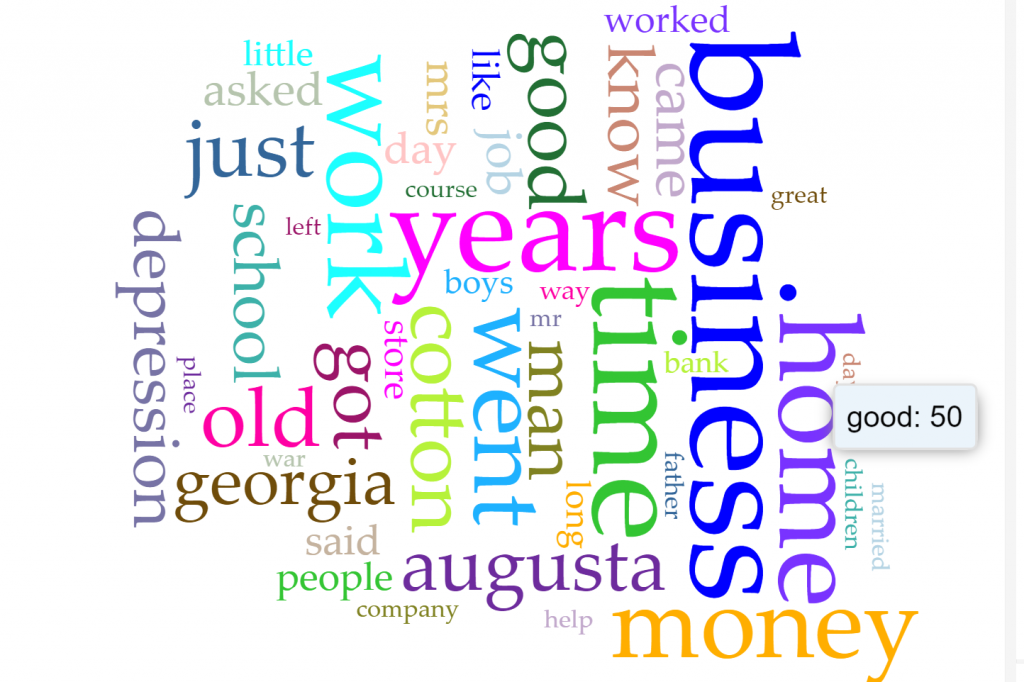
For this project, I decided to use my own corpus, which is the 10 files that relate directly to my historical question. My historical question is, “How did the aftermath of the Great Depression affect the people who lived during it”. Through this question, I was able to find several files that matched up well with this topic and gave me a great insight into my question. However, I chose to compare it to the class corpus as well to try and be and visualize the similarities and differences between both of the corpus.
The American Yawp gave me great insight into the great depression and how it affected everyone’s lives. They talked about how it affected the market directly by saying, ” The market temporarily stabilized but fears spread over the weekend and the following week frightened investors dumped their portfolios to avoid further losses.”. 1 “The Great Depression” American yawp. http://www.americanyawp.com/text/23-the-great-depression/2. This quote helped me narrow down what I wanted to do for my distant learning even before I had used Voyant tools. The podcast on Hoover, who was president at the beginning of the great depression, talked about what happened to people after the market crashed. “Nearly half of its banks failed, nearly a quarter of its workforce out of a job.”. 3 “The Memory Palace”, Podcast, http://thememorypalace.us/2017/10/hoover/ . This led me to decide what I wanted to look at in my corpus. What I immediately noticed within my corpus was the word business. It was easily the biggest word on the Cirrus image. I was able to find that the word business was mentioned over 100 times in all of my files; this led me to do my distant learning based on this word because all of the other words were smaller and did not hold as much importance. When looking through where the word business fell in my files I found a pattern. Every time the word was mentioned it was either that the person owned a business, worked within a government entered business, or just were apart of a standard business. Several people had lost or closed their business as soon as the stock market crash while others did a few years later. For example, in one of my files titled “Honest and Fairness to the Bitter End”, a man had to close his business in 1936, seven years after the stock market crash. He had mentioned that people have tried to help him keep it open, but nothing was successful. I was surprised that he was even able to keep it open for a whole seven years. Secondly, I saw that many people had mentioned that after the stock market crash the government promised that businesses would resume but most of them never did.
My last step was comparing my 10 files based on my historical question to the large class corpus. First off, there was a larger amount of results in the class corpus because there were 300 more files. I was surprised to see that in the larger corpus I could not even find the word business in the cirrus. I thought I would for sure see the word business but I could not find any information on it. The biggest word in the larger corpus was “resources” and it was mentioned almost 2000 times; compared to the largest word in my corpus which was only mentioned about 100 times. Secondly, the trend graph for both of the corpus was drastically different. The class corpus trend graph was much more congested and harder to visualize. Whereas my corpus trend graph was easier to understand and pick out certain themes. In conclusion, I was able to compare both of the corpus and how we can learn to distant learn from a little information to a larger amount of information.
Citations: “The Great Depression” American yawp. http://www.americanyawp.com/text/23-the-great-depression/
“The Memory Palace”, Podcast, http://thememorypalace.us/2017/10/hoover/.