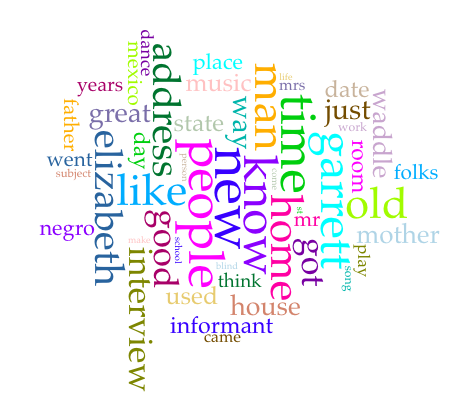
My historical question was: How were the lives of musicians in the 1930s, primarily minorities, impacted by the time period/events? After reading through many interviews that seemed like a great question to answer, however, after using the voyant tool and looking at these interviews through a distant reading scale, I was able to notice things I didn’t before. I was initially able to see what words were most commonly used through the use of the “word cloud, with more frequently occurring words shown in a larger size.”1 The first word that stuck out to me was “home.” It’s a simple word that holds variable meanings depending on who’s using it.
My question shifted from how musicians’ lives were impacted, to what did these musicians consider to be their home? To stay on the theme of musicians I was limited to using only my documents, as the others did not quite apply. This proved to work out better anyways as it allowed me to better compare how words were used in fewer documents. One of the features I relied on was term searching and plotting them on the trend graph. My initial goal was to search between terms I thought would relate to “home” and see if the trends aligned.
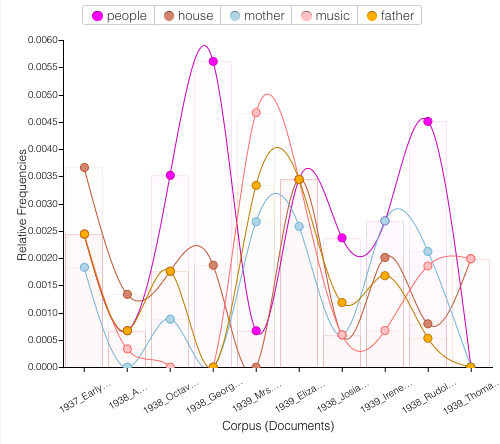
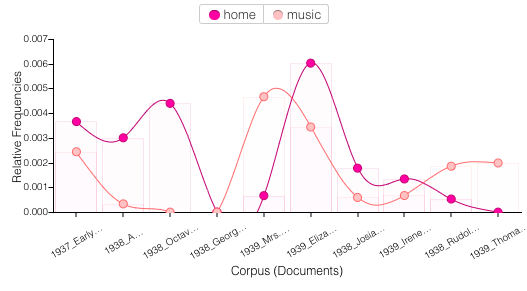
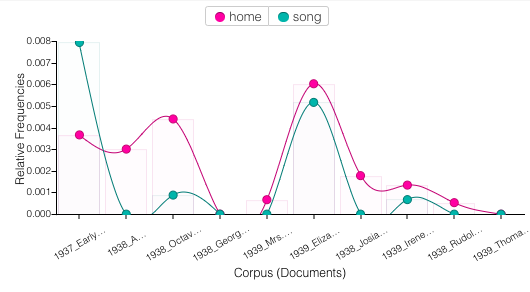
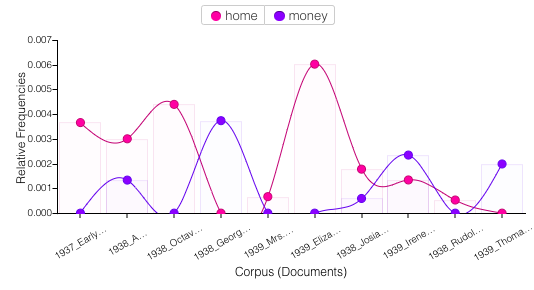
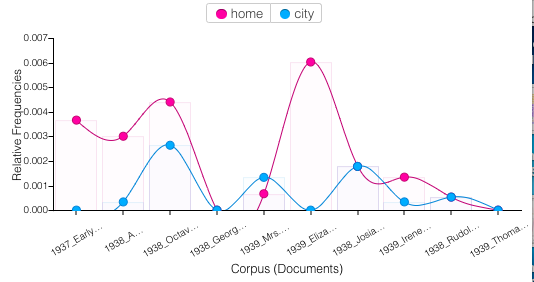
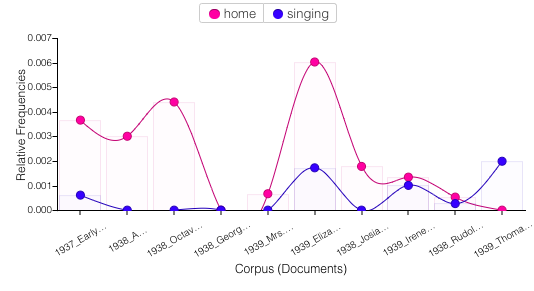
While the meaning of “home” clearly means different things to the different people in each interview, there are still some similarities. The greatest similarity between all individuals that were interviewed, is that they used the words “home” or “house” to a similar frequency they did as words used to describe family members. With a few exceptions, physical places weren’t commonly used, so it can be assumed, many of them didn’t associate home with a physical location. This makes sense when considering the migratory nature of the time period, especially with so many musicians being inspired by the events of the dust bowl and great depression.23 Although through distant reading, it can be difficult to tell for certain whether or not this is entirely accurate, it provides a great start to look at these interviews more closely and gain a better understanding.
- Miriamposner. “Miriamposner/Voyant-Workshop.” GitHub. Accessed November 8, 2019. https://github.com/miriamposner/voyant-workshop/blob/master/investigating-texts-with-voyant.md.
- Dana Cochran et al., “The Great Depression,” Matthew Downs, ed., in The American Yawp, eds. Joseph Locke and Ben Wright (Stanford, CA: Stanford University Press, 2018).
- “The Migrant Experience : Articles and Essays : Voices from the Dust Bowl: the Charles L. Todd and Robert Sonkin Migrant Worker Collection, 1940-1941 : Digital Collections : Library of Congress.” The Library of Congress. Accessed November 8, 2019. https://www.loc.gov/collections/todd-and-sonkin-migrant-workers-from-1940-to-1941/articles-and-essays/the-migrant-experience/.
