Final Project: Digital History in the 1930’s

Although I came into this class having knowledge of the 1930’s, the skills and resources we have used this semester has allowed me to gain new insight and perspective on the time period and how we can view history overall. Reflecting on what we learned through the use of these digitized tools I am reminded of Tony Guidone’s presentation in which we discussed the benefits and possible downsides to use of these tools. An example of which can be found in Ian Milligan’s article where he talks about the impacts of the Globe and Mail and the Toronto Star being digitized. Before digitization most newspapers were cited around the same amount. However, after the Toronto Star was digitized, it was cited far more frequently than its non-digitized counterparts.1

One of my favorite skills we learned this semester was being able to glitch images and that’s why I decided to use that for my final project. The first time we saw this being used was in Michael J. Kramer’s example of glitching, which places an African American man in the forefront of the image instead of the two other white men revealing a new narrative for folk music.2 I glitched an image of an older man sitting peacefully playing the violin. The glitching process not only created an entirely new feel to the image but allowed me to view details about the image I missed before.

The second tool I used was soundcite to help convey exactly what I was describing. Inserting sound clips makes what I’m talking about seem not only more personal, but real to the reader or listener. As Peggy Seeger suggests, you can’t “live those stories” without hearing the “voices on the recordings, drenched as they were in sorrow, joy, anger, poverty.”3 Without this tool, the reader wouldn’t be able to fully grasp what the meanings behind any of the clips.

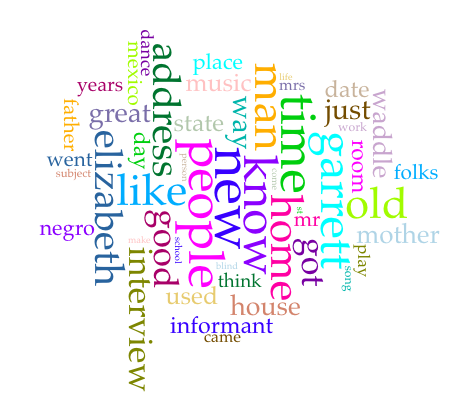
The third and final tool I used was the voyant tool which allows me to visualize text in a new way that furthers understanding. It was tricky to use at first, but once I was able to understand the mechanics of it, I was able to begin analyzing different texts. For my project, I compiled various different songs that were popular in the 1930’s and put all of their lyrics into voyant to analyze the songs based on specific words used. Based solely on the songs I chose, I thought that I had an idea of how the text analysis would go, however, after using the voyant tool and taking a look at these songs through a distant reading scale, I was able to notice things I didn’t before. I was initially able to see what words were most commonly used through the use of the “word cloud, with more frequently occurring words shown in a larger size.”4 Some of the popular words weren’t surprising, but there were others I didn’t expect to be on there, which opened up the opportunity to look at these songs and their historical meanings in a completely new way.

Final Project Link: http://jessicadoeshistory.com/cnd/exhibits/show/introductiontomusic
Folk Songs in the 1930s

The very first audio I listened to was from the collection “Voices from the Dust Bowl.” I’m not sure why I picked this specific audio and frankly, I can’t be sure if I even liked it or not. It’s certainly an intriguing song performed by Ruth Elliot in the summer of 1940 in Arvin FSA camp. The song, titled “The Old Apple Tree in the Orchard,” starts off quite beautifully and simple by depicting a child reminiscing about their father and an apple tree he planted. However, the song quickly takes an interesting turn when the singer then describes the father having an affair with a married woman, followed by his subsequent murder by the neighbors for doing so.5 This song certainly brought this question to mind: why were folk songs like this so popular for everyday Americans in the 1930s?

The song was sung as if it was a common children’s rhyme that just about everyone knew and loved. Despite what the lyrics suggest, the manner in which the performer is singing gives the song more of a humorous tone than a dark one. The song doesn’t seem to have too much historical meaning as it seems to have been written solely for entertainment purposes, but perhaps the reason for entertainment in the time period creates a historical relevance for the song.

The LA Times article by Morris Dicksten suggests that the arts, primarily music and movies, were not a means simply to distract Americans from their everyday struggles but was more of a means to counteract the crippling economy.6 Dickstein was probably right in that assertion, but for everyday Americans of that time, the arts likely meant more as a distraction than an economical support system that they wouldn’t see positive effects from for many years. In the Library of Congress article, “The Migrant Experience,” the author states that “when they were not working or looking for work…the migrants found time to engage in recreational activities,” such as “singing and making music.”7 “The Old Apple Tree in the Orchard” certainly sounds like a song that was likely created out of boredom to create a lighter atmosphere than the situations the Depression and Dust Bowl created.

Mapping Utah

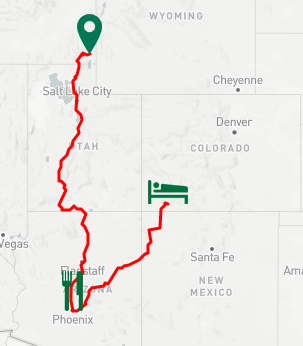
This skill assignment was a great way to visualize the migratory nature of people in the 1930/40s.As we have already discussed, events such as the depression and dust bowl, affected the majority of Americans, but there were many other problems that affected specific minority groups which is shown through the Green Book Map. Of course, traveling can be difficult for anyone, but especially for minorities as they have to worry about where they are going and who they might encounter along the way.

When comparing the tour I studied to a trip plotted using the Green Book project, I was initially shocked at how there were no available stops along the route. Upon reflection, I realized how naïve it was for me to even think otherwise.

The two nearest stops were completely of course in two different states, Arizona and Colorado. I lived in Utah for almost two years and the state is predominantly white. Of course, being white myself, it would be easy to forget this, but looking at the Green Book map puts into perspective just how difficult it must currently be and have been in the past to be a person of color in a state like Utah. Despite there being many tourist attractions in the state such as ski resorts, hiking, and other outdoor activities, there is still a lack of diversity. The Green Book Project is optimistic that “There will be a day sometime in the near future when this guide will not have to be published, that is when we as a race will have equal opportunities and privileges in the United States.”8 Unfortunately, that is clearly not the case. However, projects like the Green Book Map and The Colored Conventions Project bring awareness of these systemic racial issues and paves the way for improvement. In Sarah Bond’s article she quoted a professor that mentions “In the West, so many of the documents that record Black history have been devalued and discarded.”9 This statement, along with the Green Book map, show just how important it is to recognize our history and use these tools to learn from past mistakes and better the future, especially for minority groups.

Map Link: https://uploads.knightlab.com/storymapjs/548a98e68fd38f2bde679d15d69f1ba3/utah-a-guide-to-the-state/index.html

Special Collections and The Federal Theatre Project

The Federal Theatre Project has been one of the most interesting WPA projects we’ve studied so far. Knowing that the George Mason “Special Collections Research Center began operation originally as the repository for the records of the Federal Theatre Project” further instilled my interest in the project.10 Going back to one of our earlier classes we discussed what could be gained or lost through the digitization of materials. An example of what is lost can be found in Ian Milligan’s article where he talks about the impacts of the Globe and Mail and the Toronto Star being digitized. Before digitization most newspapers were cited around the same amount. However, after the Toronto Star was digitized, it was cited far more frequently than its non-digitized counterparts. Due to its digitization making it so easily accessible, other sources such as the Ottawa Citizen were being ignored, creating an unnecessary hierarchy of sources.11 The special collections opens up so many research opportunities as it makes studying documents and archives easy and accessible. Although it may not be as easy as the Library of Congress or other online sources, being able to do a quick search and have documents broken down by box and folder makes finding them easy to find and access. Being able to actually see these documents in real life also brings about an entirely new feeling to the document. It makes them and the events of the time feel more real and not just a random part of history.

My understanding of the Federal Theater Project before our classes was that it was similar to many of the other WPA projects as it was intended to increase the employment rate of a group of people, actors in this instance, during the depression. However, after last week, I now understand that it had a much greater cultural impact than just creating jobs for the unemployed. The Theatre Project gave a voice to previously underrepresented artists such as the African American community, promoting diversity in the arts. The all-black version of Macbeth, the “Voodoo Macbeth, solidified the shaky reputation of the Federal Theatre Project.”12 Although controversial, this project, in my opinion, was probably one of the most progressive and important for American culture and society as it completely changed the future of American theater.

Musicians’ Homes in the 1930s

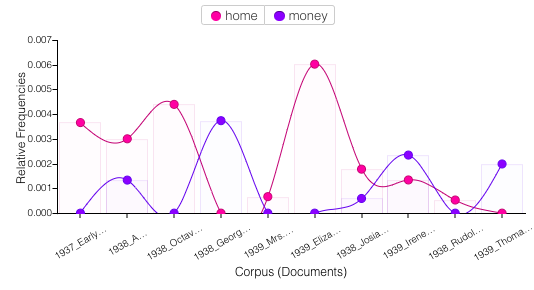
My historical question was: How were the lives of musicians in the 1930s, primarily minorities, impacted by the time period/events? After reading through many interviews that seemed like a great question to answer, however, after using the voyant tool and looking at these interviews through a distant reading scale, I was able to notice things I didn’t before. I was initially able to see what words were most commonly used through the use of the “word cloud, with more frequently occurring words shown in a larger size.”1 The first word that stuck out to me was “home.” It’s a simple word that holds variable meanings depending on who’s using it.

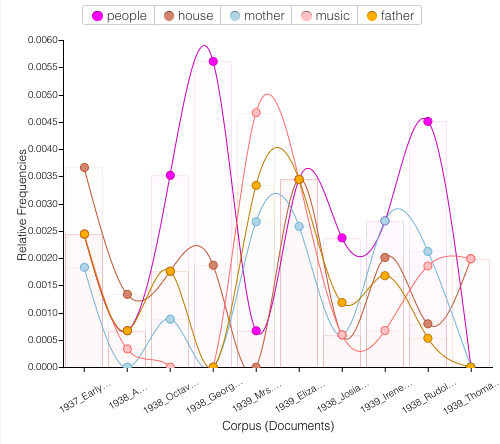
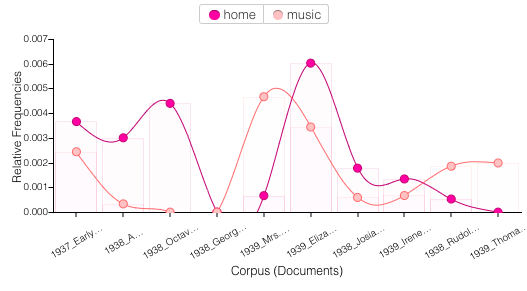
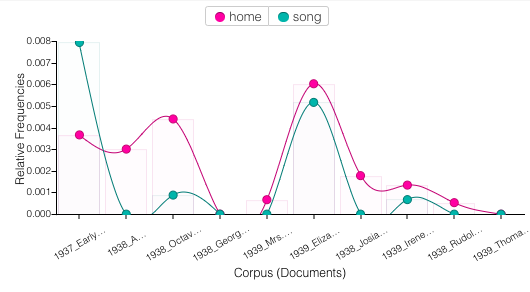
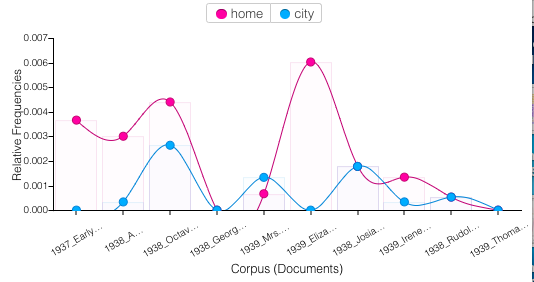
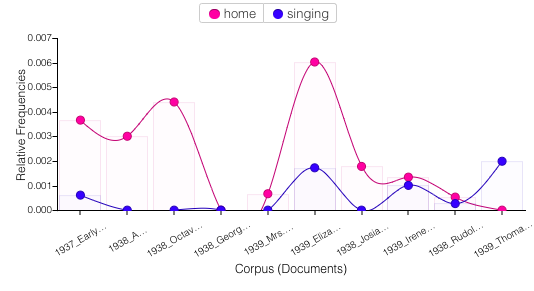
My question shifted from how musicians’ lives were impacted, to what did these musicians consider to be their home? To stay on the theme of musicians I was limited to using only my documents, as the others did not quite apply. This proved to work out better anyways as it allowed me to better compare how words were used in fewer documents. One of the features I relied on was term searching and plotting them on the trend graph. My initial goal was to search between terms I thought would relate to “home” and see if the trends aligned.

While the meaning of “home” clearly means different things to the different people in each interview, there are still some similarities. The greatest similarity between all individuals that were interviewed, is that they used the words “home” or “house” to a similar frequency they did as words used to describe family members. With a few exceptions, physical places weren’t commonly used, so it can be assumed, many of them didn’t associate home with a physical location. This makes sense when considering the migratory nature of the time period, especially with so many musicians being inspired by the events of the dust bowl and great depression.1113 Although through distant reading, it can be difficult to tell for certain whether or not this is entirely accurate, it provides a great start to look at these interviews more closely and gain a better understanding.

Timeline of Fountain Hughes

This skill assignment was very enlightening to me and I am grateful we were able to have access to such an incredible resource that gives us insight into our past. What I was able to learn from these interviews was not so much what happened exactly to slaves, but how the slaves viewed their past and current situations. The interview I listened to was that of a man named Fountain Hughes. His grandfather was a slave to former president, Thomas Jefferson. I found it interesting that it took so much prompting for him to recant his time as a young boy and slave. At first, he rambled on about money and being frugal. However, after a few more questions were asked, he started talking more about his childhood. I am not surprised that he didn’t initially wanted to talk about that time period as he clearly despised it. After recalling how difficult life has been for people after the Civil War, he stated that some former slaves were “sorry they are free now…some of them now would rather be slaves.” The interviewer then asked if Hughes would rather be a slave again or not, to which he replied: “If I thought, had any idea, that I’d ever be a slave again, I’d take a gun and just end it all right away.” 14 That was the most he had said about being a slave. There was more to learn from what wasn’t said, than what was.

This reflection on difficult times not only from the past but during the time the interview took place was very insightful into what life must have been like for African Americans in the 1930s. It was so bad that some “would rather be slaves,” implying that times must not have gotten much better by that point. This is also reflected in how they were excluded from many New Deal programs and many racist beliefs still held by many Americans. 15

Listening to the interview was a bit difficult as the quality of the recording made it difficult to understand, but what I could hear clearly, was the emotion behind what was being said. There wasn’t any anger, even when talking about hard times. There was mostly a feeling of a somber reflection. However, at times, I was also surprised by the lack of emotion. While modern technology would have made the interviews easier to understand, having them done during early to mid 1900s, gives us a unique perspective into the lives of former slaves before and after abolition.

Interview with Fountain Hughes, Baltimore, Maryland, June 11, 1949: https://www.loc.gov/item/afc1950037_afs09990a/

Timeline: https://cdn.knightlab.com/libs/timeline3/latest/embed/index.html?source=1zIYmXiIdLJ0qFPCJUJjDl3WUMEI-v7VJ5CUyqUnbHVA&font=Default&lang=en&initial_zoom=2&height=650

Algorithmic Oppression and the Long Civil Rights Movement

Before our readings on Algorithms and the Long Civil Rights Movement, I had never thought that discrimination could cross over into the digitized, artificial intelligence world. Of course, as a white woman, I have been ignorant to the ways this has impacted specifically women of color. However, upon reflection I can now see even more ways this occurs than just the example, given in Safiya Noble’s work, of the google search results of the phrase “black girls” turning up unwanted pornographic searches. I have noticed when I search for makeup products the first results are always aimed at white woman, and even if these companies offer products for darker complexions, they are not nearly as advertised as much or in the same way they are for lighter complexions. That experience especially stood out to me when Noble explained that “search results reflect the values and norms of the…company’s commercial partners and advertisers and often reflect our most demeaning beliefs, because these ideas…are normalized and extremely profitable.”15 Reading this allowed me to understand better the meaning behind the Long Civil Rights Movement and why the fight for African American civil rights continues in modern America.

The 1930’s were particularly difficult for women and people of color as many of the New Deal programs were directed towards men and left out, or discriminated against, racial minorities. Although this time period provided hard times, particularly for minorities, it did shine a light on many inequalities within the United States. One example of this was shown through the Social Security Act which blatantly discriminated against African Americans. Southerners were “afraid that economic security would allow black southerners to escape the cycle of poverty that kept them tied to the land as cheap, exploitable farm laborers.” When Roosevelt agreed with this, he removed domestic workers and farm laborers, which were primarily black men from the South, from the Act.16 This relates almost perfectly back to algorithmic criticism. Just like how Southern politicians were profiting from cheap labor in the 1930s, companies are profiting from the objectification of black women, which is only amplified through algorithmic searches.

Image Analysis & Glitching Process

I found the image I chose to use from the Farm Security Administration/Office of War collection. It is easy to tell how this image applies to the Office of War as it is an image of a man standing behind a large supply of military weapons and ammunition. This photo was taken in 1942, the year after the U.S. entered World War 2. The end of 1930s saw the beginning of the second World War. Despite the tragic events of WW2, the war did assist in bringing the U.S. out of the negative impacts of the Great Depression. More and more factories were opened and booming due to high demand in supplies for the war, creating many new jobs. As men went away to fight in the war, many women were left to take on jobs they left behind. 1 The benefits of World War 2 that the U.S. experienced makes me wonder: how did Americans of this time view the war and if did they support the war efforts?

Image analysis and the glitching process both offer different ways to look at and understand an image you may not otherwise. Simply by doing an image analysis on the original image allowed me to think more critically about what was happening in the image, the context and reasoning behind said image. The glitching process not only created an entirely new feel to the image, but allowed me to view details about the image I missed before. In Michael J. Kramer’s example of glitching, it places an African American man in the forefront of the image instead of the two other white men revealing a new narrative for folk music. 16 In the image I selected, there is a man standing behind a large amount of ammunition that can’t all be shown just from one picture, but after the glitch the amount of arsenal that is depicted seems endless. This allows us to think about just how much arsenal the U.S. needed and used during the war and just how much destruction, due to the fighting, and economic growth, due to an increase of jobs there was.

Exhibit Link: http://jessicadoeshistory.com/cnd/exhibits/show/thunderfortheartillery/artilleryin1942

Omeka Item Link: http://jessicadoeshistory.com/cnd/items/show/165

Text Searching Pros/Cons

I really enjoyed Tony Guidone’s presentation last week. It allowed me to gain a new perspective on digital history and how digital media may not always be the best resource for us to use. Text searching has certainly changed the way society engages with information, but not always for the better. When using text searching in research, we may be able to get said research done quicker and easier, but there is an added risk on missing out on vital information if we are relying solely on text searching and not reading thoroughly through the primary sources offered. However, in instances where text searching is used for non-research purposes it is a great tool to allow us to find information easily and quickly. This also encourages searching for answers to our questions as it is so easily accessible and easy to do with limited knowledge on the subject.

Tony focused a large part of his presentation on how digital projects can certainly benefit society, but can also allow some things to be lost after translating sources digitally. Despite what may be lost, digital media is still a great resource as it makes projects and research more easily accessible and attainable than they previously would have been. An example of this can be found in Ian Milligan’s article where he talks about the impacts of the Globe and Mail and the Toronto Star being digitized. Before digitization most newspapers were cited around the same amount. However, after the Toronto Star was digitized, it was cited far more frequently than its non-digitized counterparts. 1 Due to its digitization making it so easily accessible, other sources such as the Ottawa Citizen were being ignored, creating an unnecessary hierarchy of sources. Original meanings and context can also be lost due to digitization. One of the examples given in the presentation was that of German currency. During World War II, German coins started being made with a much cheaper metal than previously used. This is easily noticeable when holding a coin from before and after the war as the weight difference was significantly lighter in the cheaper coin, despite it appearing to be very similar online. 17

Blog Post #1

Although I have learned about the Great Depression and New Deal in previous classes, I can’t say I’ve ever thought about these events through the lens of technology and digital humanities. Our first week of class definitely left me more confused than when I went in, but after studying one of the projects and completing the readings, I do feel slightly more confident and I hope to see my confidence only grow throughout the semester. I do not have much prior knowledge of digital humanities, but I am eager to learn more about it and how it impacted the 1930s and beyond. In last Wednesday’s class, I found the slideshow of different technology developing through time very interesting. I was especially surprised that the silent disco/dance idea came far earlier than my time. I never would have thought or believed that in the early 1900s anyone could even fathom that idea. I’m curious to know what other ideas we had originally thought were new, were actually thought of before. It was interesting to see how ideas that seem specifically relevant to our time were just as relevant nearly 100 years ago.

The project I analyzed was Papers of the War Department 1784-1800. This is an ongoing digital editorial project that is seeking to reconstruct and transcribe documents of the War Department that were destroyed due to a fire in November 1800. Since this a collection of primary sources and historical artifacts this project would be classified as an exhibit according to Miriam Posner’s framework. The Papers of the War Department 1784-1800 project is pretty straightforward in that its goal to restore historical documents that were once thought to be lost and allow these sources to be easily accessible to the public and allow the public to participate in transcription. They provide digitized images of all documents and many have transcriptions that makes understanding and reading these documents easier. This project uses sources, such as such as letters and maps, from the 1784-1800 time frame which are then processed through reconstruction and digitized to allow users to transcribe documents that can be easily presented for public use.

Sources

Roy Rosenzweig Center for History and New Media, and George Mason University. “Papers of the War Department 1784-1800.” Papers of the War Department, wardepartmentpapers.org/s/home/page/home.

Posner, Miriam. “How did they make that?” UCLA Digital Humanities.

css.php