Depictions of African Americans

At the start of this semester, I was mostly unfamiliar with the history of the 1930s. The things I did know were painted using a broad brush in vague terms. I knew that the Great Depression occurred, as did the Dust Bowl and the New Deal. These were things I had obtained in previous history classes, but were mostly an afterthought, as discussion of the time period was relegated to describing the 30s as the period between the two World Wars. While this is accurate, I’ve since learned that it’s far from the full story. Hopefully, my exhibit accurately conveys the skills and information that I’ve learned.

For example, I had almost no knowledge of the folk culture that developed and exemplified the decade1. The nature of the Federal One Project was an interesting discussion, and the content that was created then seems just as relevant now. The extravagant theater productions that created new perspectives on classic works of art laid the groundwork for the many remakes that we see nowadays. Orson Welles thought he could make a version of Macbeth that would appeal to his audience2, just as Greta Gerwig is trying to make Little Women apply to a modern audience with her recent adaptation.

The digital tools we applied and learned about were incredibly practical, in a way that I wasn’t expecting in a history course. At the outset of the course, I was unsure what exactly an examination of the “Digital Past” would look like, or how it would apply to my work and studies. Even as a Journalism major, I had no idea how helpful many of these tools are, whether they help visualize information and data or they simply create new ways of thinking about older sources.

To start, image glitching was a helpful introduction to these digital skills, as it is in many ways a thought exercise. The results of image glitching can be used to reexamine what we think we know about the past, and look at it new ways or perspectives3. By transforming the nature of a source firsthand in a skill assignment, we were able to reassess the different values and limitations of sources that may not have been otherwise considered. Later in the semester, we also saw image glitching used to make a point, to emphasize the shifting nature of our culture and exemplifying the destruction of the myth of the nuclear family4.

For my exhibit, I tried to use the skills that I am most likely to keep with me as I pursue a career in journalism. Soundcite was the first skill that I selected. In traditional journalism, you are limited in the number of senses that you can engage. One is limited to telling a story through written words, without being to fully convey the sounds or smells or feelings associated with an event. Through the Soundcite tool, an extra sense can be added to the storytelling. I also used Voyant’s distance reading tools to create word clouds and links, because word choice is more important now than ever. Finally, I chose to use image glitching because I believe that the content that is omitted or rearranged in an image can be incredibly effective.

At the beginning of this semester, I had no real opinion on the 1930s, and did not know of any real connections between that decade and our current culture. Now, I know that the 1930s’ concept of a definitive American culture5 has permeated our public consciousness for decades. The escapism in films and the accessible nature of folk music are the lasting legacies of the 1930s.

At the end of the day, the digital nature of the course will stick with me. As a young person, I had a passing knowledge of algorithms and how they’d infiltrated our lives, especially as Netflix continues to recommend shows that I have no interest in. Obviously, that algorithm isn’t perfect, but that’s because of how it was programmed by humans. Just as no human is without bias, there is no perfectly neutral or just algorithm6. With the functioning understanding of algorithms I gained through our discussions, I can be more mindful of what information I am feeding algorithms and how they are using that information. Even if I can’t avoid the algorithms, at least I can be aware of how they are created and their effects.
Hear It for Yourself- Folk Music

Personally, I associate the culture of the 1930s with the folk tunes produced by artists such as Woody Guthrie. Of course, there are dozens of folk artists who found success in this time, but not all of them have permeated the modern culture as much. So, it is interesting for us as observers from the 21st century to look at the music produced in the 30s, the common themes and tunes, and how it reflected the reality of the era.

First, it’s important to reflect on the widespread and unspecific nature of the “folk.” There is no single definition for the folk music and culture that became popular in the 30s, and this is part of its strength. The folk movement didn’t idealize a homogenous America, but acknowledged strength through diversity7.

At the same time, the tone8 of folk songs of the time often reemphasized the economic reality faced by millions of Americans during the depression. Slow, sad sounding tunes accompanied individuals who faced a slow, sad economic depression.

Still, not all folk songs maintained the same tone, especially those that had been passed down for a longer time via an oral tradition.

The connective tissue tying all folk music together is a sense of authenticity about the reality of America. This includes an embrace of immigrants and the music they brought with them9 from their own cultures.

Both of the recordings in this post are a result of the Federal One Project’s efforts to encourage and capture the music and folk culture of the time. For one reason or another, these songs were deemed as important enough to listen, record, and maintain over the course of 80 years. The songs recorded as part of the project reflected the reality of American culture, as opposed to just what the mass media produced or valued10.

The fact that we are able to discuss and listen to these recordings decades later and draw conclusions about life during this period speaks to the value of the Federal One Project. Although the projects, especially the Federal Theater Project, received a great deal of scrutiny for their focus on the arts in a time of financial hardship, they have proven their value from a historical perspective. Even without consideration to the direct benefit that the projects had to the artists and individuals involved, the projects provided value to future generations.

In this instance, I believe that the inclusions of sound greatly emphasize the points of the text. I can describe a song as sad or foreign or celebratory, but none of that compares to allowing an audience to experience that for themselves. It’s similar to a game of telephone, every step along the way may lose an aspect of the original recording or song. So, by allowing the audience to hear the song for themselves, some steps are removed, and the audio can be experienced firsthand.

Exploring the Old Dominion

I have had a few takeaways from this course that will stick with me for a while. They were further emphasized in this skill assignment. Based on previous work in the course, I understood that historical artifacts do not last forever, and their absence and destruction is often notably silent. There were several stops on my tour that no longer existed, despite their historical relevance, and are not even honored with a plaque. Especially as a native of the Washington, D.C. area, I was surprised to hear what used to be considered a tourist attraction. Additionally, I’ve developed an understanding that individuals experience history differently based on their experiences, and the use of the Green Book as a resource enhanced this point. My mapping project can be found here.

The first thing that caught my eye about this project as the transient nature of historical sites in the Washington D.C. area. Among the ten locations marked in my map, the Hoover Airport, Mount Eagle, and Fort O’Rourke have all been demolished. In historical context, not that much time has even passed since these sites were relevant to the culture. They were considered destinations to visit less than a hundred years ago, and each of the sites was established less than three hundred years ago. Given the rapid expansion and modernization of this area during the 20th century, it makes sense that each of these sites were replaced with government buildings, transportation infrastructure, and housing. This also made me consider how historical artifacts will be treated in our new digital age. The nature of historical research is undoubtedly changing11 If something doesn’t take up physical space, but space on a hard drive, is it more likely to be saved? And how do we determine what is worth saving? The Hoover airport wasn’t a commercial necessity. It became obsolete and unnecessary when more airports were established in the area. Why would it be worth maintaining?

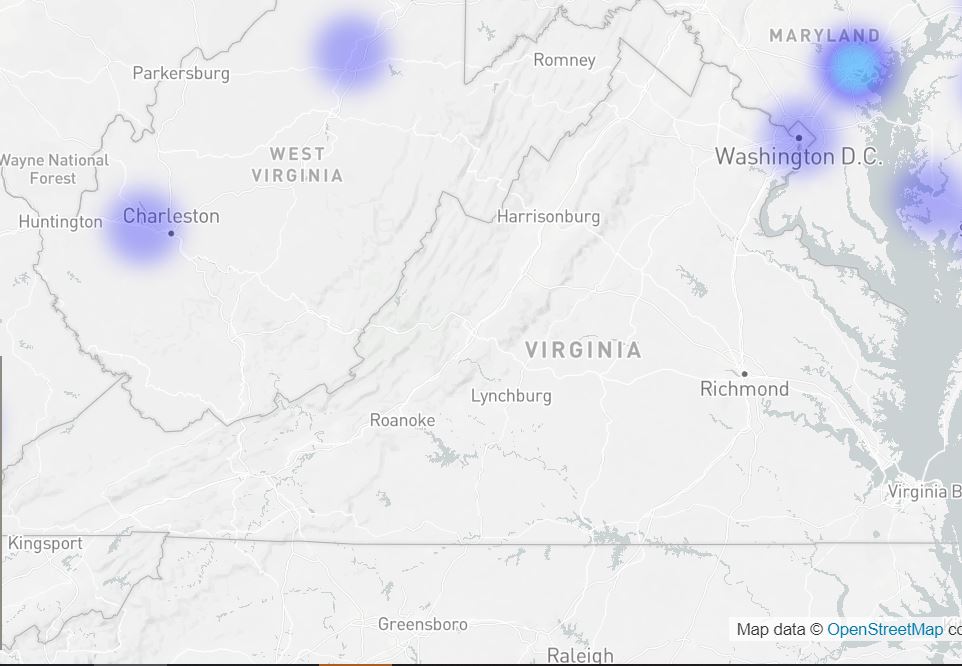
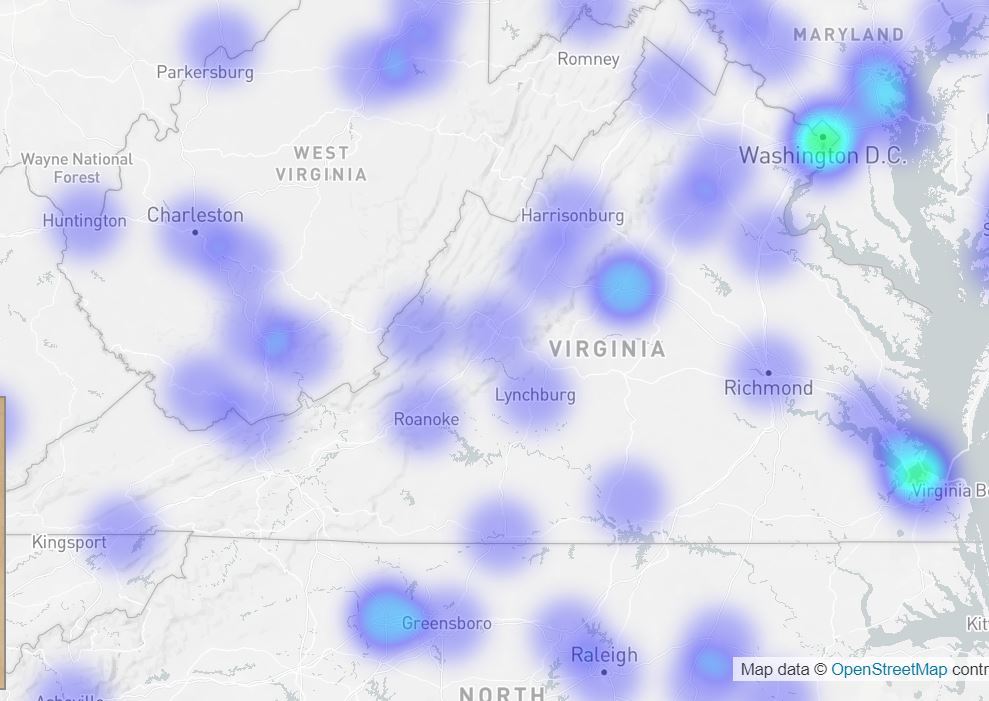
Alternatively, I also considered the role of diversity and perspective in historical preservation and tourism. In the first heat map I developed for this area, there were zero establishments that were marked as being welcome for African American travellers.

Although, this did improve in the succeeding decades. The above map shows information from the 1947 Green Book, while the below map shows information from the 1956 Green Book.

Still, this map is effective, as maps often are12, in helping to visualize and understand the reality of an individual’s existence. That first map portrays the uncertainty that any African American would have regarding tourism in Virginia.

Still, through the destinations provided, it becomes clear that African Americans are not a considered demographic for this guide. Despite discussions of three different plantations in this tour, there was zero discussion of enslaved people, but plenty of discussion about the architecture of said plantations. The focus on these plantations also leads to a situation where, if you’re an African American who doesn’t wish to visit the sites where people were enslaved and tortured for having the skin color that you currently have, the tour becomes unenjoyable.

Depictions of African Americans in the Federal Writers Project

My historical question focused on how the Federal Writer’s Project depicted the experience and culture of African Americans during the 1930s. How did the Federal Writers Project depict African Americans? I did not go into this assignment with any specific ideas regarding the question, but I had two possible trains of thoughts. Both depended on the interview subjects that were chosen as part of the Federal Writer Project. I thought that non-white subjects would discuss a more realistic view of African Americans, with a focus on the specific hardships that were endured. I thought that white subjects may have a different depiction. They may focus more on the cultural and folk contributions of African Americans at the time. Especially regarding the construction of identity in the Southern United States, I thought that there could be a great deal of disparity, with some sources focusing on the dialect and culture, with others discussing the continued oppression experienced by African Americans13 .

Together, the ideas and depictions provided by the different interview subjects would start to build a fuller picture regarding depictions of African Americans in the United States during this time.

For the sources that I contributed to the class’s corpus, I searched for interviews that discussed famous African Americans of the period, such as Langston Hughes, Louis Armstrong, and Jesse Owens. Based on previous readings, I understood the role that culture, escapism, and transportation played during the Great Depression14. It was likely that many of these people may choose to speak about some of the iconic figures of the day as opposed to the negatives of their own life.

I was particularly drawn to the visualization tools that linked and emphasized particular words within the corpus. For example, the word cloud option provided a practical overview of some of the more common themes present within the texts.

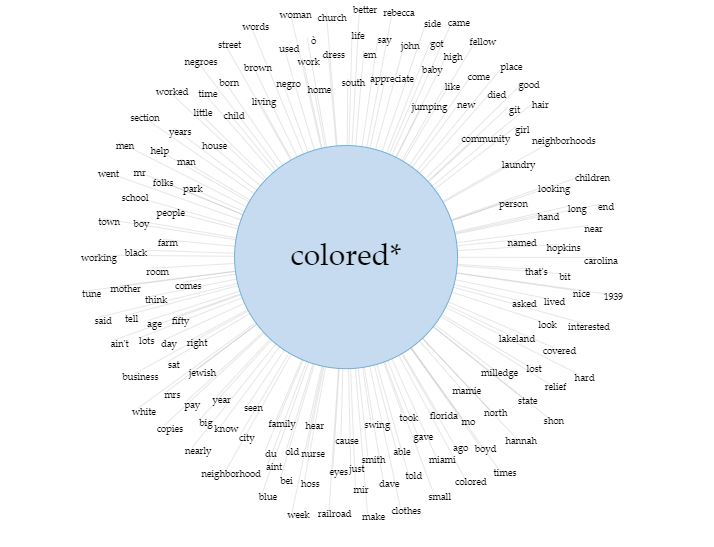
However, this tool is just an overview, and doesn’t show any connections between particular ideas or themes, which is a necessity for my question. So, I used the link tool to observe the common words associated with words such as “negro,” “black,” and “colored.” With the use of these three terms in conjunction, I was able to see some of the more interesting concepts associated with African Americans in the time period.

Many of the links focused on locations, of where different people were centered. While there were links to folklore, culture, and dialect as I expected, I was surprised to see a connection to workers, audience, and the like. With links to the word black, I received the adjective as opposed to the ethnicity, but I was surprised some of the negative and derogatory terms attached to it, such as the n-word, “sonofabitch,” and “bastard.” Without further close reading, its unclear whether these instances are individuals describing the words that were used against them, or something else.

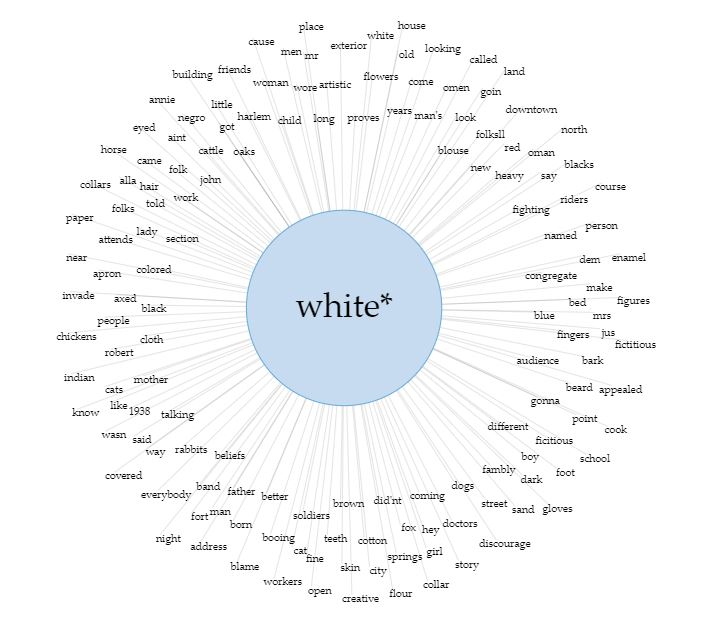
For reference, I also looked at the links for “white,” in an attempt to better understand how white people were better depicted in the project.

I thought it was interested to see the tone of words that were associated with white people, such as “appealed,” “discouraged,” “creatives,” and “friends.” The role of white people in the interviews appears different than African Americans.

The tools helped me to determine that there were a number of ways that African Americans were depicted in the Federal Writers Project. They were shown as audience members, hard workers, mothers, fathers, and children, in addition to bastards or other derogatory terms. This is likely in line with how people of color existed in the 1930s. While they attempted to continue their existence during the economic downturn, they were still faced with prejudice and racist attitudes.

Fountain Hughes’s Narrative

For this assignment, I listened to an interview with Fountain Hughes, conducted by Hermond Norwood. Over the course of the thirty minute interview, I was able to notice the value of his experience, and the ways that his experiences did and did not align with my expectations for his narrative.

Here is the timeline that I created based on Fountain Hughes’s interview.

Learning from a narrative

I believe that there is a lot of value within Fountain Hughes’s experiences. Through this interview, historians receive a firsthand account of what it was like to be an enslaved person in the United States during this time. Something that stood out as particularly poignant during the interview was how Fountain discussed slavery in terms of the 1940s. He speculates that some people now “would rather be slaves.”15

Fountain notes that he would rather kill himself than go back to being a slave. He notes that they were treated like dogs, and would never go back to that existence. This directly contradicts the narrative of the jovial slave that was spread by people in the argument that slavery wasn’t as bad as it seemed. Fountain Hughes claimed to be more than one hundred years at the time of this interview and had not been enslaved for more than eighty years. Still, the trauma of slavery stuck with him so strongly that he would not hesitate to resist in the most severe and permanent manner.

Additionally, Hughes’s narrative is valuable as a man who originally lived in the South before moving to Baltimore, leading to a unique construction of southern identity. In particular, his discussion of going to church in a log cabin and being led by an older preacher in the singing of gospel songs, adds to the idea of a southern identity16

I was actually surprised by Fountain Hughes’s reluctance to talk about some of the specific hardships he endured as a result of his enslavement and status both during and after the Civil War. He says he doesn’t like to talk about it because “it makes people feel bad.”17 While the goal of chronicling the narratives of enslaved people as a part of the Federal Writer’s Project was to understand what enslaved people endured18 , one can not account for someone who doesn’t feel comfortable sharing what they went through.

Still, this interview has limitations. As a result of Fountain Hughes’s advanced age, his memory of events may not be as accurate as it once was. Also, it is limited by his previously discussed reluctance to discuss topics that he believes will bring others down. Obviously, there is no reason to believe that Fountain Hughes is intentionally telling any mistruths, but as a result of his age, some aspects of context may have been lost to time. For example, during the interview he describes an occasion when, as a youngster, he and his brother slept in an automobile. But, based on his age, Fountain would have already been in Baltimore by the time automobiles became commonplace in this country. He may have been referring to a more recent event with his brother, or he may have been intending to say they slept in a place that was “like” or “the size of” an automobile.

Finally, I was a bit surprised by how much Fountain Hughes’s depiction of his own life relied on broader events as signposts. Multiple times during the interview, Fountain remembers an event by President Garfield being assassinated, or someone’s death happening during or after the Civil War, or how hard life was when he and his family had just become free. Currently, I don’t remember my own life in these kinds of terms. Then again, I’m 21 and not 101.

Glitching the Federal Arts Project

I found my image by delving into the Federal Arts Project Photographic division. I selected this particular image because it showed a direct experience of a child participating in the Federal Arts Project. This, combined with the image’s original caption, was very interesting. In a sense, it encapsulated the need for arts programs and the American people’s need for escapism and movement16

This image has also inspired me to ask questions such as, how did the Federal Arts Project specifically impact children? And to what extent should researchers consider the corruption of digital images when conducting research?

The methods used in this assignment allow for us to consider both the value and the hazards associated with digital images, specifically when it comes to glitching and digital images. We are also encouraged to consider how the source code for an image and an exhibit impact our experience when viewing and studying the information. How easily can these codes be manipulated in different ways? And how does that impact the conclusions that we draw as researchers. I believe that the creation of a glitched image does have some value, as it allows us to, in a way, view the image in the way that computer view images. We are forced to consider different focuses, areas, or outlines.

I was a bit surprised by how much I was forced to think about my image during and after the glitching process. When finding my image, I considered the context a great deal. The discussions of culture and segregation in The American Yawp had already encouraged me to consider the role that race played in the different Federal One projects. 17

However, I did not spend as much time considering the bits and bytes that actually constituted the image. The first time I glitched the image, the little boy, William, was completely gone from the image. Instead, I was left with his outline in varying shades of gray, while the background and outer edges remained mostly in tact. Future iterations of the glitched image continued to show me different aspects that I had not considered closely. The final version that I decided to upload for the assignment caused me to focus on William’s eyes, which are intently focused on the clay at his hands. His mind was not wandering to the other aspects of his life, which is part of the goal of the Federal Art Project. When people are creating artwork out of nothing, they focus their brainpower on their creation, instead of thinking about the uncertain future, things that were lost in the past, or the hardships of the present.

Links

http://jessicadoeshistory.com/cnd/exhibits/show/liam-griffin–glitching-an-ima/federal-arts-project-brooklyn

http://jessicadoeshistory.com/cnd/items/show/197

References

Dickstein, Morris. “Facing the Music.” The American Scholar, December 11, 2014. https://theamericanscholar.org/facing-the-music/#.XZ9W8UZKg2y.


Wright, Benjamin, and Joseph Locke. American Yawp: A Massively Collaborative Open U.S. History Textbook. Stanford University Press, 2019.

What’s Gained and What’s Lost in Digital History

In Tony Guidone’s experience as a historian, he has examined a plethora of different primary sources and artifacts of varying degrees of significance and rarity. However, in the framework of the digital humanities, every primary source has a series of values and obstacles that accompany the digitization of an artifact.

The positives of digitization are seemingly obvious. Ideas of distance reading and keyword searching go back decades, but the ease of searching a digital source easily trumps the hassle associated with scanning through text using a microfilm reader19. Nowadays, the ease of scanning through hundreds of pages in the matter of seconds by searching for a keyword, is truly valuable. This has positively shifted my interaction with academic sources, as I can insure the sources I utilize in my research or scholarship will truly be helpful. Additionally, it is much easier to formulate effective arguments that are supported by credible sources, since those sources are easier to find.

Furthermore, the digital nature of modern historical projects allows them to inflict a greater amount of social change. In previous years, one may not hear about the Enslaved Children of George Mason project, unless they are directly involved. The digital nature of this project allows it to collect a great deal of data about George Mason’s legacy, and presents it in a way that is easily accessible to the general public20.

Although, the digital nature of a source may impede one’s understanding of important context. As noted in the presentation, a photograph of a coin may not account for the texture of said coin, the weight, craftsmanship, or quality. Such factors may enhance one’s understanding of a period in history and allow for new insight. While this information can be included in detailed captions, it still may fall short of holding the artifact in one’s hand.

Ultimately, there are a variety of positives and negatives associated with the digital nature of certain history projects and exhibits. In total, the emergence of keyword searching and distance reading is an invaluable gift, as is the ability to spread information via social media. Though some elements of history may be more likely to be ignored, individuals are able to overcome these obstacles as curious scholars.

Blog Post 1

Part One:

In the first week of this course, I learned a great deal of context. The context for this course included a basic understanding of the setting for the New Deal, the cultural associations that were established as a part of the New Deal, and developed a broader definition of “technology”. Furthermore, I received a crash course in the relevant technologies and concepts that led to the development of our modern digital age.

While I had a basic understanding of what the New Deal was and had a basic understanding of its broader effects on American society, I was completely unaware that the New Deal had any pronounced cultural effects. The discussion in the course so far has enlightened me regarding the different public arts programs that were established as a part of the New Deal. The intention of these public arts programs was twofold. After the economic atrocity of the Great Depression, many artists needed work. So, public programs put artists back to work, and allowed them the opportunity to create again. Additionally, the production of art, such as theater, and music, provided a distraction for all Americans. When consuming the arts, people were less likely to dwell on what they had lost in the preceding years.

Part Two:

For the next part of the assignment, I was assigned to review “Media and The Movement”, which examines how the media covered the Civil Rights and Black Power movements. In Miriam Posner’s framework, Media and the Movement would be classified as a multimedia narrative. The project combines longform academic writing with oral histories, feature-length films, and radio broadcasts. The sources in this project are numerous and diverse. They include films/videos, recordings, photographs, and text documents or artifacts. Most of the sources are processed by being photographed or scanned, or in some otherway digitized in order to be uploaded to the webpage. Finally, the sources are presented in a way to be easily accessible on the web and able to be observed by visitors. The digital nature of this project enhances the efficacy of the project’s sources. By presenting primary sources in line with appropriate context, individuals are able to learn in more ways than one, and see first hand what the historian is trying to convey.

References

Dauterive, Jessica. (2019, August 27). What is Digital Humanities?Retrieved from https://slides.com/jdauteri/what-is-digital-humanities#/1.

Davis, Joshua Clark & Kotch, Seth. Media and the Movement. Retrieved from http://mediaandthemovement.unc.edu/

Posner, Miriam. (2019, August 28). How Did They Make That? Retrieved from http://jessicadoeshistory.com/cnd/exhibits/show/fall-2019/dh.


css.php