Dream Radically: A New Deal

Coming into this class, I had very little knowledge on the New Deal. For instance, I had no idea that the government attempted to get artists back to work through federally-funded agencies. I also never gave much thought to the history of socialism in the United States, I simply assumed that leftist-politics weren’t prominent in the US until after the cold war. But that idea was dismantled when we learned about Huey Long’s “Share Our Wealth Society” campaign.1 But what really intrigued me in this class was how in such a precarious a time, President Roosevelt challenged various cultural and societal norms in order to rehabilitate and create a stronger nation. Although the New Deal was not inherently radical in its intent, it created major structural change in American law, culture, and society.2 The history of the 1930s isn’t dead, and it should be used to envision a better future. Learning about the diverse ways that the “government assumed the role of protector” gave me hope for a possibility of a future where we can revert to the same, if not better, framework of progression; a framework based on collectivism and protection for all people, not just CEO’s and the top 1%, our modern-day robber barons.3

Screenshot from “Millennials Are Screwed”

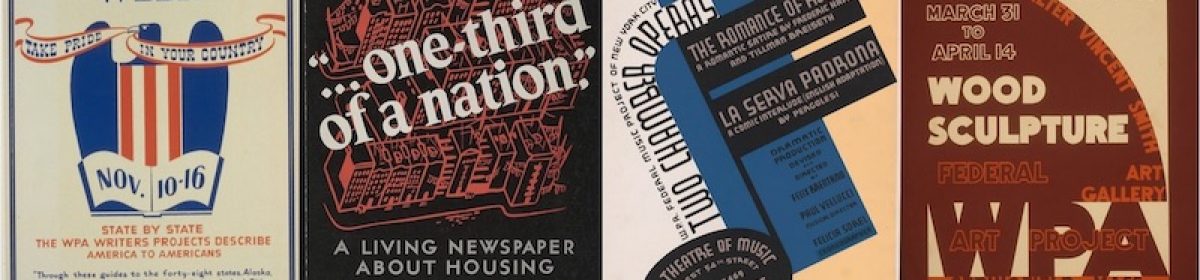
For my final project, I named my exhibit “The WPA & The Reimagining of American Life” because through the WPA and FDR’s legislation on labor, there was a rethinking of what the standards of working and living should be in America. In the first segment, I use a timeline to help the audience better contextualize how President Roosevelt used a multifaceted approach towards changing the trajectory of labor. Using the timeline was beneficial because I was able to put each distinction, the legislation and the WPA projects, into its own layer. In the next segment, I used the image analysis to break down the significance of the WPA posters and how their individual campaigns- work safety, recreation, art, and education, affected working class lifestyles. The final segment mapped the infrastructure created by the various WPA agencies in Washington, D.C. The mapping tool allows the audience to see how extensive the WPA agencies were, the range and diversity of the constructed sites, and whether the establishments are still used today.

Overall, I hope this exhibit allows people to recognize that there are living, reoccurring themes in history. What seemed radical and unachievable to many people in the 1920s, is seen as socially acceptable and normal now; a minimum wage, restrictions on child labor, and the creation of a pension system were policies that Roosevelt had to carefully craft into success. By 1934, he had opposition from business-friendly republicans, democrats in the South, and various conservative justices in the Supreme Court.4 What I hope people recognize is that it’s not naive to dream of a radically better future, it’s achievable. And it’s also our responsibility. It’s our responsibility to be critical of the products of tech-capitalism, corporations, and systems that only benefit a few, over the exploitation of many. As Michael Hobbes beautifully crafts in his digital storytelling, we can let our economic infrastructure keep disintegrating and wait to see if the rising seas get us before our social contract dies. Or we can build an equitable future that reflects our values and our demographics and all the chances we wish we’d had.”5

Final Project: http://jessicadoeshistory.com/cnd/exhibits/show/reimagining-american-life

Decolonizing our Discipline

Historical discourse includes and excludes events, people, and concepts very deliberately, especially in neocolonial societies. But it’s important to be aware of that there is the ability and responsibility to reconstruct the narrative. One method of decolonization is the prioritization of the voices of the colonized and oppressed. Through the recording of the first-hand experiences that marginalized people face, there lies an ability to prevent the erasure of the history that those in power were willing to hide.

Archival sources include letters, photos, memos, manuscripts, and more. But, often, the written records in an archive cannot emphasize the emotion or significance of an event the way that an audio source can. 6 The “Voices Remembering Slavery” collection in the Library of Congress could be very resourceful to someone analyzing memory, emotion, or how people remembered traumatic events from their own past. In addition, using oral histories as legitimate sources plays a larger role of helping shift away from archaic structures of oppression.

It is important to note that oral historical records aren’t meaningful in their nature, they can be highly problematic as well. In the Slave Narrative Collection, the interviewers were primarily white and that led to a perpetuation of stereotyping the informants, who were all Black. But as the Library of Congress notes, “the representations of speech in the narratives are a pervasive and forceful reminder that these documents are not only a record of a time that was already history when they were created: they are themselves irreducibly historical, the products of a particular time and particular places in the long and troubled mediation of African-American culture by other Americans.”7

The perspective through which the marginalized are analyzed and understood in academia has historically been that of white men. But by privileging oral history, there is an acceleration of the process of changing the rigid metanarrative that has been consuming our society for decades. In 1940, Juan Bautista Rael documented the Hispanic music and culture of the Northern Rio Grande.8 The documentation of Mexican wedding songs, alabados (hymns), and other forms of music provide proof that American culture has been created and shifted by various groups of people.9

Decolonizing the archives and history as a discipline means accepting oral histories as legitimate and useful sources. Although, because technology has made it so easy for everyday people to be a part of this archival process, I wonder how historians’ perspectives on the validity of oral histories will shift in the next decade. Just as the 1970s propelled a “new social history,” or a history that is written from the bottom up, the upcoming decades also have potential to facilitate collaborative collecting and further democratize the archive. 10

Blog #7

When I visited Los Angeles two years ago I did not expect to see the bizarre car-culture frenzy that I did. A monstrosity urban sprawl, coupled with inadequate public transit, made it almost impossible to get anywhere without a car. I selected the Los Angeles Guide because I was interested to see whether the private ownership of a car had always impacted tourism and the ability to move through space in LA. Although the Guide notes railroad stations, bus stations, services, and streetcars, in the general information section of the book, it does not make any reference to them throughout the tours. The Guide assumes that the audience owns an automobile and this implies multiple things. The first is that Guide seems to be created for an affluent audience who owns automobiles and has the time for leisure activities. This is reaffirmed by the landmarks that Tour 6 focuses on, such as a mineral spring, multiple camp sites, and private beaches. But more importantly, the assumption that the audience owns a car also implies that makers of the Guide knew that cars would play a significant role in America’s future. They even note that “the Los Angeles of the future is likely to evolve along highways.” 11

Similar to most other things we have learned about in this class, maps do not offer an inherently impartial and “objective” perspective on history. It’s easy to forget that maps are also manmade and subject to the bias of the creator. Power and privilege must be taken into consideration when using maps and analyzing spatial history, otherwise mapping can very easily become a tool of oppression.

Digital mapping can be useful for historians because “it can allow us to reconstruct, preserve, and visualize vestiges of the past.”12 Mapping Tour 6 on StoryMapJS was helpful because it allowed me to see how the urban sprawl was taken into consideration when selecting points of interest for the tours. Although it was slightly difficult to find the exact locations of certain places because some of them did not exist anymore.

Tour 6 from the Los Angeles Guide on StoryMapJS
Tour 6 on the “Navigating the Green Book” project.

The “Navigating the Green Book” project allowed me to see how compressed a “tour” would have been for an African American traveler in 1947. In comparison to the original tour, which spanned a larger distance, safe spaces for Black individuals would only involve a couple miles between West Hollywood and Central LA, with just three hotel accommodations. The comparison of these two geographic visualizations can be useful in helping people understand how radically different it is to navigate this country in a non-white body. As Sarah Bond argues, digital humanities projects can go beyond “amusing data aggregation” and they can actually create a deeper understanding about the impacts of racism.13

Archives and Communist beavers

Archives are central to the work of Historians. They provide access to records, memory, knowledge, and more. “Who gets to be remembered and historicized by way of record creation?”13 Arroyo-Ramirez argues that record keeping and creation is an act of power in itself. Just as there is no raw data, there is no neutrality in archives. In Silencing the Past, Michael Rolph Trouillot argues that the making of archives is how the silencing of a particular people or event in history occurs. The silencing of a people can be seen most distinctly in ex-colonies and modern-day settler states. We need to be more critical of how power plays a role in the creation of historical narratives and this needs to ensue at the archives.

The digitization of archives is great because it can potentially increase the scope of people who have access to historical data, and in doing so, it can also allow for an increased awareness of the politics behind archives. As we talked about in our visit to the Special Collections center, archivists decide to digitize materials based on their popularity, quality, and feasibility. Although the digitization of archival materials can be advantageous, I can’t say that is the case for all the materials in an archive. The Thomas Jefferson Library exhibit in the Library of Congress is a great example that shows how physical artifacts, whether real or constructed, can play a role in influencing our interpretations of people and events.14

I’m grateful for our visit to the Special Collections Center because it helped me contextualize the controversy of the Federal Theater Project. It was only after looking at the program for the “Revolt of the Beavers” that I really understood how anti-intellectualism and fear had perpetuated the controversy of the FTP. The children’s program had a cartoon drawing of a beaver on the cover, yet it was used by the House un-American Activities Committee as evidence that Hallie Flanagan was promoting communist ideals. Holding the physical copy of the program and imagining the HUAC using the same children’s program (with the cartoon beaver cover) in court was a humbling experience.

Blog Post 6: Unions & Text Analysis

My original historical question was, “what factors helped shift the public perception of labor unions in the 1930s, and how?” And with “public perception,” I was referring to the working class’ trust in unionization and the efficacy of unions. Initially, I assumed that labor unions were stigmatized negatively in the 1930s because of their lack of success in years prior, and that affected the willingness of the working class to unionize.15

I selected my sources from the American Life Histories collection by refining the search with the subject of “labor unions.” The items I selected for part one were particularly interesting to me because of the passion and candor the interviewees spoke with when referring to unionization; there was actually a document that was a manuscript of a Worker’s Alliance Meeting in New York, and the entire thing was just the prayer that someone led before starting the meeting.

Voyant turned out to be really beneficial for text-analysis and helping me create a more constructive question. I utilized the class corpus by creating a new corpus with only 62 documents that involved the words “union” or “unionization.” Distant reading was useful in this aspect because it allowed me to see the frequency in which unions were talked about throughout the collection. Now that I had a corpus that was composed of manuscripts about labor unions, I wanted to see how people were talking about them.

In the “contexts” section of the site, I was able to search “union good”~15 and “union bad”~15, and this allowed me to find sentences with the words “union” and “good” within 15 words of each other. I got a total of ten results and only 1/10 of those documents used the word “bad” to describe unions in a negative manner. The other nine documents used the word “good” to refer to unions in a positive light. After pairing my findings with close reading, I realized that the documents do not clearly and explicitly present the factors that affect the working class’ perspective on labor unions. So, my original historical question went from, “what factors helped shift the public perception of labor unions in the 1930s, and how?” to “what was the public perception of labor unions in the 1930s?”

To conclude, the manuscripts in my close reading of the 10 documents proved to be useful in emphasizing peoples candid thoughts and passion about labor unions. But most importantly it shed light on how there were discrepancies in attitudes about unionization, that were determined primarily by your status as a working-class individual. For example, the manuscripts showed that while some people had the freedom to unionize, others were fearful of retaliation in the workplace. Also, despite reading Miriam Posner’s blogpost beforehand, I still went into this assignment thinking that Voyant would provide a “straightforward window into a text.”16 But by the end of the assignment, I realized, as Posner argues, that text analysis and Voyant should instead be used “as a way to talk about how we interact with texts and what kind of meaning evades capture by computational tools.”17

Blog post 5 / Skill assignment 4

https://docs.google.com/spreadsheets/d/e/2PACX-1vRiCJ7ek3wVoOHTfzw1X8AhM2yfmBLs1BQQ40dwepiN707dv_95yct2tG5Z-QSQXHimWdiEgAC-hDyj/pubhtml

I listened to “Interview with Aunt Harriet Smith, Hempstead, Texas, 1941,” which was a four part interview. One of the things we can learn about the experience of enslaved people from this interview is that church was a very big component in a lot of their lives. Harriet Smith talks about her relationship to the church and how it played a significant role in her life, from childhood to adulthood.  

The two timeline layers intersect because Harriet Smith’s personal history is impacted by the larger, political history. Her personal history includes her experience as an enslaved woman, her spirituality, and her relationships. These micro aspects of her life were impacted by the large political and national events, such as secession, the issuing of the emancipation proclamation, and FDR’s presidency. This experience with the timeline has taught me that categorizing the significant events of someone’s life is a challenging job because it’s difficult to know how much importance micro-events held in someone’s life when they are not there to tell you. But more importantly it requires a deep-level of analysis in order for the historian not to erase micro-histories. These autobiographical accounts stand “as one of the most enduring and noteworthy achievements of the WPA” and if done properly, the transcription of these oral accounts can help the proliferation of knowledge about slavery in the United States 17

I’m surprised the interviewee didn’t mention more detail about her children. She spent a significant portion talking about her past husbands, but never her children18. Regardless, this interview could be really useful for people studying the experiences of enslaved women in America. The limitations of the interview include the poor sound quality and the lack of scope in regard to the questions being asked.

By listening to the voices of the interviewer and interviewee I learned that what I, as the listener, would take away from the interview is going to be different than anyone else. Each listener has their own experience due to their background and experience with this process. It was hard to understand what was being said at times, but I feel as though if someone had practice it would be much easier. That being said, transcribing sources is very helpful to people who aren’t familiar to interviews such as these, but to transcribe the sources in the first place should require a bit of experience in order to get accuracy. But it’s important to note that someone transcribing these interviews should be aware of the possible reproduction of racial stereotypes and biases19

Blog Post 4

At a time when the federal government was first seen shifting its priorities to create the basis of a welfare system, there was also the inescapable question of who is deserving of these new rights and benefits. Franklin Roosevelt not only failed to address the difficulties that Black Americans faced, but he also continued the institutionalization of racism with federal government policies. Roosevelt rejected the proposal to abolish the poll tax and declare lynching a crime. But the most visible codification of racism in federal law came with the removal of domestic workers and farm laborers from the provisions of the Social Security Act.20

Although, the Long Civil Rights movement and the popular front impacted the 1930s by helping create a more equitable society for the marginalized when the federal government failed to do so. The activists from the LCRM and the popular front fought to expand the nation’s immaterial boundaries of who is a citizen worth fighting for and I would argue that this is the same struggle that digital activists are fighting today. Marginalized groups are still scrutinized and discriminated against, except this time it’s less identifiable who’s doing the discrimination and how.

Safiya Noble argues that the “traditional misrepresentations in old media are made real once again online and situated in an authoritative mechanism that is trusted by the public: google.”21. Noble’s keyword search of “black girls” represents how algorithms can perpetuate harmful misrepresentations and the dehumanization of people.22 Despite the fact that marginalized groups are the ones who are being exponentially affected by Google, I would argue that this is a human rights issue that everyone should be concerned about. Anyone using the internet today, whether a target of the state or not, is trading in their privacy, personal information, and most importantly their immaterial labor.

As of right now, the general public is not aware of how algorithms are made and there is a common assumption that the mathematical language of the algorithm would be a barrier to understanding it. Yet, the foundation and design of algorithms can be understood without having to learn a mathematical language. According to Cathy O’Neil, to build an algorithm you need a historical data set and a definition of success. At its core, those are the only two things that need to be understood to get a general grasp of algorithms. Algorithmic literacy must be taught to the public in order to transform artificial intelligence into a less problematic and dangerous entity.  


Capitalism & the music industry

Morris Dickstein predicted that after the 2008 recession Americans would “demand lighter fare as people look to escape their troubles.” I think her prediction was flawed because the problem wasn’t that Americans demanded a lighter fare, rather it was the artists who were afraid to create more radical music. This isn’t a remark on their character, rather a critique of the system of music production and consumption that dominates popular culture. Big record labels do not want their artists producing music that would alienate a fanbase because that would lead to a decrease in profit. I would argue that Dickstein’s prediction was rudimentary, and it did not take the free-market’s effect on music and popular culture into consideration.

But to Dickstein’s credit, she’s not entirely wrong about the dominance of lighter-fare music. Based off of the music that tops the charts, I would argue that the majority of artists prioritize creating lighter-fare music over music that emphasizes social, economic and political issues. Yet, there are also artists who recognize people’s desire for music that has political implications: Kendrick Lamar, Beyonce, Janelle Monáe, Solange, Anderson Paak, and more. Music has historically been used as a form of resistance for the African American community and to say that American’s, as a blanket statement, would prefer a lighter fare after the 2008 recession ignores the racial division in popular culture.

That being said, I would argue that many artists still aren’t as radical as people portray them to be. For example, it’s pretty ridiculous that Kacey Musgrave’s song “Follow your arrow” created so much controversy. The song was banned from playing on the radio stations and was censored in the 2013 CMA awards. In the song, Musgrave’s makes direct references to LGBT culture and marijuana with, “kiss lots of girls if that’s something you’re into” and “roll up a joint, or don’t,” and apparently that’s just too much to handle.[1]

But the suppression of music that’s viewed as controversial in popular culture is prominent across the globe. Mashrou Leila, an indie-rock band from Lebanon, has been creating controversies from 2008 up to the present. The band’s lyrics are overwhelmingly and unapologetically about the dynamic between homosexuality, politics, and religion. Mashrou Leila* is an excellent example of how artists can create radical music that doesn’t adhere to the norm, or the “lighter fare” that Dickstein argues people desire. But at the end of the day, as Dickstein states, “as our troubles worsen, as stress morphs into anxiety and depression, we may desperately need the mixture of the real and the fantastic, the sober and the silly, that only the arts can bring us.”[2]

*My favorite band on Earth and I recommend listening to the songs “Cavalry” and “Shim El Yasmine” (read the translation for the lyrics).


[1] https://countryrebel.com/blogs/videos/this-country-song-was-banned-from-radio-play-but-now-the-lyrics-are-everywhere/

[2] https://www.latimes.com/la-oe-dickstein1-2009apr01-story.html

History ≠ the past

I selected the image through the FSA colored photographs section because I’m interested in the dynamic between women and the work force during the New Deal era. This image very clearly shows that there was a presence of women in work environments after the great depression. More specifically, this image allows the current audience to develop a better understanding of the different components that go into the creation of a documentary photograph. For example, critics of this photograph might argue that because the photograph was staged, the authenticity of the photograph and the presence of women in the workforce might be lessened. This photograph makes me question whether women were accepted in male-dominated work forces and how unions played a role against gender discrimination.

Image analysis is a very useful method in thinking more critically about digital history. According to Trever Owens, “the integrity of objects is something that can be expressed through a range of software enabled readings of it.”23 History, as a discipline, has not always prioritized the analysis of a primary source image beyond what is given at face-value, so these principles of image analysis are actually quite progressive.

The process of analyzing an image might actually teach a lesson that is more important than what the image is saying in the first place; the lesson being that sources can perpetuate a very certain perspective on history and that should be deconstructed.

Moreover, this western perspective has monopolized the way historians react to the past and glitching photographs is an excellent way towards destabilizing that monopoly. As Michael Kramere argues in his article, glitching photographs can produce “a more accurate interpretation of the history it captures.”24. I found the glitching method to be more engaging and useful than the principles of image analysis because in addition to creating a more accurate representation, it can help people better analyze the relationship between agency, systems of oppression, and the creation of historical narrative.

The principles of image analysis and glitching helped me interrogate my historical question by helping me think beyond what is given at face-value. I glitched the photograph so that the gender of the person in the photograph is less obvious, yet still recognizable if viewed closely. The transition between the original and the glitched image allows the audience to be more critical of the original artists intentions on emphasizing the woman in the work environment.

Omeka exhibit: http://jessicadoeshistory.com/cnd/exhibits/show/hibba-khan/lucile-mazurek-working-in-1943

Omeka item: http://jessicadoeshistory.com/cnd/items/show/161

Digital historians and the knowledge accessibility Revolution

Text searching has changed the way I engage with information online because it has made me very cautious of the results I receive. For example, the formatting of a search, the choice of words or even the order in which the information is entered can impact what kind of results are given. In addition to academia, text searching impacts things as simple as a google search to find food nearby. But more importantly, text searching has also made me aware that not everything is as it seems and it’s necessary to be critical of the results that are given. Just working on this blog post has made me curious about the relationship between the collection of personal data, text searching, and the given results that are catered to each individual search and person.

The democratization of access is something that is gained by using digital media, but there are also a few things that are lost. One aspect of Tony Guidone’s argument was that by using digital media the meanings conveyed by touch and the original reading experience can often be lost. This is essentially what Ian Milligan is arguing when they said that optical character recognition (OCR) struggles with medium transformations, printing noise, and non-standard fonts. More specifically, medium transformations make it hard for the sustainability of an original documents information and meaning.

25

Regardless, I do think that digital projects can create significant social change because the democratization of the access of information is definitely progression, but I would be cautious to link the increase in digital projects to the democratization of data. I think the privatization to the access of knowledge is something that historians need to avoid as digital history expands and becomes more popular. For example, databases that are offered to university students that are normally not open access is limiting the audience to boundaries of employment and age. On the other hand, the Enslaved Children of George Mason on the Mason’s legacies repository is a good example of the impact a digital history project can make in democratizing access. The information on George Mason and Gunston Hall is now readily accessible and allows for more people to become aware of the situation at hand.

css.php