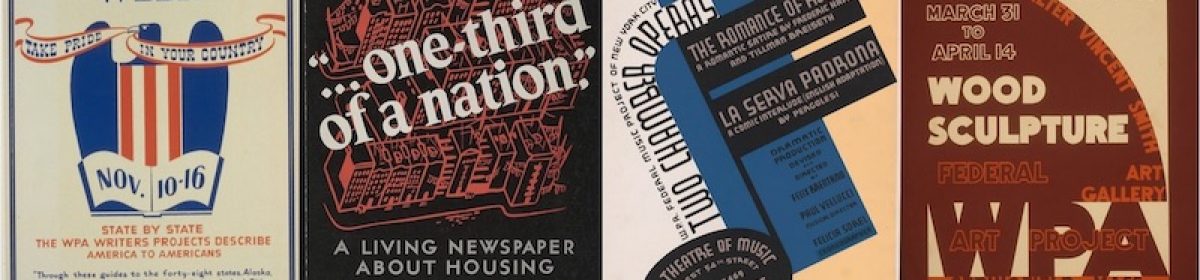
Coming into this class, I had very little knowledge on the New Deal. For instance, I had no idea that the government attempted to get artists back to work through federally-funded agencies. I also never gave much thought to the history of socialism in the United States, I simply assumed that leftist-politics weren’t prominent in the US until after the cold war. But that idea was dismantled when we learned about Huey Long’s “Share Our Wealth Society” campaign.1 But what really intrigued me in this class was how in such a precarious a time, President Roosevelt challenged various cultural and societal norms in order to rehabilitate and create a stronger nation. Although the New Deal was not inherently radical in its intent, it created major structural change in American law, culture, and society.2 The history of the 1930s isn’t dead, and it should be used to envision a better future. Learning about the diverse ways that the “government assumed the role of protector” gave me hope for a possibility of a future where we can revert to the same, if not better, framework of progression; a framework based on collectivism and protection for all people, not just CEO’s and the top 1%, our modern-day robber barons.3

For my final project, I named my exhibit “The WPA & The Reimagining of American Life” because through the WPA and FDR’s legislation on labor, there was a rethinking of what the standards of working and living should be in America. In the first segment, I use a timeline to help the audience better contextualize how President Roosevelt used a multifaceted approach towards changing the trajectory of labor. Using the timeline was beneficial because I was able to put each distinction, the legislation and the WPA projects, into its own layer. In the next segment, I used the image analysis to break down the significance of the WPA posters and how their individual campaigns- work safety, recreation, art, and education, affected working class lifestyles. The final segment mapped the infrastructure created by the various WPA agencies in Washington, D.C. The mapping tool allows the audience to see how extensive the WPA agencies were, the range and diversity of the constructed sites, and whether the establishments are still used today.
Overall, I hope this exhibit allows people to recognize that there are living, reoccurring themes in history. What seemed radical and unachievable to many people in the 1920s, is seen as socially acceptable and normal now; a minimum wage, restrictions on child labor, and the creation of a pension system were policies that Roosevelt had to carefully craft into success. By 1934, he had opposition from business-friendly republicans, democrats in the South, and various conservative justices in the Supreme Court.4 What I hope people recognize is that it’s not naive to dream of a radically better future, it’s achievable. And it’s also our responsibility. It’s our responsibility to be critical of the products of tech-capitalism, corporations, and systems that only benefit a few, over the exploitation of many. As Michael Hobbes beautifully crafts in his digital storytelling, we can let our economic infrastructure keep disintegrating and wait to see if the rising seas get us before our social contract dies. Or we can build an equitable future that reflects our values and our demographics and all the chances we wish we’d had.”5
Final Project: http://jessicadoeshistory.com/cnd/exhibits/show/reimagining-american-life
- Huey Long, “Share Our Wealth,” The American Yawp, Accessed December 12, 2019. http://www.americanyawp.com/reader/23-the-great-depression/huey-p-long-every-man-a-king-and-share-our-wealth-1934/
- Marlene Park and Gerald E. Markowitz, “A New Deal for Public Art,” in Critical Issues in Public Art, (Michigan: IconEditions, 1992), 131.
- Ibid.
- “X. Voices of Protest,” The American Yawp, Accessed December 12, 2019. http://www.americanyawp.com/text/23-the-great-depression/
- Michael Hobbes, Millennials Are Screwed, https://highline.huffingtonpost.com/articles/en/poor-millennials-print/
