My historical question was: How did the theatre impact the morale of people of color in the late 1930s? Originally, I felt like I could answer my own question with research and in-class readings about how it made theatre more accessible to all, more diverse, and lifted the spirits/served as escapism of the Great Depression
1. However, after realizing that I wouldn’t find a personal narrative to say that, it made this assignment more difficult. My question was refined, changed, and even entirely overhauled days before the assignment was due but, what I have now, I really like.
My searching process was very specific. I started with narrowing down the date. Next, I started to do some keyword searching. I searched “black theatre” “black theater” “people of color performance” “colored theatre” “theatre and race” “theater and race” “black actress” “black actor” “federal theater project black” and “black plays”. I came across some really good documents about black actors being interviewed about how their life changed while on Broadway or vaudeville and others about the parties people threw afterwards. To me, it seemed clear that the general disposition was lifted. I picked sources that talked about the personal experiences of black actors. Finding these sources was harder than I thought but when I did find them, it was exactly what I was looking for.
I liked Voyant tools but I don’t think I will need to use it again. It’s very specific for this type of at-a-distance reading. As a theater major, I probably could use it to analyze scripts. But, for what it’s used for, it was really useful. My favorite tools were Cirrus and TermsBerry because they showed exactly what I wanted, frequency. I narrowed down the stopwords that I needed to get rid of that our tutorial so graciously taught us about
2.
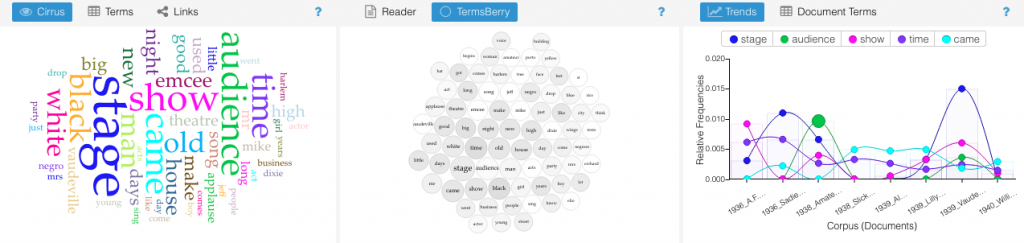

I compared my specific documents to the corpus as a whole to better understand how they differed from everyday rhetoric to the niche rhetoric of performance. I did a good job of exploring the different tools that Voyant had to offer. But ultimately, the research I have struggled to answer my question. So I did a little more closer reading to my texts and tried to understand if those readings confirmed my hypothesis. All of my readings centered around how much people of color were happy when talking about being in theatre which confirmed my concerns with my historical question. In the end, I feel like my question was answered. I was shown that people of color had a better outlook on their lives after the Federal Theater Project facilitated them being involved in the theatre. I was definitely searching for specific documents that answered my historical question how I wanted to see it and not how it objectively appeared but, I don’t yet have the corpus to truly delve into the truth of my historical question which, can only be left up to the future.
- “The Play That Electrified Harlem: Articles and Essays: Federal Theatre Project, 1935 to 1939: Digital Collections: Library of Congress.” The Library of Congress, 2019, www.loc.gov/collections/federal-theatre-project-1935-to-1939/articles-and-essays/play-that-electrified-harlem/.
- Posner, Miriam. “Investigating Texts with Voyant.” GitHub, GitHub, Inc., 2019, github.com/miriamposner/voyant-workshop/blob/master/investigating-texts-with-voyant.md.
