Scared Since the 30s

The historical question that I focused on was “Why were ghost stories common across America in the 1930s? What does this say about the time period?”. Ghost stories were common across America in the 1930s because it was a way to bring communities closer together. Having a common topic, one everyone in the town knew about, that was a distraction from their current economic crisis would’ve been a relief to a lot of people. I’m sure many were scared, but as we’ve seen from how popular ghost stories are, people enjoy that kind of fear. Especially how not everyone who told a ghost story believed in it, many were skeptics. But it’s more about how ghost stories and scaring each other is a form of bonding, one that many communities take part in.

I got all of my sources from the Library of Congress Federal Writers Project interviews which meant that I only had what people talked about. We didn’t mention ghost stories at all in class because there isn’t much on it from the 1930s, but I’ve always been interested in ghost stories and I thought it would be a unique idea for my final project. I’d already had a corpus from our project on Voyant to go off of, but I decided to create a new list of ghost stories so I could gain insight into ghost stories from around America rather than random ones that I had chosen a month ago. I wanted to see if there were regional differences in the stories, and I had decided that along with Voyant, my project was going to have a map. I wasn’t really aware of how helpful maps can be to enhance a project until we read the introduction to Discovering the South: One Man’s Travels through a Changing America in the 1930s and had the accompanying website that marked Jonathan Daniels’ travels 1. The map allowed me to go on the journey with Daniels as he worked to document his travels and the general feelings of southerners at the time. The map gave me visuals and a brief description of where he was and why it’s important that he stopped there. A few weeks after going through Daniels’ journey, we created our projects on mapping, and with it read an article about how digital mapping has evolved to allow digital historians and professors to be able to teach in a more tangible way 2. These mapping projects give a real insight into what it was like to live as a black person immediately after emancipation or be able to understand how many lynchings happened in the South between 1877 and 1950. Seeing racism plainly shown, with data to back it up, can be very impactful, especially for students who don’t have much experience in learning about racism. I also included an image analysis in my project because I felt like the picture I found perfectly encapsulating what I meant when I talk about people enjoying being scared.

This class has really helped me understand the digital world and the 1930s in ways I hadn’t before. Many of the websites and ideas we learned were completely new to me but were still relatively simple to understand. I enjoyed when we had to go to a New Deal site near us, because not only did it give me an excuse to explore DC, but it also put the New Deal into a realistic context so that we could see that the effects are still around us in many ways. I had no idea how many parks and structures across the country came from the 1930s, and how much we use them in our everyday lives. The lessons we had on copyrights and data usage have been eye-opening into how complicated and restrictive they are 3. I was also fascinated by our conversation about how memes are completely changing how we interact, and how information gets spread 4. Both relevant and important topics today, and connecting them to the 1930s only enhanced the topic more in my mind.

Before this class, I didn’t know much about the 1930s, only that it was when the Great Depression happened and FDR was elected. I had no idea the New Deal included so much art, writing, and theater and wasn’t just infrastructure and economics. Being able to directly connect consequences from the 1930s to today’s world is a valuable skill and I’m glad this class was able to offer me the chance to do just that.
The 1930’s Aesthetic

The historical question I have is why does the poor quality of audio from the 1930’s create a more authentic feeling for the listener? I believe it’s because when listening to older audio, we can expect certain things. In the context of slave narratives, we talked about and were warned that we could expect racism and that a lot of what was written or asked was from what the white people expected the black slaves had gone through 5. And we accept this because we understand that the 1930’s were a different time. So when we listen to an interview from the slave narratives, like this one with David White, we understand and accept that the quality is poor because the technology was new and wasn’t as refined as we have now 6. In this interview, I especially found it difficult to understand what was being said and even the transcript mentions it. But in a way, this poor audio is part of the experience of listening to older audio. If there was a crystal clear recording from the 1930’s, no one would believe that it’s actually from that time period. Even the songs from the time period have a static quality to them 7. So if the quality is so bad from that time period, then why do modern day people romanticize it? There are new songs today that mimic the static quality, “I Have Friends in Holy Spaces” by Panic! At the Disco comes to mind, and even in places like Instagram there are filters that are supposed to make your pictures look old 8. This all comes down to what I believe is nostalgia and purely aesthetic. Not many people actually want to live in the 1930’s, they want just the good parts. Whether that’s good or bad isn’t up to me, but it’s when we take the history away from that context that things get messy. As technology advances, historians are going to have to continually adapt how they are able to listen or see or interact with data created on outdated pieces of technology 9. So by being able to fake static or pictures to make them look older than they are, digital historians are going to have to reinvent the ways that they date a lot of content they study.

Mapping an American Guide Tour

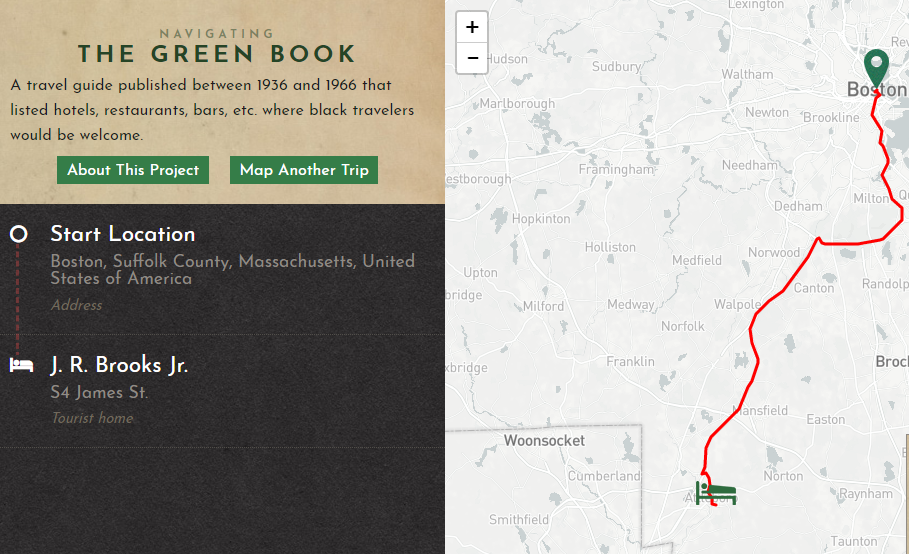
Mapping and spatial history can tell us a lot about the past. Old roads that no longer exist, or towns that exist now but live where a forest once was brings historians to ask the question; why? Why is this road abandoned but not another one? Why did people choose this specific place to build a town and not a place a few miles away? Answering these questions gives us a deeper look into history and the decisions that led to the present day. The map I made was from Boston, MA to Tiverton, RI. This map is very specific to me because it actually goes through my hometown, Easton Massachusetts, and through a lot of towns I grew up around. I was surprised to see Easton on the route because I don’t consider it a very well known town, but it definitely adds a more personal element to my map and I was able to use a picture my mom had taken which I thought was a great addition. Reading through the guide about the towns around Easton, I was surprised at how little things had changed. Sharon still doesn’t have much and is more of a rich residential area, Blue Hills is still a beautiful hiking spot that but now they also have an animal sanctuary which include river otters, and Easton’s public library.Seeing how little things have changed there since the 1930’s was a little surprising, but I feel like I should’ve expected it since they’re very quiet towns and not much happens there. Washington officials wanted to guidebooks to be composed in exactly the same way, but some state directors rebelled, and one of those was Ray Allen Billington from Massachusetts who argued against the strict essays they were expected to write and instead wrote his own 10. When reading over what was actually written in the guide books, it’s not easy to tell to me, but maybe if someone was reading a lot  of the guidebooks, it would stick out more.

The route black travelers would have to take if they wanted to go from Boston, MA to Tiverton, RI.

When I looked at the trip through the Green Book map, it looked very different. There was only one rest stop for black travelers between the starting point and ending point, and when looking at the heat map, there were barely any in the area. It’s also the closest stop to Rhode Island, because there were no stops for black travelers at all in RI. Considering how many cultures and how diverse Rhode Island, and especially Providence, is today this isn’t a result I was expecting. The black travelers that would be taking this trip wouldn’t be able to stay where they wanted to go, they wouldn’t have many places to stay at all throughout the trip, and it would be a long way before they could even stop. This map helps highlight the racism that was prevalent at the time and can help the public better understand the history of racism and slavery 11. Not having a place to stay meant that not a lot of black people could explore America like their white counterparts, which meant that they couldn’t experience America like the guidebooks wanted Americans to be able to.

GMU Special Collections and Archives

After our visit to the Special Collections, I felt like I better understood the role of archivists and their importance. I obviously knew who they were from our class discussions, but actually hearing the archivist talk about what they do and how much politics go into it, I was surprised. It makes sense that some people pay to get their item archived first, but that isn’t really a problem I would’ve thought of on my own until she explained it. I also had no frame of reference for how long it takes to archive these items, but hearing that it took 12 full time staff and 14 part time students 6 years to digitize 60,000 pictures gives me a whole new idea of how long this can take. Archivists protect a lot of history and I’m sure after hearing about the wide range of topics that the GMU Special Collections has that they’ve saved countless professors, grad students, and undergrad students in their search for items that help with their class or thesis, or papers. The general public could also use archives to learn more about a specific part of history or to learn more about a niche subject. Archives can help anyone find out more about their topic. However, in a lot of cases government records only include people or events they believe should be remembered so that affects who is and isn’t seen in the future, as well as that evidence being historical itself because it reflects the time period and the policies of the administration 12 . Unfortunately this means that a lot of history has been lost to us because a lot of minorities and their accomplishments of the past weren’t recorded as significant, even if they changed a lot of lives. It could also mean that their identity was left out, which changes the meaning of the work, or someone else took the credit, and the real creators name is lost. 

The archivist we met with talked about how they mostly archive photos, because it’s harder to digitize things like costumes or diagrams since those are more physical, and it’s harder to digitize documents, like the plays from the Federal Theater Project we looked at, since the paper is delicate and might rip or affect the materials it’s made of. However with all archivable items, the archivist also talked about how they have to be careful with copyright issues because those can be very complex and not always straightforward. Another issue with digitizing is how archivists preserve born-digital records-texts, images, and data created digitally 13 14. In the past they’ve been able to recreate the software and hardware that the items were originally created on, but as technology advances at a faster and faster rate it’s getting harder to emulate these archives and they’re going to have to figure out another way to preserve these important items.

After looking at the archives from the Federal Theater Project I feel like I understand more about the play we looked at than before. My group analyzed the playbill for the play “The Revolt of the Beavers” which is a play for children about sharing, but many were concerned that it had communist undertones. We were able to learn a lot about the play and from each other’s analysis. One person in my group pointed out that there were pig names, and that the pigs might represent the capitalists, while the beavers represented communists and were the protagonists of the story. We also talked about how they were definitely hand folded and most were made of cheap paper which reflected the economy of the time. If we can learn that much about a play just from the playbill, it’d be interesting to see what we can learn from even more archives and more analysis.

Ghost Stories from the 1930’s and Voyant Tools

My historical question was “In what ways have ghost stories changed, if at all, and based on these accounts are people more or less careful around ghosts? Why?” and while I was curious about the answer, I had figured that it would probably be similar to the ghost stories we tell today, although I did expect people to care about it less, which ended up being untrue from what I read. 

When I first started looking up words, I wasn’t sure if I was going to find any, but luckily there were a good number of actual ghost stories. I used words like “ghost” “spirit” and “supernatural” with more results than I was expecting, although sometimes I’d get more religious texts with “spirit”, or people would use phrases like “pale as a ghost” which was not what I was looking for. 

It took me a bit to really understand Voyant and which tool would work best for me. Since my topic is pretty niche, I found that the word map wasn’t helpful, but that the graph and the contrast tools helped me compare my corpus with the class’ to find similarities and differences 15.

The amount of times the word “ghost” showed up in my corpus
The amount of times the word “ghost” showed up in the class’ corpus

What I did in this picture was I entered the word “ghost” into both my corpus and the class’ corpus to see how often the word shows up throughout texts. Most of the spikes in the class’ corpus was from the stories I submitted, but there was one that was very high that I hadn’t submitted. It ended up being just a sentence from an interview but because the interview was only one sentence, it made the graph think that because “ghost” was a common word in the interview, simply because there were few other words, that means it must be relevant.

In the end I feel like my historical question doesn’t fit what I found so I’d change it to something more like “How common were ghost stories? How important are they to the communities their told in?” because I found that they were somewhat common throughout many towns and they inspired bonding in certain stories 16. I also found that I enjoyed looking through the different ghost stories and how they ended up being similar to the ones we tell today, despite how different the times are. One of the most interesting things I found was how the debate over whether ghosts are real or not was just as relevant then as it is now, with both skeptics and believers arguing. The biggest difference I think is how today, people mostly talk about evidence being caught on camera, and whether or not it’s faked, but in the 1930’s, catching a ghost on camera would be near impossible so the beliefs were based on personal experience. The conversations have shifted from personal to objective, unaltered proof, which while can be more believable, it discounts a lot of experiences that cannot be seen, such as the emotional energy tied to a place, and credible psychics, however rare they might be.

Ledbetter’s Interview

For my interview I listened to Uncle Bob Ledbetter, who was around 79 years old at the time of the interview and lived in Oil City Louisiana. In mine specifically, Ledbetter only talked a little bit about slavery, mostly how he never got into trouble, but he was only 2 years old when emancipation happened. But I think that in any interview with an enslaved person we can learn a lot about them, and what being a slave was like because there’s no third part coming in and only taking out parts they believe are important. When there are direct interviews, it not only humanitizes them, but it also makes sure that any information they wanted to share, is shared.

A lot of Ledbetter’s big events happened at very different times than the national events. For example when he spoke about getting married around 1881, and in my timeline, there are many big events that happened around then. People experience history in a completely different way than it’s told which is why first hand accounts are so important.

I was surprised that the audio ended right before Ledbetter could say what presidential election he voted in, because I think that would’ve been interesting to hear about, and he might’ve explained why he voted the way he did which I would have loved to hear about. I was also surprised he really never talked about any big events in history, he just talked about his own personal life, which is great but unexpected. I think it’s unexpected to me because if I were to make an account of my life I probably would talk about some big events, but then again we live in a very different time and I am a very political person so that would change how the interview goes.

The interview is useful if you want to get to know more about daily life for a black person in the late 1800s to early 1900s but it has its limitations in that it‘s very short, so you don’t get a lot about their life, it’s hard to figure out dates, although I was lucky because Ledbetter talks about his age a lot in them so using that I can work backwards and figure out what year the events he talked about happened. However it can be really difficult to hear sometimes, and sometimes they talk over each other as well, so the transcript was very helpful but without one I think it’d be hard to understand everything they’re saying. It confirmed what I thought of oral history as a primary source, because it’s great if you want to know about the subjects life, but it’s also difficult to hear and you never know what answers you’re going to get so it’s best to have an open mind about whatever they’re saying.

Their voices added a lot of the meaning behind their words in the interview, and since Ledbetter would sing, it added another layer of exploring who Ledbetter was as a person, not just as an interviewee. Transcriptions definitely allow you to understand what people are saying, but they can take away some of the meaning behind the words. However it can also show the transcribers bias. The transcriber may over exaggerate some words and phrases that they think the interviewee might’ve used based solely on stereotypes, this is especially true if there is no recording because that makes it difficult to hold them accountable for changing what people have said 17.
The interview itself can’t tell us a lot outright because they’re usually talking about the past and not the time of the interview itself. However the way they interact and how they talk is history itself, which tells us a lot about the time period. Like how Ledbetter would still call Lomax, the  white man interviewing him, “sir” sometimes, indicating that despite the 15th amendment and emancipation, many black men still felt like they had to be respectful to white men, because white people still had social power over black men. Some interviewees even thought the interviewers were government workers so they would change how they spoke to them, hoping to get government help 18.

WPA Activism and Bias in Algorithm

Algorithmic criticism is when people look at algorithms and discover the bias’ that exist within the algorithm. Algorithms themselves don’t have bias’ but the people that create them do, so often times people don’t realize the racism or sexism that is apparent in their work 19. Many scholars and activists suggest that people go more in depth into their research and don’t just blindly trust what your device tells you. 

The Long Civil Rights Movement (LCRM) impacted the 1930’s because it paved the way for the civil rights movement in the 1960’s by beginning the start of trying to get black people’s rights, even though a lot white people felt like they didn’t want black people to have equal rights, but they were sympathetic towards them. The actions of the 1930’s movement are what made our society today. The WPA-activists are what led to the civil rights movement in the ‘60s, which granted many people of color rights, and continues to inspire many people today. Discrimination in the New Deal programs brought civil rights to the forefront  of American politics and it continues to this day to be a defining cause in many politicians campaigns 20

WPA-activists and contemporary digital activists are similar in that they fight against something that is very ingrained into society that many people don’t realize. Until people of color protested how they were treated in the New Deal, nobody except them realized what was happening. People today don’t realize how racist and sexist a lot of algorithms are until people like Safiya Noble point it out and how we often don’t go very in depth into our internet research and just take the first results at first glance. I think a lot of the contemporary techno- and algorithmic critics are using some of the same tactics as WPA-activists of speaking out and I think people are also reacting in the same way. When the WPA activists pointed out the racism in the New Deal and how people of color were treated in society, a lot of white people agreed but didn’t want to do anything about it, and it’s the same way here. When people learn about bias in algorithms, many are sympathetic but don’t want to change how they do research.

Photo Analysis and Glitching

At first I wanted to find a photograph of real people to analyze, but as I search I didn’t find any that I connected with and felt like I could properly analyze. Then I started to go through WPA posters and I found mine (http://jessicadoeshistory.com/cnd/exhibits/show/nationalyouthadministration/nya-advertisement and http://jessicadoeshistory.com/cnd/items/show/158) soon after. I thought it revealed a part of the Depression Era that we haven’t talked about yet, which is the children. We’ve mentioned them in class, but we haven’t talked about their role in the depression and on how they were working as well to help their families. I thought this poster embodies the willingness of the young kids who wanted to work and how they could contribute to the family at such a young age. I have a few historical questions that I’ve been asking. One of them is what was the role of children in the Great Depression? This poster helps answer that by calling for boys to come learn how to work, but what about the younger children who couldn’t work? What about the young girls who maybe wanted to work but weren’t being catered to like the young boys were? This poster doesn’t answer any of those questions but rather brought them to my attention. I think the glitching method would’ve been engaging if I had been able to make it with my own computer, but even without it I still felt like I was changing the image to make it my own. When I first watched the video about glitching I enjoyed how much fun they had with it and how every image was personal to them in a way and wanted to make one that had colors blocking the image 21. Then without even knowing what I was doing, I was able to glitch my image to have colors blocking the bottom half of the image. I felt like it allowed me to focus on only the top half and realize how important the image was to the poster. The picture is of a young, white, able bodied boy, which would be the ideal person that the National Youth Administration wanted in their programs. What led me to this analysis was not only the picture but also from the Introduction of Jennifer Ritterhouse’s book Discovering the South: One Man’s Travels Through a Changing America in the 1930s because of how it talks about the racism that was still very much present 22. By bringing race and gender into the conversation I got a better idea of what employers were looking for, even though they could use any worker they could get. I know a lot of people were skeptical of this method and in some ways I am as well, but I feel like this project helped me understand how you can look at images differently from them being glitched. I don’t think it works for every picture, but for this one it helped me focus on who this ad was aimed at, which then answered some parts of my historical question.

Keywords and Digital Projects

Tony Guidone’s presentation was engaging and I really enjoyed how he brought in coins and newspaper articles from the past and let us examine them. The information he provided as well as the reading we did the night before really put keyword searching into a different light for me. I find it to be a very useful tool for when I’m writing papers and just want to find something immediately, but the Illusionary Order article talked about how when researchers do this, they tend to stop looking for many different sources and therefore lose the element of different opinions and writings. For example, in 1998 the Toronto Star was cited 74 times out of 67 dissertations, but after the Toronto Star was digitized in 2010, a year with 69 dissertations, it was cited 753 times. The paper argues that this is a result of historical researchers not branching out into other sources and only getting their information from one area. This reduces their chances of getting different information and opinions on the time period because it limits them to only one area of Canada and to only one group of writers and publishers in that one newspaper. This could end up negatively impacting their research and doesn’t give enough room for nuances. 23

Guidone also pointed out in his presentation that by only looking at specific pieces of information, we lose a lot of context that might help us in learning even more about the time period and boost our argument in papers. Like how when we only look at one very small article in a paper, we lose what other news that had happened that day which can lead to a loss of understanding what life was like during that time. He also pointed out how men were the only newspaper writers for a long time so we lose how diversity comes into play during that time if we only read the words of men, and one could argue that most of those men were probably white too so we lose even more varying opinions.

Digital media keyword searches do make it easier to find very specific topics however and can be very helpful in finding that information quickly and without wasting time. I’ve used them a lot in papers before, especially in high school, but now that I’ve learned about how limiting it can be I’m definitely going to try and branch out to use more sources in the future. 

I think it would take a lot for a digital project to cause social change because it would have to be entertaining and interesting enough for a lot of people to see it and want to share it. Many of the digital projects we’ve looked at have been for very specific areas, such as the Enslaved Children of Mason project, and wouldn’t apply to a lot of people. Theoretically, another university could see this project and replicated it with their own founder and then another university does it and then it continues on to most universities, but I sincerely doubt that will happen. This kind of project wouldn’t be able to apply to colleges who’s founders didn’t have slaves, or those that don’t have the money, time, or area to put up this kind of project. It also depends on how widespread the hypothetical social change would be. Is this all of American society? Just this university? Just this class? Because I think a digital project could definitely change a classroom or even a universities society, but I think it’d take a lot for one to affect American society and cause such widespread change. 24

Blog Post #1

I already knew a bit about the 1930’s because I took AP US History in high school so I remember a lot of the new deal and of the great depression. However in class we never went over the impact of specific programs because to go over every single one would take too much time but we went over how the programs help the United States overall. I’m very interested in seeing how promoting the arts will help stimulate not only the economy but also enrich the lives of Americans through these difficult times. I haven’t worked a lot in digital history although I am very invested in learning history so I’ve researched different periods in history for specific groups of people before. I’m nervous that I’ll have difficulty in certain areas like trying to find information on specific ideas or groups because I’m not sure how much was recorded in that time period. Overall I’m excited to be in this class and I think it will be engaging while also pushing the boundaries of what I’ve thought before.


I was assigned the project “Musical Passages” which plays the first transcribed African music in the Caribbian. This music was written down in 1707 by Hans Sloane who wrote a book called “Voyage to the Islands of Madera, Barbados, Nieves, S. Christophers, and Jamaica” and the music tells the stories of slaves. The first thing you hear when you open up the page is the ocean, and then suddenly different kinds of music play from different areas, but all with the sound of the ocean in the background so you feel as though you’re listening on a boat or by the sea. At the bottom it explains what Sloane wrote about, the different types of African music in the Caribbian, and it also breaks down each piece that they play while you’re listening to them. This project was created to share the story and music of the slaves whose stories are often forgotten and spoken over. Musical Passages gives the listener a sense that they’ve gone back in time and if you close your eyes, you’re practically transported. It is interactive as well because the listener can click on the music they want to hear. The set up makes you slow down and really interact with a different time period in a way we’re often not able to do.

Works Cited:

http://www.musicalpassage.org/#explore

https://archive.org/embed/howdidtheymakethat

css.php