Blog Post #9

Voices Remembering Slavery: Freed People Tell Their Stories explores the way in which such narratives have impacted modern-day Black History. The individuals documented in these various presentations say much about living life as African Americans between the 1870s to the 1930s. 

In connection with the audio collection from “Voices Remembering Slavery: Freed People Tell Their Stories”, “Born in Slavery: Slave Narratives from the Federal Writers’ Project” is a narrative collection that consists of texts derived from the oral interviews. The interviewers were writers that were trained in the phonetic transcription of speech.

An interview with Wallace Quarterman at Fort Frederica, St. Simons Island, Georgia was conducted by Alan Lomax, Zora Neale Hurston, and Mary Elizabeth Barnicle. Quarterman describes Quarterman’s life during enslavement. He discusses the time he heard gunshots and began to sing “I surrender, surrender, surrender” listen for he and his had to “leave their land for the sake of Uncle Sam”. listen

Enslaved African Americans were nothing more than property. They worked as domestic house servants, providing services for their master’s and were overseer’s of families. In the second part of this interview, Quarterman discusses being set free and expresses such with much zeal. He then breaks into song listen. Though a freed man, he was unable to seek opportunities that the white man could have because listen. Without an education, resources were limited and work was scarce.

Embedding the audio of Wallace Quarterman engages the reader as it offers a real-world experience, stimulating the mind and creating a sense of imagery.  Giving insight as it can tell us about character, place, and time. It also informs us as well as moves us in ways visuals cannot.

Hearing Quarterman describe his life as a slave in the 1930s has raised concerns. We are aware of the cruel and inhumane treatment endured by slaves though, why must history be a never ending cycle of unfortunate events. Black history has been repressed, rewritten, and condensed in the cataloging of American history. Modern-day history continues to showcase the prejudice against African- Americans through racial discrimination,oppression, and marginalization of people of African descent have all contributed to an under-representation of black voices. 

“Interview with Wallace Quarterman, Fort Frederica, St. Simons Island, Georgia, June 1935 (part 1 of 2)”, Voices Remembering Slavery: Freed People Tell Their Stories, Library of Congress, https://www.loc.gov/item/afc1935001_afs00342a/ .

“Interview with Wallace Quarterman, Fort Frederica, St. Simons Island, Georgia, June 1935 (part 2 of 2)”, Voices Remembering Slavery: Freed People Tell Their Stories, Library of Congress, https://www.loc.gov/item/afc1935001_afs00342b/ .

Blog Post #7

The American Guide Project outlines different topics to include in the state guide. When exploring the Guide To the Old Dominions, I came across societies, folk customs, transportation, and natural resources. According to the American Guide Series, “the guide would convey the “true” America to its people”.

The structure of the Guide To the Old dominions followed the set format stated in The American Guide Series. It focused on the origins of the states and their customs through the lens of a local resident, provides descriptive information about the states like important monuments and wild-life, and lastly, tourism. Which informs readers of the roads, transportation options, major cities and their attractions, natural and historical sites of relevance, and other points of interest to travelers (efn_note)http://exhibits.usu.edu/exhibits/show/americanguideseries/americanguideseries(/efn_note).

Mapping a tour from the American Guide Series compared to that of Navigating the Green Book displayed major differences. During the 1930’s, segregation laws existed in southern states. Due to such and racial bias, African Americans were prohibited to travel in various states causing them find alternative routes that enabled them to reach their destinations. Whereas their white counterparts were free to move from state to state, having unlimited access to restaurants, accommodation and more.

When navigating through the Green Book, I was reminded of the reading the discussed the way in which racism was mapped. W.E.B. DuBois, a prominent African American activists,”traced the routes of the slave trade to Southern states, the value of blacked- owned property…” (efn_note)https://sarahemilybond.com/2017/10/20/mapping-racism-and-assessing-the-success-of-the-digital-humanities/(/efn_note). 
Through these resources, mapping and spatial history tells us much about the pass. It tells a story plotted through space showing  us the scale from one place to another, which involve the use of movement. The two coexist when studying the mobility that took place throughout history. The GIS, a platform for organizing and visualizing data, enhances the ability to examine spatial data (efn_note)https://www.historians.org/publications-and-directories/perspectives-on-history/september-2017/blending-local-and-spatial-history-using-carto-to-create-maps-in-the-history-classroom(/efn_note). Engaging in the process of mapping enables one to think critically about the relationships between the different spaces. Mapping locations enables the use of primary sources to consider spatial relationships in new and productive ways. The use of primary sources spatially provides us with firsthand accounts or direct evidence concerning an event. It allows for research to be conducted, enhancing our knowledge and broadening our understanding.

Blog Post #8

Archives provide first hand information about the past. They serve as primary sources and evidence of significant historical events for scholars. Archive also play a role when telling stories, increasing our sense of identity and understanding of cultures (King’s College, 2019). Archives are in many cases used to carry out research, create architectural designs, as well as demonstrate knowledge and development through literature. 

According to The Artifactual Elements of Born- Digital Records, author LeFurgy explains to readers that archivists engage in the process of emulation as a way to “persevere artifactual characteristics of born- digital archival collections”.

Commonly, archivists digitize records to facilitate access. Those digitized copies may be found in multiple locations, which in turn protect and maintain the state of the original copies from improper use and or physical damage such a wear, tear, and possible binding. 

Though, various factors are considered when deciding whether or not to digitize an archive. Some include but are not limited to; the size or dimension, the context, the quality, maintenance of digital files, and the cost.1https://www.google.com/amp/s/peelarchivesblog.com/2017/05/31/why-dont-archivists-digitize-everything/amp/[/efn_note]

In my opinion, the digitization of archives may affect our interpretations and could consequently impair our judgement concerning past events. Though we are presented with firsthand material, we may still lack the central idea surrounding the concept’s purpose and value. 

Visiting the Special Collections exhibit bettered my understanding of the Federal Theater Project. For example, I was able to explore the archives from MACBETH, a production by the Federal Theater Project’s Negro Unit. In the collection included various photographs of actors, actresses, extras, props, and even play- goers. Other collections pertaining the 30’s were also present.

Looking through the digitized copies gave me an insight on how advanced and well organized the Federal Theater Project was described to be. Prior to such, I could not have imagine that technologies of the 1930’s were quite similar to those used today. Each archive sparked my interest as they almost seemed unbelievable. I could not grasp the fact that I was exploring such things of the past better yet, experiencing each for myself as they were well kept and maintained.

“What Are Archives?”, Kings College Cambridge, accessed November 12, 2019, https://www.kings.cam.ac.uk/archive-centre/introduction-to-archives/a/1

“Why don’t archivists digitize everything?”, Archives @ PAMA, accessed November 12, 2019, https://peelarchivesblog.com/2017/05/31/why-dont-archivists-digitize-everything/


Blog Post # 6

When formulating my historical question, it was my goal to discuss the impact that African slaves had on American history, specifically amongst those in the Black community. My historical question was “What influence did slavery have on Black culture and identity” ?


My initial ideas regarding my answer was that African slaves lead the way for many historically prominent Black figures today. Due to the adversity faced by our ancestors, who were then forced against their will to endure inhumane treatment while trying to survive in harsh living conditions, it was up to the next generation to pick up the pieces. Which would eventually cause us to create a name for ourselves, enabling the entire Black community to form an identity like none other, only enhancing our already rich and diverse culture.

When selecting my sources, I went through the Slave Narratives from the Federal Writers’ Project, where I searched for keywords through the manuscripts like “negro culture”, “slavery”, and “negro spirituals”.

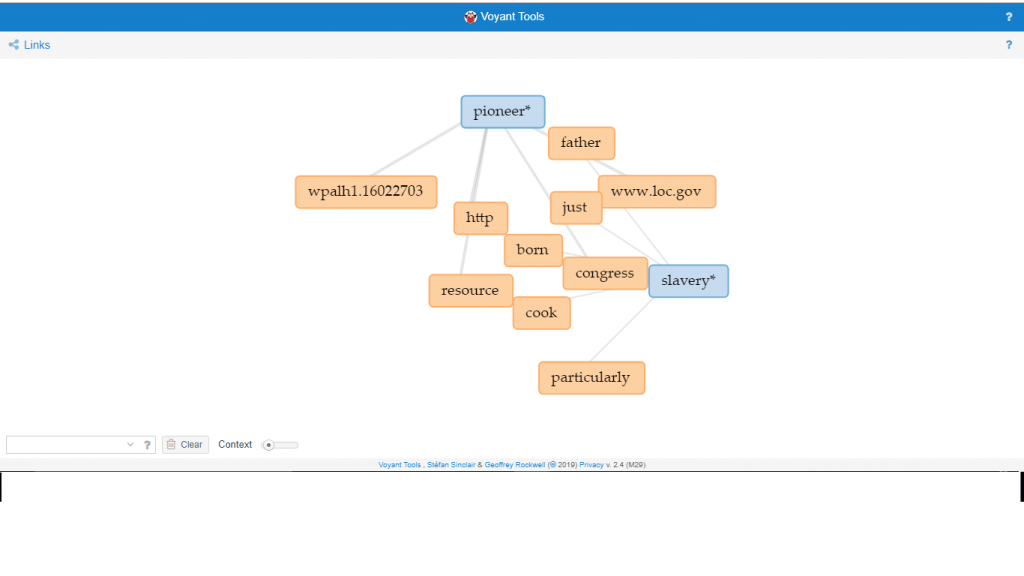
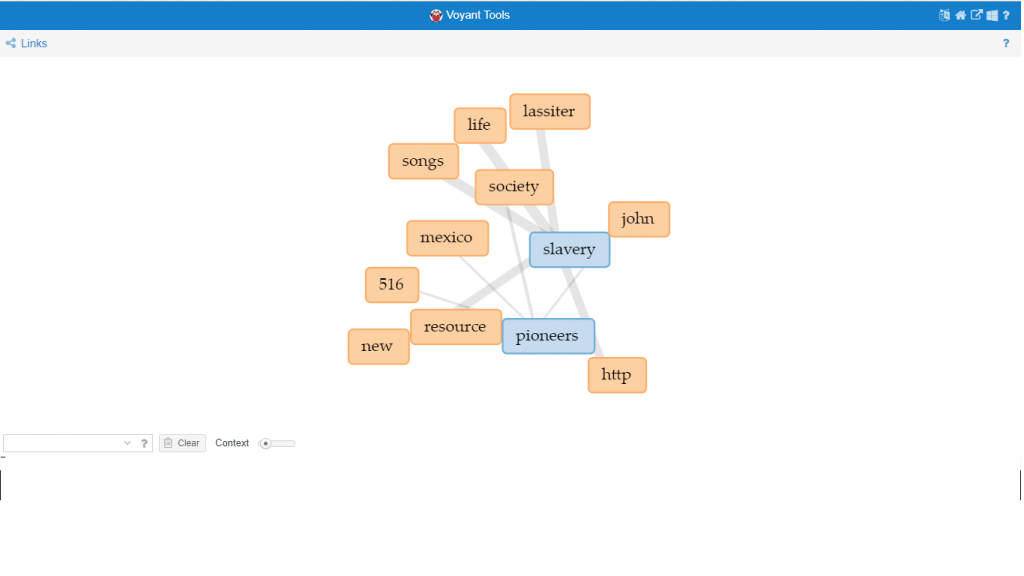
Using Voyant Tools was quite difficult. I did not understand how any of the different tools worked or what they were trying to tell me. Though, with much practice I am now able to navigate my way through the site with ease. As I have become familiar with how each tool interprets the text from documents within the corpus. The one tool I found particularly useful was the “Links” feature. It allowed me to search for terms like “pioneer”, “negro”, and “slavery”, which connected to people, places, job titles, and more. I chose to compare my corpus of ten documents to that of the class to see the difference ( if any) between a corpus on a larger scale and one on a smaller-scale, when searching for the relevance of the key terms previously mentioned.

“Link” Tool from corpus on Larger- scale
“Link” tool from Smaller- scale corpus

I would say that performing text analysis on the corpus broaden my ideas and assumptions based on my historical question. Pairing my findings with close reading enabled me to explore these ideas. The Reader and Trends tools helped me to locate the various words that were connected to the keywords in the Links tool, making it easier for me to contextualize the relevant documents in both my corpus and that of the class.

To conclude, I can say that close reading is quite helpful when analyzing text. Being able to understand how and why specific words correlate with one another within a text or outside of another is important as a reader. Through the use of Voyant Tools, I was able to draw that the influence of slavery on Black culture and identity shaped many Black trailblazers and pioneers. Many who sought to receive an education that their ancestors could not, guaranteeing them success and a brighter future; not only for themselves but for the generations to come. It is because of their sacrifices that we have been able to establish our true identities. Not the ones that the white man so vaguely gave unto us, but rather the ones we worked so earnestly for.

Blog Post #5

“Voices Remembering Slavery: Freed People Tell Their Stories” was a project done by the Federal Writers’ Project that interviewed former slaves who discussed their experience as enslaved people. They described vivid memories of slavery as well as the hardships and harsh conditions faced by Black people during and after the Civil War.

Fountain Hughes, a former slave from Baltimore, Marylamd was interviewed by Hermond Norwood on June 11th, 1949. During the interview, Hughes explains how difficult his life was during the 1800’s – mentioning “if ever a slave again, he would end it all right away.” At the time, Blacks were treated as property or even like dogs, Hughes adds. They did not have much and did their best to live according to their means. Hughes mentioned that slaves would often gather into a log cabins for worship and ask God to deliver them from adversity.

When discussing his former life, it was surprising to hear Hughes say that he never had shoes until he was thirteen 2. Yet, he continued his hard labor as he was hired out for “one dollar a month” by his mother. Hearing Hughes compare the dollar value from the 1800’s to the 1900’s was vile. A dollar bill was worth much more than what it was fifty years ago and even today as some slaves were paid only a few cents a day. 

Remembering The Voices of the enslaved people in my opinion is imperative to American History. Growing up, I was “told” how blacks were taken from Africa by white colonialists and were forced to work against their will. Though, I was never informed of their inhumane living conditions, the ill- treatment, violence and abuse, and most importantly, their impact on American society. Black people have played a key role when shaping the U.S. today and continue to do so.  

Though useful, the interviews had limitations in which many narratives were impaired. The former enslaved people were unable to remember much about past events such as the Civil War as many of them were young in age. Being that they were unaware of the details regarding the Civil War of 1861, events like the Mexican War (1846), the assassination of former U.S. President James A.Garfield (1881), and Tennessee’s adoption of a new constitution abolishing slavery (1865) were more than likely unknown. Historians categorize these historical events and define them as things of the past. However, many of our ancestors have lived through these traumatic events and have experienced the social, economic and political effects of the country. 

The former enslaved people were unable to remember much about past events such as the Civil War as many of them were young in age. Being that they were unaware of the details regarding the Civil War of 1861, events like the Mexican War (1846), the assassination of former U.S. President James A. Garfield (1881), and Tennessee’s adoption of a new constitution abolishing slavery (1865) were more than likely unknown. Historians categorize these historical events and define them as things of the past. However, many of our ancestors have lived through these traumatic events and have experienced the social, economic and political effects of the country.

https://cdn.knightlab.com/libs/timeline3/latest/embed/index.html?source=1jZslAz4nyqH8_YTgtFONsdbtsE-hRQ7SUTQrcaHE8HM&font=Default&lang=en&initial_zoom=2&height=650

References:

Norwood, Hermond, and Fountain Hughes. Interview with Fountain Hughes, Baltimore, Maryland. Baltimore, Maryland, November , 6, 1949. Pdf. https://www.loc.gov/item/afc1950037_afs09990a/.

The Jefferson Monticello. Getting Word: African American Families of Monticello. Retrieved from https://www.monticello.org/getting-word/people/fountain-hughes.

Blog Post #4

Algorithmic Criticism is “human-based criticism with computers”. It is how we research, often organize our thoughts, and how we put them into words through search engines 3. According to O’Neill’s video, algorithms are an “opinion bedded in-math that can be sexist, racist, and even perpetrate structural inequality.”4. Though scholars and activists suggest that ethics be built into algorithms so that they are fair, transparent, and kept accountable.


In Noble’s excerpt, the same ideals of algorithmic criticism are looked at. She discusses the prejudice against black women and how they are sexualized and even degraded through these various searches. Noble includes that “Internet users have no idea how these ideas come to dominate search results…”. However, this is due to how the algorithms have been created. Rather than they be built to provide recourse, which is the ability for people to modify the outcome, they are based on mere human judgement and there is no way around it.

During the 1930’s, movements such as the Long Civil Rights Movement, Feminism, and the Popular Front impacted the era as it had much to do with politics, race, gender, and social class. The Long Civil Rights Movement placed emphasis on the fact that the Civil Rights movement started well before the 1960’s. The movement not only aimed to create equal rights for African Americans but, in turn served a purpose in the Feminist movement. Women of all backgrounds sought for equal rights; which included being able to enter the workforce and exercise their right to vote.
As a result, these movements paved the way for many of us today, especially women and people of color. More women have entered the workforce and both men and women can freely exercise their right to vote. The LCRM granted African Americans equal rights that only their white counterparts could exercise.

The WPA- era was known to be one of the motivating factors in reinvigorating the economy. Today, digital activism has used technology as a platform for mass mobilization and political action. It has allowed for significant changes into this new age of technology. Calling out the wrongdoings of this country and doing more to promote and bring awareness to ethics and social justice. Like the WPA- era activists, who worked to employ job- seeking individuals to perform public work projects, digital activists use internet platforms like social media to create movements that have proven to be a tool to spread an agenda or political message. Movements like #BlackLivesMatter and Arab Spring Uprising are just a few examples.

References:

Cpotter. (2016, October 24). Toward Algorithmic Criticism. Retrieved from https://blogs.newschool.edu/digitalhumanities/2016/10/24/toward-algorithmic-criticism/

O’ Neil, Cathy. (2019, October 9). The Truth about Algorithms. Video retrieved from http://jessicadoeshistory.com/cnd/exhibits/show/fall-2019/critical

Noble. (n.d.). Algorithms of Oppression Excerpt. Retrieved from https://www.dropbox.com/sh/l0nncfvgpnd5s59/AABVeDfbIkwnJdX6YEjXGHkBa/Readings?dl=0&preview=Noble%2C+Algorithms+of+Oppression+excerpt.pdf&subfolder_nav_tracking=1

Blog Post 3/ Skills Assignment 3

The selection of the still image of the “[Receipt for sale of Jane, age 18, and her son, Henry, age 1 and all future children, December 20, 1849]” was to done to shed light on the cruel and ill- treatment of African Americans during the time of slavery. As much as American history has become an academic curriculum throughout the United States, African American history alike is an important part of American history however, it never seems to get the recognition it deserves.


The image is a photographed copy of the sale of negro slaves that had been handwritten on a document in order to keep record of the transaction. It reveals the lack of technological at the time. If we compare the imaged receipt to the receipts used today, the key difference is the use of technology. Whose responsibility is to properly and efficiently calculate and record our very own transactions.
Regarding this specific time period, historical questions concerning the imaged receipt may include:


If slavery were to still exist today, about how much more would individuals of African descent be worth today?


Being that slavery has long been abolished, what reparations would be appropriate for the unfair treatment of African Americans over the past couple decades?

The methods used such as the Exhibit Image Annotation allowed me to think more critically about my digital image. It enabled me to analyze the image through the Principles of Image Analysis. For example, the “Site of Production” subcategory helped me to identify who the receipt was for, when the transaction for the sale was taken place, for whom the transaction was for, and why. Though, the “Site of Self Image” a more challenging subcategory, made me think extremely hard about the visual meaning of the image. One does not think too deeply about the visual meaning of a written document. When trying to do so, I asked myself how. How would I be able to interpret the visual meaning of the digital image in a way that my audience would understand? 5

I concluded that the image was a visual representation of history itself, displaying the era in which African American Slaves were mistreated and were held against their will. The receipt was the only form of tangible record for the sale and purchase of slaves amongst both slave and plantation owners.


Through my analysis of the digital image I formulated my historical questions. After years of cruel and unfair treatment of individuals of African descent, it is important that we be given the proper reparations needed to heal from our traumatic past. 6


Compared to the Exhibit Image Annotation, the glitching process, did not help me to think more critically about the digital image. Though engaging, I did not see the significance of such and did not understand how or why it would have enhanced the digital image. I had trouble converting the image from .jpg>.txt to .txt>.jpg. However, I can say that glitching is often not done by mistake. Rather, it is a “digital tactic that produces new iterations of a digital file by introducing or removing strands of code at random or logical “chance operation”.

References:

Kramer, Michael J. “Glitching History: Using Image Deformance to Rethink Agency and Authenticity in the 1960s American Folk Music Revival”. Volume 1 (2018), https://doi.org/10.31835/crdh.2018.08

Teaching Tolerance. “Teaching Hard History: Teaching American History Through Inquiry”. February, 2018. https://www.tolerance.org/sites/default/files/2018-02/TT-Teaching-Hard-History-American-Slavery-through-Inquiry-C3-Report-Feb2018_0.pdf

Omeka Item:

http://jessicadoeshistory.com/cnd/items/show/162

Omeka Exhibit:

http://jessicadoeshistory.com/cnd/exhibits/show/bridget-r–amaniampong/annotated–receipt-of-jane—-

Blog Post #2

Today, text searching has allowed us to navigate through databases by simply looking up words and phrases. It is convenient as words are searched and indexed, enabling one to find other key terms and or resources that correlate, expanding their research. “Keyword searches enables large-scale media searching: representations of a specific word, etc”. 

Text searching through various databases has made academic research less of a task. It is easy for me to type in a common word and watch it appear in many other documents, files, and images. Milligan states that “historical databases have profoundly reshaped the foundation upon which Canadian historiography is constructed”.He also states “historians have overwhelmingly embraced these online tools”. 

The use of text searching has also allowed for the rise of digital projects. Digital projects have the ability to create social change by focusing on specific topics/issues, gathering detailed information, and drawing audiences that may potentially further findings of such research. The application of digital projects have added to scholarships. It has enhanced digital media by creating new research tools and new and emerging subdisciplines.

Over time, digital media has had some losses which have included mail digitization. It was often an issue for documents to be read through digital processors. Magazines and newspapers alike were the issue. Physical, paper copies were done away with as they were microfilmed, digitized, and as a result, data was lost. However, digital media has made it possible to access worldwide information. Giving many “new and different perspectives through online exchange to create and collaborate”. The development of digital media creates an understanding of synthesized information from across the globe which has added to existing as well as generated knowledge. Digital sources today are in many ways different from the traditional ones. Though evolved, features that call for a better experience is needed for future digitization projects. 

References:

Milligan, Ian. (December 2013). Illusionary Order:Online Databases, Optical Character Recognition, and Canadian History, 1997–2010. The Canadian Historical Review, Volume 94(4). Retrieved from https://muse-jhu-edu.mutex.gmu.edu/article/527016

A, Menten. Five Ways To Use Technology And Digital Media For Global Learning. Retrieved from https://asiasociety.org/education/five-ways-use-technology-and-digital-media-global-learning

Techopedia. What Is a Full- Text Search. Retrieved from https://www.techopedia.com/definition/17113/full-text-search

Blog Post #1

During the first week of class, we learned about historical events such as the Great Depression, the effects of information technology, as well as digital humanities that took place throughout the early 1900s. I was intrigued to not only see how far we have come as the use of technology has advanced in many different ways, but how it has also remained the same. For example, Radiophone Dances that took place in the 1920s are essentially Silent Disco parties today. Though, if we were to compare the difference between now and then, we would be grateful that coding is no longer needed to understand and interpret text. The process in which such was made possible was through the creation of Codex, then Printed Books, and later, Ebooks. A source of text- reading often used today. 

The latter part of the 1900s into the 21st Century was a time where many of us witnessed and experienced technological advancement. From playing on block- sized computers monitors that had CD Roms and Floppy Disks to using laptops and handheld devices such as smartphones and tablets. Like many today, I often wonder how much more can technology advance and to what extent. It is my hope to learn how such can continue to impact our lives today as many of us cannot live without it through the use of social media. I would like to understand how ideas for apps like Facebook, Twitter, and Instagram come about and why they are constantly changing and or updating to serve our needs as a society. 

The digital project I analyzed was titled “Slave Voyages”. The digital memorial was created as a database to explore the dispersal of enslaved Africans across the Atlantic. It provides information on the largest slave trades in history and offers resources that answer many of our lingering questions and concerns.

This source provides many examples from Mariam Posner’s framework that include timelines, 3D imaging, maps, multimedia narratives,etc. The inclusion of these tools provide those visiting the website a clear and very vivid outlook on what took place during the time. This database was equipped with sources like images, videos, and texts that were processed through digitization and organization and lastly, presented to the public in a way that was searchable and made interactive. The advancement of technology has allowed historians, librarians, scholars, computer programmers, and even ourselves the opportunity to access such information and contribute as needed.

References:

Dauterive, Jessica. (2019, August 27). What is Digital Humanities? Retrieved from https://slides.com/jdauteri/what-is-digital-humanities#/1.

David Eltis. ‘A Brief Overview of the Trans-Atlantic Slave Trade,’ Voyages: The Trans-Atlantic Slave Trade. Database, https://www.slavevoyages.org/voyage/about.

Posner, Miriam. (2019, August 28). How Did They Make That? Retrieved from http://jessicadoeshistory.com/cnd/exhibits/show/fall-2019/dh.

css.php