Blog Post 9

California, home to gold mines and new possibilities. In the midst of the Great Depression, people began to move west. Talk of a fresh start spread throughout the country. People packed up and left the East. Entire families left behind everything they knew and moved to a strange new place. Many people didn’t even get to California; they stopped and settled in the mid-west, or at the time, the Dust Bowl. However, with these mass migrations of people, came with it the spread of art and music. Folk music became huge. People writing and singing songs about everything one could think of. Songs like the one below. The type of singing changed as well. It began to vary from upbeat and happy to slower and emotional. A lot of the time, with folk music, the voice of the singer was lower and rougher, also demonstrated in the song below.

listen to this

This song is called “The Lowlands Low,” sung by Ward H. Ford, in 1938. “Recorded by Sidney Robertson Cowell in Central Valley, California on December 25, 1938. Forms part of a group of field materials documenting Warde Ford performing Anglo-American songs on December 25, 26, and 27, 1938, and Septebmer 4, 1939, collected by Sidney Robertson Cowell in Boomtown [Central Valley], Shasta County, California.”1 Sidney Robertson Cowell collected many recordings of different folk singers of the time. Her collection, California Gold: Northern California Folk Music from the Thirties, has played an essential role in understanding the lives of people in the thirties. Without her recordings of these folk songs, our view of music from that time would be different. Folk music had such an impact on the lives of Americans. It kept their hopes up. It helped them to believe that they would make it through this Depression. Folk music was not only big with the white population but with the people from all backgrounds. “The folk became figured not as failures or malcontents but as embodiments of America’s strength through diversity.” 2 Many of the musicians and singers of the time were from non-anglo backgrounds. This next song is sung by a Portuguese-American named, Mary Silveira.

listen

Also part of the California Gold: Northern California Folk Music from the Thirties collection, this song titled, “Bella aurora” or Lovely dawn, 3 expands on our knowledge of folk music. Sidney Cowell, saw the diversity in the music and the performers. This opening verse to “Bella Aurora,” gives us the upbeat and happy folk music that helped to get Americans through this rough patch. Prior to this collection of music, many of the non-anglo musicians never received any credit for their music. White Americans would here their music on the radio all the time. However, women, African Americans, Mexican Americans and many more rarely heard their music. If they did, it would be being sung by a White, Male, American not the original creator. 4
Blog Post 7

Automobile tours of American came about in the 1930s while the United States was struggling through the great depression. During the New Deal Era, the Works Progress Administration (WPA) undertook several projects. The largest and most known, being the Federal Writers Project. The American Guide Series was a series of books written as of the projects by the Federal Writers Project. It was a cooperative effort of State and Federal Organizations. Part tour guide and part almanac, these guide books were meant to encourage people to see America, to travel and move out west.5 Colored people have using similar books and maps for a very long time to visualize racism. The Green Book, a travel guide that listed hotels, restaurants, bars, etc. where black travelers would be welcome. This book helped many colored people who were traveling for work or vacation, get there safely and enjoy their time. “Many prominent African-American activists at the time turned to maps and other data visualizations in order to help the public–and even the president–to understand the detrimental effects of slavery on the country.” (Sarah Bond, 2017)6

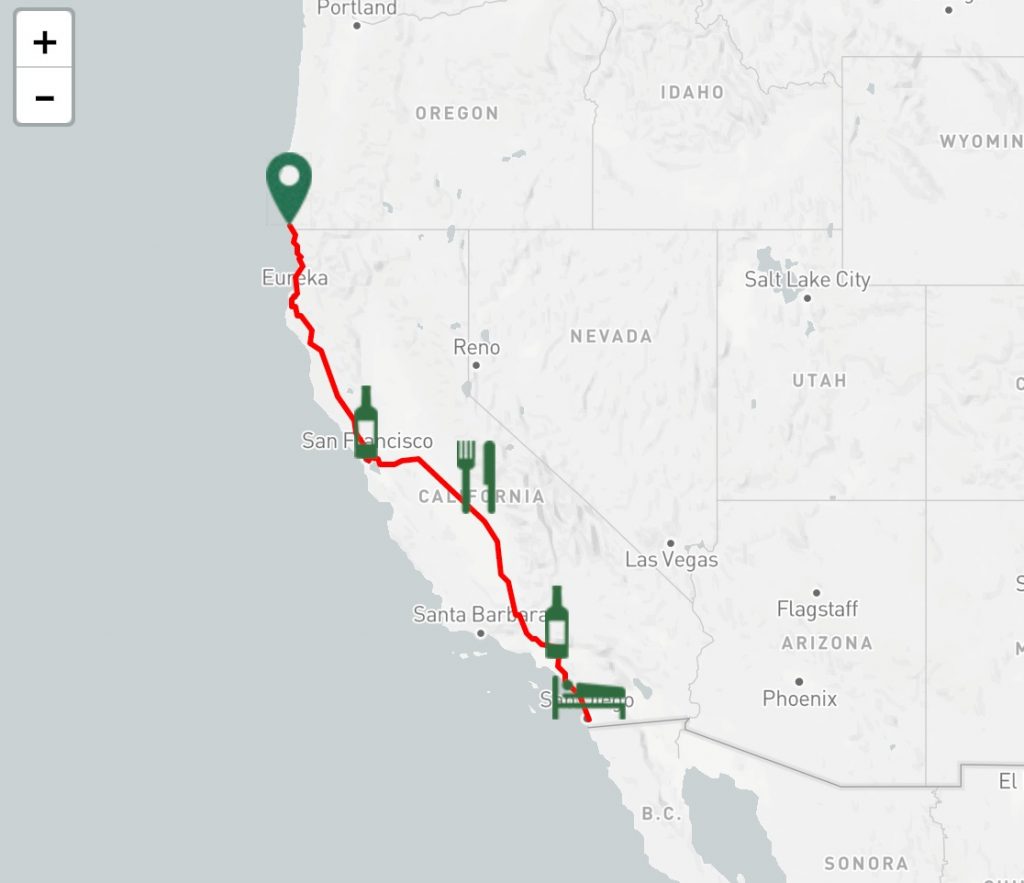
When choosing my tour for my map project I wanted to focus on a place that I have never been before. I wanted to be able to learn about a new place as well as learning about mapping. I chose to do the state of California. More specifically the coast of California. I’ve never been out west and do not know much about it. I also was curious as to how welcoming the west was to colored people. Since the west was developed later on, near the end of slavery, would it be easier or harder to travel there being colored? As I was mapping the points on my map, it was a little difficult to find information in the guide book about the stop itself. Most of what the guide book talked about was what came before and after the stops. It talked about the sites you see on the way to and from each stop. This caused most of the information I talked about in my map project to be about the surrounding areas. It was still very interesting. I also pulled photos from the web for each stop on the map. Once my map was complete, I took to The Green Book website. I entered my beginning point and my destination. The map it gave me was pretty bare. Not many restaurants or hotels that would except colored people. It was really shocking to see. Even though California was developed later on, the effects of slavery and segregation carried on from the east. This map also deviated from the coastal course given in the guide book. It took the trip further in-land through Fresno instead of through San Jose and Santa Barbara. https://uploads.knightlab.com/storymapjs/e2b1c65bcece3b107a43c7955431b69b/the-golden-state/index.html

The Green Book map of my tour.

“American Guide Series: The WPA Federal Writers’ Project: The Guides.” Research Guides. Accessed November 18, 2019. https://libguides.rowan.edu/c.php?g=248106&p=1653082.

Bond, Sarah. “Mapping Racism And Assessing the Success of the Digital Humanities.” History From Below, October 20, 2017. https://sarahemilybond.com/2017/10/20/mapping-racism-and-assessing-the-success-of-the-digital-humanities/.

Blog Post 8

Archives can play a very large role in the lives of scholars. Archives can provide deep and hands-on insight into research. Physical archives allow you to immerse yourself into the history. You can feel the history throughout the items you touch. Those items were preserved so we could experience them in the same way they did so many years ago. This is so significant to scholars because they care about that topic and want to experience it. For the general public it is just really interesting and a cool experience to be able to see these archives in person. With Digital archives you lose that experience. You lose the close-up and personal feel of the history. However, digital archives are more accessible to not only scholars but the general public as well. Digitizing materials greatly affects our interaction with them. For example, when looking at a photo of a printing press stamp online, you have a different reaction than if you were holding the stamp in your hands. When we visited the Special Collections, I had the experience of actually holding several printing press stamps. I was able to feel the weight, see the details, and understand how it would have been used. If I had only looked at a photo it would not have been as interesting an experience.

When digitizing archival materials, there needs to be a good amount of though into which items archivists digitize. One of the main things to think about is consent. In the article “Bias, Perception, and Archival Praxis,” Elvia Arroyo-Ramirez states that, “the library profession’s blanket tendency to digitize pre-Internet print resources can be harmful especially if it clashes with the original consent of participants involved.”7 I found this interesting because it is true. Historians were given consent by the owners of certain materials to keep them in an archive. They were not always given consent to publish it to the internet for the entire world to see. These materials could include sensitive information that the owners may not want the public to know. This has been an issue in several cases over the years. Another thing that must be considered is the hardware in which the material is created. This mainly applies to already digital data, but digital for old hardware. 8 This old digital data would have to be converted to something that could be understood on our technology today. If the archives were physical, one could look at the data on a computer that the data was created on. They could see it how the people saw it in its time.

Manus, and Susan. “The Artifactual Elements of Born-Digital Records, Part 1.” The Artifactual Elements of Born-Digital Records, Part 1 | The Signal, November 28, 2011. https://blogs.loc.gov/thesignal/2011/11/the-artifactual-elements-of-born-digital-records-part-1/.

Padilla, Thomas. “Bias, Perception, and Archival Praxis.” dh lib. dh lib, October 24, 2017. https://acrl.ala.org/dh/2017/09/13/archivalpraxis/.

Blog Post 6

How did the hope and hard-work of everyday Americans pull us out of the Depression? I asked this question because we have been talking about how the Federal Arts Project was what really helped us out of the Great Depression but I was curious to see how much the everyday working Americans really contributed. My initial thought was that the working class was the main reason we survived the Depression. Without the working class to work all the jobs provided by the Federal Arts Project, the projects would not have succeeded. So, I believe that the sole reason America made it through the Great Depression, was because of its everyday working-class Americans. When selecting my sources, I looked for ones that talked about work and providing for their family. I searched using a few different filters. I began with words such as: work, family, living, and hard. Then choose the type of source I wanted: manuscript. I used these filters and found my ten manuscripts that I believed would help me to answer my historical question.

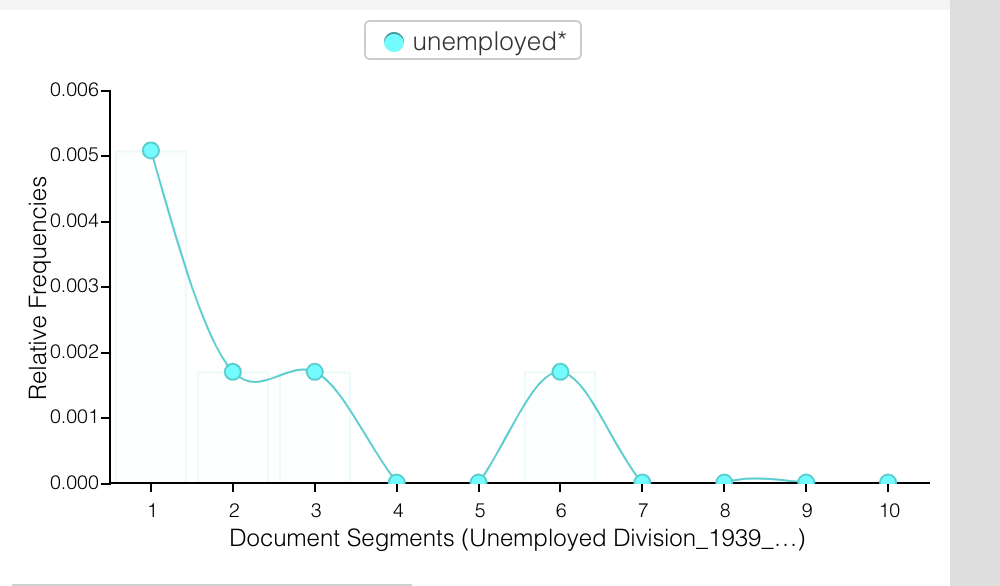
I am still deciding whether I like Voyant tools or not.9 When I first started using it I kept getting frustrated with it. I didn’t know how to do certain things and it was really confusing. Once I sat down, read a bit about it, and played around with it, I began to understand it more. 10 I was able to compare three documents at once which was helpful. After messing around with the program, I began to analyze the texts. When comparing the texts, I could narrow it down by searching for certain words such as: unemployed. This was helpful to search through other people’s documents that they found. After using Voyant Tools and analyzing several different texts, the conclusions I came too were equivalent to my initial ideas. I found that, in fact, it was the hard work of the Americans that fueled the Federal Arts Projects, that then pulled America out of the Great Depression. As far as text analysis goes, it was harder than I had expected. It took me a while to find sources that I could later analyze and it took a while for me to get accustomed to Voyant Tools.


Mining the Eleanor Roosevelt My Day Columns
, regan008.shinyapps.io/mining_my_day/.

Miriamposner. “Miriamposner/Voyant-Workshop.” GitHub, github.com/miriamposner/voyant-workshop/blob/master/investigating-texts-with-voyant.md.

Blog Post 5

The audio recordings that I listened to were of Mrs. Laura Smalley, a former slave, being interviewed by a Mr. John Henry Faulk. These interviews are part of a collection called, “Voices Remembering Slavery: Freed People Tell Their Stories.”11 These interviews of freed people took place in 1941. Because of this, the recordings were good for the time, however, the spinning of the record makes it hard to hear the talking. Also, the difference in dialects between the interviewer and the interviewee made it difficult to understand. Since Mrs. Smalley never had a proper education, trying to understand her sentences on top of her heavy accent was quite tedious. I never really considered oral histories a reliable primary source for the exact reason of language. I may interpret what she said in a completely different way from which it was intended. This could skew the information and distort the true history. Even with a transcript available, the transcriber could interpret the words differently from the interviewee and from me.

     I did, however, learn quite a bit about Mrs. Smalley’s life. She lived in slavery for the first 12 years of her life, so her memory from those times is very vague. She does not remember to many significant events besides June 19th, when the remaining slaves in America were freed including her. She remembers a few whippings, mainly the really bad ones. She also told a story of watching soldiers walk by her home all the time during the Civil War. She noted that most of the soldiers were colored. After Freedom Day she never went into specifics except when talking about her family. She married twice. The first was when she was only sixteen years old. That marriage lasted ten years until her husband died. Four years later she remarried. She said she has about fifty grandchildren and great-grandchildren combined. 12 I was very surprised when she said that one of her great grandchildren was fifty years old. She also talked about the places she lived. She lived in an oil field for thirty years and then moved to Hempstead, TX, where she spent the rest of her life.

https://cdn.knightlab.com/libs/timeline3/latest/embed/index.html?source=1PBXXDk0RHDJgYeIgAP-hr3FtuEAi1klhBt5sxfnxZBA&font=Default&lang=en&initial_zoom=2&height=650

“Interview with Laura Smalley, Hempstead, Texas, 1941 (Part 1 of 5).” The Library of Congress, 1941, www.loc.gov/item/afc1941016_afs05496a/.

“Interview with Laura Smalley, Hempstead, Texas, 1941 (Part 2 of 5).” The Library of Congress, 1941, www.loc.gov/item/afc1941016_afs05496b/.

“Interview with Laura Smalley, Hempstead, Texas, 1941 (Part 3 of 5).” The Library of Congress, 1941, www.loc.gov/item/afc1941016_afs05497a/.

“Interview with Laura Smalley, Hempstead, Texas, 1941 (Part 4 of 5).” The Library of Congress, 1941, www.loc.gov/item/afc1941016_afs05497b/.

“Interview with Laura Smalley, Hempstead, Texas, 1941 (Part 5 of 5).” The Library of Congress, 1941, www.loc.gov/item/afc1941016_afs05498b/.

Blog Post 4

Algorithmic Criticism is essentially math with an opinion according to Cathy O’Neil in her video, “The Truth about Algorithms.” 13.The algorithms that we, as humans, create, are embedded with biases that we may not be intentionally programming in. Algorithms are capable of having all types of biases including racism, sexism, and many other inequalities we can see in our culture today. 14 However, many professional institutions are trying to steer artificial intelligence away from the biases and inequalities, and towards a better and more equal path. Most of the institutions working on equaling artificial intelligence have even called for, “more fairness, accountability, and transparency,” (Matsakis, WIRED) in regards to new developments in artificial intelligence.

During Franklin Delano Roosevelt’s presidency, women’s labor legislations became more protected. In the Supreme Court case, West Coast Hotel Co. v. Parrish, with Franklin D. Roosevelt’s influence, Washington State’s minimum wage legislation was upheld as constitutional. This paved the way for more protected labor legislations for both women and men. Eleanor Roosevelt was one of the largest voices for women in the 1930’s. She was a very visible and vocal part of Franklin D. Roosevelt’s administration. Eleanor was always by her husband’s side. She constantly supported FDR throughout his presidency, not only with his administrative decisions, but also his lasting struggles from his severe case of polio. FDR also supported her. He fought for women’s rights and believed in equality for men and women. Eleanor Roosevelt surrounded herself with hardworking and trustworthy women. She brought women, other than the first lady, into the Whitehouse and into the United States government. Eleanor became a role model for every little girl growing up in 1930’s America. Even today people still look up to her and believe in the things she stood for. She is one of many important women to fight for women’s rights early on in the history of the United States. Even through Eleanor’s efforts for equality and FDR’s contributions to women’s rights, we can till see these inequalities and biases today. Our culture today practically runs on algorithms. However, these algorithms show these inequalities and biases that FDR and Eleanor wanted to stop.

Lewis, Jone Johnson. “Slow and Steady: Women’s Changing Roles in 1930s America.” ThoughtCo, ThoughtCo, 6 Oct. 2019, www.thoughtco.com/womens-rights-1930s-4141164.


Matsakis, Louise. “What Does a Fair Algorithm Actually Look Like?” Wired, Conde Nast, 14 Feb. 2019, www.wired.com/story/what-does-a-fair-algorithm-look-like/?GuidesLearnMore.

Blog Post #3

     This image I selected is called “Hartop Goshtigian playing the violin, portrait, photograph.” The man in the photo is an Armenian-American Musician. Him and his wife, Mary, lived in Fresno, California and played music together. When searching for my image I wanted to find one that would interest me. When browsing through the resource guide I read number ten, “California Gold: Northern California Folk Music from the Thirties Collected by Sidney Robertson Cowell.”15 This grabbed my attention because I do not know much about the music culture in 1930’s California. I looked through the collection and saw some really interesting images. There were quite a few photos of instruments and of musicians playing their them. The photo of Goshtigian with his violin caught my eye. 16. It is a simple photo but tells a whole story. The story this photo tells is that of the life in the 1930’s. In this photo you see Goshtigian sitting in a chair outside what is presumably his home. He is in a nice suit, playing his violin. The chair and the house are both rundown and old. He is living in California during the height of the gold rush. To many people with little money. From examining the background, one could assume that Goshtigian’s house is one of many rundown houses all in that area. Since the Goshtigians were both musicians, they probably helped to keep up people’s spirits with their music.

     The main historical questions that I am asking are: Why did he want the photo this way? What parts of 1930’s life are shown? How can this photo provide insight into the lives of musicians in the 1930’s? Some of these questions can be answered without further research. They way that Goshtigian is pictured was more than likely his choice. He wore a suit to show that he is still a person even though he may be poor. However, Goshtigian wanted to be seen as a musician over any other label. He does not want to be seen as a struggling or a prospering artist. He just wants to be seen as an artist, period. This photo shows both worlds. The poor background but the hope of success in the future. The suit represents the hope. However as long as he is seen as an artist, that is all that matters. He wants to not labeled as an Armenian artist, colored artist, struggling artist, he just wants to be known as a musician. In regards to the insight of non-White American musicians we can interpret from what we already know. While many people prospered and White Musicians gained fame, musicians of color and other races still struggled. Many of the songs that White singers became famous for, were originally created by an artist of color. Yet the original artist received nothing.

     Asking these questions helped me to better analyze the photo. Without questions I would have been looking at this photo without any context or reason. Also, being able to annotate the image and focus on one specific area at a time was very helpful. I was able to look closer and dig deeper into the photo. With the annotation, I was able to write out my thoughts and be more organized. Overall, I found this assignment very interesting. It was a technique I had never used before. This image analysis process will definitely come in handy in other projects outside of this class.

“How Song, Dance and Movies Bailed Us out of the Depression.” Los Angeles Times, Los Angeles Times, 1 Apr. 2009, www.latimes.com/la-oe-dickstein1-2009apr01-story.html.

http://jessicadoeshistory.com/cnd/exhibits/show/kylie-leake-image-analysis

http://jessicadoeshistory.com/cnd/items/show/166

Blog Post #2

     In general, the way we look at texts, and history has changed. Yes, you can still go in person to the library and research, however, nowadays everything has been digitalized. I can go online and search up anything from the library of congress. I can search through a specific text by using a program to look for one sentence. The whole historical research process has become easier. This is especially beneficial for students. With tight deadlines, we need to use every second of the time we have. So instead of spending hours reading books looking for the information you need, you can cut that time in half with the web. It, of course, is not as engaged or hands on, but you are still learning the information you need to succeed. Digital projects can also make significant social change. Everyone is online now and would be more likely to come across an article or paper than if they were only printed. Not many people read hard copy newspapers anymore either. Because of this, more article can be included in the online newspapers with links and sources, allowing people to continue their own research. This creates a domino effect almost. One article with a bunch of good sources will bring light to those sources that all address a topic. Then these sources get read and passed on through another article, and so on. With so many articles on one serious topic, the more people that would be informed, the more social changes that are made. Of course, there are some things that are lost with the use of digital media. The hands on feeling of turning pages and feeling the history is lost. You would no longer be able to feel really connected with the history. When reading a text that was written so long ago, and reading it in person gives a different feeling. It is a more hands on feeling with history. However, we do gain a lot from digital media. We gain access to texts from all over the world. We can find translations of texts. We can save time doing research and would then have more time to focus on portraying the information to its fullest.

Kelseyfritz. “The Good and Bad of Digital Media.” Digital History Methods, 17 Jan. 2011, www.dighist.org/2011/01/the-good-and-bad-of-digital-media/.

Milligan, Ian. “Illusionary Order: Online Databases, Optical Character Recognition, and Canadian History, 1997–2010.” The Canadian Historical Review, University of Toronto Press, 27 Nov. 2013, muse.jhu.edu/article/527016.

Blog Post 1

After our first two classes of The Digital Past and the introduction to the New Deal, I have already learned quite a bit. Everyone in the class has a different perspective on what we discussed, whether it is having a grandparent who lived during the Great Depression or only ever learning about it from a text book. Using many different online tools that I had never heard of will be challenging, however, I am curious to see how we can build a bridge between our digital age and our past, using these tools. I have only ever learned about the 1930’s from textbooks and lectures. It will be very interesting to see how we are still learning lessons from America’s past through technology that didn’t exist then.

I was assigned Digital Humanities project number 25, America’s Public Bible: Biblical Quotations in U.S. Newspapers created by Lincoln Mullen. The basis of this online resource is to explore the history of the Bible in American newspapers and to discover the trends of the quoted verses. This site also looks to explore the relation of these quotes to what was happening at the time of their use. This resource looks at the different interpretations of the quoted verses as well. “[God] hath made of one blood all nations of men” (Acts 17:26) This was quoted at the time when people began to speak out against slavery. This quote was the “crucial text with which American Christians thought about race and slavery, especially since it was a proof text for the unity of human beings regardless of race.” (Mullen, America’s Public Bible) This is just one example of the thousands of quotes found in American Newspapers.

When looking at the trends of the number of quotes used, one can see that the number increases during a period of national hardship. The number of quotes used during the 1920’s and The Great Depression is much larger than in 1910. Mullen provided, on the website, two graphics showing these trends. One is a graph showing the difference in number of quotes between The Bible, The Old Testament, and The New Testament. The second graphic shows the trends for the different verses, Acts 17:26, John 15:13, Luke 18:16, and Proverbs 14:34. All of these quotations can be found on the Explore the Quotations tab. You can also find specific quotes separated by decade and passages that were frequently quoted together on the Topics and Verses tab. This page I found particularly helpful as I do not know very much about the bible. This page helped me understand better the use of specific quotes. Since quotes were put into time periods in which they were used and I had prior knowledge of these times I could connect what the quote really meant. The Final page on this site is the sources and methods. Muller includes on this page not only all of his sources, but the code he used to collect the quotes.

Sources

Lincoln Mullen, America’s Public Bible: Biblical Quotations in U.S. Newspapers, website, code, and datasets (2016): <http://americaspublicbible.org>.

The Denver star. [volume] (Denver, Colo.), 09 Jan. 1915. Chronicling America: Historic American Newspapers. Lib. of Congress. <https://chroniclingamerica.loc.gov/lccn/sn84025887/1915-01-09/ed-1/seq-4/>

css.php