End of Semester Reflection

I believe, throughout this semester, I have been growing more and more adept at seeing history through another person’s eyes. That may sound like meaningless tripe, but our multimedia approach helped incorporate enough viewpoints, enough points of analysis, that I felt I had a reasonably well fleshed out picture to go about a juncture in history. I love history, but the periods I am interested in are long before the advents of sound and visual recordings. It was refreshing to know that there were real people behind the pages of the annals. I found the slave narratives fascinating to listen to, absorbing the “collective portrait of a historical population” and picking up just how casually, how disappointedly those century-old voices discussed bondage. I can now say that I finally understand what is meant by ‘living history’. 1

Never before, when I studied the Great Depression for school, did I have such a detailed and analytical view of the interaction between Roosevelt’s new institutions and the people. The Farm Security Administration seems just as real to me as Social Security or the Department of Defence in today’s news when I read the in-depth Library of Congress articles that witness “FSA camps [furnish] the migrants with a safe space in which to retire from the discrimination that plagued them and in which to practice their culture and rekindle a sense of community”, or when listening to the myriad recordings the Farm Security Administration made of folk songs. 2 Institutional racism– normally such an abstract topic– hits home when expressed by digital history tools. The message comes across so much rawer, so much more directly when you see racism classified into red and yellow circles– and how big those circles are. 3

The tools that aided the most in realising digital history would have to be the Knightlab services. Storymap and Timeline were intuitive, clean-looking programs that take long strides towards newer, better visuals. Though I found them to be a pain to work with at times, I delighted in the results, which encouraged me to be a consummate ‘visualiser’, putting into visuals what I wanted to say. Soundcite, in particular, excited me; ever since I can remember, navigating to a whole other page whenever I wanted to listen to what an article or song review was talking about annoyed me to no end. I never really noticed how annoyed it made me until the class was introduced to Soundcite, and now I have a name for an article that makes you navigate away from their page, just to get some context: badly designed. Storymap and Soundcite were crucial to my final project, allowing me to analyse in unique ways two big aspects of migrant culture: their music and their movement. Underpinned by a few nice photographs, I arrived at a project I was proud to have composed.

The Knightlab visual tools inspired me to think of the medium as the message you want to convey to audiences. This philosophy echoed throughout the course, and I felt it was declared most potently in Michael Hobbes’ ‘Millennials Are Screwed’. We know that millennials are screwed. We have read countless think pieces with the same premise and similar data. What makes Hobbes’ articles unique is that visuals not only punctuate his point, but they are the point, portraying the data in a way that is interesting to those familiar with it, but with a universal language that reaches those unfamiliar with it. Because the accessible graphics enabled such a universality, Hobbes’ arguments are significantly amplified. That’s the power of a good medium. 4

This applied equally to our discussions of historiography and how representation, sample sizes, contexts, down to even the tone and race of the historian conducting the history can seismically change our present-day understanding. As digital consumers and producers, a goal that should be constantly kept in the background of our Internet is how radically the media we express a message in impacts future viewings of that message, to the point of it becoming the message altogether. What we have of history today is a very mixed bag of disparate historiography quality. Hopefully, as more aware digital citizens, using keener and more accurate tools, we can mitigate that disparity.
The Mexican Migrant Experience

What did the Lomaxes want to learn about Latino migrants during the Great Depression from their songs? John and Ruby Lomax were aware of the plight of the Hispanic migrants, and recorded some of their songs in the late 30s. Never accepted in America, never accepted in Mexico when local governments deported them, and subject to unjust deportations, the Mexican-Americans of the 1930s became an entire “lost Generation… people that were lost in Mexico, people without the documentation, people that were denied their right to a life as an American.” 5 Even so, Mexican immigrants had a significant stake in America, as they “had long been an integral part of agricultural production in the United States and were not newcomers on the scene even in 1940. In fact, when the Dust Bowl families arrived in California looking for work, the majority of migrant farm laborers were either Latino or Asian, particularly of Mexican and Filipino descent.” 6

Mexican migrants had to transition from “workers [that] were regarded as essential” during the 20s to aliens, “regarded as foreign… unwanted… not supposed to be here” during the 30s. Families had to cope with the greater scale of deportations that followed. All this translates into the songs John and Ruby Lomax recorded as a shocking chipperness. The migrant lullabies and children’s melodies are playful, frequently implementing sunny patters 7 and colourful lyrics 8. The Lomaxes and the Mexican singers chose to record the songs from the latter’s childhoods, songs designed to convey happiness and positivity to the youth, having nothing to do with ugliness or Mexican migrants’ situation. Buoyant songs glow 9 when compared to the African-American lullabies the Lomaxes recorded, which, perhaps in a truer but more weathered reflection of the era, are far more bluesy and sombre and quiet. 10 11

John and Ruby Lomax, along with the migrants who lent their voices for the project, seemed to want to convey the good feelings of a traditional childhood, not the very real malaise that came from the Great Depression. The lullabies of the migrants speak of sweet fruits and hugs 12 and covering up from the cold, a joyful little habitat away from the oppression buffeting Mexicans from all sides. I believe the folk lullabies the Lomaxes wanted the nation to remember are keenly related to the popular escapism propagated by the broader arts, performing the role of “a lifeline as well as a pleasant diversion, a source of optimism and energy as well as peerless insight” for underprivileged Mexican families. 13

Alaska

https://uploads.knightlab.com/storymapjs/5b0a1b53c05106520621c0f260f751f8/alaska-a-guide-to-the-last-american-frontier/index.html

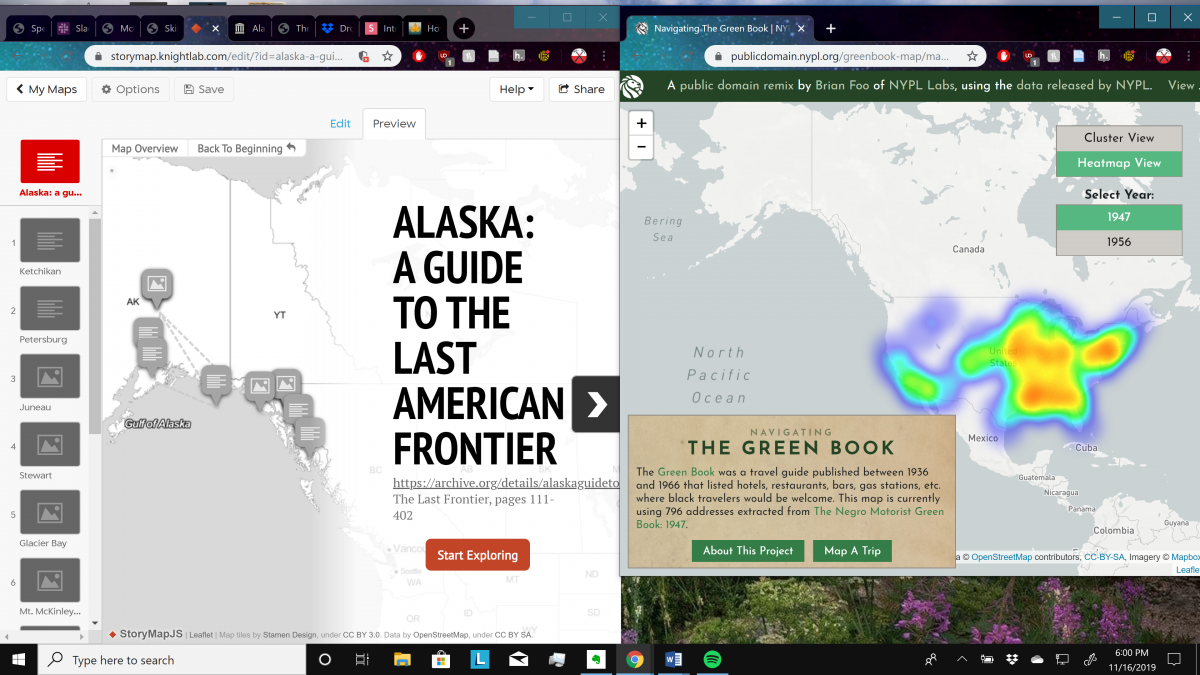
What I planned for this project was to use the data of the Green Book Project to find out what mobile citizenship looked like in a place as remote and physical as Alaska, if there were accommodations for coloured hikers within the territory. However, the Green Book Project showed no data whatsoever outside of the mainland United States. This makes sense; in a state such as New York or Pennsylvania, you could take a tour and theoretically never leave your car. This is impossible in Alaska, due to the lack of roads. To access the capital, Juneau, even to this day you must take a ferry or a plane since there are no roads leading into it. Alaska is a destination attractive for its hiking, first and foremost, and one would be hard-pressed to drive there.

We can infer information about Alaska from similar states known for hiking and northern climates: Colorado and Washington, respectively. By the looks of the reports from the Mapping Inequality Project, it appears that black populations were not much more liberated there than in most of America; of one prominent black district in Denver, the surveyor writes, “For a Negro section, it is very well kept up. Were it not for the heavy colored population much of it could be rated ‘C’.” He rates every coloured section of Denver similarly. Regarding black residences in Seattle, the surveyor simply wrote “This is the Negro area of Seattle”, and ranked it a D. Considering the echoing ramifications of these reports, it seems reasonable that black people were precluded from the free time and capital required for serious hiking. 6

The improved mobile citizenship the Green Book promised in the 1940s did not apply to a more active brand of tourism. One look at the Green Book Project, and one can see that lodging for the more mountainous regions is sparse, ranging from five in Colorado to one in Montana and none in Washington. I believe that a perfect storm of decreased institutions for black people (evident in low coloured populations in those areas) and simple incapability of travel to mountainous locales led to this dearth of trail lodging in popular hiking destinations, conclusions which can be extended to Alaska.

By all means, mountain hiking was restricted to white tourists. Tourism as the “ritual of citizenship” so cherished by many would be null and void when it came to experiencing natural wonders up close, excluding me from the beauty of the country I want to be a part of. If I were a black traveller, the infrastructure simply would not be there to preserve me from humiliation and discomfort were I to hike in Alaska. This wouldn’t be just nothing, as “the 1930s might best be characterised by a pervasive interest in culture… the more anthropological concept of culture denoted by a shared set beliefs and behaviours”– and the pool of these shared beliefs and behaviours would shrink all the more with my myopic access to hiking in America. 14

Special Collections Visit

Archives contain data meant to be kept forever, documents and photos and other things that researchers place enough stock in to warrant preservation. Obviously, scholars place value in archives– if a piece of data is in an archive, then by definition it must hold some use– but when I thought about how the general public would access archives, the utility grew murkier. I suppose that this is an archive’s chief mission: to appeal to the public so it can get the donations it needs to survive. The archivist for George Mason University’s special collections explained that her archive relies on donors.

The stark processing priorities surprised me very much from the “archival work [requiring] an ethics of care for the deeply personal and the deeply political” Elvia Arroyo-Ramirez espoused. What was most shocking is that sometimes, data donations are not always wanted for the archive. They are accepted because the donor has generously donated money, but mostly, they are irrelevant. An archive’s information is not just the biggest open books in the world, I discovered, but it is beholden to donors and just what data is actually available.

What archives digitise– the information deemed valuable enough to really be available for the general public, not hidden in basement boxes only to be seen by tenacious literati– is limited, too, often just for copyright issues. Thus, most of the digitised items are non-copyrighted photos. It made me realise just how much data I’ve yet to expose myself to. Most of my primary source research is done digitally, and when I found out just how few primary sources are realistically able to be digitised, I wondered about the limitations of some of my most ordinary research; in other words, “Who gets to be remembered and historicized by way of record creation? Who is forgotten or purposefully silenced in history by way of omission or destruction of records? How are records themselves… used to communicate misguided notions of holistic representation, truthfulness, neutrality, and objectivity?” 15

Our examination of the real data provided me with context for the period, what it would feel like handling these materials. Before, the Federal Theatre Project existed as a vague notion in my head, but the plethora of physical data we interacted with tethered that notion to earthly materials. It shouldn’t have mattered as much as it did, but I found another dimension added to my mental picture of the Federal Theatre Project, considering what these data would be like with the awareness and physicality of objects directly around me. The documents themselves that I looked into helped me understand just what “the integration of the theater with community life in the smaller communities” meant (before it became a ‘secondary air’), painting a picture of mobile theatres and the incredible innovations people put out. The documents helped me feel the elation of those government officials trying to stretch their craft to the American hinterlands, and clued me into what might’ve been frustration when FTP officials “encountered ignorance and intransigence when they made their ‘courtesy calls’ on state administrators.” 16

Black Interviewees

For my analysis, I wanted to capture the priorities of black people during the Depression. I asked myself, “What did black interviewees want to talk about? What did black writers seek in their interviews?”, basing my question off Maryemma Graham’s statement that “the largest single impact on black writing before the civil rights movement was really the WPA, not the Harlem Renaissance.” I was not able to glean as much as I wanted from the side of the writers, but within their interviews remained a healthy cache of information about the experience of black folk. 17

In my initial research, I began with specific black authors– namely Zora Neale Hurston and Ralph Ellison– whom I knew were in the Writers’ Project. I slimmed down my scope to smaller interviewers, authors that were not black but had excellently interviewed black people. I ended up with a decent corpus featuring all sorts of writers interviewing black men and women about their experiences.

In squaring my interviews up to the broad sources, I hoped to compare and contrast what black interviewees wished to discuss and what general interviewees wished to discuss. Thanks to Voyant’s extensive customisation options, it was quite simple to sift useless observations out of the results (dialect words, common words).

Something that truly fascinated me was that in the broader corpus, there were far more references to time and time periods. ‘Time’ and ‘year’ are two of the most prevalent words throughout the broad corpus– contrasted to the very few times ‘time’ or ‘year’ crops up in the work of the black writers. I was surprised how intuitively Voyant enabled this comparison, and how many avenues existed for me to deduce it. In closely examining my corpus, the interviewees would either talk about their general experiences (without mentioning dates) or specific events in their lives.

I also noticed that by far the biggest topic in my corpus was race. ‘Negro’ and ‘white’ were the most mentioned words, and according to Voyant, the most correlated with one another. However, within those documents, they were used just as signifiers (‘this man was a negro’) and seldom spoken of in a politicised manner. ‘White’, however, is more often used in politicised contexts (which is also where ‘negro’ and ‘black’ are most politicised). Racial terms are not included at all in the broader corpus.

I discovered that change was not a theme in black discourse. As the collective minds of American Yawp put it, “The Negro was born in depression. [The Great Depression] didn’t mean too much to him… Black workers were generally the last hired when businesses expanded production and the first fired when businesses experienced downturns.”  The African-Americans of the 30s did not have the fiery rhetoric of their descendants in the 60s, and were often focused on their own lives, the joys and strifes laying there.

18

.

Mrs. Laura Smalley

https://cdn.knightlab.com/libs/timeline3/latest/embed/index.html?source=1DIfl-EUk9Kn-aP__fEkRqRBQQkNvx86bxh6XRAZxvUE&font=Default&lang=en&initial_zoom=2&height=650

While Laura Smalley obviously suffered during her childhood as a slave, those recollections seem to be more distant to her. What she really recalls is the preachers, who “preached better then… now they [preach] by scripts most of the time. But then… they just preach, preach by the spirit”, or how they would cut and dry grass to make good bedding. The larger sufferings still remain, but Mrs. Smalley couldn’t remember any abuse that she herself took. 19 Nor could she talk about slaves being sold like cattle, stating “us children never did know that, you know. We heard talk of it, but then I reckon that was after, after slavery I reckon.” It seems that slaves placed a high value on their children, on their community, and sought to shelter their children from its horrors. Of course, the horrors still shone through to her, such as when the plantation’s mistress beat a woman slave in the peach orchard and snuffed out a pipe on her skin; young Laura recalls having to grease her back afterward. 20

Laura was immune to monumental things like the end of Reconstruction, the labour reforms of Teddy Roosevelt, World War I, or the Great Depression’s onset, existing as mere gaps in memory. The tectonic shifts in America reached Laura and her community much slower than I would’ve expected; when the Civil War ended, her master didn’t even tell his slaves that they were free for six months (nor did any slave owner in Texas until Juneteenth). Even the race riots in the area passed by Laura; I was surprised that she was swift to recall “when colored folk [killed] one another for a while… Women killing other women about they husbands”, making me think the events are related. 21 22

No community is immune to every social or political change, so I quickly deduced that the omissions of major happenings were Mrs. Smalley’s error. Throughout the interview, she came off as addled, and I frequently sympathised with the interviewers who kept angling their questions for meaningful answers– only for Laura to confess she knew nothing about what they were asking. Though I found value in hearing just what daily life consisted of for those enslaved– the oral account allowed for inflections and repetitions of speech to tell the story, elements I appreciated– there is a big asterisk next to that value concerning Laura’s advanced age.

I was fascinated by the interviewers’ frequent interjections. The Faulks remained professional, but when Mrs. Smalley went into detail about the treatment of some slaves, they never failed to exclaim ‘Good God’ or an assenting grunt. They added a very human element to their part, making the interview a true conversation. It made a difference to Laura, too, as she eventually grew more comfortable in how she spoke. While a transcript would clarify much of Laura’s dense dialect, it would take away her progression of comfort as the interview continued, the dynamic between interviewer and interviewee. It speaks to the ethos of the FWP that the Faulks turned the interview into a conversation, that they and the best of their peers wanted their history to be a dialogue. 23

The Popular Front’s Legacy

Algorithmic criticism is about as varied and hard to define as algorithms themselves. There are multiple lenses one can look through when critiquing algorithms: the conformist lens, the scrutinising lens, the feminist lens, the black lens, the black feminist lens, the scholarly lens, and so on. There are as many lenses for examining algorithms as there are algorithms, I feel. One thing all those perspectives can agree on is that one should always examine the established order. This goal of defiance appears to me as a lofty goal, especially when all the institutions of the web are like the monolithic ad-buildings of Blade Runner, almost primeval in their permanence.

All this is terribly reminiscent of the aims of the Popular Front movement. Just how the socialist coalition strove to battle the status quo of capitalism, modern activists strive to battle the status quo of ad agencies and complacency with those ad agencies. With the potency of folk singers and labour activists, the Popular Front encouraged alternative thinking about our institutions, tacitly urging that Americans must interact with them and mustn’t turn a blind eye to their presence. Had ‘the communist-oriented International Legal Defense (ILD)’ chosen not to come ‘to the aid of the “Scottsboro Boys”’, yet another injustice would have been carried out and America would have been further proved as a nation that does not care to challenge its status quo. Instead, the plight of the Scottsboro Boys and efforts of the Popular Front’s law firm ‘became a national symbol of continuing racial prejudice in America and a rallying point for civil rights–minded Americans.’ (Cochran et al.) 1

The Popular Front’s stance against capitalism and racism lent a stark model for activism and interrogation of what we know (as provided by institutions). The institutions of today are perhaps more furtive, but no less insidious. Advert agencies, in service of the status quo, now implement algorithms that serve to uphold complacency to such a point that ‘the clicks of users… mean that representations of women are ranked on a search engine page in ways that underscore women’s historical and contemporary lack of status in society’. (Noble) 23

Safiya Noble, in the defiant and questioning tradition of the Popular Front activists, offers some ideas as to how to subvert and interrogate our institutions. She advocates for literacy at a basic level of Internet citizenship, maintaining ‘that one need not know the mechanism of radio transmission or television spectrum or how to build a cathode ray tube in order to critique racist or sexist depictions in song lyrics played on the radio or shown in a film or television show.’ (Noble) In other words, we should place faith in our intuition and judgment over the intuition and judgment of erroneous, as Cathy O’Neil terms it, ‘opinions embedded in math’. (O’Neil) 24 25

The Glitch

http://jessicadoeshistory.com/cnd/exhibits/show/luke-beverley/glitched-creek-county

http://jessicadoeshistory.com/cnd/items/show/151

For my assignment, I decided that I wanted a photograph that depicted the plight of black communities in the Depression. I discovered that there existed a prominent photographer named Russell Lee that strove to document just that, to introduce white America to the lives of different communities and inspire sympathy through his photographs. I chose to glitch one of Lee’s excellent prints, one that I found had the most pathos and industrious, determined spirit we discussed in class. To glitch it, I simply added the entire lyrics to Eminem’s “Without Me” within the code.

Black history can be dreadfully depressing. It seems impossible to imagine that amidst such woe and poverty, black people were ever tapped into the same individualism and grit of their white counterparts. But when one looks at the context of this picture, one sees an echo of that America; in 1940, “despite the fact the white school received free books, none arrived for the Negros. The teacher was so afraid of losing her job that she would not make any inquiries about the books and the children were sharing the few books some could buy.” (Lee) Lee’s photo encapsulates that sentiment keenly, the determined need to better oneself and be educated, the marriage of self-improvement and solidarity. In spite of the adverse conditions– the shortage of textbooks, the crampedness of the desk– these two girls learn and are willing to learn, and are willing to spread the wealth. When one adds the lyrics of “Without Me”, the claustrophobic desk and restricted bodies are erased, the meagre textbook locking their gazes wiped from view, to prioritise the girls’ heads. This is what the American spirit stands for: in spite of every hardship, value your singular wits. 24

The glitched image established my new take on Lee’s picture, acting as something of a mantra for my analysis. But did black communities feel the same Depression-proof American spirit that white communities felt? The results are muddled. While many more black students became literate in the 1930s than in the 1890s, that literacy was undeniably shallow, usually consisting of eighth-grade level comprehension. The simple fact is that those educations were at second-rate Jim Crow schools. Black educator Benjamin Mays terms it best, maintaining that the “inevitable consequences of inequality has warped the minds and spirits of thousands of Negro youths. They either grow to manhood accepting the system… with bitterness in their minds. It is the rare Negro child who comes through perfectly normal and poised under the segregated system.” (Mays) Though the education was poor, it is supremely telling that black people still wanted to find the time; “The children need all the education they can get, but we need them to help on the farm. If you don’t make your crop, the white man will put somebody else here to do the work.” (Irons) They and their children exerted themselves for education– the two girls worked with their disadvantages without visible resentment– and though the education was poor, the effort and the purpose here show, in part, that one’s singular wits were always in centre focus. 26

Tony Guidone’s Presentation

Tony Guidone brought up an interesting debate I was not previously aware of: digital research versus analog research. I had always figured the digital means of research had usurped the analog means, and that there was no real contention in the matter. Guidone demonstrated that there are two sides to any coin– namely, German coins in the 1930s. He explained that although the web’s improved fluidity of resources enriches researching, there is a loss of physical context that analog researching affords. One must always view the digital data through the eyes of the author; Trevor Owens states as much in his article, describing data sets as a ‘human-made artifact… having the same characteristics as text. Data is created for an audience. Humanists can, and should interpret data as an authored work and the intentions of the author are worth consideration and exploration.’ Guidone simplified this sentiment into more tangible terms: you can’t feel the weight of a coin from a picture, and you can’t feel the material of a newspaper from its transcript. Anyone who creates anything has an agenda, and there is more room for exclusion through a digital medium. 27

Another aspect Guidone brought to my attention was that the web’s astounding ease of access might just serve as a detriment. As Ian Milligan elaborates, ‘in 1998, a year with 67 Canadian history dissertations in the ProQuest dissertation database, the Toronto Star appeared 74 times in that data set; by 2010, it appeared 753 times in a slightly larger data set of 69 dissertations.’ Milligan explains that the Toronto Star went digital. This is an almost 1000% increase in citations– but the Montreal Gazette and the Toronto Telegram, papers that did not go online, ‘remained relatively stagnant’ at a ’16 per cent increase’ and a ’72 per cent decrease’, respectively. The marvellous convenience of the web skews towards resources with the fortune of being digitised, thus biasing researchers to those resources. Milligan posed this as a problem for Canadian historiography and historiography in general, criticising digital databases’ ‘lack of methodological reflection about how these databases work’. 28

Blog Post 1

One tends to categorise the Internet– and on a broader scale, technology– as an innovation of recent memory. In the history of technology as in conventional history, it’s customary to attribute sweeping innovations with the works of one man (like Thomas Edison or Alexander Graham Bell) and their teams and predecessors are left by the wayside. The history of the Internet as we’ve been covering in our class was not the result of the Great Man high school history covets. When we covered the manifold players in the creation of the Web, it was a refreshing reminder that innovation– like the Internet– is long, complex, collaborative, messy– and beautiful. I look forward to gaining the tools to become a better scholar and process history more thoroughly.

I had the pleasure to peruse the Mapping Inequality Project this week. Never has the systemic racism of 20th-century America been so fun to scroll through. The entire project comes chiefly from primary sources: the records of the Home Owners’ Loan Corporation. The authors of the site optimise HOLC reports to their localities in an organic way, compiling the data from the reports into visual and textual media. The quantification of the data is simple; HOLC officials divided their cities into neighbourhoods with letter grades, so the authors translated the letter grades into concentric rings of colours representing each city. It’s difficult to discern the significance of these rings even after becoming acquainted with the legend, but they do the job and you’ll never have to stare at many numbers or percentages. The presentation of the visuals is clean and easy to grasp most of the time– though the site’s zoom tool is obscenely laggy.

The Mapping Inequality Project is a fascinating glimpse into what exactly segregation means and its forms. The authors endeavour to show that the poisonous racism so talked about in public discourse, so devastating to communities, manifests itself as a calm, calculated banker’s lexicon. The loan evaluators use code words such as ‘blighted’, ‘infiltration’, ‘heterogenous’, or ‘subversive elements’ to express their prejudices; an evaluator derides an East Los Angeles neighbourhood as ‘a “melting pot” area… literally honeycombed with diverse and subversive racial elements’ and thus grades it poorly, excluding the area from much-needed loans. HOLC was a success, ‘seen as both a savior to the housing sector and a force for racial segregation’ (Nelson et al).

One extrapolates from this that a generation is made from their weakest moments, and because the Great Depression was such a low point for that generation, the New Deal’s weaknesses reverberated all the stronger. Because housing loan appraisers deemed certain neighbourhoods certain letter grades, those neighbourhoods were not eligible for the redemption of the New Deal, precluded from prosperity.

Sources:

Robert K. Nelson, LaDale Winling, Richard Marciano, Nathan Connolly, et al., “Mapping Inequality,” American Panorama, ed. Robert K. Nelson and Edward L. Ayers, accessed September 2, 2019, https://dsl.richmond.edu/panorama/redlining//#loc=13/32.067/-81.105&maps=0&city=savannah-ga&area=C12&text=intro&adviewer=sidebar.

Posner, Miriam, director. How Did They Make That? How Did They Make That, UCLA Digital Humanities, 4 Apr. 2014, archive.org/details/howdidtheymakethat.

css.php