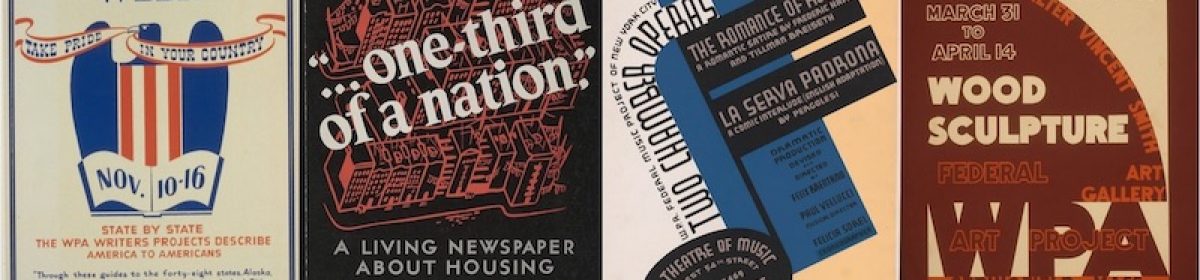
At the start of this semester, I was mostly unfamiliar with the history of the 1930s. The things I did know were painted using a broad brush in vague terms. I knew that the Great Depression occurred, as did the Dust Bowl and the New Deal. These were things I had obtained in previous history classes, but were mostly an afterthought, as discussion of the time period was relegated to describing the 30s as the period between the two World Wars. While this is accurate, I’ve since learned that it’s far from the full story. Hopefully, my exhibit accurately conveys the skills and information that I’ve learned.
For example, I had almost no knowledge of the folk culture that developed and exemplified the decade1. The nature of the Federal One Project was an interesting discussion, and the content that was created then seems just as relevant now. The extravagant theater productions that created new perspectives on classic works of art laid the groundwork for the many remakes that we see nowadays. Orson Welles thought he could make a version of Macbeth that would appeal to his audience2, just as Greta Gerwig is trying to make Little Women apply to a modern audience with her recent adaptation.
The digital tools we applied and learned about were incredibly practical, in a way that I wasn’t expecting in a history course. At the outset of the course, I was unsure what exactly an examination of the “Digital Past” would look like, or how it would apply to my work and studies. Even as a Journalism major, I had no idea how helpful many of these tools are, whether they help visualize information and data or they simply create new ways of thinking about older sources.
To start, image glitching was a helpful introduction to these digital skills, as it is in many ways a thought exercise. The results of image glitching can be used to reexamine what we think we know about the past, and look at it new ways or perspectives3. By transforming the nature of a source firsthand in a skill assignment, we were able to reassess the different values and limitations of sources that may not have been otherwise considered. Later in the semester, we also saw image glitching used to make a point, to emphasize the shifting nature of our culture and exemplifying the destruction of the myth of the nuclear family4.
For my exhibit, I tried to use the skills that I am most likely to keep with me as I pursue a career in journalism. Soundcite was the first skill that I selected. In traditional journalism, you are limited in the number of senses that you can engage. One is limited to telling a story through written words, without being to fully convey the sounds or smells or feelings associated with an event. Through the Soundcite tool, an extra sense can be added to the storytelling. I also used Voyant’s distance reading tools to create word clouds and links, because word choice is more important now than ever. Finally, I chose to use image glitching because I believe that the content that is omitted or rearranged in an image can be incredibly effective.
At the beginning of this semester, I had no real opinion on the 1930s, and did not know of any real connections between that decade and our current culture. Now, I know that the 1930s’ concept of a definitive American culture5 has permeated our public consciousness for decades. The escapism in films and the accessible nature of folk music are the lasting legacies of the 1930s.
At the end of the day, the digital nature of the course will stick with me. As a young person, I had a passing knowledge of algorithms and how they’d infiltrated our lives, especially as Netflix continues to recommend shows that I have no interest in. Obviously, that algorithm isn’t perfect, but that’s because of how it was programmed by humans. Just as no human is without bias, there is no perfectly neutral or just algorithm6. With the functioning understanding of algorithms I gained through our discussions, I can be more mindful of what information I am feeding algorithms and how they are using that information. Even if I can’t avoid the algorithms, at least I can be aware of how they are created and their effects.
