
While doing this skill assignment, I realized that the American Guide series seemed to focus a lot on the culture and geography of states, instead of really honing in on issues. This statement, however, only really applies to the New York American Guide from 1940 because this is the one that I analyzed and used for my map. For actual research purposes, I would have to read multiple guides from different states to see what those writers and editors chose to emphasize on. No matter what the state, like Marguerite Shaffer quoted in her See America First: Tourism and National Identity, 1888-1940, all guides sought out to attempt to create a “‘literature of collective of self-consciousness, a people’s and a nation’s biography, a story of human and physical geography.’ In both its scope and design, the WPA American Guide series manifested this desire to document and design a unique and indigenous American culture” (Shaffer, 2001, p. 203). 1
In the “Navigating the Green Book” feature by the New York Public Library, I was really surprised to see so few establishments available for people of color in 1947. I was expecting to see a lot more locations open, especially in the North. While looking at it, I thought to myself about how Victor Green went about receiving information about these different establishments. Perhaps, there were more that catered to Black customers, but Green simply didn’t have that knowledge in 1947. In comparison to the 1956 map, the 1947 one seemed to unfortunately lack, in my opinion, enough places to service Black Americans. Seeing the 1956 map made me consider whether or not establishments were moving towards a more tolerant and progressive business structure and started to allow Black people into their stores, or did Green simply learn more information over the decade. In Sarah Bond’s article, “Mapping Racism and Accessing the Success of the Digital Humanities,” she talks about the fact that “people of color have been using maps to visualize racism for a long time,” including W.E.B DuBois and Booker T. Washington in the late 1800s and early 1900s (Bond, 2017, p. 1). 2 I think the Green Book series in a way is a continuation of this trend set by prominent Black activists to show America how racist and detrimental it is towards people of color.
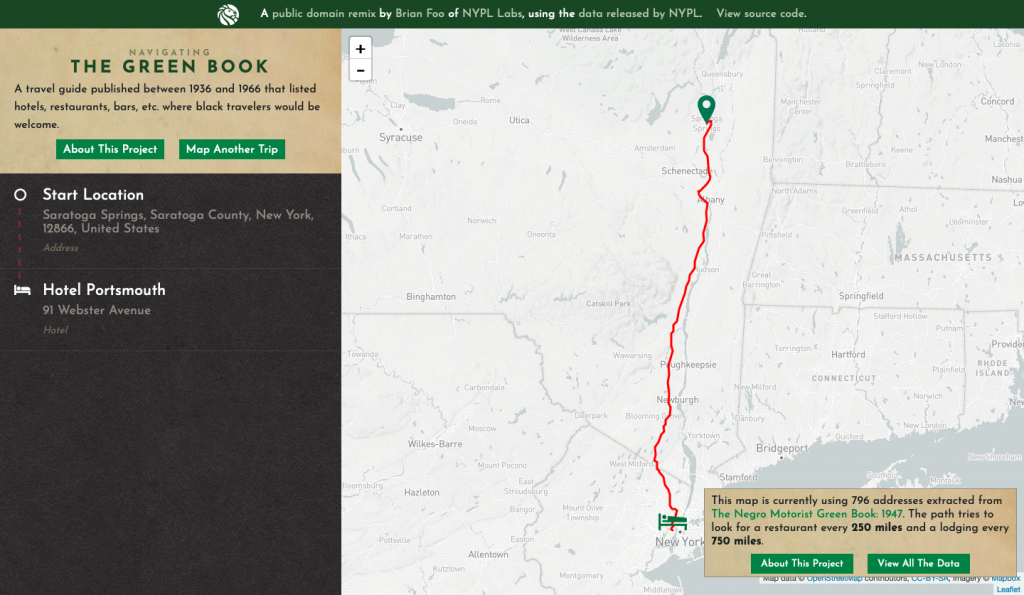


I chose the American Guide to New York titled, “New York: A Guide to the Empire State.” I mapped out Tour 21, which featured locations starting in Montreal, Quebec, Canada and ending in New York City, NY. What I found from the coverage of most locations was that the writers tended to focus on the geography of these specific places. Information about the state itself was featured in other sections. The Tour barely talked about the present-day, as in 1940 when the guide was written, locations and the people who inhabited them, but rather the locations in a historical context, as well as their relation to highways and local routes. This is a big contrast to the Green Book. The Green Book didn’t feature as many locations and it only strictly focused on culture (restaurants, lodging, etc.) and not history. There’s history to be found in both, though. In looking at these books, it’s easy to decipher treatment of ethnic Americans at the time. At least for the New York American guide, foreign-born, Black, and Native Americans are all spoken about statistically, and if not statistically, then either not at all or simply blown over. However, the Green Book is essentially always radicalized. Although it’s just a map with safe places for Black Americans to stop on their travels, it’s a historical statement over the fact that guides like that existed in general.
