
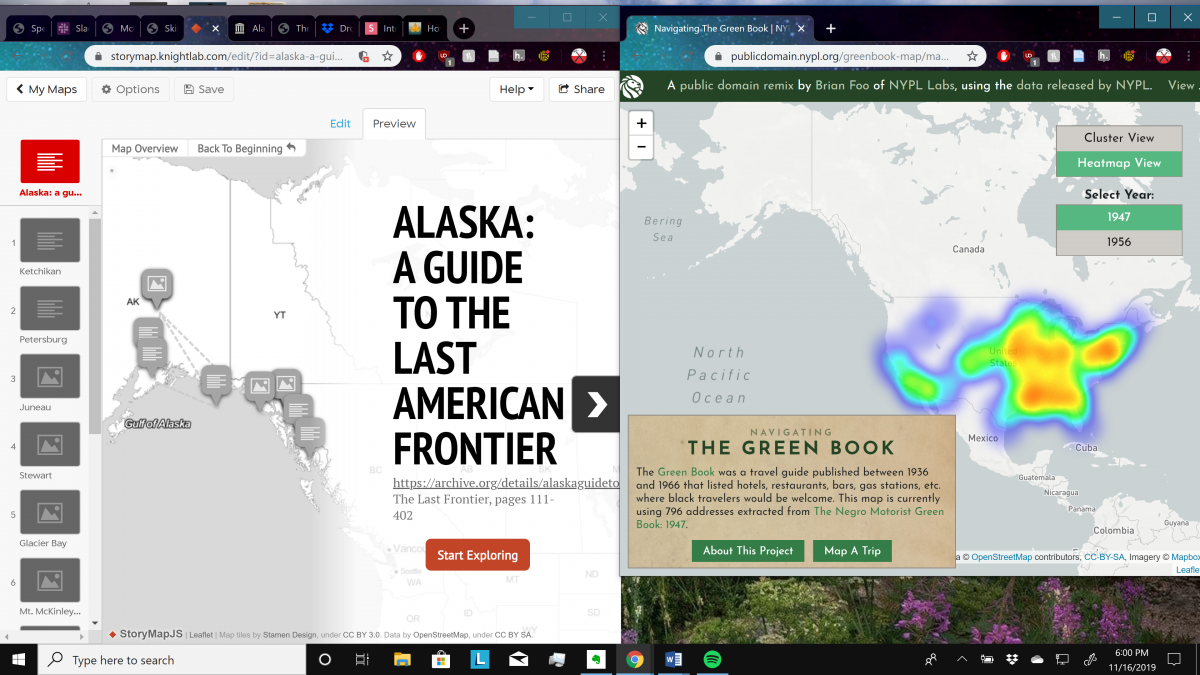
What I planned for this project was to use the data of the Green Book Project to find out what mobile citizenship looked like in a place as remote and physical as Alaska, if there were accommodations for coloured hikers within the territory. However, the Green Book Project showed no data whatsoever outside of the mainland United States. This makes sense; in a state such as New York or Pennsylvania, you could take a tour and theoretically never leave your car. This is impossible in Alaska, due to the lack of roads. To access the capital, Juneau, even to this day you must take a ferry or a plane since there are no roads leading into it. Alaska is a destination attractive for its hiking, first and foremost, and one would be hard-pressed to drive there.
We can infer information about Alaska from similar states known for hiking and northern climates: Colorado and Washington, respectively. By the looks of the reports from the Mapping Inequality Project, it appears that black populations were not much more liberated there than in most of America; of one prominent black district in Denver, the surveyor writes, “For a Negro section, it is very well kept up. Were it not for the heavy colored population much of it could be rated ‘C’.” He rates every coloured section of Denver similarly. Regarding black residences in Seattle, the surveyor simply wrote “This is the Negro area of Seattle”, and ranked it a D. Considering the echoing ramifications of these reports, it seems reasonable that black people were precluded from the free time and capital required for serious hiking. 1
The improved mobile citizenship the Green Book promised in the 1940s did not apply to a more active brand of tourism. One look at the Green Book Project, and one can see that lodging for the more mountainous regions is sparse, ranging from five in Colorado to one in Montana and none in Washington. I believe that a perfect storm of decreased institutions for black people (evident in low coloured populations in those areas) and simple incapability of travel to mountainous locales led to this dearth of trail lodging in popular hiking destinations, conclusions which can be extended to Alaska.
By all means, mountain hiking was restricted to white tourists. Tourism as the “ritual of citizenship” so cherished by many would be null and void when it came to experiencing natural wonders up close, excluding me from the beauty of the country I want to be a part of. If I were a black traveller, the infrastructure simply would not be there to preserve me from humiliation and discomfort were I to hike in Alaska. This wouldn’t be just nothing, as “the 1930s might best be characterised by a pervasive interest in culture… the more anthropological concept of culture denoted by a shared set beliefs and behaviours”– and the pool of these shared beliefs and behaviours would shrink all the more with my myopic access to hiking in America. 2
- Madron, Justin, Robert K. Nelson, and Nathaniel Ayers. n.d. “Mapping Inequality.” Digital project. Mapping Inequality. Accessed November 16, 2019. https://dsl.richmond.edu/panorama/redlining/.
- Shaffer, Marguerite. 2001. See America First: Tourism and National Identity, 1880-1940. Book. Smithsonian Institution.
