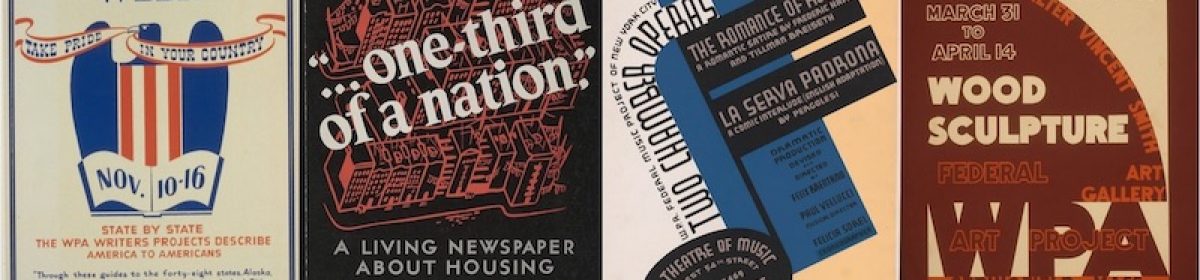
Although high school to many of us may seem like a far off dream, I remember my time in secondary school very well thanks to one man – Mr. Stulac. My Latin teacher was very proud of the places he had lived. One of these places was Nebraska. I would often tease him for his pride in inhabiting in such a strange place, but Mr. Stulac informed me that this state surface-level appearance by no means compared to the wonderful of this state.
For this project, I wanted to test my high school Latin teacher’s beliefs. Is Nebraska, the “cornhusker state”, really as remarkable as he claimed?
For this project I examined Tour 1A. Omaha-Bellevue in the WPA’s Nebraska: The Cornhusker State. A majority of the sites listed in this tour pertained to the area’s natural landscape, missionary practices, and governmental history. Considering these landmarks through the eyes of an American living in the 21st century, it’s difficult to understand the significance of these places. However, when perceived through the eyes of an American living during the Great Depression, these sites take on a new meaning.
With regards to the area’s natural wonders, many Americans during the 1930s sought to assign new value in their culture and have it hold its own against those of Europe. As is explained in American Culture Defined: The American Guide Series1, Americans valued their landscapes as works comparable to those created in Europe. This was a bold endeavor, but one which has benefited our nation’s National Parks Services, from Yosemite to the small Fontenelle Forest in Bellevue, Nebraska.
Additionally, the WPA’s Nebraska: A Guide to the Cornhusker State provides readers with information on road conditions and means of transportation around the city. This information is significant, as it encouraged tourists to travel across the state as individuals through the use of the automobile. This sense of empowerment given to the average American was much needed during the hopeless time of the Great Depression.
However, this does not mean that the WPA’s guide series empowered all Americans. For African Americans living during the time of Jim Crow, travel was a daunting task: Where will my family rest safely at night? Where can I find my family a decent meal? These questions plagued African Americans considering a tour of their own nation, and the answers were bleak. The map below shows the places an African American’s business would have been accepted on a journey from Lincoln to Omaha.
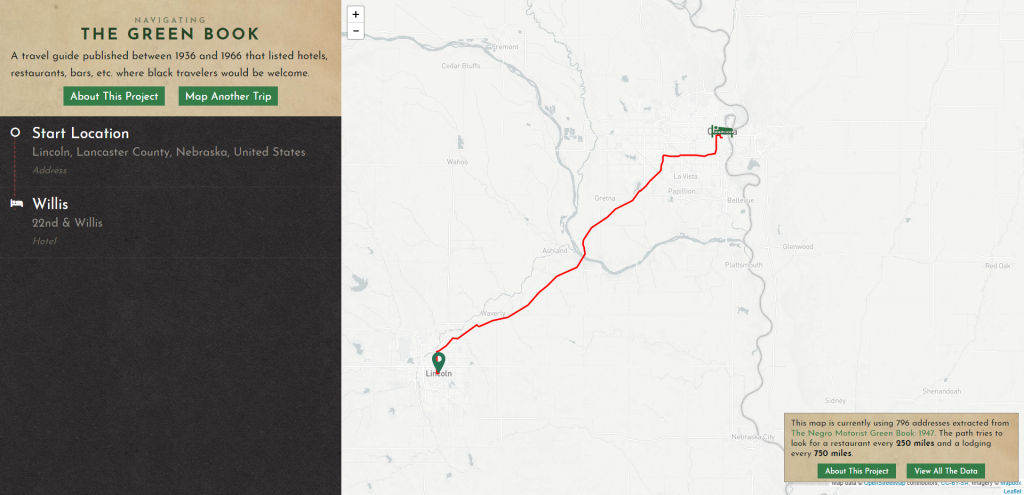
As we can see, the options were scarce, and African Americans were excluded from this opportunity provided by the Roosevelt Administration. In Sarah Bond’s article “Mapping Racism and Assessing the Success of the Digital Humanities,”[enf_note] https://sarahemilybond.com/2017/10/20/mapping-racism-and-assessing-the-success-of-the-digital-humanities/[/enf_note] mapping projects such as the Navigating the Green Book provide audiences with a clear image of the presence of discrimination. What could be more frightening than the insecurity of one’s safety.
Ultimately, I believe that Mr. Stulac was right in saying that Nebraska was an interesting place to live. Behind the stern face of the cornhusker lies a past filled with American nationalism and racial bigotry.
