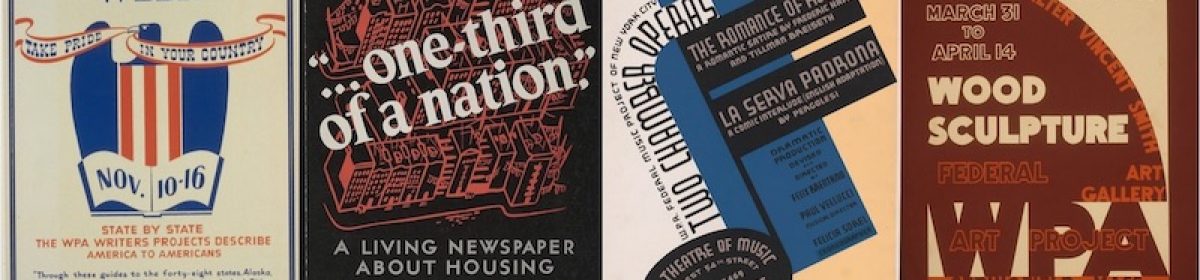
The New Deal has had a lasting impact in so many ways around Washington D.C. Many of its buildings and artwork is a direct result of the New Deal. However, just because the impact of the New Deal is long lasting does not mean that its message has been preserved. In D.C. today it is very likely that most of the sites that are products of the New Deal are still physically in tact. This does not extend to the ideological preservation. While they have not been destroyed. But merely that the message the original sites held has been pushed away, hidden, or in some small cases removed.
The notion that one can use mapping projects to show the success of something or the message of something is talked about in a piece by Sarah Bond 1. The piece shows an example of racism as core idea to map. With the sites of the New Deal in Washington D.C. one can largely do the same thing. This is especially apparent with what is discussed as the “success” of something. In the article the success of Digital Humanities is discussed. In the Capital, however, one can discuss the success of the message of New Deal Sites using mapping. This is because in D.C. many of the surrounding area is largely the similarly preserved as the site itself. Two of the best kept sites are the West Wing and the Lockkeeper’s House. One can look at the surrounding area, in this case the Federal Triangle, and it is clear there will be a high level of preservation. The buildings being such well preserved structures, some also products of the New Deal, indicate through mapping that areas around them will also be well preserved. This is also equivalent inversely, one example is the Recorder of Deeds building. Many of the buildings around the Old ROC building have been destroyed. So, following the map trend, the ROC building and the message have also been altered or partially destroyed.
Time can also have a great effect on the the sites themselves. Using timelines one can see, visually and ideologically, how the sites have changed. The Old Post Office building which once brought the Nation together is now seen by many as a symbol of corporate greed. It is now largely rented out by the Trump Organization which has caused some bias in the original buildings preservation. It is incredibly important to be aware of this archival bias that is present in Museums 2. One must understand that due to the Hotel that was built, this has pushed the message of the post office away. This is meanly why a timeline comparison was chosen for sites such as this one. One can use it to both compare the old message and the new bias for or against the original message.
The Depression hit many people but due to rampant racism, it hit African Americans much harder 3. Due to this many artists of the time would express this in the murals and paintings. The murals in the ROC Building were created to represent the various important African American political figures that worked there. This in many ways is how art was used throughout the 1930’s 4. It was an expression of the reality around them and a also an escape.
The Legacies of the New Deal have extended far into the modern age. However, many of the messages have been lost or are hard to find. Through research, the many sites that once held great historical significance have been changed drastically. This has thus destroyed much of the effects that could have happened because of the New Deal. Despite this, the New Deal’s long lasting effects have had a more subtle impact today. Even though physical monuments have been changed, the ideas that were created live on in those who believe in the original messages.
REALLY IMPORTANT
There seems to be a limitation with what Omeka can do with annotated images. It seems to destroy other parts of the page if there is other content. It will also simply not show anything if it is alone. However, this only happens if you are not logged in to omeka. So, you should not have a problem with this but I am not the only one that had this happen. Secondly, if this does in some way effect the project I have attached to the site a “Part 2” which is me analyzing the images but by not using the annotating tool. Please you this if the if there are no image annotations on the other page. Thank you. gg
Also if you paste it as plain text it may also work normally.
Image Analysis
- Bond, S (2017) “Mapping Racism And Assessing the Success of the Digital Humanities” History From Below
- Padilla, T. Arroyo-Ramirez, E. (2017) “Bias, Perception, and Archival Praxis” dh+lib
- Stanford University Press (2019) ” THE AMERICAN YAWP” Stanford University
- Webster, S. Harriet, S. (2019) “New Deal for Public Art” HarperCollins
