Final Blog Post:

I chose my final exhibit to be about crime and the fluctuations of crime rates. Being a criminology major all I do is research crime, but I have never actually looked into crime happening during the 1930’s. I knew of the Prohibition and what J. Edgar Hoover did for the Federal Bureau of Investigations, but I have never looked at them in great detail. America had gained a slogan during that decade, “Lawless in the Depression Era.” The more I researched, the more apparent it became to me that the criminals and the general public had more power than the actual law did. Mobsters would gun down the law enforcement agents, eventually the officers/ agents would not try to intervene. The public was being controlled by fear of powerful Mobsters or Gangsters. Half of the population would partake in crime itself by becoming a bootlegger/ rum-runner, or speakeasies. Serial killers started to become widely active in this decade, and drugs were being trafficking out of every possible source. Places like Canada, China or Mexico flourished economically because America was desperate. Hoover’s changes to the FBI structure helped more than he thought they would. Trained agents now walked the streets and helped take down the high profile criminals. New divisions were started to be developed such as, forensic laboratories and counterintelligence. 

Breaking up the exhibit was a challenge, I knew what I wanted to share but did not know how to format it. The information did double over in some of the pages. The major thing that increased crime was the prohibition. That caused mobsters and gangs to gain more power, and illegal running of alcohol to become more popular. Then the New Deal Programs was one of the major things that happen to decrease the crime rates. Millions got jobs, and had a stable income. That led many away from crime such as robbery, or being involved in a gang.

During this semester I learned so much. I am not a computer person by any means, I could care-less about them to be honest. But the tools used during this semester were so easy to use and displayed information in a way anyone can understand. Granted I did get frustrated a lot during this semester, looking back I can use the tools I learned in the future. My favorite project was the glitching project, I found it fascinating  how easily it was to distort an image. Then after is was glitch how many interpretations you can gather from just one image. Another thing that was useful was learning how to navigate the Library of Congress, library resources, and online databases. I would spend hours trying to search through this huge databases, but learning tips from our readings, and from Tony Guidone made it so much easier to narrow down sources. Already these tools and tricks helped me in research papers done this semester. Even though this semester taught me a lot, History and IT (computers) are still my least favorite subjects.

Sources:

Kramer, and Michael J. “Glitching History: Using Image Deformance to Rethink Agency and Authenticity in the 1960s American Folk Music Revival.” Current Research in Digital History, 1 Jan. 1970, http://crdh.rrchnm.org/essays/v01-08-glitching-history/.

Milligan, Ian. “Illusionary Order: Online Databases, Optical Character Recognition, and Canadian History, 1997–2010.” The Canadian Historical Review, University of Toronto Press, 27 Nov. 2013, https://muse.jhu.edu/article/527016.
Blog Post 9 (Skill 7):

Lynching is the act of hanging a man or woman for alleged offenses, in most cases without a legal trial. Lynching are typically carried out by a large mob, many of the people present do not even know the crimes the individual was accused off, they are just bystanders. In Virginia this was the main form of justice between 1880 and 1930. There were over 90 men hanged (over 4000 world wide), all but a handful were African American. In 1880, Virginia passed the “Lynch Law,” in hopes to assert dominance over the African American population. It was not until the mid 1930’s till an ‘Anti-lynching’ movement was put into place, but till this day there is still no law against it.

In 1935 in Dunnsville, Virginia three (Hill, Lowman, War) interviewers interviewed Aunt Phoebe Boyd. Ms. Boyd was a former slave and participated in the 1930’s WPA slave narratives.  During this interview she walked the interviewers through her childhood and teenage years. She told stories in great detail about these years. One story that stuck out to me was when she witnessed her first lynching. She briefly mentioned seeing multiple throughout her years as a slave, but she went into detail about one in particular. She recalled seeing a man on a stage, struggling and crying with a thick rope around his neck, and two police officers standing on the side near a leaver. The police officers were laughing at the man who was about to lose his life. She mentioned how his mother, father and brother stood in the crowd crying in a way she had never seen before. She recited a short prayer for them. People who lived near and people who are just walking by stopped and stood watching. None of them knew the reason why this man was being hung, and no one was bothered enough to ask. One of the interviewers had asked Aunt Phoebe Boyd if they buried the bodies, but she responded that they burned them instead. Ms. Boyd had explained that her faith had made her stronger, and her faith is the reason why she made it through her years as a slave.

Sites:

“Interview with Aunt Phoebe Boyd, Dunnsville, Virginia, 1935 (Part 7 of 8).” The Library of Congress, https://www.loc.gov/item/afc1984011_afs25752a.

“An Introduction to the WPA Slave Narratives  : Articles and Essays : Born in Slavery: Slave Narratives from the Federal Writers’ Project, 1936-1938  : Digital Collections : Library of Congress.” The Library of Congress, https://www.loc.gov/collections/slave-narratives-from-the-federal-writers-project-1936-to-1938/articles-and-essays/introduction-to-the-wpa-slave-narratives/.

Blog Post 7: Mapping

Blog Post #7: (mapping)

Growing up in Philadelphia I had its history drilled into my head every year. Eventually I got tired and just stopped paying attention in history classes. This project though helped me learn about historical Philadelphia in a new way. Being able to plot the locations and make it all interactive made me want to learn compared to reading words in a textbook. Having visual aid to go along with the history makes it way easier to retain. Working with JS story maps, it helped me figure out exactly where each location was and the significance of that area.

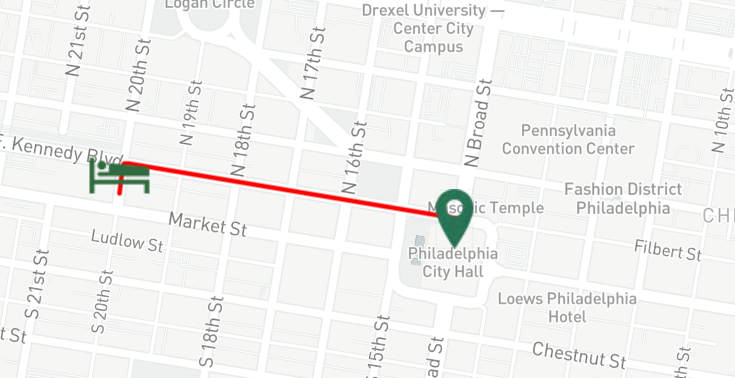
While looking through various versions of Green Book maps I noticed most of them had a cluster of sleeping and eating spots. Before inputting the route I wanted the map to follow I expected there to be a higher number of tourist locations. I choose center city for my Green Book map. Even though was typical for Northerns to not own slaves, Philadelphia had a big slavery number. There was not a lot of african american tourists in the Philadelphia area. But I do think the Philadelphia area became a popular tourist area because of the Anti-Slavery movements that started in this area.

Sites:

“Philadelphia, a Guide to the Nation’s Birthplace, Compiled by the Federal Writers’ Project, Works Progress Administration, for the Commonwealth of Pennsylvania : Federal Writers’ Project (Pa.) : Free Download, Borrow, and Streaming.” Internet Archive, [Philadelphia] William Penn Association of Philadelphia, 1 Jan. 1970, https://archive.org/details/philadelphiaguid00fedemiss.

Encyclopedia of Greater Philadelphia, https://philadelphiaencyclopedia.org/.

Blog Post #8

The Federal Theatre program was put in place in 1935, and ended in 1939. Some problems that the program faced were railroads costing too much. Individuals could not pay the fee of the trains and then the cost of the tickets to see the plays. Another problem is movies, they started to take over the theatres. There was no need for actors, directors, stage crew, etc. Due to budget cuts, lack of employees, and lack of an audience the Federal Theatre Program ended.

The goal of the Special Collections Research Center (SCRC) is to document and preserve documents and collections. They also make them available to the general public. Archivists digitize certain items/ collections to save the information, for example a piece of paper from over a hundred years ago may start to disintegrate. Or a tape or record may get scratched or destroyed over the years. Though not every piece of material is digitize due to many factors. These collections are extremely old and important, they need to be handled with care. The process of scanning has to be done with extreme caution. Then the Archivists have to ensure the quality and maintain it over time. George Mason University’s SCRC has over 70 digitize collections from the Federal Theatre Project. Being able to look at physical artifacts from the era the Federal Theatre program was active helped me see how impactful it was. Being able to look at the actual documents/ collections from that time was more impactful to me than reading articles about them.

Sites:

“Federal Theatre: Melodrama, Social Protest, and Genius  : Articles and Essays : Federal Theatre Project, 1935 to 1939  : Digital Collections : Library of Congress.” The Library of Congress, https://www.loc.gov/collections/federal-theatre-project-1935-to-1939/articles-and-essays/federal-theatre-melodrama-social-protest-and-genius/.

“The Play That Electrified Harlem  : Articles and Essays : Federal Theatre Project, 1935 to 1939  : Digital Collections : Library of Congress.” The Library of Congress, https://www.loc.gov/collections/federal-theatre-project-1935-to-1939/articles-and-essays/play-that-electrified-harlem/.

Blog Post #5: Fountain Hughes

Timeline:

http://timeline.knightlab.com/#preview-embed

I chose to do my timeline on a gentleman named Fountain Hughes. He was born into slavery, both of his parents were slaves to Thomas Jefferson up unto his death. Mr. Hughes talked alot about his childhood, explaining how he would play games and be running around with the other children. But made it clear when it was time to work on the field or in the bar, no one messed around and got their work down. Which actually surprised me while listening because in the textbooks they normally only talk about the negatives, and typically say there was no time for fun and games. By the time the Civil War started Mr. Hughes was only thirteen years old (roughly seventeen years old when it ended). He does not recall much from the war itself besides his father dying in the war (he was sold to fight in the war) and the northern soldiers raiding the plantation. I am not too surprised he does not remember much about him actually working on the fields or the war itself. These were traumatic events in his life that he most likely repressed. 

I think a major limitation about the oral histories is the time period in between. The interviews were conducted ninety to one hundred years later. Memories are fading, or completely forgotten in that time span. Details of the events they do remember may be hazy, or not make sent. Also, false memories are probably created from the countless stories people tell. Another possible limitation is sensitivity. The interviewers may struggle with asking questions about some topics, escpically with a topic such as slavery. Also stated in a previous reading, A Note on the Language of the Narratives, most interviewers were white. So the interviewees might have not felt comfortable with sharing due to the ugly racist past. 

A positive to the oral histories is getting first hand stories. Hearing these individuals recall their life events makes it more real. Since slavery and the 1930s happened so long ago things get lost, emotions are forgotten, but these oral histories make you feel connected.

Sites:

“Interview with Fountain Hughes, Baltimore, Maryland, June 11, 1949.” The Library of Congress, https://www.loc.gov/item/afc1950037_afs09990a/.

“A Note on the Language of the Narratives  : Articles and Essays : Born in Slavery: Slave Narratives from the Federal Writers’ Project, 1936-1938  : Digital Collections : Library of Congress.” The Library of Congress, https://www.loc.gov/collections/slave-narratives-from-the-federal-writers-project-1936-to-1938/articles-and-essays/note-on-the-language-of-the-narratives/#note.

Blog Post #3: Glitching

Exhibit: http://jessicadoeshistory.com/cnd/exhibits/show/brooke-kostyk–josephine-hill

Item: http://jessicadoeshistory.com/cnd/admin/items/show/176

 Initially to pick a photo for this skill assignment, I chose a random number from one to nineteen to determine what resource to use. After I chose that number, I read about the collection and looked through all the attached media. I specifically chose Josephine Hill because she just looked uninterested. She did not look straight at the camera and her posture seems relaxed and unbothered. The other portraits the men and women are looking straight into the lens and their posture seems to be fixed, like they were staged. Josephine also gives off the impression of hopelessness, which was a general them during the 1930’s. 

Reading about Josephine and the other men and women who were born into slavery has only peaked my interested more. I found myself questioning, How did the Great Depression impact Slavery? How were the slaves treated during this time? The slaves that were lucky to get paid before, did they continued to get paid? 

I found the glitching method more interesting and helped me think more critically about. The actual process of glitching was very fun to try. It was fascinating to see what lies beneath the photo and be able to manipulate it how I wanted. In the article Glitching History, Micheal Kramer stated “Misrepresenting our artifacts allows us to consider the full range of their representations.” This phrase made me think about how five people can be looking at the same photo but each person has different interpretations, questions, ideas, etc. Glitching allows even more questions to arise, and come to conclusions no one would ever thought of looking at the original photograph. Another way glitching is referred to is, “…finding the soul in the machine…” (The Art of Glitching). Glitching the photo of Josephine had me looking at this portrait in new ways. 

My final interpretation of the glitched picture of Josephine is her being slowly blown away, forgotten, turning into just a name on a website.Her story will eventually be forgotten by all, no one will know who she was. Another way I see this photo is her being swallowed up by the darkness, which can me a metaphor for slavery.

Sites:

Kramer, and Michael J. “Glitching History: Using Image Deformance to Rethink Agency and Authenticity in the 1960s American Folk Music Revival.” Current Research in Digital History, 1 Jan. 1970, http://crdh.rrchnm.org/essays/v01-08-glitching-history/.
YouTube, PBS Digital Studios, 9 Aug. 2010, https://youtu.be/gr0yiOyvas4.

Blog Post #2:

I found Tony’s presentation very useful and definitely very helpful. I will be able to apply the techniques discussed in multiple of my other classes too. It was also really interesting to look at the coins and the newspapers he had bought for us. One of the tips that Tony explained that really resonated with me was text searching. This especially helped me when I started to look for sources for my research paper for my Criminology class. Being able to use keywords to search through the countless amount articles make it easier to find the right sources. Keywords also help make sure the article you are reading is exactly what you are looking for. Each result that pops up will include the date, page number, author and that specific highlighted section where that word was found. I think digital projects can create a big social change. I think they are a powerful way to bring words and information to everyone. These projects make it easy for the reader to engage with information in a more creative way than just reading it in a text book or watching the news. Digital Media has many benefits. One is improving social interaction, the media connects thousands of people everyday from all different walks of life. The media has given so many people a voice. Another benefit is enhancing education. By improving literacy rates among the youth, also by encouraging lifelong learning. A negative of the Digital Media is that lack of Historical information (Digital Dark Age). This is a result of technology constantly changing, and software or hardware going out of date. Even though a lot of historical information has been converted into digital media, some has unfortunately been lost throughout the process. Another negative is that a lot of the information that is on the internet is often false or incorrect. In Ian Milligans article, Illusionary Order, he stated that it was due to miss written citations, or no citations at all. He also said that the difference from  how historical newspapers were used then and now are also a negative. 

Sites

Milligan, Ian. “Illusionary Order: Online Databases, Optical Character Recognition, and Canadian History, 1997–2010.” The Canadian Historical Review, University of Toronto Press, 27 Nov. 2013, https://muse.jhu.edu/article/527016.

Tony Guidone presenation

Blog Post #1

I have slight knowledge of the 1930s through the many history classes I have sat through in High School. Class discussions about the Great Depression, and the New Deal only strengthened my understanding about these topics. Class also helped me learn more effects these topics had on the American population, rather than the World as a whole. Though the information technology/ digital humanities part of the lectures were new topics to me. I learned about the production of the first computer, and the introduction of the first computer web browser. I am very interested in using many of these online tools to research more about the digital past, and learn more about technology.I hope I can help expand my understanding about America’s past and learn about how “history might be repeating itself.” 

I have been assigned to the “Seattle Civil Rights and Labor History Project,” written by faculty, community groups, undergraduate and graduate students at the University of Washington. The idea of this project is to bring attention to Civil Rights in Seattle, also to the labor movement. Throughout the 1900’s civil and labor Unions and Radical organizations have shown proof of giving critical support to racial justice. This project uses a variety of different tools to relay information, such as oral histories, film & slideshows, and research reports. The data that was collected was well presented, it included extensive well written research. Each Historical Essay cited within this project is about interesting issues and incidents. Some topics include immigration rights, Native American land rights, segregation, women’s rights, etc. Each Historical Essay is fully equipped with photos, and clippings of Newspapers. The Film & Slideshow tab of this site has proven to be incredibly useful. Being able to watch and listen to individuals who have personally experienced these conflicts helped solidify my understanding of the issues.  Also cited on this site are different Civil Rights Organizations that were present in Seattle at the time, and the efforts they extorted to help support this movement. Unfortunately, some of the links listed on the site were expired, or not found. So I was not able to fully explore this exhibit.

Sites

“Seattle Civil Rights and Labor History Project.” Seattle Civil Rights and Labor History Project Seattle Civil Rights and Labor History Project, 2004, http://depts.washington.edu/civilr/.

css.php