Music and the Depression

Music connects cultures. Music builds emotion. Music creates beauty.

It is only obvious that the Cultural New Deal would use music to grow a national identity and urge depression relief. Unlike other projects the Music Project was well received, and while it was in operation received very little opposition. But not long after the Federal Music Project became wide spread in it’s influence some of it’s popularity was torn out of History. How could something so widely accepted as AMERICAN be just as quickly torn out of societal norms?

Unlike the controversial disbandment of the Federal Theatre Project the Cultural New Deal created the Federal Music Project. This project focused on education and national identity. Through the efforts of this project the glorious world of American Music was discovered. Folk music became distinctly American, and people found the new trend highly agreeable. the Federal Theatre Project did not present to the people a viable reason for it’s funding and distribution. It had educational programs and catered to a wide American audience.

The most widely accepted piece to come out of the Federal Music Project, accepted by the Republican Party, The Democrats, and even the Communist Party  was the Ballad for Americans. 1

This incredibly unique piece gave America an image of their reviving country to grasp onto. Written by a gay man and sung by a black man it’s surprising that it was so widely accepted in an age when the people who created it weren’t accepted. The project included other pieces that built a more regional perception of American and cultural identity. The same broadcast that presented The Ballad for Americans presented an exotic image of Hawaii through The Hawaiian Pursuit of Happiness. 2

This music presents a picturesque image of America, and appeals to all who have fallen prey to the Great Depression. Several years later that all changes. Once anti-Communist sentiments settled in The Ballad for Americans legacy, and it was torn from the music books. The songs of the Federal Music Project, whether regional or wide spread, have the people of the 30’s a means form of art all could grab onto as their own, but the 30’s had to end some time. These overarching themes of a need for an identity shows the 30’s was a time of great rebuilding, and the Federal One Projects used all they had to rebuild the culture.
The WPA Documenting the American Folk

The Works Progress Administration, founded in 1935 as part of FDR’s New Deal, set out to document American culture. The methods that they used to record the folk vary from spoken interviews, songs, photographs, written interviews, and state guides.

As part of the Federal One project the Federal Writers Project was tasked with reaching out and recording the stories of the American people. 

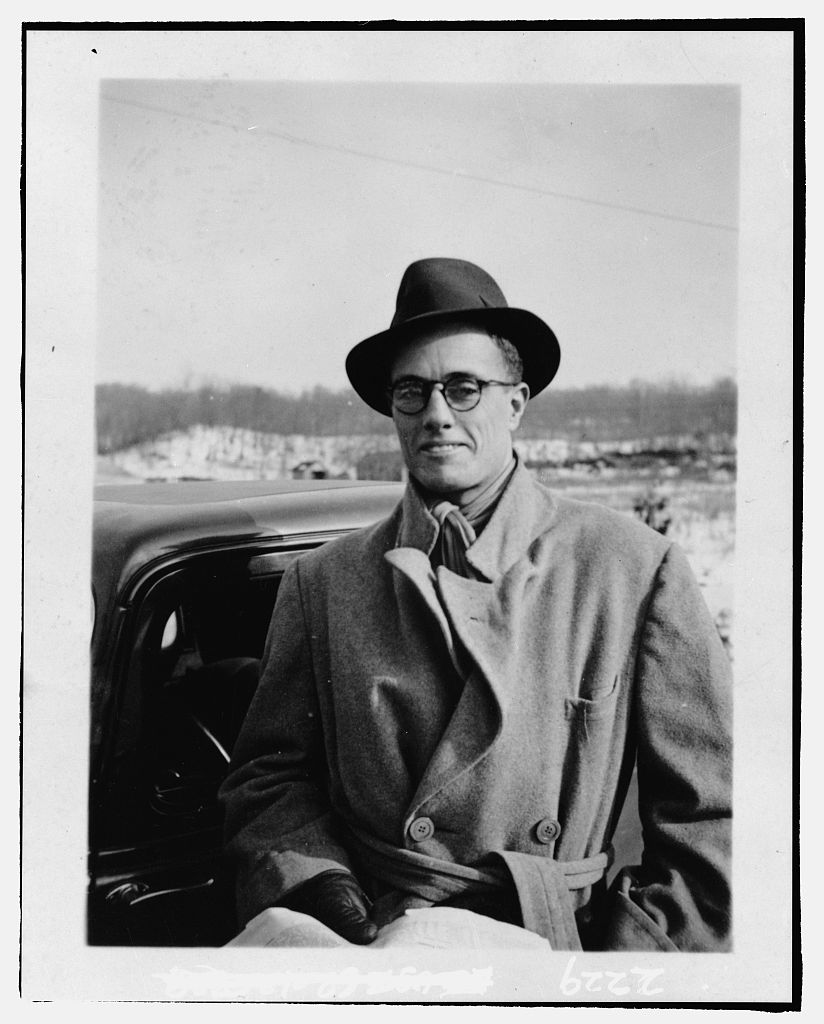
The FWP was managed at both the state and federal levels. John Lomax was a folklore editor and in March 1939, he and his wife Ruby set out on a journey that would traverse 6500 miles across the southern states. 2

John Lomax out on the road. 3

They made recordings of folksong of all kinds, ballads, cowboy songs, fiddle tunes, lullabies, and many more. In all there were more than 25 hours from over 300 different performers, all with their own unique story to tell and culture to represent. 4

 In addition to folksongs they recorded sermons like the one in Houston, Texas, April 12, 1939 by John Lowry Goree. 5

John Lomax was not the only FWP contributor to take to the open road. In the 1930’s Sidney Robertson Cowell was one of the folk music collectors associated with the Northern California WPA. She was perhaps the greatest activist in California when it came to collecting and documents the migrant experience. She interviewed and recorded the culture and songs of immigrants and their families. 6

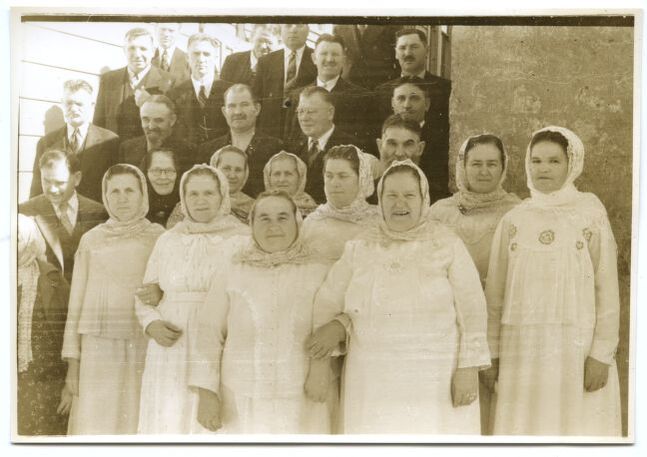
As part of her collection Cowell also took still photographs of the people she chronicled. Her endeavor was “ one of the earliest ethnographic field projects to document European, Slavic, Middle Eastern, and English- and Spanish-language folk music in one region of the United States”. 7

 “Less than a quarter of the total adult group.” Forms part of a group of field materials documenting unaccompanied singing and preaching in the Russian language performed during services of the Russian Molokan Church, Potrero Hill, San Francisco on September 14, 1938, collected by Sidney Robertson Cowell. 8

In addition to the FWP other Federal One Projects documented the American folk. The Federal Music Project and Farm Security Administration also fell under the Works Progress Administration. 9

The Federal Music Project was regionally managed and really showed the distinctiveness of the different parts of the US. This was vital, the southern hymnals were very different from the migrant songs of the people in Northern California. Just as the people were distinct so too was their music. 10

One project took place in the Federal Music Project Office, Jacksonville, Florida. The performer, Zora Neale Hurston sang a number of songs that helped to document the way that music featured in the culture and work of slaves. 11 Many of them are “work” songs, their beats keep time for the task they are doing. The music that the FMP recorded is a treasury of folklore, some telling stories and others long traditions from generations past.

The Farm Security Administration took more than 270,000 photographs during its effort to document the trials and tribulations of the American people across the country. The famous Migrant Mother image taken by Dorothea Lange is part of this collection. It shows the lives of the people displaced by the Dust Bowl and downtrodden from the Great Depression. It documents the many camps that sprung up and the people that lived there. The very people that the New Deal set out to help. These photos are perhaps the best record of how the New Deal was helping people.

The famous Migrant Mother 12

Throughout the New Deal era the Works Progress Administration sought to define the American people. What they did was document just how much of a “melting pot” the United States really is. Through the recording of local music, written interviews, and thousands of photographs the Federal One project illustrated the unique and engaging American Folk.

Hear It for Yourself- Folk Music

Personally, I associate the culture of the 1930s with the folk tunes produced by artists such as Woody Guthrie. Of course, there are dozens of folk artists who found success in this time, but not all of them have permeated the modern culture as much. So, it is interesting for us as observers from the 21st century to look at the music produced in the 30s, the common themes and tunes, and how it reflected the reality of the era.

First, it’s important to reflect on the widespread and unspecific nature of the “folk.” There is no single definition for the folk music and culture that became popular in the 30s, and this is part of its strength. The folk movement didn’t idealize a homogenous America, but acknowledged strength through diversity13.

At the same time, the tone14 of folk songs of the time often reemphasized the economic reality faced by millions of Americans during the depression. Slow, sad sounding tunes accompanied individuals who faced a slow, sad economic depression.

Still, not all folk songs maintained the same tone, especially those that had been passed down for a longer time via an oral tradition.

The connective tissue tying all folk music together is a sense of authenticity about the reality of America. This includes an embrace of immigrants and the music they brought with them15 from their own cultures.

Both of the recordings in this post are a result of the Federal One Project’s efforts to encourage and capture the music and folk culture of the time. For one reason or another, these songs were deemed as important enough to listen, record, and maintain over the course of 80 years. The songs recorded as part of the project reflected the reality of American culture, as opposed to just what the mass media produced or valued16.

The fact that we are able to discuss and listen to these recordings decades later and draw conclusions about life during this period speaks to the value of the Federal One Project. Although the projects, especially the Federal Theater Project, received a great deal of scrutiny for their focus on the arts in a time of financial hardship, they have proven their value from a historical perspective. Even without consideration to the direct benefit that the projects had to the artists and individuals involved, the projects provided value to future generations.

In this instance, I believe that the inclusions of sound greatly emphasize the points of the text. I can describe a song as sad or foreign or celebratory, but none of that compares to allowing an audience to experience that for themselves. It’s similar to a game of telephone, every step along the way may lose an aspect of the original recording or song. So, by allowing the audience to hear the song for themselves, some steps are removed, and the audio can be experienced firsthand.

Fountain Hughes’s Narrative

For this assignment, I listened to an interview with Fountain Hughes, conducted by Hermond Norwood. Over the course of the thirty minute interview, I was able to notice the value of his experience, and the ways that his experiences did and did not align with my expectations for his narrative.

Here is the timeline that I created based on Fountain Hughes’s interview.

Learning from a narrative

I believe that there is a lot of value within Fountain Hughes’s experiences. Through this interview, historians receive a firsthand account of what it was like to be an enslaved person in the United States during this time. Something that stood out as particularly poignant during the interview was how Fountain discussed slavery in terms of the 1940s. He speculates that some people now “would rather be slaves.”17

Fountain notes that he would rather kill himself than go back to being a slave. He notes that they were treated like dogs, and would never go back to that existence. This directly contradicts the narrative of the jovial slave that was spread by people in the argument that slavery wasn’t as bad as it seemed. Fountain Hughes claimed to be more than one hundred years at the time of this interview and had not been enslaved for more than eighty years. Still, the trauma of slavery stuck with him so strongly that he would not hesitate to resist in the most severe and permanent manner.

Additionally, Hughes’s narrative is valuable as a man who originally lived in the South before moving to Baltimore, leading to a unique construction of southern identity. In particular, his discussion of going to church in a log cabin and being led by an older preacher in the singing of gospel songs, adds to the idea of a southern identity18

I was actually surprised by Fountain Hughes’s reluctance to talk about some of the specific hardships he endured as a result of his enslavement and status both during and after the Civil War. He says he doesn’t like to talk about it because “it makes people feel bad.”19 While the goal of chronicling the narratives of enslaved people as a part of the Federal Writer’s Project was to understand what enslaved people endured20 , one can not account for someone who doesn’t feel comfortable sharing what they went through.

Still, this interview has limitations. As a result of Fountain Hughes’s advanced age, his memory of events may not be as accurate as it once was. Also, it is limited by his previously discussed reluctance to discuss topics that he believes will bring others down. Obviously, there is no reason to believe that Fountain Hughes is intentionally telling any mistruths, but as a result of his age, some aspects of context may have been lost to time. For example, during the interview he describes an occasion when, as a youngster, he and his brother slept in an automobile. But, based on his age, Fountain would have already been in Baltimore by the time automobiles became commonplace in this country. He may have been referring to a more recent event with his brother, or he may have been intending to say they slept in a place that was “like” or “the size of” an automobile.

Finally, I was a bit surprised by how much Fountain Hughes’s depiction of his own life relied on broader events as signposts. Multiple times during the interview, Fountain remembers an event by President Garfield being assassinated, or someone’s death happening during or after the Civil War, or how hard life was when he and his family had just become free. Currently, I don’t remember my own life in these kinds of terms. Then again, I’m 21 and not 101.

css.php