
According to the guide book Vermont was originally comprised primarily English settlers. This racial and cultural homogeneity persisted well into the 20th century because there were no major manufacturing centers in the states. This ensured that there was little to no foreign immigration to the state. As quarry towns began to pop up there was a slow trickle of “Poles, Czechs, and Russians… Austrians and Swedes. ” (51) There was also a predominate number of Scottish, Italian and Welsh people. Interestingly a majority of immigrants either settle in after leaving nearby New Hampshire or were a part of the significant French-Canadian population.
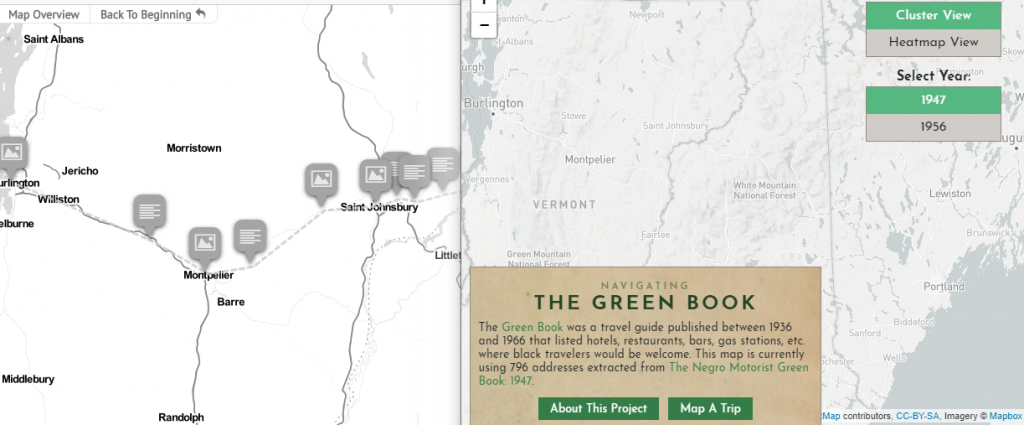
Having read all of this information before looking at the Green Book travel guide, I already new traveling in the area would have been extremely limited if not completely unavailable to Black people. I was of sadly, correct in my estimation. There was no route in the state of Vermont and much of New England was unavailable as well.
Although the guide books where essentially well received and bolstered tourism within the United States, and helped to underscore “states’ diversity and natural landscape”1 they also perpetuated a false narrative about who was included in that idea of America. These guide books, although generally informative and interesting to read can only fully be navigated by white or white passing men and their families.
In mapping my route as I was reading the descriptions of the different locals I was very particular about which stops I would be willing to make. I was unwilling to chose destinations that seem like they might be too secluded because as a woman traveler it would be a safety risk. Likewise I also avoided selecting towns like Danville, VT where there seemed to have been a strong confederate presence, or a great number of sympathizers. I was constantly aware of how I, as a Black woman would have been forced to navigate spaces that likely would have been hostile and unsafe.
It is particularly bizarre to think about the violence that might have been visited upon me because I have actually taken this trip. This juxtaposition is particularly poignant as I ponder how I would have fared 70 years ago. My race and gender would have informed every choice I was able to make in the public sphere.
The Green Book mapping project and others like it do a phenomenal job of illustrating the spacial impacts of racism. When this sort of information is rendered as a map, it allows for a greater depth of understanding. Being able to “geolocate social justice movements, visualize both historical and present racism and highlight racial issues”2 is essential to examining narratives about the past and who was allowed to be American, and understanding injustices as they occur in the present.
- The American Guide Series. USU Digital Exhibits. Accessed November 18, 2019. http://exhibits.usu.edu/exhibits/show/americanguideseries/americanguideseries.
- Bond, Sarah E. “Mapping Racism And Assessing the Success of the Digital Humanities.” History From Below, October 20, 2017. https://sarahemilybond.com/2017/10/20/mapping-racism-and-assessing-the-success-of-the-digital-humanities/.
