Living it up in the 1930s

What really captivates me about the past is people’s lifestyles. This desire to get a glimpse at their lives back then led me to my historical question: What were lifestyles like then, and how were they recorded by the Federal writers. I was immediately greeted by a flurry of words. The problem was that they all seemed very simple. Home and work, like and folklore. These words caused me to think a little more about what my historical question could be.
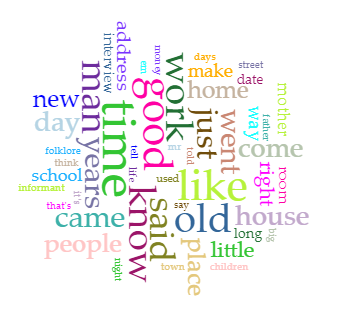
https://voyant-tools.org/?stopList=keywords-f4547f893cb245720fcc371d1768e931&whiteList=&corpus=a0d1dfae2c29f39d7cde744e33a7eb3b&view=Cirrus

My thoughts moved on to consider World War II, so I shortened the class corpus to any document that was recorded between 1939-1945. What I learned was that our corpus stopped in the year 1941 which is when America joined the war. This date could imply that the government turned from focusing on these writings and recordings to focusing more on the war effort.

Voyant was pretty helpful in getting me to visualize these lifestyles before America joined the war. In the word cloud (Cirrus Tool) above, the words work, good, old, time, like, house and came recurred very frequently. This gave me the idea that a lot of these people’s lives were more centered around work as that was what the New Deal set out to do, provide jobs and relief for the people in this time of uncertainty. “Like” and “Old” are words very reminiscent of jargon typically used to describe locations (Old) and forming comparisons or statements of “ought to” or “should” do something. These words being prominent showed, to me, that the interviewers were most likely very relaxed when it came to discussing these topics with their interviewees. They carried the valence of narrative and really felt like stories painting the picture of family life in the past. 1

The tool that helped me the most was the Links Tool. It really put these words into perspective by showing how they connected with words in similar documents. Using this, I could closely investigate the documents to see why the algorithm assigned these certain words to link. A good example was “family.” Links linked the word with “medicine,” “home,” and “Doughty” as the Doughty document discussed their life at home. This link conveys a sense of home being a place of healing and security as that was where the family was. A similar thing could be seen with “people” being connected to “folklore” as folklore was the story of the people which they passed down, holding meaning in their culture.
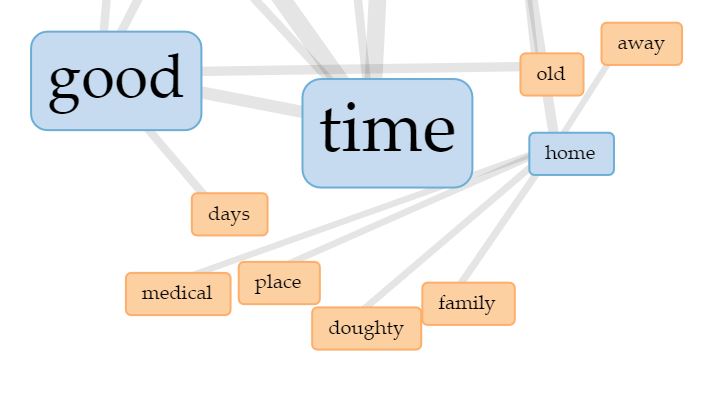
https://voyant-tools.org/?corpus=a0d1dfae2c29f39d7cde744e33a7eb3b&stopList=keywords-f4547f893cb245720fcc371d1768e931&query=time&query=good&query=people&query=came&query=school&query=home&mode=corpus&context=3&view=CollocatesGraph

Distant Reading is a really fun tool for getting a broad sense of what a group of documents could possibly mean. I enjoyed getting to explore the tools and answer my historical question. During the time before America joined the war, they were very focused on home, doing good, working to support their families and trying to keep healthy. 2

Text Analysis – Drug use in the 1930s?

My historical question is “How big of a problem was drugs in the 1930s?” and the things relating to that like how they handled the drugs, what drug was the most popular, etc.  Since I’m a Criminology major with a concentration in Homeland Security I focus a lot of my studies on drugs and how drugs get into the US. So what batter topic to study than how drugs were evolving in the 1930s? 

Based off my knowledge of the Great Depression, before doing research on this topic, I assumed that since the Great Depression was a really hard and upsetting time that drug use would be heavy. I assumed this because the Depression was a very sad time for everyone, so why not take some things that helped “distract” them and give them a high? The government was trying to find things to distract people like theater and folklore. 3 I also thought maybe since the government was trying to find things to help people take their mind off struggles, maybe drugs were a big problem. 4

I found my sources by searching for very basic keywords that have to do with drugs and the usage of them. Keywords such as: Drug, addict, Morphine, Heroin, Snuff box, addicted, dealer, doctor, etc. It was not easy to find sources, but with using different terms and phrases I was able to find my 10. The sources I found said very little about addiction or drug use, which I was surprised to find. They all lightly touch on the subject enough for me to get an understanding but the topics of each source as mostly about other things with the touch of drug use. For example, Drug store clerks stealing some drugs and selling them, Doctors selling drugs on the side, a few war victims being addicted to the pain reliving drugs they were given, etc. 5

I noticed while using Voyant tools that my 10 sources had a lot of similar words and topics which is good. Not just similarities describing drug use but the fact that many of the interviews were actually similar even with different stories, which is something I was worried about. I then made it so that very basic words were not included in the poll, words such as: just, said, says, got, it’s, congress, library, etc. I chose to keep these words out because they did not help my topic at all since, they are just very basic branching words. After that I was left with this:

The first picture shows me that a lot of these sources come from 1939 which could possibly mean that I need to narrow down my topic to that year since it shows up the most. I also concluded that with all the documents in the corpus not a lot of things regarding my topic show up unless you specifically look for my 10 sources, meaning there’s not a lot of talk on the question I’m asking. On the next picture I made a graph of the keywords that I was looking to find my sources to see how much they actually showed up in the corpus. The main ones are Doctor, and Drug. This shows me that majority of my interviews talked about people getting their drugs from a normal doctor. If they became addicted to those drugs or over proscribed I’m not really sure.

Based off all this I think the question I’m asking is to broad, so it would benefit me to narrow it down more. Something like “why were people addicted to drugs in the 1930s?”. Also since there is not a lot of information on just drugs in general maybe it would be a good idea to explore the other topics in my field but ones that possibly relate more to this topic. 

Extra Credit – Thinking of the next thing.

I attended Laura Crossley’s presentation on October 29th, 2019. In her talk she discussed many things, all those things revolving around Digital Huminites. She her main goal was so discuss Text Mining Digital Humanities Blogs with APIs, Open Refine, and R. During her talk she used a lot of big words and terms that I didn’t really understand, but I did take away a few things from the talk that I thought was interesting. 

One of the things I picked up on was how she was saying that nowadays blogposts on word press are belittling. She said it is getting harder for her and the program she uses called DH Now. This program takes blogs written on WordPress that were nominated to be on the homepage after being peer reviewed. These blogs consist of many different topics in Digital History. In her talk Crossley talks about how although she runs this website it was supposed to shut down this summer and now, she’s not sure what its future looks like. She then says that there aren’t enough blog posts being posted to WordPress in order for the site to keep promoting them. She later brought up that it seems to have been taking over by twitter. 

This connection had me thinking, as technology advances is it possible that what is happening to DH Now is the same type of effect that happened to Theater in the 1936-era? Around 1939 theater was takin over by radio and movies, so it was hard to preserve the plays and such forth making the actors, directors, etc. lose their jobs. 6 Crossley was talking of a way to preserve DH Now instead of completely shutting down the website. What if instead of shutting down the website she “evolves” with the times? Maybe by finding a way to implement twitter into the equation, which I know she said that would be complicated. If not implementing twitter then possibly find a way to implement younger generations onto WordPress/Blog posts. 

The way the FTP made people want to go to the theater was by making them cheaper, putting in a lot of time/energy into making them, employing people since jobs were scarce, by making people happy and distracting them from their current situation, and by spreading out to different states. It could be possible DH Now just needs a revamp like the theaters did to keep them going and preserve them. 7

Either way, I really enjoyed Crossley’s talk. It really put a new perspective on Digital Humanities, and how things are lost in each technological advancement. Everyone is so focused on the next phone, the next laptop, the next of the next, and so on. It really made me take a step back from our everyday experience of the “next and newest thing”. It made me think about things of the past and how the next thing effects the past. 

Extra Credit

Laura Crossley’s presentation was informative and engaging. It did a good job of outline the ups and down of the digital research space. Her research question was about the representative nature of blogging and whether or not it was still an appropriate way to disseminate information about the digital humanity space as peer reviewed journals and about these subjects become more readily available.

She introduced discourse about the permanence of the scholarship that is done on line, and I found this to be a particularly relevant critique of digital media particularly in this new information age. DH Now is run on a stable platform that is actively managed, but for websites that not well preserved and articles that are older issues of dead links are always top of mind. There is not singular united way to preserve digital scholarship appropriately in the case of a blog or website being abandoned. Part of the appeal of blogging as a complement to traditional scholarship is the free flow of information. In this presentation in particular Crossley mentioned that she was only analyzing links that were not restricted behind paywalls. The internet itself “has more archival information than scholars have ever had access to” 7This of course highlights the ways in which the internet has democratized the spread and use of information for people who cannot afford to be pay for access to journals.

Lastly, in her text modeling she spoke at length about the ways that topics modeling helped her to see certain trends in word usage while also highlighting the distribution and coherence in word use over time as well the extremely common and closely related vocabulary. It seems that although there are certainly subsections within the digital humanities space, the overall conversations that are happening are rather narrow and untied. I wonder how much of that has to do with the newness of the field and how much of that has to do with the people who are engaging in the scholarship.

Test Post-Digital Sound Studies

This is a test post for Digital Sound Studies Project. In order to make this project, I can take a clip of audio that I find compelling and embed it directly into the text of my post. For example, I am interested in the work that Sidney Cowell did as a woman working for the WPA. Her fieldwork created hundreds of recordings with people performing their traditional cultures. For example, Cowell documented the history of square dance calling within Southern communities who moved West because of the Dust Bowl.8

Cowell attempted to create a record of folk culture in the 1930s, and was devoted to creating as objective as a record as possible. Cowell approached as cultural expression as equally valid and deserving of respect and a place within the historical record. As she wrote, “How does one find songs? They are everywhere at hand.”9

This legacy is essential to understanding the record from which people have continued to draw in order to locate and define America’s folk cultures. It also represents the spaces available for women like Sidney Cowell to find spaces within the WPA to pursue her own her intellectual and cultural as a program director.

Extra Credit, Live-stream

I enjoyed the live-stream about data analysis in the context of art curation that was hosted by the National Gallery of Art. There were a number of presentations which highlighted different facets of the museum curation and selection process while also interrogated the ways in which decisions are made about art acquisition and display practices.

I found that the introductory presentation, given by Diana Greenwald was particularly illuminating because it underscored the importance of not only digitizing information and having data points, but also contextualizing it properly and grounding it in the realities of the art curation process. She also made sure to highlight the fact that cataloguing information from the archives is an entirely human process and is subject to error.

The Data on Display presentation was the most interesting to me because it actually interrogated the question that I most often ask myself when entering a museum space. “Who is on the wall?” is fundamental to understanding whose narratives are being represented and whose art is readily accessible to me as an observer who does not have large knowledge base about the fine arts. I often seek out exhibitions that highlight diverse perspectives and diverse peoples but often these works are confined to one space and not seen throughout the museum at large. This presentation brings attention to the importance of diversity throughout a museum and not just specifically for one exhibit.

This presentation made that point that data curation and art curation should go hand in hand. Knowing whose art is being prominently displayed allowed curators to decide to make different choices in terms of acquisition and staging. In the National Gallery of Art in particular it was mentioned that only 10% of art on the walls were by women while 96% was represented the white experience. These numbers alone display the need for a more intentional approach to inclusiveness.

Another interesting presentation was given on the influence of woman as donors on the long term curation of art given through trusts, donation, or through foundation. Nearly 47% or 42,000 was acquired by the museum because of women who saw the importance in preserving art.  

This set of presentation made clear to me that different decisions need to made at all levels of the art acquisition process to create a more diverse and welcoming experience for the typical museum attendee.

Crime in the 1930’s

Originally, my historical question focused on crime rates and the type of crimes during the New Deal Era. My question was “How did crime alter during the New Deal?” I had some initial ideas to answer this question like that crime rate would be extremely high. I assumed many people were starving and couldn’t afford a place to live. This usually leads to extremely high theft rates and vandalism crimes. Many parents would steal food just to provide for their family or rob someone of their money, so they could buy food or a place for their family to stay. Usually, small petty crime can lead to more complex and violent crime including assault, armed robbery, and murder.

Personally, when searching for sources, I didn’t filter by location or time period. I focused on articles and narratives that mentioned crime or had a person discussing their own experience with crime and violence in their life. I also looked through the details about each narrative and some mentioned topics such as violence or gangs and I thought it was important to include those in my research.

I think Voyant Tools can be extremely helpful for finding connections and ideas among multiple different sources. This was evident when I used the entire corpus, centered around the 1930’s, to find the common themes among all the readings. This included almost every source focusing on family and the importance of keeping together and trying to survive. Even when the government wasn’t helping to feed and house them. 10 I think the cirrus and trends are two very important tools for people to easily find these connections within the readings. It is also helpful to be able to be connected to the reading through the trends tab. I found it more important to use sources that ranged during the 1930’s, so I only used sources that fell between 1930-1939. I wanted to possibly see the progression during this time period.

After using Voyant Tools, I decided to refine my question to “How did crime affect citizens during the 1930’s?” I think it became very obvious after using this tools to see that family was very important and a lot of crime occurred over protecting the family. I found that many articles included topics on informants. This usually includes normal citizens reporting information to higher organizations such as law enforcement. After looking through some narratives, I found there was a lot of theft and people were fighting with native Americans at the time. It is also interesting that school seems to be very important at this time when families were struggling to make money and provide. Especially when the government was helping to put people to work, it seems weird they would send children to school. 11

https://voyant-tools.org/?corpus=e9ad3641cf6f43466080c5057aa8fcc1&stopList=keywords-75d9cdf97459b59cbe07be393ca9cab9&skipToDocId=c0e715c5d1d85c9b09912946a1661f33&view=Reader

https://voyant-tools.org/?corpus=85e8a5c62062ad9394cffb477f1e05f9&stopList=keywords-a855684c102f9afa4aef341b2c4403aa&whiteList=&view=Cirrus

https://voyant-tools.org/?corpus=85e8a5c62062ad9394cffb477f1e05f9&stopList=keywords-a855684c102f9afa4aef341b2c4403aa&query=informant&view=Trends

Lastly, it seems that crime and violence are correlated with this time period. When survival is most important, people are more likely to commit crime to provide for themselves and others. This includes, robbery, theft, and murder etc. I also think text analysis is very important to make connections and correlation among topics.

To Re-code

How does the National Gallery of Art represent America? How can the National Gallery of Art further redefine itself to attract America in the future? These questions pose a universal issue of representation and identity of a Nation. Because of that the Datathon, named “Coding Our Collection”, highlighted something that many don’t think of, the issue of representation.

The whole premise behind the Datathon of evaluating and quantifying representation while rethinking why artwork is picked reminded me of the time we met with the head history library. He talked about the questions that go into researching, and how we need to ask why the collector brought together these particular pieces. Then, we discussed how those questions can further our ideas of our own questions we were exploring. History in the digital age is changing as new questions are being asked.

To evaluate the galleries techniques and contributors is to ensure the future of the Gallery. Everything changes.

The first segment talked about the representation of women artists within the national gallery as their work being put on display. The representation is way below that of men, and even if their gallery were to show an  exhibit totally by women the representation would still be significantly below men’s representation.

Another segment talked about women’s contribution in the donation spectrum of the National Gallery. A late 40’s percentage of donors were women. Even though female artists weren’t nearly as represented, a significant number of women did have a say in the collections of the Gallery. Names of artists are something that’s well known in comparison to the benefactors. Benefactors are just as important as Artists. Artists create, but without someone to acknowledge that beauty it is insignificant. 

Each of these presentations offers a new take on how the National Gallery is to change and grow, and representation is something that a Nation needs to feel whole.

Datathon Talk

The Datathon Talk was an idea of Diana Greenwald for the National Gallery of Art (NGA). Which purpose does it serve? The NGA has for mission collecting Art. Nevertheless, compared to other museums, the NGA has a pretty young collection, started in 1941. Of course, the collection has grown, notably thanks to gifts from donors. According to Greenwald, all of the aforementioned lead to new possibilities and especially the use of data science in order to understand the NGA collection. Data scientists and historians can gather around three central criteria: analyze, centralize, and visualize.

When Greenwald looked at the NGA collection, she wondered “Does this export to a spreadsheet?”. The answer is yes. In Art history, there are simple bias. For example, the idea that “tall means healthy” was a belief in the old times but it is not representative. There can also be a disproportionate attention to some artists or medias. The Datathon teams decided to combine collection data with methods analysis. As a matter of fact, questions emerged mainly around diversity and inclusiveness.

The teams participating to the Datathon Talk were formed by professors, historians, data scientists, but also graduate and undergraduate students. Each team had a subject assigned.

Team 1 talked about “Diversity on display: who is on the wall at the NGA?”. It shows that most objects in the collection are from male and white artists. In addition, depends on the building (east or west), the objects are from different group of people, ethnicity, and gender. The representation of women becomes concentrated in some rooms of the museums as well. The team also noticed that when doing data research, they encountered difficulties with transparency, accuracy, and availability. For example, the painting “Girl on Globe 2”, is not linked to any location, the data is not available. Data mining can be challenging.

Team 2 talked about “Influence of women as donor in the Collection”. Surprisingly, there were many women, some of them famous, who influenced the collection. For example, Julia J. Noorell, a collector in the South, Kathan Brown, and Ailsa Mellon Bruce who donated 182 paintings. When the NGA received consequent donations, it reshaped the NGA’s perspective, sense, and aesthetic.

Team 3 talked about “Acquisition History”. The team noticed that volume of art created by men stabilized over the years, but women’s work is increasing. They also observed that American art is in expansion since the 1980s. They studied the proportion of works by gender and by media type in the entire collection. For example, most female representations are in photography and prints. The different NGA directors, for a total of five, also influenced the direction of the collection.

Team 4 talked about “Display versus Holdings”. Indeed, they ask the question “what should go on the NGA’s walls?”.  The biggest criteria for decision making is the artist popularity. This is something we can observe on Wikipedia pages for example and see how many times they were visited. For example, Van Gogh, Da Vinci, and Neil Armstrong. It is particularly interesting to notice that 97% of the page view correspond to 20% of the artist. There is a huge concentration of interest on a few famous artists.

Team 5 focused their research on a software called “Inception V3 Neural Network”. The idea is to see abstract art to be representative of life. They gathered thousands of pictures together in a visual goal. The result is surprising, and many interpretations are possible.

Team 6 analyzed spatial evidence. There are different scales of space. For example, widener Artworks Exhibition locations over time, relationships, building level, room level.

What should be the conclusion of this Datathon Talk? According to Greenwald, we should remember that the NGA evolves depends on taste and institutional priorities. Data research brought up questions related to curatorial work. Is it aesthetically pleasing? Is it worth collecting? Curatorial work is socially bounded and changes overtime. Data research should be playing a main role in understanding and reshaping the NGA or even other collections of museums. Data research can bring a new dimension to the curatorial work through the use of diverse and useful data tools.

Using Text Analysis to Answer Real World Questions

This afternoon I attended Laura Crossley’s presentation “Text MiningDigital Humanities with API’s, OpenRefine, and R” 12. When Laura started her presentation I was worried that I wouldn’t understand much as I am pretty new to Digital Humanities. As a historian I am much more comfortable with centuries old paper than I am with any of the software she described. Her project was using DHNow, a digital publication originally intended as a case study for “PressForward”, and trying to describe its usefulness and its relevance to future digital humanities projects. She used DHNow’s Editor’s Choice blog as a corpus and was determining how much they are used currently. She noted that it’s number of blog posts has dropped in recent years, but argues that it is still useful and worthwhile project.  One of the larger questions Crossley was investigating was whether or not blogs in general could be considered a useful scholarly source, the issue being that over time links break and are no longer a valid pathway to the information in the blog, making citations increasingly difficult. 

One really interesting aspect of her presentation was seeing the way that she used tools to analyze the DH Now corpus. During our lecture yesterday the Voyant tools were really intimidating. I was unsure of how this type of text analysis tool would be used in real world projects. I could understand it’s usefulness in the scope of our assignment but not in a larger real world sense. Seeing this presentation changed that for me. Seeing the application of these tools to formulate questions was great. One thing that Crossley mentioned when she was discussing how she used topic models was that they are much better tool for forming questions- than for answering them. This was something that I missed when Professor Jess 13 was walking us through the different text analysis tools, so I was really glad that I attended the presentation. It was informative to see that these tools do more than make visually impressive word art. I was impressed with how she was able to use text mining tools to sift through mountains of data and find usable information for her investigation. 

css.php