Blog #6: Folklore and Music in Depression Era Chicago, Illinois

My historical question asked what folklore and folk music from 1930’s Chicago could reveal about the social climate of the time. I based this question off of a collection of ten different sources from the FWP corpus, with this specific interest in mind while I compiled them and close-read them in the first part of the assignment. Folklore and folk music have always interested me, as I see them as a crossroads between the fields of history and english, so when I discovered a wealth of documents pertaining to music in particular, all from the same place and time, I was immediately intrigued. I recognize after working through the second half of this assignment that my topic perhaps might be better suited for a paper or presentation, instead of a key-word based assignment using Voyant Tools, however I have tried my best to make it work with the technology at hand by focusing my text analysis specifically on my own smaller corpus of materials rather than the extensive library of files downloaded from Dropbox. Originally, I tried to navigate through the entire zip file provided to us, however this proved extremely frustrating and hindered a lot of the research I wanted to get done.

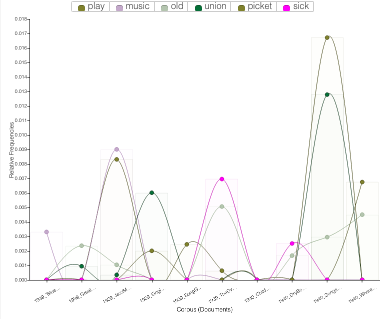
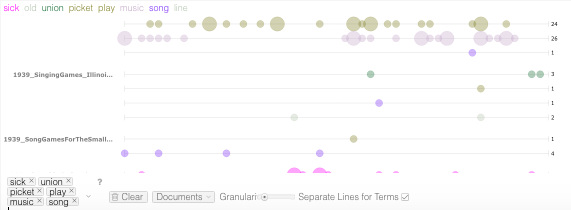
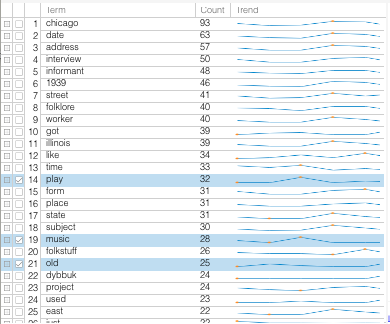
So, having uploaded my own miniature corpus of FWP sources, I began looking up keywords. Some of the suggested terms, ranked by their prevalence throughout the documents provided (and which were not merely derived from the standard headings of each), were: play, union, picket, music, sick, and old. I think that these key words give an interesting summary of the topics, but also of the themes at play in the city. The sources which I compiled covered a variety of subjects, all centered in Depression Era Chicago. From my close readings as I looked deeper into the prevalence of these key words, I learned that during this period, there was a strong push for unionization and workers rights. A surprisingly large percentage of the recorded children’s songs—mostly sung while playing jumprope games or other similar activities in the schoolyard—referenced parents working in factories or organizing picket lines, indicating the reach and social upheaval of the workers’ protests of the time. According to other sources, which recounted the folklore of various pockets of Chicago’s community, illness and disease were also prevalent during this time. In some Jewish communities, it was believed that these illnesses were caused and spread by an entity called a “Dybbuk,” yet it is noted that the Dybbuk only attaches itself to Jewish people, and that the illnesses did spread elsewhere as well. Finally, the last key word that struck me was music. Beyond the song games of Chicago children at the time, there were also multiple sources in this collection which discussed jazz and blues music, suggesting an uptick in their importance and popularity in the city. Especially where the blues genre is concerned, music provided an artistic outlet and an escape from the hardships of daily life, in a context which was not only heavily impacted by the Depression itself, but was also undergoing radical social changes and demonstrations in terms of its industrially-based economic. 

Overall, I felt like this tool was incredibly useful in helping me visualize and articulate my exploration of my historical question. The various ways that key word prevalence was displayed helped me find common threads throughout the majority of my compiled sources, and isolate core themes of the time. Ultimately, I was not surprised by what I found through this tool. The commonalities presented through the charts, lists, and graphs were similar to those that I had noticed while converting, compiling, and close-reading my files in Part I, however the tool greatly helped me understand which points called for the most focus, and how things overlapped. It is a great visual tool for those who, like myself, need a visual representation of the information in addition to written notes.

My final note on my historical question is this: The folklore and music of New Deal Era Chicago is home to a wealth of information. These sources provide us with incredible commentary on political issues, community health, and forms of escapism, even in the places we would least expect, such as the children’s jump rope rhymes. Combined together, this collection paints a vivid, albeit austere, portrait of Chicago between 1939-1941, and allows for a more personal view of the state of the city. The interview and observation based sources effectively capture glimpses of daily life, in a way that formal histories may fail, and because of this I will close with the argument that folklore and song serve a vital purpose in shaping our understanding of a culture, from city to civilization.
(Please note: I’m still having trouble figuring out how to make footnotes, but I promise I am trying)

Works Cited:

Posner, Miriam. “Miriamposner/Voyant-Workshop.” GitHub, github.com/miriamposner/voyant-workshop/blob/master/investigating-texts-with-voyant.md.

American Life Histories: Manuscripts from the Federal Writers’ Project, 1936-1940  :  Digital Collections  :  Library of Congress.” The Library of Congress, www.loc.gov/collections/federal-writers-project/about-this-collection/.
The Lack of Republican Party Criticism

When beginning, my question was this: “What were the major criticisms of the FWP from the Republican side?” This, seemingly at the time, was a good question to ask. It is always interesting to ask, “well what are the counter argumetns to this?” However, I quickly came to realize that while there were going to be detractors and flaws to a government program as always. They may not be coming from the conservatives or Republican Party of the time. I had made a lapse in my knowledge and had forgotten that the Republican Party at the time had actually been going through a switch, much like the Democrat party. This error came when trying to do research for this in Voyant. Overtime I simply could not find anything that had to do with any criticism from the Republican Party.

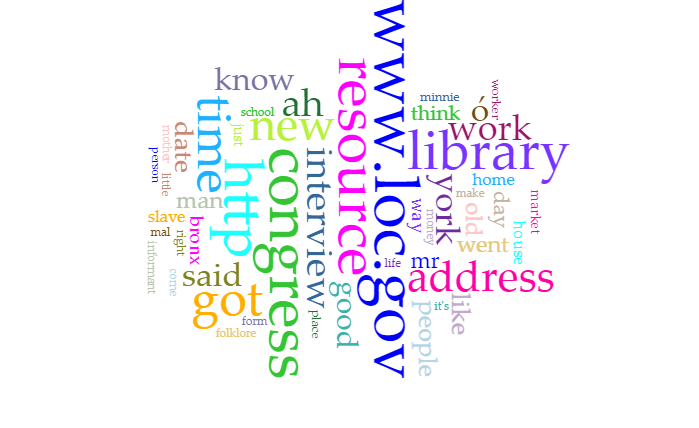
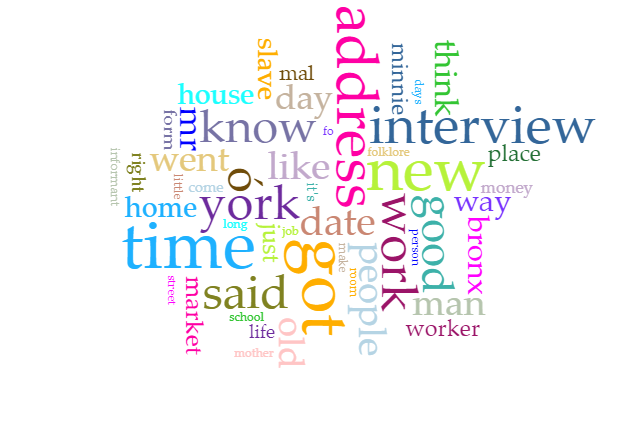
At first in trying to find some form of criticism I first tried to limit the words that were used using the “stopwords” tool in order to narrow the search. However, ultimately my search came up with nothing. Some of the words that I black listed are what one might expect. As shown in the “before-after” image many of the original words in the first corpus needed to black listed as they were simply not useful or were redundant.

Before
After

It must also be noted that when selecting the sources, I specifically choose sources that had an inherent problem. Sources that perhaps described something going wrong or something negatively. I believed that in these sources there could have been someone who was a supporter of the Republican Party and thus could have stated some negative opinion in the programs. The first 10 sources that I submitted did not “work.” Meaning that I initially thought the reason I was unable to find any Republican criticism was due to my 10 simply not having any. As a result, I created a “Final Corpus” which used some from the original ten that had negative insight and some new ones that I had not previously been exposed to.

In end, I used a distant reading method to first find some criticism on programs 1. Then, I moved into a close reading method in order to analyze that source. However, while there was some criticism in the source there was nothing to indicate it was coming from a republican ideology. Despite not finding something relating to the question I posed, without the tools of black/white listing it is likely I would not have been able to find any criticism. Due to the size of the corpus close reading would not truly bring good analysis on these sources while using close reading would not be feasible. So, by using the Voyant Tools as an in-between (to close and distant reading) I reached a goal of finding some criticism.

As I was getting ready to revise my original question in favor of a new one, I began to understand why there was no Republican criticism. The party had actually began to switch its sides just as the Democrats did. I had actually previously known about this switch but had mistakenly thought it had occurred quickly after the civil war

2

. With this, by complete accident, I had uncovered something quite interesting. Perhaps the reason that I could not find much information on the Republican Party criticism was simply because there wasn’t any, at least not in this. The reason for this being is that maybe the Republican party may not have actually truly disagreed with what the Democrats were doing 3. Of course, there will always be disagreement simply for the sake of disagreement between political parties. But, due to there being little to zero Republican criticisms in these documents shows that they might not have %100 disagreed with what F.D.R was doing.

Without the Voyant Tools, none of this understanding would be possible. Distant reading was far to broad and close reading was too specific. Voyant tools helped me find an in-between point where I could both look at all the documents I had selected and analyze them.

Text Analysis

The Federal Writers’ project was a way for white Americans to document the experiences of others during the Great Depression. This created more jobs and historical documentation of the Great Depression through the lens on many Americans. The texts I chose for my text analysis project were based on Latino immigration. While reading a A Cultural History of the Federal Writers’ Project by Jerrold Hirsch I came across a quote on immigration that says “Only after World War II was immigration apotheosized as quintessential part of the American experience. Historian Oscar Handlin argued ‘Once I thought to write about the history of immigrants in America. Then I discovered the immigrants were American History”4 This quote is a great example on how the Federal Writers’ Project spread through different states and gathered distinctions/similarities of Americans.

My historical question was composed from the quote by Hirsch “How did Immigrants experience life in America during the Great Depression? What do their experiences teach us about America during this time period?”. My assumptions about the life of immigrants during the Great Depression became one that included starvation and poverty. An example of immigration hardships and decline can be found is in the American Yawp “1930 to 1940 the Mexican-born population living in Arizona, California, New Mexico, and Texas fell from 616,998 to 377,433. with jobs suddenly scarce, hostile attitudes intensified, and official policies less than welcoming, immigration plummeted and deportations rose. Over the course of the Depression, more people left the United States than entered it.” 5 While choosing text files, I noticed a pattern of immigrants who had a great come up and then transitioned into struggle during the Great Depression. Regions like Florida and New York had immigrants who worked in factories and were able to purchase multiple properties. However, when Depression hit America, many were faced with the reality that their only options were to try and make ends meet or go back to their countries.

Uploading the class Corpus to Voyant was easy but I refrained from having any specific assumptions on my findings since I knew my classmates historical questions varied from mine. However after it was uploaded, I was fascinated by being able to look at topics aside from my own. It is a great visualization of what others were discussing in this time frame. The set statistics demonstrate important commonly used words, a map of places discussed in the texts and a number of unique words. I used the map tool called Dreamscape, which shows the most commonly listed areas in the documents. This also included places I had used in my text files search. The cirrus tool contains an array of words that also correlate to words I had seen in my texts. Overall, this was a great way to analyze texts and generate more ideas by being able to play with different aspects of the text. This also made me conclude that immigrants journey is only slightly different than Americans during the Great Depression and that their experiences are more similar than different.

Exploring Text Analysis – Christina O’Farrell

The historical question that I was aiming to answer was, “What was it like to be an immigrant in the United States, and what kind of jobs did they have?”. The assumptions I had regarding this question was that it probably wasn’t a super easy adjustment and that immigrants took on “odd jobs”.

I searched “immigrant” and “immigration” when I was trying to find sources for my question. I would look at the “Subject Headings” before opening the PDF and I would look to see if any specific countries were part of the subject headings, which they usually were, along with the word “immigration”. I knew once I found those two headings listed, that it was a good document for me to read and possibly download.

My experience using Voyant Tools was a bit overwhelming at first. When I first uploaded my corpus, it was a bit overwhelming to see the five different displays that popped up on the screen. However, I found that the “cirrus” display which showed the most popular words in the corpus, was very useful. I liked being able to see what words are repeated the most because it gives anyone a general idea of what the document will entail. The best way to describe Voyant is the way Miriam Posner described it. 6 The corpus I chose to upload and explore were ones that were about immigrants. There was about 12 files within it. Many of the ones I uploaded were people who were of Latino/Hispanic descent and I was able to identify that by looking at the last names. I’m Hispanic, myself, so looking for Hispanic surnames in the .txt file name wasn’t too difficult.

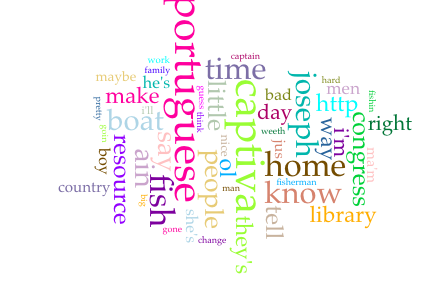
My assumptions changed a good amount by using these text analysis tools. I stated that I figured the immigrants had “odd jobs” when they arrived in the United States, but by using the text analysis tools, many of the reoccurring words on the “cirrus” display proved differently. One example was that one document was about a man named Joseph Captiva, from Havana, and he was a fisherman in Massachusetts 7 Just by using the Voyant Tools, I was able to disprove an assumption I had, which I believe is pretty helpful. Pairing my findings with other reading helped me to contextualize these ideas that I had found.

Joseph Captiva from Havana “cirrus” display.

Final conclusions I made about my historical question was that some immigrants when they came to the States during the late 1800s-1930s were able to acquire somewhat normal jobs. Their families were able to adapt well and refer to the U.S. as their home. I found the word “home” used quite often by using Voyant tools, which is another important thing to point out. Text analysis is a very useful tool that I plan to use again, especially if I’m doing any kind of research project. I think close reading is a lot easier to do versus distant reading, but distant reading requires less time. I view distant reading as “skimming” through stuff, which most people have done before. This assignment definitely helped me to learn useful ways to go over a document.

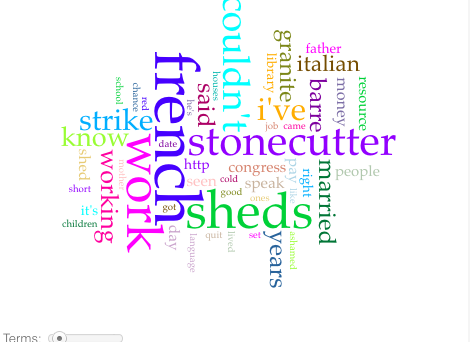
French stonecutter with Italian father’s “cirrus” display.

References

Banks, Ann. “American Life Histories: Manuscripts from the Federal Writers’ Project, 1936 to 1940, Introduction.” Library Of Congress, 1980. https://www.loc.gov/collections/federal-writers-project/articles-and-essays/introduction/

Posner, Miriam. “Investigating texts with Voyant.” Voyant Workshop, 2019. https://github.com/miriamposner/voyant-workshop/blob/master/investigating-texts-with-voyant.md

Depictions of African Americans in the Federal Writers Project

My historical question focused on how the Federal Writer’s Project depicted the experience and culture of African Americans during the 1930s. How did the Federal Writers Project depict African Americans? I did not go into this assignment with any specific ideas regarding the question, but I had two possible trains of thoughts. Both depended on the interview subjects that were chosen as part of the Federal Writer Project. I thought that non-white subjects would discuss a more realistic view of African Americans, with a focus on the specific hardships that were endured. I thought that white subjects may have a different depiction. They may focus more on the cultural and folk contributions of African Americans at the time. Especially regarding the construction of identity in the Southern United States, I thought that there could be a great deal of disparity, with some sources focusing on the dialect and culture, with others discussing the continued oppression experienced by African Americans8 .

Together, the ideas and depictions provided by the different interview subjects would start to build a fuller picture regarding depictions of African Americans in the United States during this time.

For the sources that I contributed to the class’s corpus, I searched for interviews that discussed famous African Americans of the period, such as Langston Hughes, Louis Armstrong, and Jesse Owens. Based on previous readings, I understood the role that culture, escapism, and transportation played during the Great Depression9. It was likely that many of these people may choose to speak about some of the iconic figures of the day as opposed to the negatives of their own life.

I was particularly drawn to the visualization tools that linked and emphasized particular words within the corpus. For example, the word cloud option provided a practical overview of some of the more common themes present within the texts.

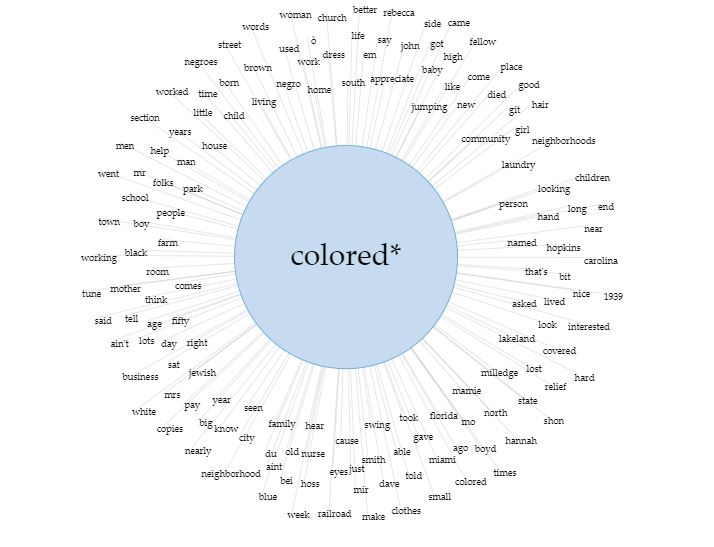
However, this tool is just an overview, and doesn’t show any connections between particular ideas or themes, which is a necessity for my question. So, I used the link tool to observe the common words associated with words such as “negro,” “black,” and “colored.” With the use of these three terms in conjunction, I was able to see some of the more interesting concepts associated with African Americans in the time period.

Many of the links focused on locations, of where different people were centered. While there were links to folklore, culture, and dialect as I expected, I was surprised to see a connection to workers, audience, and the like. With links to the word black, I received the adjective as opposed to the ethnicity, but I was surprised some of the negative and derogatory terms attached to it, such as the n-word, “sonofabitch,” and “bastard.” Without further close reading, its unclear whether these instances are individuals describing the words that were used against them, or something else.

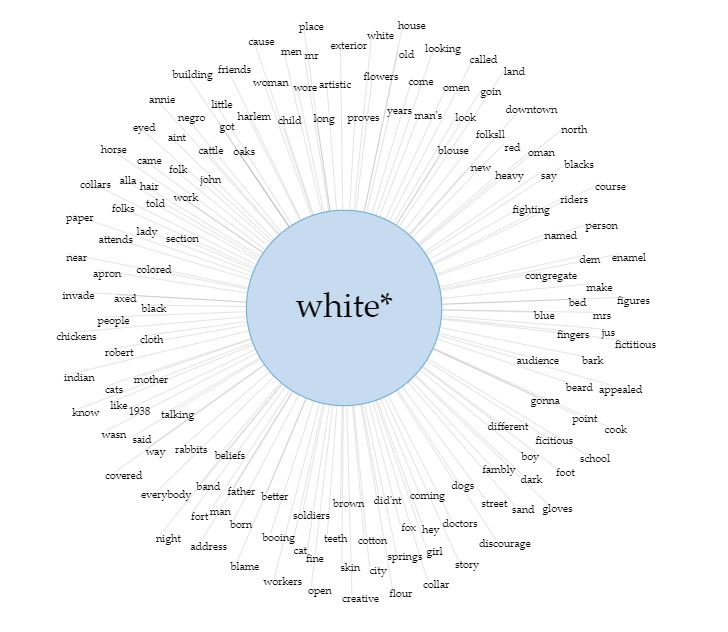
For reference, I also looked at the links for “white,” in an attempt to better understand how white people were better depicted in the project.

I thought it was interested to see the tone of words that were associated with white people, such as “appealed,” “discouraged,” “creatives,” and “friends.” The role of white people in the interviews appears different than African Americans.

The tools helped me to determine that there were a number of ways that African Americans were depicted in the Federal Writers Project. They were shown as audience members, hard workers, mothers, fathers, and children, in addition to bastards or other derogatory terms. This is likely in line with how people of color existed in the 1930s. While they attempted to continue their existence during the economic downturn, they were still faced with prejudice and racist attitudes.

Distant Reading

The American Life Histories collection, created under the Federal Writer’s Project, serves as a broad corpus of information and firsthand accounts from a time that seems so incredibly different from now. Many questions and ideas can be created when examining the life histories included in the American Life Histories collection.

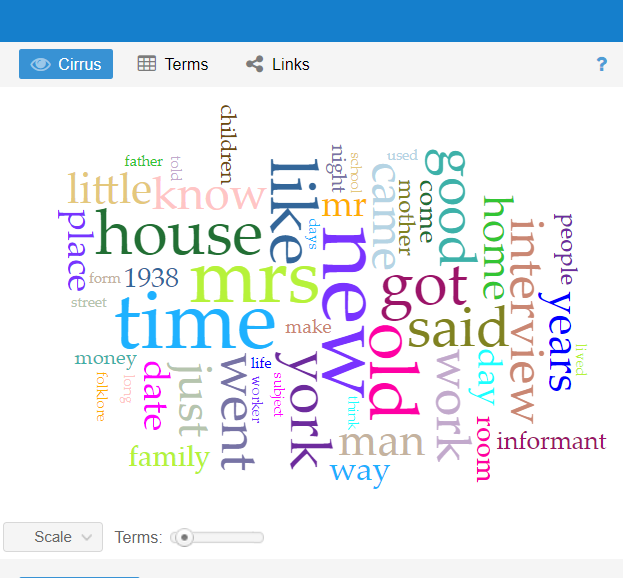
            While my initial question of “How did the New Deal era effect dating and social customs?” worked for my own ten document corpus that I assembled, it didn’t work as well with the classroom one. I made folders on my laptop for four different years that many of the documents were created in and then ultimately decided on the documents created in the year 1938. From there I input that into Voyant and noticed the major words in the word cloud were: 1- the website for the library of congress and 2- resources. Both which I new weren’t words actually important to the content of the document, so I added them to the list of words to be ignored. Upon analyzing the generated word cloud from the 1938 documents, I noticed there was a sort of family and home life theme.

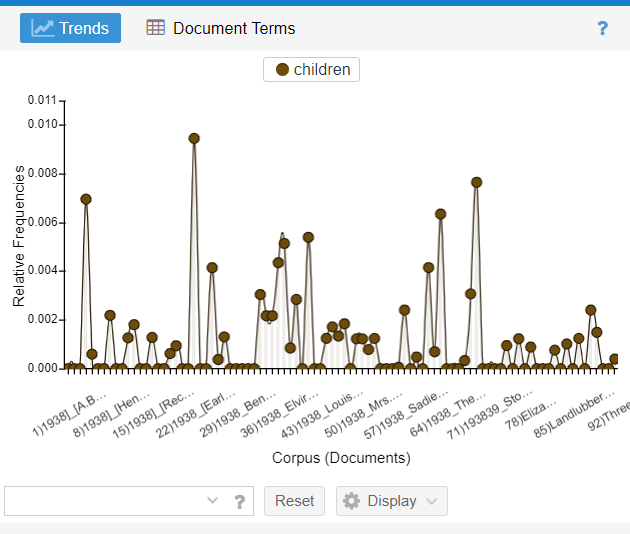
Words such as house, room, Mrs., and family appeared multiple times, thus I thought it would be better to shift my focus to that and changed my historical question to “How did the Great Depression era effect family and home life?”. While classroom lectures had briefly touched on family life during the Dust Bowl and we read about how said families had to move to different places with kids in wagons, as mentioned in 10, there wasn’t an entire lesson focused on how family life changed because of the social and economic factors of the time. In the American Yawp – Chapter V. 11, there is mention of a particular woman’s letter to the first lady about her fear and sadness of bringing a baby into the world they were in at the time (the time of the Great Depression). Both of these came to mind when I was doing a close reading of the document titled Early Railroad Travel, where a father described how he moved his kids from Kansas to Oregon. By doing a closer reading on one of the included documents in the corpus, I was able to conclude that one way families were effected was by the fact that many had to move around for work opportunities. In this way, Voyant was extremely helpful because I was able to pick the specific document because I noticed it was the one that used the word “children” the most.

In conclusion, there’s obviously more research and evaluation that can be done using voyant (and in general) of the corpus. Voyant proved itself to be extremely useful in both a distant and close reading sense. By using Voyant, I was able to draw certain conclusions regarding my own historical question, and I will be utilizing this resource for future projects.

Special Collections Archives

First, the Special Collections archive is a major resource that allows us to explore many different histories including the Federal Theater Project, our school, and the New Deal Era. The archive is very significant and important for scholars because it groups many important artifacts and information into the same place. This allows scholars to be able to easily find what they are looking for. Also, it allows for scholars and even the general public to easily find tons of information about their topic. For example, if a digital historian was looking for artifacts relating to Theater and arts during the New Deal Era, then they would just have to search Federal Theater Project and all of the information would be at their fingertips. Also, the Special Collections allows people to decide whether they want to digitally find artifacts and information or do they want to physically go and feel artifacts and learn that way. For the general public, the archive serves as an extra reminder of our history and our country’s history. Also, they can use the archive as a secondary source when they can’t find any other information or place to go.

The main thing that archivists must use to decide whether to digitize an artifact is how would the artifact appear to the user, if digitized. They must discuss multiple different things to decide if an artifact should be digitized including texture, weight, appearance, and quality etc.12It’s important to realize that archivists make sure the user will be able to understand what the artifact is based off the photo. For example, I dealt with the print press stamp during our Special Collections class and the texture on these is very unique. You can’t feel the ridges or understand how the paint/toner had to be packed into these stamps because of how deep the ridges and spaces are. Also, some of the stamps can only be seen and understood under certain angles of light, which would be extremely hard to show in a photo and would therefore not benefit to digitize. From our speaker, I learned that archivists mainly digitize photos because these are easy to see digitally and they try to keep away from digitizing objects because of all the extra factors that you use when digitizing a 3D artifact. 

My understanding of the Federal Theater Project has changed drastically after looking at the materials in class. I realize the true effect this federal project had on so many lives. The government was able to put people back to work doing something they love, such as acting, and also gave normal citizens a cheap play they could see. 13 This project was able to bring people together for a short period of time over a comedy or tragedy of some sorts. Also, I understood how this project gave more than just actors jobs. For example, now writers are able to write articles in the newspaper about the show and critics are able to give their opinions as well. Also, marketing people are able to make flyers and promo for the plays. The project seemed to be beneficial for many people. 

Aviation & the Great Depression

On our first lecture day, Professor Dauterive informed our class that we would be given the freedom to study whatever subject interested us, so long as it was done within the context of the 1930s and the Great Depression. Upon hearing this news, my mind immediately began to race to find a subject that fascinated me, and I was quick to discover it – aviation.

For this assignment, I decided to explore the world of aviation during the Great Depression and ask myself the following questions: What impediments were there to pilots during this time period, and how did pilots manage to find employment in the face of these obstacles?

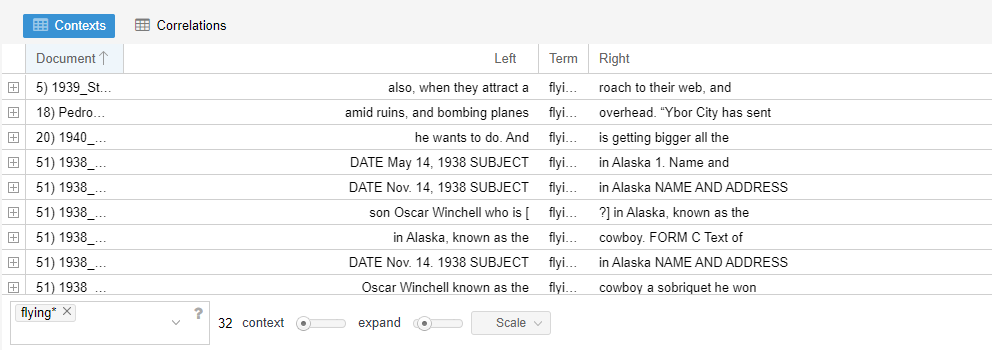
To answer these questions, I began by first deciding upon my corpus. Because the subject of aviation is relatively niche, I thought it best to employ all of the documents uploaded by our class and available in our course’s Dropbox. Following this, I began to search for words related to aviation such as flying and pilot and reading excerpts from the texts in which they were found.

In her essay, Race and Place: Dialect and the Construction of Southern Identity in the Ex-Slave Narratives, Lauren Tilton used topic modeling – the categorizing of words based on their frequent associations with one another – to begin asking questions about common topics within the Ex-Slave Narratives.14 Because I did not have access to a topic modeling program, I had to do categorize my subjects manually.

After reading reading through a number of these excerpts, I was able to determine a number of terms that were commonly associated with aviation during this time period such as teaching, stunt, passenger, and mail. After obtaining these key words, I inserted them into a table to see if I had missed any texts that relate to careers in aviation and its problems.

Having finished this process, I was able to come to several conclusions concerning my initial research questions. To answer my first question, I found that maintaining an airplane for personal use was quite an expensive undertaking, and with the start of the Great Depression, people had less time to fly as a recreation. Additionally, the construction of airports was halted by many communities who feared planes that planes would malfunction and crash into their homes and businesses.

However, there were some occupations which pilots could hold during this period. The most common were serving as a mail carriers, passenger pilots, and flight instructors. The least common job that a pilot held was as a stuntman.

Although this project required a number of days to complete, the task would have been nearly impossible without Voyant Tools. Because this application allowed me to search for key words across my entire corpus and read closely texts relating to my subject of interest, I was able to not only learn about a subject that interested me but do it within a reasonable time frame.

Special Collections Research Center- A great Resource

The experience today with the Special Collections Research Center at GMU was awesome. As a budding archivist it was great to how other archives handle their collections. Most of the rules outlined on the policy page 15 were what I have experienced in other archival centers. I was impressed with the wide range of materials that they had for the Federal Theatre Project. Being able to interact with the puppet and the “Dark Coat” was interesting and enjoyable.

It was interesting when Brittany described the decision process for digitization, seeing that they had a “top ten list” was genius! Her description of reasons for digitizing certain items was informative. I had only considered accessibility as a reason to digitize documents. But her statement about a documents stability as a deciding factor was interesting. If the document is physically compromised, but it’s contents are invaluable then digitizing it is a way to maintain that information for future.

Archives are a fantastic resource for university students and the general public alike. They are the repositories of information that could otherwise be lost. It was interesting that she mentioned the political reasons that some collections are part of the GMU Library collection. My personal experience with archives has been in the public sphere, dealing with publicly owned government records, but in considering private collections I have new questions. Her mentioning of being obligated to accept a collection because of a monetary donation fascinated me. I am of the thought that most collections are inherently valuable. She seemed to imply that some of these collections are unwanted or burdensome for the SCRC. I found that interesting, but reading the conversation between Thomas Padilla and Elvia Arroyo-Ramirez “Bias, Perception, and Archival Praxis” I understand that there is another side of archives. In this conversation Arroyo- Ramirez discusses that there is a sense of bias in collections. She states that scholars are discussing “issues of power, representation, and accountability by challenging the existing canon of archival neutrality and objectivity; speaking on colonialism, apartheid, and transitional democracies and their relationships to record keeping; and connecting these challenges to current archival practices.” 16 I have always considered archives to be neutral, but I understand how accepting collections only from certain people or groups they could be bias. If the documents collected only pertain or describe one side of history then they are not in fact neutral.

That is something that I think is really special about the Library of Congress Slave 17 narratives. These are stories from the other side of history, the often underrepresented stories. It is important for that history to be preserved alongside of the nations history.

Through our discussions about the Federal Theater Project this week I realized how much social politics affected the New Deal projects. I had the impression that they were all welcomed and celebrated for having put artists back to work in the economic crisis. It was fascinating to see that that was not the case. Our group examined the programs for the Children’s Theater’s production of “The Revolt of the Beavers” which we had previously learned was associated with communism and helped to fuel tensions for the FTP. It was really interesting to see these documents in person.

Gang Life of the 1930s

Underground markets and economies have interested me throughout my academic career at George Mason University. I believe that gangs and other black markets have a lot to offer when it comes to a society’s norms and cultures. Gangs represent the misfits of society and specifically during the 1930s people have chosen the gang life due to the economic circumstances created by the Great Depression.

I chose these ten sources from the Library of Congress under the tabs of gang and crime. I chose these two tabs because I felt that they best represented my original historical question: What was gang life like during the 1930s? I found that a lot of the stories were just that, stories. It was difficult to find original transcripts from members of the gangs but a combination of folklore as well as first hand accounts provide an image of how gangs interacted with society.

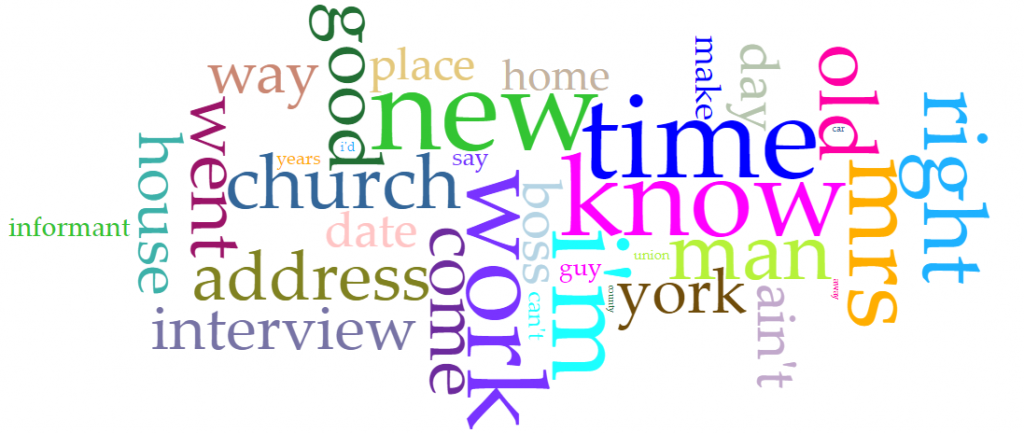
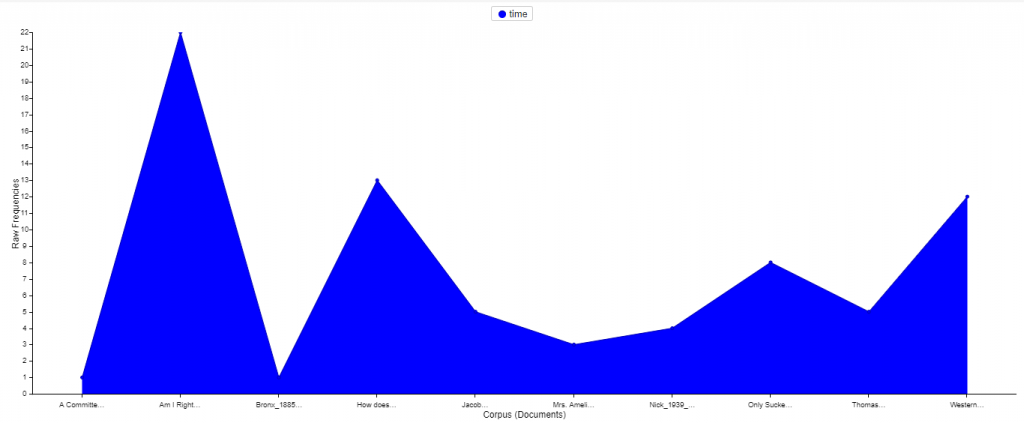
Voyant tools allowed me to understand what common themes occurred in the gangs of the time. While the cirrus above shows the separate terms “new” and “york”, New York was a recurring location that was relevant to the interviews and stories. New York gang life began in the 1920s and 1930s as way to put money into the member’s pockets but also it was merely a hobby for some but not most 18. I chose not to use our class’ corpus files with the location of New York because New York hosts many different cultures and story which may have skewed the results of my voyant tools. For the second chart I chose to focus on the word “time.” Time is a word the continues to pop up in each of the articles, some more than others. The theme here shows that the interviewees had a lot of time on their hands due to the economic turmoil that the country was facing. Because the citizens had so much time, these articles speak to the reality that they may have joined their gangs to pass the time as mentioned earlier where we discussed that gang life was also a hobby for some.

My expectations of the members of the gangs was to show that members join for financial gain. I was not totally wrong in finding this however I was surprised to know that people joined gangs for a sense of community but to also spend their time. The American Yawp’s section III addresses the economic turmoil that specifically hit New York which led to many citizens being out of work19. I concluded that some of these individuals had no where else to turn for money other than gang life. Engaging with the articles in close and distant reading practices allowed me to see overarching themes for my historical question but the close reading specifically allowed me to see how a vague word like “time” can shed light on the reality that people may have used boredom as an excuse for a life of crime.

css.php