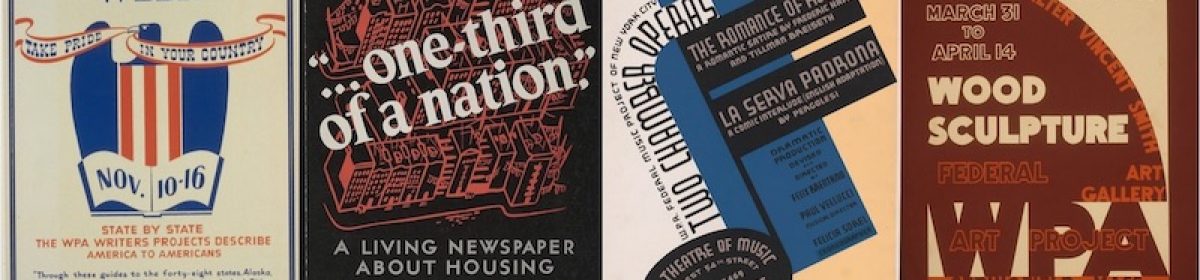
The 1930s were marked by a multitude of struggles for America and its people, but perhaps one of the most all-encompassing was the question of what it now meant to be an American. It was certainly much harder to sell the former American identity of prosperity and success that marked the industry of the Gilded Age and the 1920s when a grand majority of the country’s working class was now facing unemployment, homelessness, and even starvation. Environmental disasters such as the Dust Bowl, stacked on top of often total financial loss, only exacerbated the desperation of the decade as “farms literally dried up and blew away”[1] with the old promises of the American Dream. The solution of turning to the arts, via government programs such as the Federal Music Project, helped to craft a narrative that still resonates in American society today – taking such hardships and rebranding what came of them as the fruit of American culture.
Take the FMP’s extensive efforts to record the folk music of the decade. The very nature of “folk” music, regardless of the discourse that later arose over what qualified, necessitated looking to the rural populations of America – in particular, to the large groups of migrant workers who were striking out west with their families in hopes of better fortunes. It might have been unintentional, but this undertaking still helped to prove how many different cultures formed together to make “American” folk culture. Many of the songs and instrumentations that were recorded as such, in actuality traced their roots back to listen genres that were brought to America by immigrants. Even the most straightforward “folk” music, thought of today to be the earliest predecessor of the “all-American genre” that is contemporary country music, shared many stylistic similarities with the rhythm-and-blues music that evolved from the work songs listenof enslaved African Americans.
In a sense, this did help to prove the FMP’s ideal that “all of this music belongs to the nation”[2]. But it also raises the issue of appropriation – because of this music’s source diversity, is it truly accurate to lump all of it together under a label as broad as “American”? And who has the right to decide what art belongs to a nation that continues to often reject said art’s human creators?
Sources Cited:
[1] Bindas, Kenneth J. All of This Music Belongs to the Nation: the Federal Music Project of the WPA and American Cultural Nationalism, 1935-1939. UMI, 1989.
[2] “The Migrant Experience : Articles and Essays : Voices from the Dust Bowl: the Charles L. Todd and Robert Sonkin Migrant Worker Collection, 1940-1941 : Digital Collections : Library of Congress.” The Library of Congress, https://www.loc.gov/collections/todd-and-sonkin-migrant-workers-from-1940-to-1941/articles-and-essays/the-migrant-experience/.
[3] “The Dark cloud and a Caucasian folk song”, American Folklife Center, Library of Congress, https://www.loc.gov/item/2017702005/
[4] “We Hab a Jest Gawd”, American Folklife Center, Library of Congress, https://www.loc.gov/item/flwpa000069/
