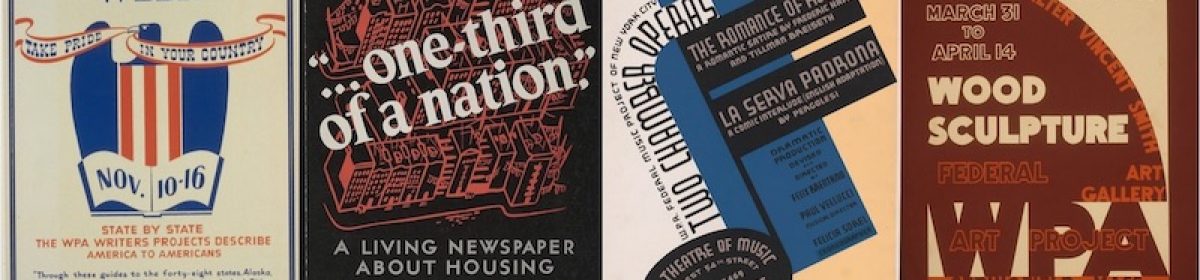
As this was a very early time for civil rights the Long Civil Rights Movement is a movement brought up in Jennifer Lynn Ritterhouse’s book Discovering the South: One Man’s Travels Through a Changing America in the 1930s 1 that states that while the civil rights movement was at its peak in the 1960s the LCRM can be considered a sort of pre curser to that. What the LCRM did was simply layout the foundation for what was considered the height of the civil rights as well as modern civil rights movements. During the 1930s there was a push for a cultural lift in the United States spear headed by people like Harry Hopkins as well as The New Deal on FDR’s part. However, as discussed in The Living New Deal’s Working Together 2 the New Deal failed to address the hardships of minorities in during the Depression Era and in some ways even heightened the hardships. Therefore, movements like The Popular Front and the LCRM are mostly credited with the advancement of civil rights during the 1930’s. There simply weren’t many things that the U.S. Government was doing for the advancement of minorities. People like W.E.B De Bu Bois, Jane Adams and Marcus Garvey are essentially the first step of the 1960s civil rights explosion and that of modern times. Some contributions such as the books and papers that were written or physical organizations like the NAACP are still at the forefront of civil rights. Also, while they may not have lasted as long, things like Jane Adams’ Hull House 3 were at the time some of the best advancements for class injustice as well as other civil rights issues. With these movements and organizations, the central idea was for basic racial, class, and many other forms of equality. Also, as discussed in The American Yawp
4the central message was to give the people clearly being discriminated against some form of control in their government. The example given in the book states that even though the heavily African American community of agricultural workers still had to pay taxes they would not receive the benefits of the Social Security Act. The reason for this being that “…(white southern lawmakers were) afraid that economic security would allow black southerners to escape the cycle of poverty that kept them tied to the land as cheap, exploitable farm laborers…” 5. This clearly was wrong and many of the civil rights leaders of the time vouched for some representation as many white southern lawmakers only advocated for discrimination.
In many ways this has not changed today with other issues that are at the forefront of politics. The way that many people saw the treatment of African Americans in the 1930s specifically regarding the Social Security Act is largely the same when regarding biased and unfair algorithms today. Much like the little control the African Americans had over their right to social security many today argue that there is too little understanding of what happens inside of an algorithm. This, much like the little representation in social security, results in zero control over large part of the algorithm
6. Overall while people think that algorithms are something that is unbiased it has been shown that many can give unintentional bias or even intentional. It has been exposed that many of the algorithms that can decide very crucial things in people’s lives are unreachable in how they are made. This results in people not actually knowing how or why they were denied insurance, for example 7. One example that has recently plagued many early detection police algorithms has to do with African American crime rate. Obviously African American are not more likely to commit murder. However, due to the statistic of African Americans making up 13% of the population while making up 50% of all homicides in the United States many algorithms have mistakenly understood this as “African American are more likely to commit crim.” Clearly this is not the case, this is a biased and bigoted thought but because the algorithm only sees the statistic it has been known to sort of “let go” of other races. This clearly is a problem and many situations like this is what has caused many activists to call for access to these crucial algorithms. The lack of access and thus lack of control has proven to be a problem time and time again and thus needs to be addressed in the future.
- Jennifer Lynn Ritterhouse “Discovering the South: One Man’s Travels Through a Changing America in the 1930s” (2017) UNC Press Books
- The Living New Deal “Working Together” (2019) University of California
- Jane Adams Hull-House Museum “About Jane Adams and Hull-House” (2019)
- Ben Wright, Joseph L. Locke “The American Yawp” (2019) Stanford
University Press - The American Yawp, 2019, Chapter 23 part XII
- Cathy O’Neil “The Truth About Algorithms” (2018) Nice Shit
Studio - Louise Matsakis “What Does a Fair Algorithm Actually Look Like” (2018) WIRED
