George Johnson and Jefferson Davis

George Johnson had the unique experience of being owned by Jefferson Davis and his family. 1Jefferson Davis was the President of the Confederate States of America, elected in 1861, and a fierce opponent of abolition and a supporter of states rights. With this reputation, I found it interesting that Mr. Johnson described him as a fair, even kind at times, owner. His experience is very different than the norm. The only incident he recounts that even hints at violence against a slave, is the story of a young boy who was having trouble keeping up with the rest of the group while hoeing a line. The foreman wanted to whip him, but the boy ran to Jefferson Davis and informed him of the incident. Jefferson Davis sent the boy to get breakfast, and fired the foreman.2And even though Mr. Johnson had been free for almost 80 years at the time of the interview, he still referred to his former master as Master Jeff, and spoke highly of him. I’m not sure that I’ve ever encountered this attitude towards a former master in the accounts of freed slaves I’ve read.

The two timeline layers intersect in 1860, when Lincoln was elected, and in 1941 when the interview was conducted. I included the end of the Civil War in 1865 as more context, even though Mr. Johnson didn’t explicitly mention any events in 1865. History is often tracked through a military lens. Lincoln’s election was a triggering event in the Civil War, the Civil War ended in 1865, and the United States entered World War II in 1941. Personal histories are tracked in a more specialized and day to day way, whereas the most common lens for wider histories is the so called “Great Man” lens. I was surprised Mr. Johnson didn’t talk about emancipation, or about the actual Civil War itself, as he was a young boy during those years. The interview itself was highly interesting, and if one were writing about the formation of towns and communities of color following the Civil War, it would be highly useful. Oral histories are often hard to track, especially if they’re oral tradition, or stories passed down for years. I think if they’re like this interview, a personal history being told by the subject themselves, and they’re recorded, oral histories can be beyond useful. It may be difficult to track timelines though, without the inclusion of specific dates. I had some trouble with this.

Mr. Johnson’s voice is very clear, and he doesn’t seem to need much prompting. He knows exactly what he wants to say, and the interviewers don’t need to interject much, and don’t interject much. They occasionally ask clarifying questions, but mostly just let Mr. Johnson speak. There are a few “uh huhs” interjected, but it’s mostly just a recording of Mr. Johnson talking about his life. It’s really interesting and feels very natural, like they’re just recording a conversation. I think that in the 1930’s and early 1940’s, historians realized that they needed to record the voices of these men and women who have lived through a truly insane portion of American history. Not only were these men and women born as slaves, but they lived to see slavery outlawed, the end of the Civil War, World War I, and in the case of some of them, World War II. I’m very glad they did. Weight is given to these histories when you hear them straight from the people who lived them.
https://cdn.knightlab.com/libs/timeline3/latest/embed/index.html?source=11QyV47oBzDHgwOhTYed5Ec5dvnZlBLaDUvG3McqAoIw&font=Default&lang=en&initial_zoom=2&height=650

Fountain Hughes Interview: Blog Post #5

I came into this with the question: What is the transition from a slave to a free citizen like? Fountain Hughes is a Charlottesville, Virginia born slave who was birthed by Mary Hughes on May 10th, 1948. He worked at the Monticello farm with his mother, and brother. He states mentions that his grandfather “belonged” to Thomas Jefferson and his master would treat him and the other slaves well. However, Hughes’ experience tells a different story. They were not given shoes until age 13, they had no rest or break during work; they would work through sickness, fatigue, and malnourishment. He often references his treatment to that of a dog. “If I was to be put back into slavery now, I would take a gun and end it myself.” He said when speaking about the experience. Although Fountain talks about how drastically his life changed once he was free, it was not an easy transition. He mentions that the first couple weeks of freedom he and his brother had no place to go, no place to sleep, and nothing to eat; they had nothing nor a clue of what to do. Their first couple weeks of freedom they would just find any random car in any random spot and if it was unlocked, they had a place to sleep. Luckily their mother, Mary Hughes, had a home in Baltimore where she allowed them to stay but had to pay rent. At first I thought there was no way they would be able to afford it with the eventual $1.00 a day wages, but the rent was so cheap their mother only requested $1 a month from each of them (which is equal to about $10.00 today. I could not find any corresponding stories in our readings however, the reading in this ling describes his life on the Monticello property, as well as his family history, and other stories from slaves that have had similar backgrounds and situations as he did. ( https://www.monticello.org/getting-word/people/fountain-hughes ) 3

My timeline ( file:///Users/dandami4gmail.com/Downloads/Fountain%20Hughes%20Timeline%20(1)/od1.html ) puts all of his most cherished and valuable memories into chronological order. This interview helped me answer my question because he talks about the horrors of slavery and how it helped shape him as a free citizen. I love how he initially talks about how he never takes handouts, never asks for a loan, and never pays with credit. He prides himself on a lifetime of “If I want this item, I will work and pay for it in cash once I have the money.” He is humble, smart, hardworking, and kind. He holds no debt, once he was free due to the abolishment of slavery in 1964, he worked and made a living. I thought this interview gave good insight on how different life is now versus the 1800s. The interview was also interesting because it was made in 1949 so the quality of the audio was almost impossible to understand. His story puts into perspective how life is meant to be cherished and to be grateful for the things you have.

Blog Post #5: Fountain Hughes

Timeline:

http://timeline.knightlab.com/#preview-embed

I chose to do my timeline on a gentleman named Fountain Hughes. He was born into slavery, both of his parents were slaves to Thomas Jefferson up unto his death. Mr. Hughes talked alot about his childhood, explaining how he would play games and be running around with the other children. But made it clear when it was time to work on the field or in the bar, no one messed around and got their work down. Which actually surprised me while listening because in the textbooks they normally only talk about the negatives, and typically say there was no time for fun and games. By the time the Civil War started Mr. Hughes was only thirteen years old (roughly seventeen years old when it ended). He does not recall much from the war itself besides his father dying in the war (he was sold to fight in the war) and the northern soldiers raiding the plantation. I am not too surprised he does not remember much about him actually working on the fields or the war itself. These were traumatic events in his life that he most likely repressed. 

I think a major limitation about the oral histories is the time period in between. The interviews were conducted ninety to one hundred years later. Memories are fading, or completely forgotten in that time span. Details of the events they do remember may be hazy, or not make sent. Also, false memories are probably created from the countless stories people tell. Another possible limitation is sensitivity. The interviewers may struggle with asking questions about some topics, escpically with a topic such as slavery. Also stated in a previous reading, A Note on the Language of the Narratives, most interviewers were white. So the interviewees might have not felt comfortable with sharing due to the ugly racist past. 

A positive to the oral histories is getting first hand stories. Hearing these individuals recall their life events makes it more real. Since slavery and the 1930s happened so long ago things get lost, emotions are forgotten, but these oral histories make you feel connected.

Sites:

“Interview with Fountain Hughes, Baltimore, Maryland, June 11, 1949.” The Library of Congress, https://www.loc.gov/item/afc1950037_afs09990a/.

“A Note on the Language of the Narratives  : Articles and Essays : Born in Slavery: Slave Narratives from the Federal Writers’ Project, 1936-1938  : Digital Collections : Library of Congress.” The Library of Congress, https://www.loc.gov/collections/slave-narratives-from-the-federal-writers-project-1936-to-1938/articles-and-essays/note-on-the-language-of-the-narratives/#note.

Life of Charlie Smith – Blog Post 5

https://cdn.knightlab.com/libs/timeline3/latest/embed/index.html?source=1DDN2MqsPsKJQVjBjqr4lSkQP9zylbkkBHFeIuBHGumo&font=Default&lang=en&debug=true&initial_zoom=2&height=650

https://www.loc.gov/item/afc1975023_afs17510/

In this interview between Elmer Sparks and interviewee Charlie Smith, Charlie recounts his life as both a slave and a freedman, with stories from Africa to out West. Charlie’s story is an abnormality compared to other freed slave interviews, as he doesn’t feel that he had the same experience. He was purchased and renamed by Charles Smith in New Orleans and states that Charles treated him with kindness and raised him with his own children, without prejudice. His story is also unique in that he lived most of his life out West, and describes himself as the “first black cowboy.” Because of this, he was not subject to the same experiences as other enslaved people of the time.

The two timelines created intersected in major moments of Charlie Smith’s life, as he experienced them first hand. He vividly remembers the start of the Civil War, and how war reached him even out West. The Emancipation Proclamation was another event of note that changed the course of his life. Even though he never truly felt like an enslaved man, following being granted his freedom he moved to Mississippi and started a new chapter of his life. He started working for the government, and following the shooting of popular president Garfield, he describes being called upon as a hired hand to find the shooter, something he remains very proud of and remembers vividly. Perhaps the most shocking event he remembers, however, is watching Custer’s Last Stand at the Battle of Little Bighorn as he was working as a cowboy nearby. The intersection of personal experience and historical event is the starkest here, as he describes this event simply, without the same emphasis it’s usually given.

I was surprised at how clearly and chronologically Charlie Smith was able to recount events, especially considering that he is one of the oldest people alive, even being included in the 1980 Guinness World Record book. He was able to recount names, dates, and experiences with minimal prompting, and was aware of large historical and cultural events occurring at the same time. This interview is useful in how comprehensive it is, as events in Charlie Smith’s life extend a hundred years or more, with a unique perspective on them. However, the downfall to having such an elderly individual recount these experiences is that details and memories alter as we age, leading to some doubt about the credibility of some statements. Oral history is something that can be incredibly important and offer a different side of history but also can be inaccurate and misleading, as the human experience is not always historically accurate.

I appreciated the tone and questions of the interviewer, Elmer Sparks, as he asked comprehensive questions and seemed to want a genuine response. He helped keep Charlie Smith on task with gentle prompting, although Charlie was remarkably clear and comprehensive for his age. I have some hearing loss, which makes picking out muffled sounds and inaudible sounds very difficult, so looking through a transcription of the audio recording would be enlightening and lead to greater comprehension of the tape. This interview didn’t go into great depth concerning the social climate of the 1930s, or of any time period for that matter. Charlie Smith’s only remark regarding the social climate of the time was how different his experience was compared to the average experience of an enslaved or freed person. He never felt truly enslaved, and so didn’t experience the Emancipation Proclamation in the same way.

A recounting of the incredible life of Ms. Celia Black.

Mr. Ernie E. Sparks interviewed former slave, Ms. Celia Black, in the presence of her daughters, in October of 1974. Born in September of 1859, Celia was 115 years old at the time of the interview- an astonishing fact itself. The way that Ms. Celia Black narrates her experience growing up in an enslaved family seems surprisingly less harsh that I expected at first. She begins her narration with describing how wonderful her birthday was, and recounts the family she was raised with- Mr. and Mrs. Clay, assumed to be white slave owners. Celia describes being “raised in the fields” picking cotton, but doesn’t elaborate much further on the experience itself, other than noting it’s importance in her early life.

My first timeline layer identifies some of the events from her childhood that Ms. Black noted, and while no specific dates other than her birthday were given, it wasn’t too difficult to estimate the rest. Ms. Black’s recollection of her childhood was astonishing, and being able to pull some of these events onto a digital timeline made her experiences feel all the more real. Adding the second layer of other significant events that occurred during Ms. Black’s lifetime was surreal to look at- having known she lived from the time of Lincoln’s presidency, to the resignation of Richard Nixon, and realizing she lived through almost off of the significant conflicts in American history- from the beginning of the Civil War to the end of the Vietnam War. Bringing the two timeline layers together into one seamless product made me realize how valuable personal accounts can be. History so often looks primarily at the larger picture, but having personal accounts, oral or written brings back the personal, real aspect of history- it helps us reaffirm that everything’s that’s happened in history had a real impact on someone’s life.

The most constricting part of the interview was simply the lack of specific dates, but given the age Ms. Black was when the interview took place, the fact that she was able to recall events from her childhood over a century prior makes the interview an invaluable resource. Perhaps it was the recording, or perhaps it was Ms. Black’s age which made a transcript read-along necessary to clarify everything that she was recounting. Even though the transcript was incredibly helpful in accurate understanding, having the audio to listen to brought together two histories would rarely intersect. Listening to the speech patterns of Ms. Black as opposed to those of her daughters was a beautiful comparison in the way that the American dialect has changed over the centuries, regardless of race or geographic location.

Even though the Slave Narratives Project and these series of interviews was begun and completed for the most part in the 1930s and early 1940s, the fact that some interviews were still taking place much later in 1974 is again a testament to the importance of the root of the project- bringing light to a previously untold part of history, and allowing voices that had once been trampled and silences the ability to speak their truths.

Bibliography

“About This Collection  :  Born in Slavery: Slave Narratives from the Federal Writers’ Project, 1936-1938  :  Digital Collections  :  Library of Congress.” The Library of Congress. Accessed October 25, 2019. https://www.loc.gov/collections/slave-narratives-from-the-federal-writers-project-1936-to-1938/about-this-collection/.


“Interview with Celia Black, Tyler, Texas, October 11, 1974.” The Library of Congress, 1974. https://www.loc.gov/item/afc1975009_afs17476/.

Slave Narratives

Through this interview, we can learn about all the hardships that African Americans had to go through during slavery and even post slavery. For example, I learned that after slavery ended, many African Americans ended up on the streets. They didn’t own any property and didn’t have any money, so they would have to sleep in alleys and on posts.4  It is sad to see all the pain from being sold into slavery to not owning any property to being separated from your family. Most people don’t think about all the suffering that these people went through.

I think it is interesting how the two layers of the timeline intersect. It shows how events happening around the world and in the United States can affect what is going on in somebody’s life. For example, Abraham Lincoln was elected president and shortly after, the Civil War broke out and Fountain Hughes received his freedom from slavery. This just shows how everything you do can intertwine with each other. It is interesting to see how historians cover large topics going on in the world, but then don’t cover the small issues or topics that affect so many people.

https://cdn.knightlab.com/libs/timeline/latest/embed/?source=1cWqQBZCkX9GpzFtxCWHoqFXCHg-ylTVUWlnrdYMzKUI&font=Bevan-PotanoSans&maptype=toner&width=600&height=600

Personally, I never thought about the fact that young slave boys didn’t receive a pair of shoes until they were at least twelve. It is something that never occurred to me as important until listening to Uncle Fountain. Also, the topic of not being able to spend the little money you made until you were twenty-one was surprising to me.

This interview is useful because it gives a first-hand view of what young slave children endure during their childhood. Fountain lived with his mother and brothers. They each had a job to do on the plantation. It can really make you emotional hearing them describe the harships in their life. However, oral history as a primary source is difficult because many times they don’t remember dates, just the events that occurred. It is always important to consider dates with relativity to history and with oral history, you don’t get that perspective.

I think it is important to listen to the voices of the interviewer and interviewee. First, this helps to understand the different dialects of a person and to possibly think about where they are from. Also, with this is many slaves didn’t receive an education and therefore after being freed they still weren’t educated. It can be heard in the interview different slang terms, due to not necessarily being highly educated.5

This interview can help understand the position that many African Americans were in, in the 1930’s. Their family most likely was not well off and therefore they were living in poverty with little property. This makes it hard to enjoy life and go out and do things because you are always working to make money.

Oral Histories

https://cdn.knightlab.com/libs/timeline3/latest/embed/index.html?source=1w5tPlrAwV9jsc3I0MNVkK_f54O55BtQMvIRBJHgwRU8&font=OldStandard&lang=en&initial_zoom=2&height=650

Looking through the Library of Congress’s collection “Voices Remembering Slavery: Freed People Tell Their Stories” 6 I was frustrated with the lack of information. When the Federal Writers Project was conducting these Slave Narrative interviews they did not take very accurate records. Part of that is the issue is that there was not a standard for how these interviews were done, and part of that is the fact that record taking in general had not developed as we know it yet. Even the question of how old a person is at any given time is not constant. In one interview a man named Billy McCrea of Jasper Texas 7describes that he isn’t even exactly sure how old he is. At different points and what I assume are census recordings there was a variation. He is somewhere between 89 and 117. 8.

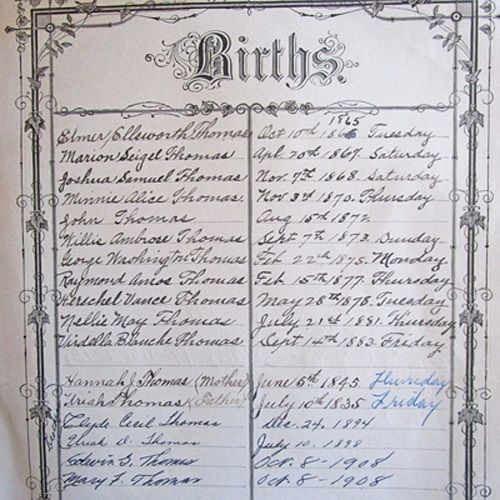
Often in that time period the only record of a person’s birth, life and death was kept in a family bible. People did not have much, but they nearly always had a family bible.

I listened to many of the interviews and read the accompanying transcripts trying to find one that I was able to understand and had relative content for the assignment. 

For my timeline I looked at the “Interview with Uncle Bob Ledbetter in Oil City, Louisiana 9 . John and Ruby Lomax interviewed Bob in 1940. There was a lot of potential information, however much of it is assumed. There is no mention of dates, so I have based every date listed on a rough calculation. For example, the interview takes place in 1940 and Uncle Bob is 73. I worked backwards assuming that he was born in 1867, was probably about 10 years old when his father taught him to read, a teen when he saw his friends in jail and 21 when he could have voted in the 1892 Presidential Election. I was able to use 1887 as the date of his marriage since he said he was 20 years old. I really took some creative license and tried to apply a reasonable age to events. I was surprised that the Lomax’s did not press him for more information about his life. I would have thought that it would have been important to their project. 

The limitations of these interviews are the oral story in itself. I listened to many of the interviews and read the accompanying transcripts trying to find one that I was able to understand and had relative content for the assignment.  Most of the recordings are very difficult to understand. I am a little hard of hearing, so it was pretty difficult. The assignment scope was just to listen 10 but unfortunately I found that only using the audio was impossible for me. I listened to it to get a feel for the overall flow of the interview, but I used the transcript for actual information. Some of the transcripts have a disclaimer about the poor quality of the recordings and include passages where the transcriber simply used “????????” or (unintelligible). Being as we are in such a digital age I had previously put a lot of value on oral history. I still think that it is important, but now include the caveat that it is only as useful as the reliability of the recorded media. Oral histories that have been transcribed are more useful than a beeswax recording roll that is garbled and not understandable. 

Listening to the overall tone of the recordings were insightful however. Some of the people interviewed were very animated and impassioned talking about certain subjects. Other times it seemed obvious that they did not want to go into greater detail but felt pressured by the interviewer. The dynamic is interesting, there seems to be a wariness, and maybe a condescending feel to how they interviewed people. They certainly don’t all flow naturally though. This was an interesting assignment and showed me that oral histories are valuable but that the way they are recorded can have a significant impact on their usefulness. When they are also made available with text they are far more useful and can really tell a fuller story.   

Although it is by no means a past time of mine, I have always enjoyed listening to interviews. When I first discovered the YouTube channel Blank on Blank during my sophomore year of high school, I distinctly remember listening to each interview available on the channel without pause. It’s difficult to describe, but hearing authors, politicians, and other well-known figures discuss their works and experiences using their own voices was strangely fascinating to me. So, when this assignment was announced, I was elated.

The subject of my interview was the cowboy, bounty hunter, and former slave, Charlie Smith. In his interview with Elmer E. Sparks, Smith describes his passage from Liberia, Africa to the United States as well as his upbringing. He states that his family was tricked by slave traders who had landed in his country and brought by these men to New Orleans, Louisiana. Upon arriving in the United States, Smith was purchased by a wealthy cattle rancher named Charlie Smith, who Smith describes as raising him as though he were his own child (even going so far as to give Smith his own name). On his owner’s ranch, Smith was the sole black cowboy and, following his owner’s death, Smith was granted his freedom.

Throughout his interview with Sparks, Smith does not spend a great deal of time focusing on his enslavement. Instead, he chooses to focus on his many achievements within the United States, including his involvement in the killing of the notorious Billy the Kid and the capture of Charles J. Guiteau. Although this interview is categorized as an interview by a former slave, one would find it difficult to note this had he or she only listened to two thirds of the interview. In Smith’s case, his previous enslavement did not impede his capacity to achieve. However, Smith does note among his numerous accomplishments that he was truly proud of lending his aid in the tearing down of a sign in Oxford, Mississippi that prevented blacks from entering onto a piece of property.

As stated previously, Smith does not seem to have let his former enslavement withhold him achieving; however, the prideful tone with which he notes his achievements indicates that they were not only small feats, but ones which seemed almost impossible for a black man to have accomplished during his day and age.

The power that interviews hold is not the content of their speech, but the subtle intonations that characterize them and their meanings for the speaker. In the case of Smith, he is certainly proud of what he has managed to achieve in this country, but this interview allows audiences to understand the source of that pride – that an uneducated, former slave made an impact in this nation’s history. A history that is scarred by its history of enslaving men and women just like Smith.

Timeline of Fountain Hughes

This skill assignment was very enlightening to me and I am grateful we were able to have access to such an incredible resource that gives us insight into our past. What I was able to learn from these interviews was not so much what happened exactly to slaves, but how the slaves viewed their past and current situations. The interview I listened to was that of a man named Fountain Hughes. His grandfather was a slave to former president, Thomas Jefferson. I found it interesting that it took so much prompting for him to recant his time as a young boy and slave. At first, he rambled on about money and being frugal. However, after a few more questions were asked, he started talking more about his childhood. I am not surprised that he didn’t initially wanted to talk about that time period as he clearly despised it. After recalling how difficult life has been for people after the Civil War, he stated that some former slaves were “sorry they are free now…some of them now would rather be slaves.” The interviewer then asked if Hughes would rather be a slave again or not, to which he replied: “If I thought, had any idea, that I’d ever be a slave again, I’d take a gun and just end it all right away.” 11 That was the most he had said about being a slave. There was more to learn from what wasn’t said, than what was.

This reflection on difficult times not only from the past but during the time the interview took place was very insightful into what life must have been like for African Americans in the 1930s. It was so bad that some “would rather be slaves,” implying that times must not have gotten much better by that point. This is also reflected in how they were excluded from many New Deal programs and many racist beliefs still held by many Americans. 12

Listening to the interview was a bit difficult as the quality of the recording made it difficult to understand, but what I could hear clearly, was the emotion behind what was being said. There wasn’t any anger, even when talking about hard times. There was mostly a feeling of a somber reflection. However, at times, I was also surprised by the lack of emotion. While modern technology would have made the interviews easier to understand, having them done during early to mid 1900s, gives us a unique perspective into the lives of former slaves before and after abolition.

Interview with Fountain Hughes, Baltimore, Maryland, June 11, 1949: https://www.loc.gov/item/afc1950037_afs09990a/

Timeline: https://cdn.knightlab.com/libs/timeline3/latest/embed/index.html?source=1zIYmXiIdLJ0qFPCJUJjDl3WUMEI-v7VJ5CUyqUnbHVA&font=Default&lang=en&initial_zoom=2&height=650

Oral History – Blog Post #5 Christina O’Farrell

The specific interview I listened to was with Fountain Hughes, a former slave, and he discusses what life was like after being enslaved. Thinking back to when I was in middle school history class, I just remember learning about who slaves were, the Civil War, and when the war ended, but never anything about the lives of the enslaved people after the war. These interviews really bring to life how enslaved people began to really live in freedom.

The timelines intersect very similarly. Historians would define the years that Hughes was enslaved as the Civil War era, but Hughes would define those years much differently because he was living during that time. On my timeline, the year 1845 was an important one to Hughes and to the country. Historians would look at 1845 and immediately think of Texas’ Congress voting for annexation to the U.S., but Hughes would look at it and know that was the year he began working as a slave. It’s just interesting how years have different meanings to different people, groups, etc.

I was surprised that Hughes never mentioned a marriage or any of his friends in the interview. He did discuss his family a bit, but he didn’t dive much into his friendships, especially his friendships after being freed. A part of me wanted to learn more about his relationships in Baltimore 13 and how well he settled in there after being freed. This interview, however, was very useful in painting a visual of what it was like being enslaved and their daily lives. The stories that Hughes told about the people he worked for and what he did for them really helped me imagine it more clear. Limitations of this interview might be the rambling that Hughes went on. Some of his rambling confused me a bit and he bounced from thought to thought a bit, but it’s understandable considering he said he was 101 years old during it. It challenged my view of oral history for sure. It proved to me that oral history can definitely help you learn more vs. written history (glancing at a textbook).

It was a bit hard to understand the dialogue at some points. 14 I could tell the recording device was quite old, but it did bring an immense amount of authenticity and a genuine feel to the oral history being told. Transcribing the sources wouldn’t be able to convey the emotion 15 that I could hear on the audio. Hearing the emotion let me identify what events were important to Hughes by the way he was talking about it.

This interview can show that in the 1930s, people weren’t afraid to talk about slavery and learn more about it. The interviewer in this specific interview sounded very respectful towards Hughes, which is something that wouldn’t have happened years prior due to the racism held in the country.

Norwood, Hermond, and Fountain Hughes. Interview with Fountain Hughes, Baltimore, Maryland. Baltimore, Maryland, November , 6, 1949. Pdf. https://www.loc.gov/item/afc1950037_afs09990a/.

“Slave Narratives from Slavery to the Great Depression : An Introduction to the WPA Slave Narratives : Articles and Essays : Born in Slavery: Slave Narratives from the Federal Writers’ Project, 1936-1938 : Digital Collections : Library of Congress.” The Library of Congress. Accessed October 24, 2019. https://www.loc.gov/collections/slave-narratives-from-the-federal-writers-project-1936-to-1938/articles-and-essays/introduction-to-the-wpa-slave-narratives/slave-narratives-from-slavery-to-the-great-depression/.

“A Note on the Language of the Narratives : Articles and Essays : Born in Slavery: Slave Narratives from the Federal Writers’ Project, 1936-1938 : Digital Collections : Library of Congress.” The Library of Congress. Accessed October 24, 2019. https://www.loc.gov/collections/slave-narratives-from-the-federal-writers-project-1936-to-1938/articles-and-essays/note-on-the-language-of-the-narratives/#note.

Timeline.

Interview.

css.php