Special Collections Visit

Archives contain data meant to be kept forever, documents and photos and other things that researchers place enough stock in to warrant preservation. Obviously, scholars place value in archives– if a piece of data is in an archive, then by definition it must hold some use– but when I thought about how the general public would access archives, the utility grew murkier. I suppose that this is an archive’s chief mission: to appeal to the public so it can get the donations it needs to survive. The archivist for George Mason University’s special collections explained that her archive relies on donors.

The stark processing priorities surprised me very much from the “archival work [requiring] an ethics of care for the deeply personal and the deeply political” Elvia Arroyo-Ramirez espoused. What was most shocking is that sometimes, data donations are not always wanted for the archive. They are accepted because the donor has generously donated money, but mostly, they are irrelevant. An archive’s information is not just the biggest open books in the world, I discovered, but it is beholden to donors and just what data is actually available.

What archives digitise– the information deemed valuable enough to really be available for the general public, not hidden in basement boxes only to be seen by tenacious literati– is limited, too, often just for copyright issues. Thus, most of the digitised items are non-copyrighted photos. It made me realise just how much data I’ve yet to expose myself to. Most of my primary source research is done digitally, and when I found out just how few primary sources are realistically able to be digitised, I wondered about the limitations of some of my most ordinary research; in other words, “Who gets to be remembered and historicized by way of record creation? Who is forgotten or purposefully silenced in history by way of omission or destruction of records? How are records themselves… used to communicate misguided notions of holistic representation, truthfulness, neutrality, and objectivity?” 1

Our examination of the real data provided me with context for the period, what it would feel like handling these materials. Before, the Federal Theatre Project existed as a vague notion in my head, but the plethora of physical data we interacted with tethered that notion to earthly materials. It shouldn’t have mattered as much as it did, but I found another dimension added to my mental picture of the Federal Theatre Project, considering what these data would be like with the awareness and physicality of objects directly around me. The documents themselves that I looked into helped me understand just what “the integration of the theater with community life in the smaller communities” meant (before it became a ‘secondary air’), painting a picture of mobile theatres and the incredible innovations people put out. The documents helped me feel the elation of those government officials trying to stretch their craft to the American hinterlands, and clued me into what might’ve been frustration when FTP officials “encountered ignorance and intransigence when they made their ‘courtesy calls’ on state administrators.” 2

Archived Preservation: How it changes the way we see history

Apple data. This is but one example of how scholars could use archived material. The main point being that archived and preserved items can be used to analyze things from that time period Archives in general are useful in many regards. However, the way they are useful can vary from group to group. For both scholars and the public, archives offer a glimpse into history by physical manifestations of that history. This can be through actual documents being preserved or other more three-dimensional objects such as dioramas for example. As discussed in Susan Manus’ article

3

one of the major uses for scholars is to actually use archived equipment for certain purposes. Preservationists can use things like older computer systems to analyze and recover some of the out-of-date storage equipment that has simply gone out of use. An example could be using an old Macintosh system to recover old original without needing to be in that time period.

            When regarding how the public interacts and uses archived material there are some limitations to think about. One of these limitations can come from not having physical access to some of the items. Most of the time a regular person is unable to actually go a physically analyze these objects. This is one of the biggest reasons and benefits of digitization; it allows for anyone with WIFI access to view these pieces. Another limitation, which scholars face as well, is the necessity for a lot of items to be digitized. The way many of the items in collections are selected for digitization can also be an extension of this limitation. When selecting some items to be digitized, it is discussed with Thomas Padilla and Elvia Arroyo-Ramirez

4

that some of the original meanings of the items may be lost or altered. An example discussed was how an item which predated the internet was digitized without consent from those who it was meant for. This “blanket tendency” as it was called to do this can be harmful as it can leave out specific knowledge regarding the item; in this case being that it was meant for a specific group of people.

            Analyzing the items that we had in class gave a richer understanding of what the FTP was. One of the first things that I simply had not picked up on with digitized documents was that it was so much more nationwide than I previously thought. There were documents from the FTP in New York, Chicago, and other locations. While I new that it had taken place in multiple cities and venues, having physical evidence in front of you makes everything feel more real. When looking at digitized items you are fundamentally losing the realness and the physicality of that object. Holding a flier for a Macbeth show in Chicago is so much more interesting than looking at it on a screen. You can see how big it is, how it feels, the imperfections on it. All of this added so much more physical context to many of the programs we had been studying throughout this semester.

Special Collections

The Federal Theater Project, while heavily criticized, was one of the only (if not the only) occasions when the government actively supported and put money into the arts. Our visit to special collections and exploration of certain artifacts from the Federal Theater Project allowed us an in person look at actual materials that were created or written regarding or for theatrical performances for the FTP. My own opinion was genuinely affected by being able to see actual artifacts from the FTP because the article that my table paid particular attention to was a proposal by someone talking about the importance of the FTP and the arts, and it made me realize even more how little the government puts funding into the arts and values the arts and theater. Even when there was a government funded program for theater, people involved in theater/arts were still trying to convince people to care about it. The archive also serves as a means to research and gain a better understanding and appreciation for the effort of those involved in the Federal Theater Project productions. For example, when reading about the voodoo Macbeth play in the Library of Congress’ article, the reader gets the idea of the impact of the play, but not necessarily the effort or what the production looked like.5 So with archives such as Special Collections in the George Mason University Library, researchers are able to physically hold and see real life artifacts from actual productions. 

Something that was significantly interesting about our visit to Special Collections was that archivists do have a say in what gets digitized or not, but only to a certain extent. When money is involved, certain items can get digitized faster or be prioritized over other items. This could be because they were paid to digitize them faster, or it could be because they were given to Special Collections from a donor to the archive, and so of course they get priority. This did spark a question in my head about how money influences history, not only in Special Collections, but in all archives everywhere. Aside from that however, archivists do get to decide sometimes if items are just genuinely unimportant or important. They also get a say in how something will be digitized, however it’s generally a photograph if it’s a 3D object. They also make sure to have rules and regulations concerning the access to the items in order to protect their quality.6 This ensures all researchers are able to look at whatever artifacts they want to see and know that they’re in good condition and similar conditions to the way they were when they were produced. 

Special Collections proved to be valuable to us as students, and their importance to actual researchers is far greater. Our visit demonstrated to me just another reason as to how technology is an important aspect of the recording of history and the impact of digital history today.


Special Perspectives

Viewing the physical material history and remains of the Federal Theater Project when visiting Special collections was enlightening. For some objects like the costumes and puppets, seeing photos from the plays, most of which we’ve seen only in black and white negatives, do not truly show the detail that went into the making of the play. A deeper understanding of the Federal Theater Project comes with the realization that these objects were made by the seamstresses and stagehands hired by the FTP; this is the skill that the FTP sought to preserve and provide employment for.

Other objects and materials we viewed in Special Collections, like copies of Hallie Flanagan’s notes for the first meeting with the directors of the Federal Theater Project, were also interesting but not as profound. My group viewed an onion paper copy of the notes, which included Flanagan’s renowned moving speech, “Is This the Time and Place?” as well as a manuscript of the discussion among the directors. The information expressed by the source was certainly valuable; we learned the personal beliefs of those who objected the Federal Theater Project, we learned of Flanagan’s motivations in pursuing the FTP. However, this source in particular did not give much more information than a digital copy would.

We learned however, that this source is not one that is likely to be digitized any time soon. When deciding which materials to digitize, it is important for archivists to prioritize items which are fragile or have high research value, while also considering rights or privacy7. While this material could contribute to interesting research, paper stored properly should not be fragile and should last quite a while.

For these reasons, scholars and the general public can both benefit from the process by which archivists store collections, whether it be digitally or physically. For the general public who may wish to interact with these resources purely out of curiosity and interest, they can request to view and handle items of great novelty, such as the puppets, costumes, and printer stamps that we got to interact with. Items such as manuscripts and posters that aren’t quite as interesting to someone without a scholastic interest in the topic, can be stored digitally in a way that is easier for scholars to access and study. This allows for text analysis and distance reading, which can contribute to their research better than closely examining numerous physical copies. Digitizing physical copies of texts such as these allow for modern research to equitably apply to pre-internet resources just as it does to sources “born” digitally8. This process of digitizing records therefore serves the purposes of digital humanities in allowing for democratization of history.

Skill assignment 5- Text Analysis

For my text analysis project, I decided to use my own collection of ten documents, and compare it against the class corpus. My historical question is “What was the experience of working women like in New York City during the 1930’s, and how was their employment affected by the economic downturn?” The role of women in the economy has always been very interesting to me, especially women in the workforce in the early twentieth century. It wasn’t common for middle and upper class women to be employed, and it was extremely rare to see a woman in a public sort of job, like a doctor, or a reporter. I wanted to see if I could find a spread of interviews with working class women, in order to get a better idea of the jobs they had before the stock market crash, and how their careers changed as the depression continued.

A photo we talked about in class that really piqued my interest in this topic was the Migrant Mother with her children. Even though I narrowed my search down to specifically women from New York City, the female farmers who fled the Midwest during the dust bowl also had the unique experience of having to completely change their lives, and their livelihoods. Dorothea Lange wrote about her interaction with the woman in the photo’s, and it reminded me of the interviews that the Federal Writers Project conducted all over the country. “She said that they had been living on frozen vegetables from the surrounding fields, and birds that the children killed. She had just sold the tires from her car to buy food.”9

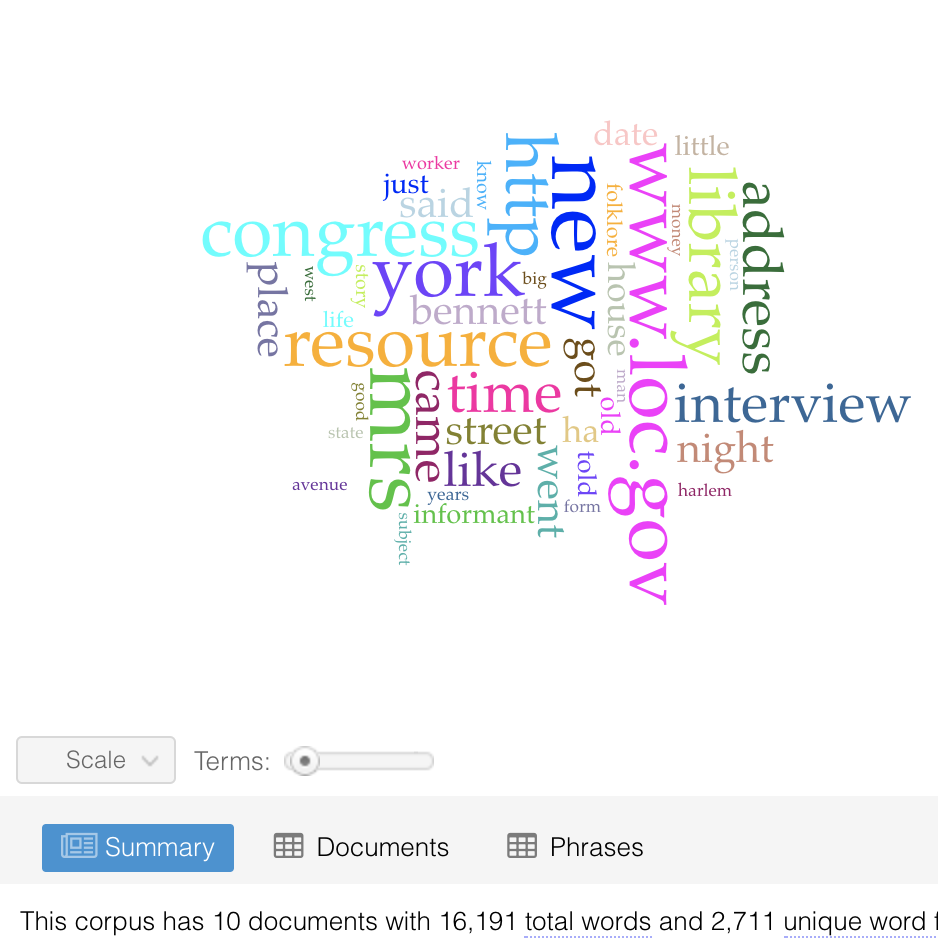
My corpus focused on my own question, so the cirrus word cloud was different for my corpus was different than the class corpus. However, it was not nearly as different as I thought it would be. The word “man” appears in the class corpus 1220 times. The word “woman” does not appear enough times to even be included in the cirrus. The same is said for my own cirrus, the word woman is not included in the word cloud. I found this very strange since all of my documents were interviews with working women in New York City. When I went back and read my interviews, I found that the word woman hardly appeared and instead the subjects were just referred to as “Mrs” or by their first names. One woman in my corpus documents was only referred to as Big Bess, and she had been prostituting herself out of her apartment prior to the depression. A surprising statement from the interviewer was included in the interview, and it’s only surprising because of the language used. “Women of minority races and economically bankrupt groups have always been exploited by materially stronger groups.” 10 That sounds like a sentence right out of a 2019 text analysis, rather than a statement by an interviewer in 1938. Big Bess no longer wanted to work as a prostitute by the time of this interview, but felt stuck. “I’m getting sick and tired of this life, but what can I do? I don’t know any other kind of work and even if I did, where would I find it? Besides, once you get accustomed to seventy-five or a hundred dollars a week, it’s pretty hard trying to get by on fifteen or eighteen.”11

Because my corpus was tailored to my specific question, I wasn’t able to find much information in the class corpus that pertained to my inquiries. This showed me that even if you have a large spread of information, it doesn’t necessarily mean that it’s useful to you specifically. Voyant helped me to locate different terms, but in the end the information the terms were attached to didn’t really help me too much.

The cirrus for my own corpus of 10 documents.
The cirrus for the class corpus of 322 documents.

Close vs Distant Reading

Using the text analysis tool Voyant was both helpful and confusing. When I created my own corpus I essentially used a keyword search 12 in the “American Life Histories” 13 collection. My historical question was “ How did the role of Motherhood change in the New Deal Era?” I entered the word “motherhood” in the search field and it yielded no results. So from there I tried “mother”, here I was more successful. I found around 15 documents and I decided to use them as my corpus. 

From there I turned to the Voyant tool to look at our class created corpus for the Federal Writers Project collection. When I first uploaded the corpus I was just interested in playing with the word art tools.

Using Miriam Posner’s 14 tutorial was really helpful as a starting point. I especially liked the section “What the heck are we looking at?” and she was correct it is initially overwhelming. But as I continued to use the Voyant tools I understood them a little more.

I found the trends tool the most helpful. I repeated the process of using the terms “mother” and “motherhood” to investigate the documents. I found that the documents with the most mentions were the ones that I had contributed to the corpus. There were other options that I was able to look through though, just not very many.   I think that in this case the corpus was just too varied in what each of us was looking for. I found that in looking for an answer to my historical question my corpus was a better fit. 

As I read through them I found a somewhat surprising answer to my question. Motherhood hasn’t really changed much since the New Deal Era. Mothers seem to be the main caregivers, responsible for the children and the family in general in all the domestic type duties. They were the ones that made sure that traditions were carried on and that knowledge was passed down from previous generations. Mother’s have always been the bedrock of the family. 

Both Sides Now: Reflecting on the Special Collections

The Special Collections Research Center has archives full of data. Specifically, they put on display for us artifacts concerning the Federal Theatre Project (FTP). Across the tables lay various documents and objects. These objects and documents are very important as they help paint a picture, help develop the story of the FTP from what we, as scholars, already know. Scholars can take this information and rearrange to make varying arguments. Where the general public is concerned, I feel they are the consumers of the stories archivists make with their collection. Say, the archivists sits out a puppet, some pictures of dancers and notes on their designs. The public would interpret it however the archivist would set it up, and then begin to question or look into it further if the collection intrigues them. In this way, the archivists educate both scholars and the general public. The scholars being able to take the research a step further, while the public, I feel, would consider it more of a “national memory” or a facet of the past that greatly exemplifies the nation of the time.

The job of the archivist is to organize the data in any way they deem fit or suitable. When it comes to digitizing, there are two categories of how the item is interpreted: one is informational, the other is artifactual. Informational concerns the fixity and validation of the data or artifact. Does the information conveyed by the data remain the same as the artifact becomes digitized? Artifactual concerns interpretation. The archivist takes into consideration the materiality of the object. For example, in Artifactual Elements Pt. 1 15, the focus is on born-digital data being recovered from old-fashioned hardware. The archivist takes into consideration how data is stored, created and processed using this hardware. Then they consider the “environment” of the information and how that impacts how the source was created, altered or access. Desktops impact how we create and store records on our computer by a fixed screen. Another and final thing to consider is how word processing software, image editing programs, or how even operating systems can impact how contemporary records creators produce creative works.

Archivists struggle with trying to keep the meaning of their collections when digitizing them. Oft times, what is lost are the sensory perceptions. When you digitize an object, you can no longer smell it or feel it. All you can do is look at it interpretively and use various digital tools to analyze it that way. An Archivist, in this case, may prefer to digitize documents or pictures because a lot of the information can still be conveyed–digitally altered even. A three-dimensional object relies heavily on being “3-D.” When you digitize it, that already takes away its depth and makes it flat. You even lose the sense of touch which could key into how the object was made. Even though they are great to marvel at, these images and objects are subject to their own biases of the time. When we digitize them, that bias is carried forward through time. The scholar takes the time to parse through this bias and figure out who or what was omitted in order to get a good idea of the history being conveyed. 16 Simply, once these sources enter the digital world, many more challenges arise.

The SCRC FTP collection we saw involved a puppet, diorama and various forms of documentation. A lot of what they had put what we learned about the FTP into context. My group specifically got to see the Vaudeville and Negro Unit’s plays, stages, and costumes. In class, we discussed how the FTP did not use a lot of money for spending, but on salaries.17 The images painted a different story for me. Everything looked so lavish and exciting, made me wish I could have seen the pictures in their original context; rather, I wish I could see all the colors and see all the dramas in actions.

Blog 6

Using Voyant for this skill assignment was a slightly bizarre experience for me. It required altering my research question several times and altering the conceit of my question all together. Initially my question sought to figure out how leisure and play activates impacted by the Great Depression in different parts of the country. However I didn’t grasp the different layers that I needed to understand in order to properly answer that question.

 Considering the way that Voyent processes information, scanning through the texts that contained the word “play” was not all together helpful because the context would be removed and I would need to close read through hundreds of texts. I also realized that one of my previous search terms, leisure, was only helpful when searching through the library of congress archive because it was a categorization term rather than a word that was naturally occurring in the text.

Looking for ‘fun’ in context

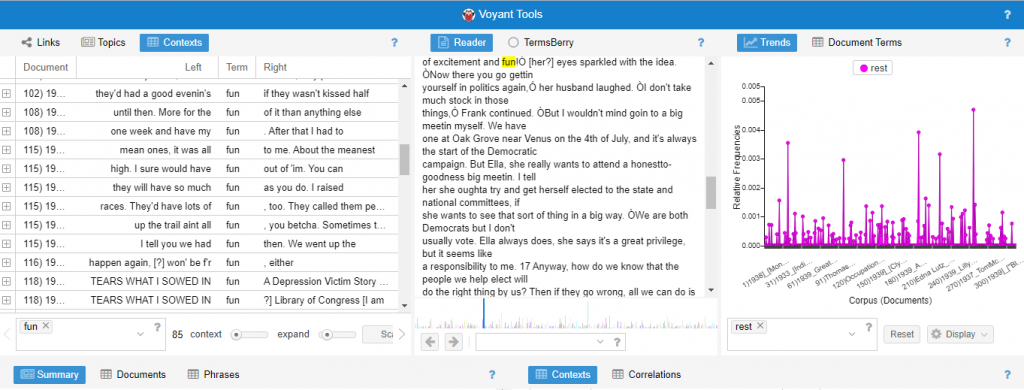
With all of this information as my foundation, I chose to approach my question from a different angle and simplified my question all together. My question essentially became ‘How did people have fun during the Great Depression’. I used the words ‘fun’ and ‘relax’ and analyzed them through the context tool. This allowed me time find every instance that these words were used while also seeing the context and way in which it was used. The tools allowed me to do a quick scan of the information and in the adjoining view look at the reader view and skim through several paragraphs of the source. I found this to be more helpful than any of the visualization tools.

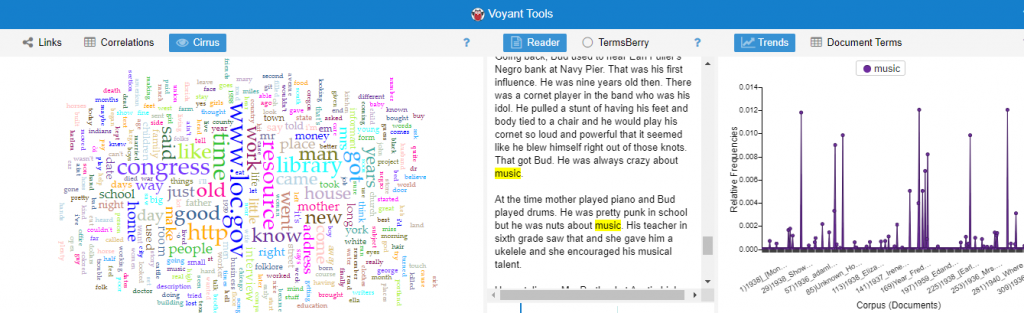
A bulk of the sources seemed to indicate that music, jazz music in particular where popular as vehicles for fun. Then I backtracked, looked at the sound cloud, selected the word ‘music’ and was able to see its use across a multitude of sources. From that point I was then able to select specific interviews to read more closely to form my opinions and conclusions.

Using Music as my search term from the word cloud

Ultimately my my simplified question ended up with a simplified answer. For fun, most people turned towards music, jazz in particular to forget about the worries for short periods of time. Delving deeper into the sources also brings in information about which cities where predominate in the jazz scene and who was playing the music.

Although I think there is merit to distant reading, I think my preference will always be for close reading. “Personal recollection has a significance of its own” 18 and i think that is best understood on a singular level rather as an aggregated data point.

Voyant is at its most useful when being used to analyze words absent of context (key word searching, graphs, word clouds, etc) and then allowing the user to re-contextualize the information rather than attempting to superimpose any particular question on the analysis. Miriam Posner mentions that discern significant differences among text and those difference being deemed meaningful 19 are not the same things. Whether or not text analysis is actually helpful depends directly on information one is attempting to transform.

Average American Life Before the Great Depression

My historical question is in the title, “How did the average American live before the great depression?”. This seemed like a fairly easy question to answer, as many of the interviews I read focused on their life growing up, rather than life during the depression, or during the time of the interview. The initial ideas I had for this question, were that the interviewees would talk much about their family, their struggles, like familial deaths, and their high points, like marriage and raising a child. Pretty much, I was hoping that they would focus on the very highs, and the very lows of their life. I assumed that there would be talk about traditions, sprinklings of bigotry here and there due to the time period, and a focus on the good parts of their lives before the depression.

Since this was a very general question, my idea was to use most of not all of the sources gathered in the corpus. However, there would obviously be a lot of words inside the hundreds of interviews that needed to be taken out to better see the juicy bits. First, I filtered out words pertaining to the meta data, like the website URL, words “Library of Congress” and the like. Then I focused less on the most common words, as they were mostly, “Got, Like, and Said”, which are worthless not understanding the full context. I focused more on the words said a few hundred times, rather than those said thousands of times, as they were usually more telling of what the interview was about. Words like “father, mother, school, and children” helped me understand the focus of the interviews better.

Using Voyant tools wasn’t too hard, as we already went over it in class and thanks to Miriam Posner’s tutorial on it. 20 I found the “Document terms” particularly useful, as it showed the exact number of times a certain term was used throughout the corpus. This helped me see the less than average terms better than in the cirrus tool which only really showed the most common terms. My main decision I made was to focus on not the most common terms, but the less than common terms which might have been buried under very common words. That way, I could find more context within words rather than general terms used in that time period.

I focused not on the most common that had thousands (Very common words) but rather terms that had hundreds of examples so I could gain more context for each.
Using the cirrus, it helped visualize the number of times a term was used.

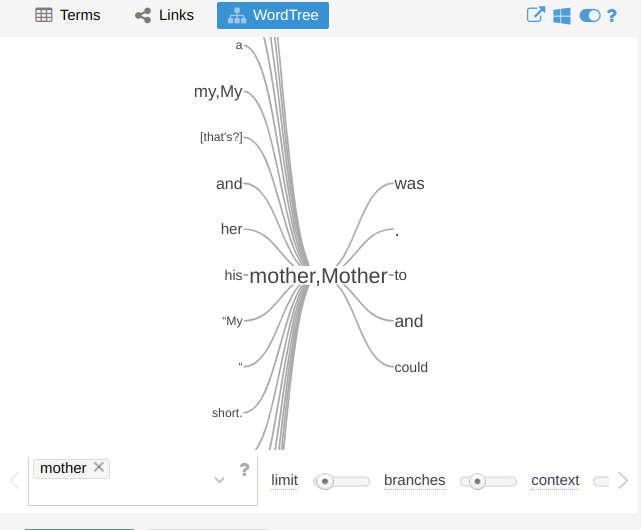
My question stayed generally the same throughout the text analysis, as the terms I gathered focused on family and the struggles they may have faced.  My assumptions that they would focus on traditions held in their family was a bit wrong, as many people seem to have talked about a very general idea of their childhood or life before the depression, rather than many specifics. This makes sense as the Federal Writer’s Project focuses on capturing as much of history as possible, rather than much specific details. 21   Interestingly enough, it was more common for people to talk about their mother rather than their father, which shows me that mothers might be more important to these people’s lives than their fathers.  With what I did with close reading, I found that the interviewees would commonly talk about general ideas about growing up, such as people they kind of maybe knew rather than any specific traditions or cultural backgrounds they had.

The final conclusion I have with my question is that many people remembered the past with a certain level of nostalgia or fondness of their past.  They focused more on their mothers rather than fathers as well, which is interesting.  They would talk about the people that were close to their family, and what they thought about them.  Overall, life before the depression seemed simple, however it comes from a place of nostalgia so it might not be very reliable.  Pertaining to close and distant reading, I conclude that both have advantages and disadvantages that can help and hinder one another.  You can get a good general idea from distant reading; however, you should supplement it with close reading so that you can get a good idea of what’s going on.

Skill #5/ Blog #6

Initially when I began this assignment, my historical question was “how did folklore and superstitions from different cultures evolve in the US?” When I first came up with the question, I was unsure how it would be answered, or even if it could be answered with the documents available. As for why I chose the topic, I have always had a fascination for stories, customs, and beliefs regarding the supernatural. When I saw the categories of folklore and superstitions in the Amercian Life History collection, I knew I had found a subject that I would enjoy diving into. This was the reason why I ultimately chose to work with my own corpus. While the other items in the class corpus covered a wide range of topics, my own corpus dealt almost exclusively with folklore and stories regarding superstitious customs and the supernatural.

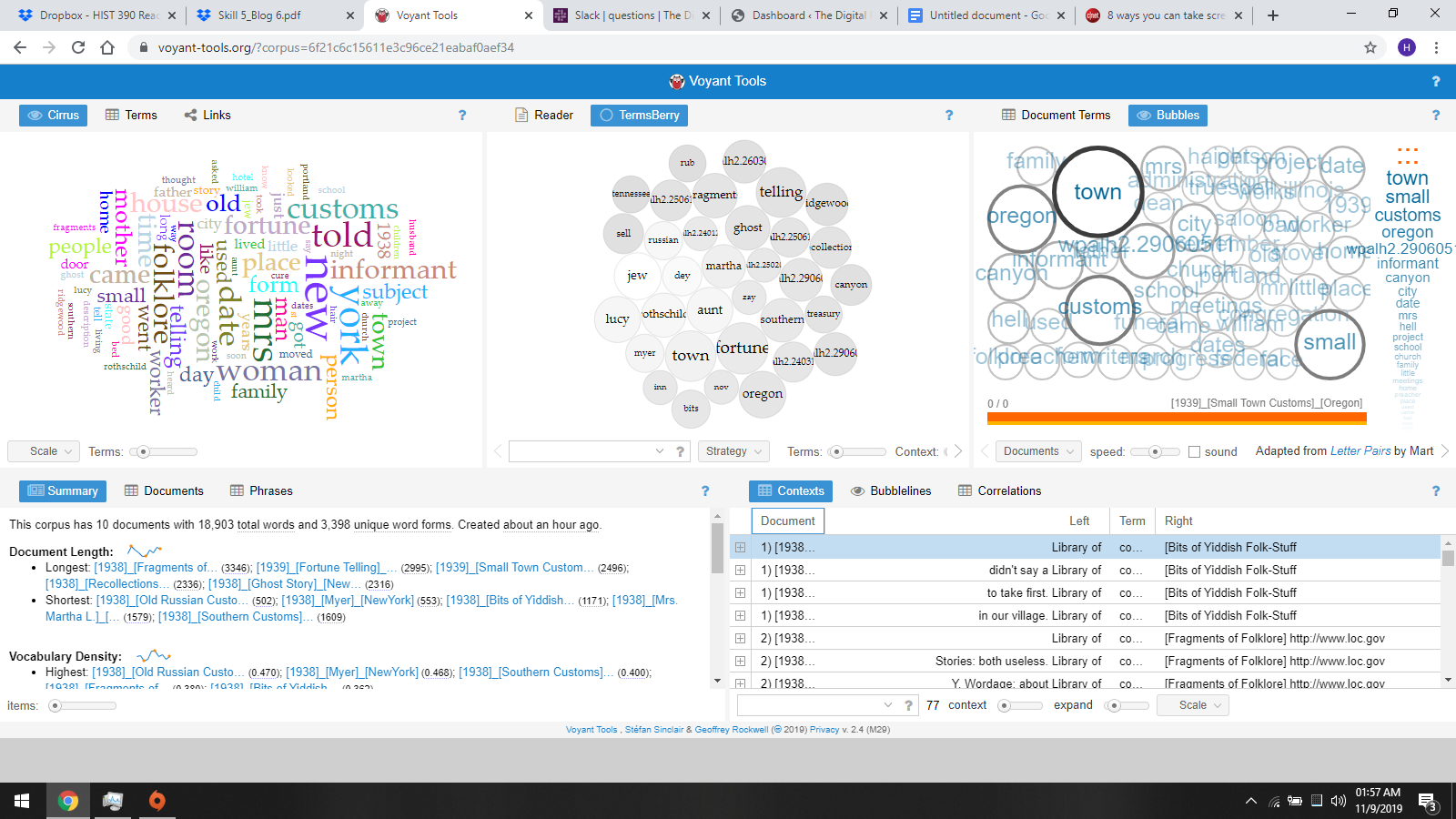
My experience with Voyant Tools was interesting. Once certain keywords are added to the stopwords, the tools become potentially useful for identifying and exploring word patterns and trends. I experimented with many different features, but my favorite feature was the Cirrus one. It arranged the words in a manner that was visually engaging, with a unique arrangement and colors, as well as useful for finding trends. My second favorite feature was TermsBerry because it also arranged common words in a visually engaging manner. With TermsBerry, the words were arranged in bubbles. The third favorite feature was the Links feature. It linked various related words together in a sort of web that you could drag and move around.

As I used the different features in Voyant, I began to realize that there is an answer to my historical question, or at least a part of an answer. Unfortunately, I did not discover any information from my corpus about how folklore and superstition evolved, but I might have learned more about its place during the 1930s. Throughout the different tools I used, some of the most recurring words were ‘family’, ‘home’, and ‘mother’. This inspired me to think about the role of folklore and superstition, and I realized that folklore and superstitions are learned and passed down through family. They require a base, such as a family, in order to survive. In the text, “Southern Customs”, an example of this is given. The speaker detailed several of the superstitious remedies for illnesses that were passed down through her mother’s family22. Also in the test “Myer”, there is another example of this occurring. The speaker detailed a story told to him by his father about a strange, potentially supernatural, event that occurred to him, and he also talked about some of the superstitions that his grandfather taught him as a child23.

Through the use of Voyant tools, I came up with a new question to consider the topic of folklore and superstition with. Through the use of close reading of the texts, I discovered an answer. While I was not able to answer my original question, I was able to answer a different one. Folklore and superstitions were passed down through families, and it is through families that they survive.


css.php