Special Collections Research Center- A great Resource

The experience today with the Special Collections Research Center at GMU was awesome. As a budding archivist it was great to how other archives handle their collections. Most of the rules outlined on the policy page 1 were what I have experienced in other archival centers. I was impressed with the wide range of materials that they had for the Federal Theatre Project. Being able to interact with the puppet and the “Dark Coat” was interesting and enjoyable.

It was interesting when Brittany described the decision process for digitization, seeing that they had a “top ten list” was genius! Her description of reasons for digitizing certain items was informative. I had only considered accessibility as a reason to digitize documents. But her statement about a documents stability as a deciding factor was interesting. If the document is physically compromised, but it’s contents are invaluable then digitizing it is a way to maintain that information for future.

Archives are a fantastic resource for university students and the general public alike. They are the repositories of information that could otherwise be lost. It was interesting that she mentioned the political reasons that some collections are part of the GMU Library collection. My personal experience with archives has been in the public sphere, dealing with publicly owned government records, but in considering private collections I have new questions. Her mentioning of being obligated to accept a collection because of a monetary donation fascinated me. I am of the thought that most collections are inherently valuable. She seemed to imply that some of these collections are unwanted or burdensome for the SCRC. I found that interesting, but reading the conversation between Thomas Padilla and Elvia Arroyo-Ramirez “Bias, Perception, and Archival Praxis” I understand that there is another side of archives. In this conversation Arroyo- Ramirez discusses that there is a sense of bias in collections. She states that scholars are discussing “issues of power, representation, and accountability by challenging the existing canon of archival neutrality and objectivity; speaking on colonialism, apartheid, and transitional democracies and their relationships to record keeping; and connecting these challenges to current archival practices.” 2 I have always considered archives to be neutral, but I understand how accepting collections only from certain people or groups they could be bias. If the documents collected only pertain or describe one side of history then they are not in fact neutral.

That is something that I think is really special about the Library of Congress Slave 3 narratives. These are stories from the other side of history, the often underrepresented stories. It is important for that history to be preserved alongside of the nations history.

Through our discussions about the Federal Theater Project this week I realized how much social politics affected the New Deal projects. I had the impression that they were all welcomed and celebrated for having put artists back to work in the economic crisis. It was fascinating to see that that was not the case. Our group examined the programs for the Children’s Theater’s production of “The Revolt of the Beavers” which we had previously learned was associated with communism and helped to fuel tensions for the FTP. It was really interesting to see these documents in person.
Living it up in the 1930s

What really captivates me about the past is people’s lifestyles. This desire to get a glimpse at their lives back then led me to my historical question: What were lifestyles like then, and how were they recorded by the Federal writers. I was immediately greeted by a flurry of words. The problem was that they all seemed very simple. Home and work, like and folklore. These words caused me to think a little more about what my historical question could be.

https://voyant-tools.org/?stopList=keywords-f4547f893cb245720fcc371d1768e931&whiteList=&corpus=a0d1dfae2c29f39d7cde744e33a7eb3b&view=Cirrus

My thoughts moved on to consider World War II, so I shortened the class corpus to any document that was recorded between 1939-1945. What I learned was that our corpus stopped in the year 1941 which is when America joined the war. This date could imply that the government turned from focusing on these writings and recordings to focusing more on the war effort.

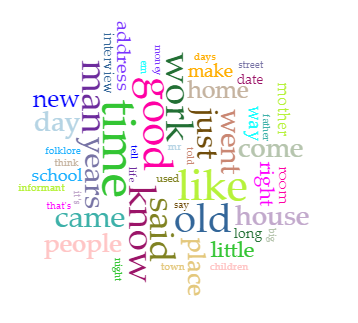
Voyant was pretty helpful in getting me to visualize these lifestyles before America joined the war. In the word cloud (Cirrus Tool) above, the words work, good, old, time, like, house and came recurred very frequently. This gave me the idea that a lot of these people’s lives were more centered around work as that was what the New Deal set out to do, provide jobs and relief for the people in this time of uncertainty. “Like” and “Old” are words very reminiscent of jargon typically used to describe locations (Old) and forming comparisons or statements of “ought to” or “should” do something. These words being prominent showed, to me, that the interviewers were most likely very relaxed when it came to discussing these topics with their interviewees. They carried the valence of narrative and really felt like stories painting the picture of family life in the past. 4

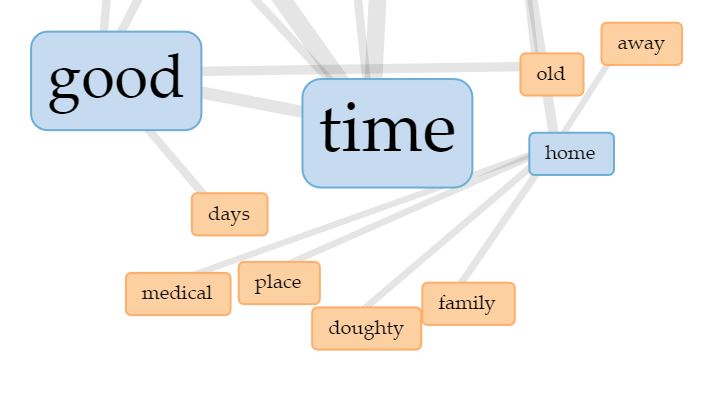
The tool that helped me the most was the Links Tool. It really put these words into perspective by showing how they connected with words in similar documents. Using this, I could closely investigate the documents to see why the algorithm assigned these certain words to link. A good example was “family.” Links linked the word with “medicine,” “home,” and “Doughty” as the Doughty document discussed their life at home. This link conveys a sense of home being a place of healing and security as that was where the family was. A similar thing could be seen with “people” being connected to “folklore” as folklore was the story of the people which they passed down, holding meaning in their culture.

https://voyant-tools.org/?corpus=a0d1dfae2c29f39d7cde744e33a7eb3b&stopList=keywords-f4547f893cb245720fcc371d1768e931&query=time&query=good&query=people&query=came&query=school&query=home&mode=corpus&context=3&view=CollocatesGraph

Distant Reading is a really fun tool for getting a broad sense of what a group of documents could possibly mean. I enjoyed getting to explore the tools and answer my historical question. During the time before America joined the war, they were very focused on home, doing good, working to support their families and trying to keep healthy. 5

Using Text Analysis to Answer Real World Questions

This afternoon I attended Laura Crossley’s presentation “Text MiningDigital Humanities with API’s, OpenRefine, and R” 6. When Laura started her presentation I was worried that I wouldn’t understand much as I am pretty new to Digital Humanities. As a historian I am much more comfortable with centuries old paper than I am with any of the software she described. Her project was using DHNow, a digital publication originally intended as a case study for “PressForward”, and trying to describe its usefulness and its relevance to future digital humanities projects. She used DHNow’s Editor’s Choice blog as a corpus and was determining how much they are used currently. She noted that it’s number of blog posts has dropped in recent years, but argues that it is still useful and worthwhile project.  One of the larger questions Crossley was investigating was whether or not blogs in general could be considered a useful scholarly source, the issue being that over time links break and are no longer a valid pathway to the information in the blog, making citations increasingly difficult. 

One really interesting aspect of her presentation was seeing the way that she used tools to analyze the DH Now corpus. During our lecture yesterday the Voyant tools were really intimidating. I was unsure of how this type of text analysis tool would be used in real world projects. I could understand it’s usefulness in the scope of our assignment but not in a larger real world sense. Seeing this presentation changed that for me. Seeing the application of these tools to formulate questions was great. One thing that Crossley mentioned when she was discussing how she used topic models was that they are much better tool for forming questions- than for answering them. This was something that I missed when Professor Jess 7 was walking us through the different text analysis tools, so I was really glad that I attended the presentation. It was informative to see that these tools do more than make visually impressive word art. I was impressed with how she was able to use text mining tools to sift through mountains of data and find usable information for her investigation. 

The Life of Uncle Bob

Timeline: https://cdn.knightlab.com/libs/timeline3/latest/embed/index.html?source=1SbRgpSwGXnD2fDx6yAOkQ6vB2j9EYmji74EQseFfeUs&font=Default&lang=en&initial_zoom=2&height=650

Uncle Bob was born during the beginning of the civil war, so his experience with slavery is very different from those older than him. As discussed in previous readings, slaves narratives can be of those who were very young or old during slavery, this is the case of the former.8 He doesn’t really speak about being a slave, as he probably doesn’t remember it, but what we do know is that he later would work on a farm as a worker. This can tell us that those who grew up as a slave, or at the very least had slaves as parents, went for labor close to what they already knew, such as farm work.

The major intersection of the two layers of the timeline is the civil war beginning and ending, with Bob’s birth in between. Frankly, being a slave in the civil war was probably much more different than being a slave before the war, as there was probably a sense of uncertainty about whether you were going to stay that way. This can tell us that being a slave isn’t probably something Bob remembers much about, due to his birth circumstances. Other intersections include the great war and WWI that begin before the interview happens. This shows us that despite being born a slave, Uncle Bob was able to survive some of the worst times in human history.

I was surprised that they never talked about the civil war, as this seems to be a major event, especially for enslaved people. In a way it makes sense why they never asked, as he was probably too young to remember at all. Still, just asking him “Do you remember anything about it” would probably have been a good idea. I’m surprised that they focused more on the little details of his life, such as him joining a church, which seems like an odd thing to talk about.

This interview is useful to figure out how people spoke back then to one another. Now obviously, a former slave speaking to a white man is going to have different speech patterns, as discussed in previous readings. 9 However, even understanding how slaves spoke to white people is important, because now we can better understand the culture between them. This is also the major limitation of the interview, as Uncle Bob seems very nervous or threatened in the interview. This could result in him telling the interviewers what they want to hear, rather than what actually happened. I held the belief that oral history isn’t always a very good source of information, due to human’s limited memory and social bias, and this interview seems to have justified that belief.

As mentioned before, the voice of Uncle Bob seems very nervous or threatened, like an animal backed up against a corner. He doesn’t seem very comfortable sharing his past, and rather tries to entertain the white interviewers rather than give them a definite history of his life. Thus, it becomes harder to transcribe their life and the source because of the social bias created by the relationships here.

This interview, and many slave narratives like it, can tell us of the relationships between white and black people a hundred years ago. Fear was the main characteristic between the two, and that creates a major bias when the two groups interact with one another. This makes it hard to trust a primary source when they’re talking to the other race, as a former slave will embellish the truth to make them seem funnier or more entertaining, rather than tell their white interviewer the truth about being a black person living in slavery.

Blog Post 5: Interview with Fountain Hughes, Baltimore, Maryland, June 11, 1949

For this assignment, I listened to an interview between Fountain Hughes, a 101-year-old ex-enslaved man, and Hermond Norwood, a WPA interviewer. 10 Hughes was living in Baltimore at the time of the interview. He previously worked as a manurer hauler when he first moved to the city. In his old age, he mostly stayed in his home and listened to radio as it played old religious songs he grew up hearing. I think this interview shows that even after the abolishment of slavery and the end of Reconstruction, ex-enslaved people still couldn’t find jobs that strayed away from the field. On a brighter note, however, a good portion of this interview deals with religious songs Fountain sung as a boy, and even up until the moment of the interview, which I think shows ex-enslaved people’s relationship and reliance on their religion.

Because of Fountain’s old age, I think it’s interesting to look at my timeline and see the range of events he lived through. He lived through the American Civil War and the establishment of Apartheid in South Africa, two racially charged moments in world history that still have repercussions in today’s society and people still haven’t healed from. This fact also shows the consistency of issues affecting the world at that time, no matter where they took place. What was most surprising was the fact that he didn’t talk about his time of enslavement in depth; though, with his age, it was also understandable. Hughes said he didn’t want to talk about it because he knew it made people feel bad, but when he did talk about, he wasn’t candid about his feelings, which I appreciated. He stated multiple times that being enslaved was like being treated like a “dog,” and that if he had to go back into being enslaved, he’d shoot himself first. I was also surprised by the fact that Norwood, the interviewer, didn’t try to pull answers out of Hughes. He just let him talk freely. Lastly, after having our class discussion on dialect, I was surprised that Hughes had a good grammar structure. I knew his time in school was probably limited, if any, (he did state that slaves weren’t allowed to read), so I was surprised to hear how he spoke and how the only real flaws present were due to him trying to remember and state his thoughts.

Charlie Smith

This assignment was incredibly interesting. I listened to an interview by a former enslaved man who’s original name was Mitchel Watkins. He was bought by a man named Jake and moved to Galveston Texas and where he states he was “treated me just like he treated his children“. I found this interesting because he had nothing bad to say about the man who raised him. He talked about how he was a cowboys and they would all shoot guns and wear boots and cowboy shirts. He seemed to fit in.

I was confused though, because Charlie also talked of the fight between the north and south which I assumed was the civil war. And that the African Americans bought Louisiana. Some of the things Charlie was stating did not make a lot of sense. He claimed to have received a letter from the Social Security at age 133. I was curious about Charlie because of these statements I heard in the interview and it says Charlie died at age 105 according to medics. He also claims to have helped Billy the Kid capture and kill the man who assassinated President Garfield and was paid by the United states $500.00. The timing of these would fit into his life span though. I did not look further into this but it is hard for me to believe. I also found that he never mentioned kids, a wife, his birthday or some of the basic information I feel like a person would state in an interview.

In the interview I could hear the interviewer doubt Charlies answers and also sometimes Charlie did not answer the questions fully or he would talk about something completely different. The interviewer also sometimes sounded rude in my opinion and this could be due to the fact Charlie did not speak as intelligent as the interviewer.

Given the claims Charlie made It was hard to believe anything he said. I know there is some truth to it all but I figure when he was interviewed he was starting to become senile.

https://cdn.knightlab.com/libs/timeline3/latest/embed/index.html?source=14E7PyfHHjOm2p0JZU6RvDw9FFgOU59SbJoWEdSD7EsM&font=Default&lang=en&initial_zoom=2&height=650

https://www.loc.gov/item/afc1975023_afs17510/

https://www.loc.gov/item/afc1975023_afs17510/

Blog post 5 / Skill assignment 4

https://docs.google.com/spreadsheets/d/e/2PACX-1vRiCJ7ek3wVoOHTfzw1X8AhM2yfmBLs1BQQ40dwepiN707dv_95yct2tG5Z-QSQXHimWdiEgAC-hDyj/pubhtml

I listened to “Interview with Aunt Harriet Smith, Hempstead, Texas, 1941,” which was a four part interview. One of the things we can learn about the experience of enslaved people from this interview is that church was a very big component in a lot of their lives. Harriet Smith talks about her relationship to the church and how it played a significant role in her life, from childhood to adulthood.  

The two timeline layers intersect because Harriet Smith’s personal history is impacted by the larger, political history. Her personal history includes her experience as an enslaved woman, her spirituality, and her relationships. These micro aspects of her life were impacted by the large political and national events, such as secession, the issuing of the emancipation proclamation, and FDR’s presidency. This experience with the timeline has taught me that categorizing the significant events of someone’s life is a challenging job because it’s difficult to know how much importance micro-events held in someone’s life when they are not there to tell you. But more importantly it requires a deep-level of analysis in order for the historian not to erase micro-histories. These autobiographical accounts stand “as one of the most enduring and noteworthy achievements of the WPA” and if done properly, the transcription of these oral accounts can help the proliferation of knowledge about slavery in the United States 11

I’m surprised the interviewee didn’t mention more detail about her children. She spent a significant portion talking about her past husbands, but never her children12. Regardless, this interview could be really useful for people studying the experiences of enslaved women in America. The limitations of the interview include the poor sound quality and the lack of scope in regard to the questions being asked.

By listening to the voices of the interviewer and interviewee I learned that what I, as the listener, would take away from the interview is going to be different than anyone else. Each listener has their own experience due to their background and experience with this process. It was hard to understand what was being said at times, but I feel as though if someone had practice it would be much easier. That being said, transcribing sources is very helpful to people who aren’t familiar to interviews such as these, but to transcribe the sources in the first place should require a bit of experience in order to get accuracy. But it’s important to note that someone transcribing these interviews should be aware of the possible reproduction of racial stereotypes and biases13

Blog post 5

Creating this timeline of Fountain Hughes life has shown me an insight to the life of a slave both before and after the civil war. This interview allows Fountain to present in is own words his own experience. From this interview we learned about the day to day activities and hardships in the life of a slave, specifically the monetary struggles. Fountain recanted about how a slave couldn’t spend money if they were under 21 because it was assumes that it was stolen money. Most of Fountain’s memories were from after the Civil War ended. He also recanted about how his hardships getting good work after the war as many freed slaves were unable to support themselves or their families. 14


The two timeline layers show how Fountain’s life interacted or was affected by the historical milestones of the time. We can tell that they line up from the death of Fountain’s father as he died during the civil war which was noted in the timeline. We can also see that Fountain moves to Baltimore for work and this had to have happened after the civil war as he was not free until after then. Both the end of the war and Fountain’s move are documented in the timeline.


I was surprised that more questions weren’t asked about Fountain’s father’s death. It was briefly mentioned and then was glossed over. I thought that this would an impactful point in his life and definitely be something he made a large note of in his life story.


This interview provides a first person look into the life of a former slave that any other account cant provide. Historical documentation lack the first hand accounts that the se interview provide. Lauren Tillton described these interviews as ‘a portrait of America’. She also stated that these life histories are vital to the cultural and historical knowledge of America.15 Obviously, these interviews do come with limitations. The interviewees are quite old and don’t have the best of memories. This could allow for some information to either be lost or remembered incorrectly. These interviews only confirmed and added on to my ideas of how slave and ex-slave life was like.


Listening to the voices proved to be a little difficult as the audio wasn’t the best and the accents and dialect made it challenging to understand all the time. The transcribed version was much easier to understand and was my main reference when making the timeline. This interview tells us how even after the civil war, the recently freed slaves felt anything but free. Thrust into the world with no guidance or help they struggled to stay afloat as the world was against them. The hardships and struggles of their life is exemplified in Fountain’s testimony.

https://cdn.knightlab.com/libs/timeline3/latest/embed/index.html?source=1CaH7YwR4bWF8UJR9m49d17x_OZQ4a9xw1ye_C0u7ieM&font=Default&lang=en&initial_zoom=2&height=650

Blog Post #5: Fountain Hughes

Timeline:

http://timeline.knightlab.com/#preview-embed

I chose to do my timeline on a gentleman named Fountain Hughes. He was born into slavery, both of his parents were slaves to Thomas Jefferson up unto his death. Mr. Hughes talked alot about his childhood, explaining how he would play games and be running around with the other children. But made it clear when it was time to work on the field or in the bar, no one messed around and got their work down. Which actually surprised me while listening because in the textbooks they normally only talk about the negatives, and typically say there was no time for fun and games. By the time the Civil War started Mr. Hughes was only thirteen years old (roughly seventeen years old when it ended). He does not recall much from the war itself besides his father dying in the war (he was sold to fight in the war) and the northern soldiers raiding the plantation. I am not too surprised he does not remember much about him actually working on the fields or the war itself. These were traumatic events in his life that he most likely repressed. 

I think a major limitation about the oral histories is the time period in between. The interviews were conducted ninety to one hundred years later. Memories are fading, or completely forgotten in that time span. Details of the events they do remember may be hazy, or not make sent. Also, false memories are probably created from the countless stories people tell. Another possible limitation is sensitivity. The interviewers may struggle with asking questions about some topics, escpically with a topic such as slavery. Also stated in a previous reading, A Note on the Language of the Narratives, most interviewers were white. So the interviewees might have not felt comfortable with sharing due to the ugly racist past. 

A positive to the oral histories is getting first hand stories. Hearing these individuals recall their life events makes it more real. Since slavery and the 1930s happened so long ago things get lost, emotions are forgotten, but these oral histories make you feel connected.

Sites:

“Interview with Fountain Hughes, Baltimore, Maryland, June 11, 1949.” The Library of Congress, https://www.loc.gov/item/afc1950037_afs09990a/.

“A Note on the Language of the Narratives  : Articles and Essays : Born in Slavery: Slave Narratives from the Federal Writers’ Project, 1936-1938  : Digital Collections : Library of Congress.” The Library of Congress, https://www.loc.gov/collections/slave-narratives-from-the-federal-writers-project-1936-to-1938/articles-and-essays/note-on-the-language-of-the-narratives/#note.

Oral Histories

https://cdn.knightlab.com/libs/timeline3/latest/embed/index.html?source=1w5tPlrAwV9jsc3I0MNVkK_f54O55BtQMvIRBJHgwRU8&font=OldStandard&lang=en&initial_zoom=2&height=650

Looking through the Library of Congress’s collection “Voices Remembering Slavery: Freed People Tell Their Stories” 1 I was frustrated with the lack of information. When the Federal Writers Project was conducting these Slave Narrative interviews they did not take very accurate records. Part of that is the issue is that there was not a standard for how these interviews were done, and part of that is the fact that record taking in general had not developed as we know it yet. Even the question of how old a person is at any given time is not constant. In one interview a man named Billy McCrea of Jasper Texas 16describes that he isn’t even exactly sure how old he is. At different points and what I assume are census recordings there was a variation. He is somewhere between 89 and 117. 17.

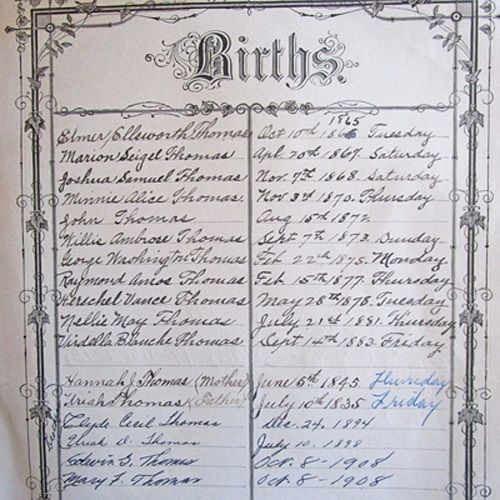
Often in that time period the only record of a person’s birth, life and death was kept in a family bible. People did not have much, but they nearly always had a family bible.

I listened to many of the interviews and read the accompanying transcripts trying to find one that I was able to understand and had relative content for the assignment. 

For my timeline I looked at the “Interview with Uncle Bob Ledbetter in Oil City, Louisiana 18 . John and Ruby Lomax interviewed Bob in 1940. There was a lot of potential information, however much of it is assumed. There is no mention of dates, so I have based every date listed on a rough calculation. For example, the interview takes place in 1940 and Uncle Bob is 73. I worked backwards assuming that he was born in 1867, was probably about 10 years old when his father taught him to read, a teen when he saw his friends in jail and 21 when he could have voted in the 1892 Presidential Election. I was able to use 1887 as the date of his marriage since he said he was 20 years old. I really took some creative license and tried to apply a reasonable age to events. I was surprised that the Lomax’s did not press him for more information about his life. I would have thought that it would have been important to their project. 

The limitations of these interviews are the oral story in itself. I listened to many of the interviews and read the accompanying transcripts trying to find one that I was able to understand and had relative content for the assignment.  Most of the recordings are very difficult to understand. I am a little hard of hearing, so it was pretty difficult. The assignment scope was just to listen 19 but unfortunately I found that only using the audio was impossible for me. I listened to it to get a feel for the overall flow of the interview, but I used the transcript for actual information. Some of the transcripts have a disclaimer about the poor quality of the recordings and include passages where the transcriber simply used “????????” or (unintelligible). Being as we are in such a digital age I had previously put a lot of value on oral history. I still think that it is important, but now include the caveat that it is only as useful as the reliability of the recorded media. Oral histories that have been transcribed are more useful than a beeswax recording roll that is garbled and not understandable. 

Listening to the overall tone of the recordings were insightful however. Some of the people interviewed were very animated and impassioned talking about certain subjects. Other times it seemed obvious that they did not want to go into greater detail but felt pressured by the interviewer. The dynamic is interesting, there seems to be a wariness, and maybe a condescending feel to how they interviewed people. They certainly don’t all flow naturally though. This was an interesting assignment and showed me that oral histories are valuable but that the way they are recorded can have a significant impact on their usefulness. When they are also made available with text they are far more useful and can really tell a fuller story.   

css.php