Archives are central to the work of Historians. They provide access to records, memory, knowledge, and more. “Who gets to be remembered and historicized by way of record creation?”1 Arroyo-Ramirez argues that record keeping and creation is an act of power in itself. Just as there is no raw data, there is no neutrality in archives. In Silencing the Past, Michael Rolph Trouillot argues that the making of archives is how the silencing of a particular people or event in history occurs. The silencing of a people can be seen most distinctly in ex-colonies and modern-day settler states. We need to be more critical of how power plays a role in the creation of historical narratives and this needs to ensue at the archives.
The digitization of archives is great because it can potentially increase the scope of people who have access to historical data, and in doing so, it can also allow for an increased awareness of the politics behind archives. As we talked about in our visit to the Special Collections center, archivists decide to digitize materials based on their popularity, quality, and feasibility. Although the digitization of archival materials can be advantageous, I can’t say that is the case for all the materials in an archive. The Thomas Jefferson Library exhibit in the Library of Congress is a great example that shows how physical artifacts, whether real or constructed, can play a role in influencing our interpretations of people and events.2
I’m grateful for our visit to the Special Collections Center because it helped me contextualize the controversy of the Federal Theater Project. It was only after looking at the program for the “Revolt of the Beavers” that I really understood how anti-intellectualism and fear had perpetuated the controversy of the FTP. The children’s program had a cartoon drawing of a beaver on the cover, yet it was used by the House un-American Activities Committee as evidence that Hallie Flanagan was promoting communist ideals. Holding the physical copy of the program and imagining the HUAC using the same children’s program (with the cartoon beaver cover) in court was a humbling experience.
I really liked this opportunity to see the special collections in class. It is definitely not something I would have sought out myself even though I am a theater major. I learned that George Mason has one of the biggest, if not the biggest sourcing of theatrical artifacts from the Federal Theater Project. The archive is important for scholars because it allows them to see the physical documents that people actually saw during the 1930s. It allows scholars to study these objects closer and better draw conclusions from them. Being one-on-one with documents or objects like these offers a new outlook on studying one’s craft. The intimate environment that the Special Collections rules have in place to study these things definitely lends towards a more focused experience. 3 For the general public, especially since George Mason is a public university, it allows them to have access to old historical documents that they cannot access anywhere else in the world. A lot of them are one of a kind so this allows a higher demand for these objects to be seen when people find out about Special Collections. I think, in a lot of ways, archivists are trying to digitize most artifacts because it allows them to be accessible by people all across the nation. If our goal is to educate others, or give them the tools to educate themselves, archives like Special Collections can be a really great resource if people know about it. But, digitized versions can lose some value that a tactile object can bring. So, our speaker talked a lot about how they try to digitize most artifacts but ultimately they do not all bring the same feeling as digitizing a document like a letter or a photograph does. My understanding of the Federal Theater Project changed because it pointed me towards how much documentation was being put out at the time. I forget that these programs had public responses, effects on the people involved, and operations that were happening that the public did not see that often kept them afloat. So, it was very cool to see them all in front of me. I was looking specifically at photographs of Voodoo MacBeth.
It was interesting to see what the photographers thought was important to catch and what wasn’t. For example, there were a lot more pictures of the audience than the backstage crew or actors preparing for the show to begin. I think that says a lot about how people viewed its impact on Black representation in theater. Overall, the Special Collections visit was a great way to see a resource I didn’t know existed. I hope it will remain in a physical and digital form so people can see it for many years to come.
Apple
data. This is but one example of how scholars could use archived material. The main
point being that archived and preserved items can be used to analyze things
from that time period Archives in general are useful in many regards. However,
the way they are useful can vary from group to group. For both scholars and the
public, archives offer a glimpse into history by physical manifestations of that
history. This can be through actual documents being preserved or other more three-dimensional
objects such as dioramas for example. As discussed in Susan Manus’ article
one of the major uses for scholars is to actually use archived equipment for certain
purposes. Preservationists can use things like older computer systems to analyze
and recover some of the out-of-date storage equipment that has simply gone out
of use. An example could be using an old Macintosh system to recover old original
without needing to be in that time period.
When regarding how the public interacts
and uses archived material there are some limitations to think about. One of
these limitations can come from not having physical access to some of the items.
Most of the time a regular person is unable to actually go a physically analyze
these objects. This is one of the biggest reasons and benefits of digitization;
it allows for anyone with WIFI access to view these pieces. Another limitation,
which scholars face as well, is the necessity for a lot of items to be
digitized. The way many of the items in collections are selected for
digitization can also be an extension of this limitation. When selecting some
items to be digitized, it is discussed with Thomas Padilla and Elvia Arroyo-Ramirez
that some
of the original meanings of the items may be lost or altered. An example discussed
was how an item which predated the internet was digitized without consent from
those who it was meant for. This “blanket tendency” as it was called to do this
can be harmful as it can leave out specific knowledge regarding the item; in
this case being that it was meant for a specific group of people.
Analyzing the items that we had in
class gave a richer understanding of what the FTP was. One of the first things
that I simply had not picked up on with digitized documents was that it was so
much more nationwide than I previously thought. There were documents from the
FTP in New York, Chicago, and other locations. While I new that it had taken
place in multiple cities and venues, having physical evidence in front of you makes
everything feel more real. When looking at digitized items you are fundamentally
losing the realness and the physicality of that object. Holding a flier for a
Macbeth show in Chicago is so much more interesting than looking at it on a
screen. You can see how big it is, how it feels, the imperfections on it. All
of this added so much more physical context to many of the programs we had been
studying throughout this semester.
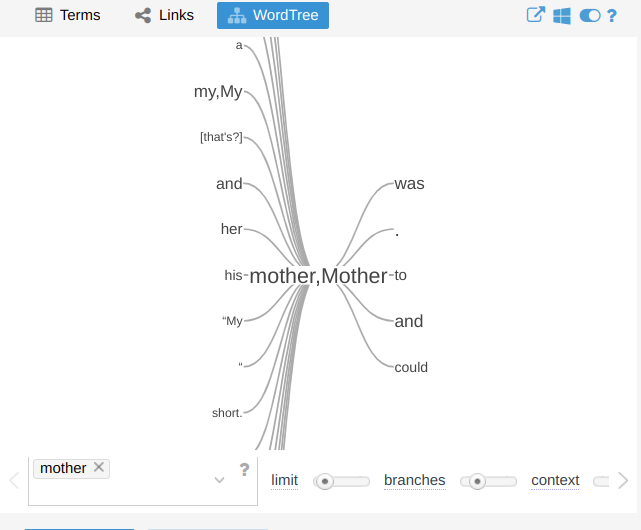
Using the text analysis tool Voyant was both helpful and confusing. When I created my own corpus I essentially used a keyword search 7 in the “American Life Histories” 8 collection. My historical question was “ How did the role of Motherhood change in the New Deal Era?” I entered the word “motherhood” in the search field and it yielded no results. So from there I tried “mother”, here I was more successful. I found around 15 documents and I decided to use them as my corpus.
From there I turned to the Voyant tool to look at our class created corpus for the Federal Writers Project collection. When I first uploaded the corpus I was just interested in playing with the word art tools.
Using Miriam Posner’s 9 tutorial was really helpful as a starting point. I especially liked the section “What the heck are we looking at?” and she was correct it is initially overwhelming. But as I continued to use the Voyant tools I understood them a little more.
I found the trends tool the most helpful. I repeated the process of using the terms “mother” and “motherhood” to investigate the documents. I found that the documents with the most mentions were the ones that I had contributed to the corpus. There were other options that I was able to look through though, just not very many. I think that in this case the corpus was just too varied in what each of us was looking for. I found that in looking for an answer to my historical question my corpus was a better fit.
As I read through them I found a somewhat surprising answer to my question. Motherhood hasn’t really changed much since the New Deal Era. Mothers seem to be the main caregivers, responsible for the children and the family in general in all the domestic type duties. They were the ones that made sure that traditions were carried on and that knowledge was passed down from previous generations. Mother’s have always been the bedrock of the family.
The Special Collections Research Center has archives full of data. Specifically, they put on display for us artifacts concerning the Federal Theatre Project (FTP). Across the tables lay various documents and objects. These objects and documents are very important as they help paint a picture, help develop the story of the FTP from what we, as scholars, already know. Scholars can take this information and rearrange to make varying arguments. Where the general public is concerned, I feel they are the consumers of the stories archivists make with their collection. Say, the archivists sits out a puppet, some pictures of dancers and notes on their designs. The public would interpret it however the archivist would set it up, and then begin to question or look into it further if the collection intrigues them. In this way, the archivists educate both scholars and the general public. The scholars being able to take the research a step further, while the public, I feel, would consider it more of a “national memory” or a facet of the past that greatly exemplifies the nation of the time.
The job of the archivist is to organize the data in any way they deem fit or suitable. When it comes to digitizing, there are two categories of how the item is interpreted: one is informational, the other is artifactual. Informational concerns the fixity and validation of the data or artifact. Does the information conveyed by the data remain the same as the artifact becomes digitized? Artifactual concerns interpretation. The archivist takes into consideration the materiality of the object. For example, in Artifactual Elements Pt. 1 10, the focus is on born-digital data being recovered from old-fashioned hardware. The archivist takes into consideration how data is stored, created and processed using this hardware. Then they consider the “environment” of the information and how that impacts how the source was created, altered or access. Desktops impact how we create and store records on our computer by a fixed screen. Another and final thing to consider is how word processing software, image editing programs, or how even operating systems can impact how contemporary records creators produce creative works.
Archivists struggle with trying to keep the meaning of their collections when digitizing them. Oft times, what is lost are the sensory perceptions. When you digitize an object, you can no longer smell it or feel it. All you can do is look at it interpretively and use various digital tools to analyze it that way. An Archivist, in this case, may prefer to digitize documents or pictures because a lot of the information can still be conveyed–digitally altered even. A three-dimensional object relies heavily on being “3-D.” When you digitize it, that already takes away its depth and makes it flat. You even lose the sense of touch which could key into how the object was made. Even though they are great to marvel at, these images and objects are subject to their own biases of the time. When we digitize them, that bias is carried forward through time. The scholar takes the time to parse through this bias and figure out who or what was omitted in order to get a good idea of the history being conveyed. 11 Simply, once these sources enter the digital world, many more challenges arise.
The SCRC FTP collection we saw involved a puppet, diorama and various forms of documentation. A lot of what they had put what we learned about the FTP into context. My group specifically got to see the Vaudeville and Negro Unit’s plays, stages, and costumes. In class, we discussed how the FTP did not use a lot of money for spending, but on salaries.12 The images painted a different story for me. Everything looked so lavish and exciting, made me wish I could have seen the pictures in their original context; rather, I wish I could see all the colors and see all the dramas in actions.
My historical question was “How did unemployment affect the people and writers of America during the Great Depression?”. This question came to me because I thought of the economic struggles that people faced during the Great Depression and then wondered about how it affected those people both socially and within their families. I had assumed that the families of America struggled to make ends meet and this forced them have dreary and downtrodden lives. I had also assumed that the writers of America would turn the pen and paper to deal with their struggles and would result in many writings about such struggles. As stated in the American Yawp chapter on the Great Depression, many families lost their jobs and subsequently their incomes with forced them into places such as ‘Hoovervilles’. 13 I selected my sources by looking for text that related to money or unemployment. I searched for the terms; money, unemployment, struggles, jobs, and family.
I found the Voyant Tool to be slightly confusing and overwhelming as it takes a large number of files and words and visualizes them in many different ways. It took a little bit to understand what I was looking at. The Voyant website states that the tools are meant to portray text in new visualizing ways that help a reader look at the text differently. I believe in the end it did help me with that. 14 I found the visualizations of the more commonly used words in the texts like the cirrus and links tools, which I have attached below as my two visualizations, to be the most useful in understanding what the text was telling me. They showed how the interviews had a common theme throughout with topics like their struggles and how life changed. It showed that all these people were affected by the Great Depression. I fumbled around with the other tools present but I struggled to find any significant meaning from those which is why I chose the ones I did.
Uploading the corpus showed me that unemployment did affect families and writers in their wallets, but it also had significant impact on their social lives and mental health. These were no topics I considered when first constructing my historical question. Pairing the findings help me paint a larger picture of the effect of the Great Depression on the American people, not just with what little ideas I had constructed before the close reading.
I concluded that my historical question was narrow in that it didn’t take into account the other problems that faced people and specifically writers during the Great Depression. I also concluded that distant reading helps with taking a large number of texts and analyzing them across the board and understanding them better.
Using the WPA guidebook Arizona: A State Guide was actually a lot of fun. I chose Arizona because I am an Arizona native and I was curious to see what parts of that beautiful state the WPA thought would be interesting to see. The guidebook itself was pretty thorough, the tour I chose had many stops and even today would make for a great day or even a weekend trip.
I think as a whole the Guidebook Series 15 is an interesting resource and I am glad that the Library of Congress has held on to them and made them available digitally. 16
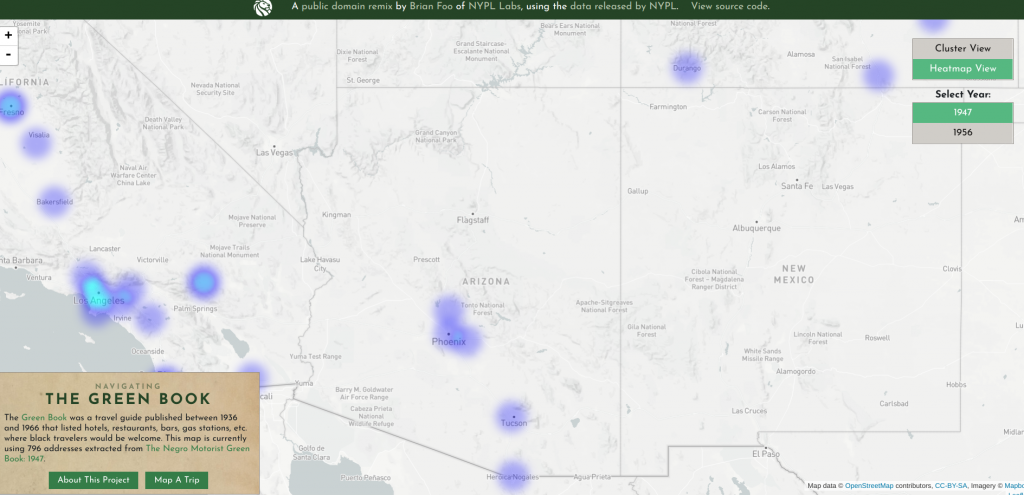
Looking at the green book map of my trip was interesting, there was not one single stop on my tour that was also on the green book 17
. I could take this to mean that Arizona was not the most diverse of places at the time or that it was simply too rural and under developed to warrant much information. As most of the tour I looked at was outdoors and naturalistic areas I don’t think that there would be a great deal of difference in the experiences of white or African American tourists. That being said I am sure that stops at diners or hotels along the way may have varied. I did some research and found that unfortunately there a great deal of Jim Crowism in Arizona at the time. A recent article discusses how Flagstaff was segregated. 181920
So minorities on this tour would have had to deal with segregation as they toured the state.
The heatmap of Arizona. From Navigating the Green Book ProjectThe cluster view of my Arizona State Guide tour. There is nothing available. The only thing that came up was much further south in Arizona and not on my tour. From Navigating the Green Book Project
Mapping data like this is a wonderful visual tool. Seeing that there are virtually no stops from the green book in all of Northern Arizona was disappointing. It was just emptiness, no safe zones. I sincerely hope that the emptiness is also indicative of the rural-ness and that it was not a dangerous place for people of color. But realistically I think that the lack of safe places means that overall it was dangerous for people of color to travel in the area.
My historical question was originally, “Aside from Federal One projects, how did the arts effect the everyday person in Chicago and New York City, two ethnically diverse cities? Additionally, were these art forms more inclusive and/or accessible to minority racial groups oppose to Federal One projects?” However, as I started to do my research and find narratives from the Federal Writers’ Project, I realized that I had to change my question. I found that I was a lot more interested in specifically jazz music, oppose to the overarching arts. My thought process in choosing the second question was trying to figure out how jazz was received in Chicago. I think it’s natural to think about jazz, plays, ballroom parties, etc. in terms of New York, especially coming out of the height of the Harlem Renaissance. I was interested in whether or not jazz had the same kind of prominence in other big, ethnically diverse cities, like Chicago, or was it overshadowed by the uprising of Folk music?
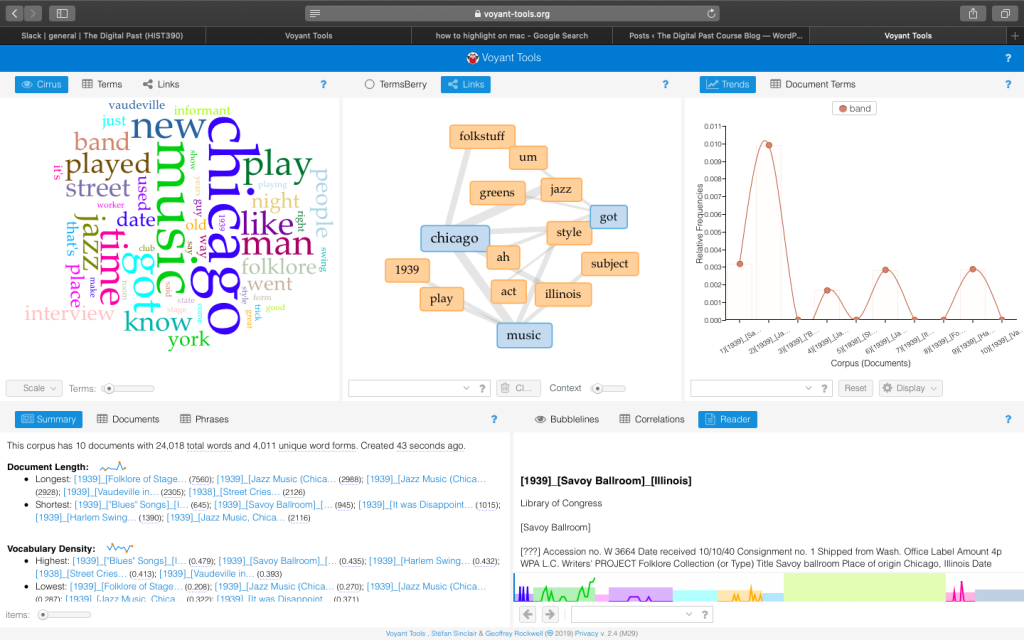
I was worried about finding narratives that would fit my historical question. Most of the narratives seemed to be about the American Slavery experience, not music in their present day. I searched for terms like “music,” “Chicago,” “jazz,” to find the narratives, and made sure they were included in the collection. For the most part, no matter what I searched, I found the same few narratives, but I was able to find enough for the purposes of the Zip drive. Voyant Tools was easy for me to use once I learned how to use some of the visualization mechanisms. I think it was a lot easier to use than some of the other technological sites we’ve used this semester. My favorite tools, and what helped me find answers to my historical question the most, were setting the first block as “Cirrus,” the second block as “Links,” the third block as “Document Terms,” and the bottom right block as “Reader.” In doing this, I could read the narratives and see correlations between words.
Using Voyant Tools, I was shocked to see that there was a correlation between “music” and “California” in the class corpus. I guess I was so caught up in studying my own corpus that I never thought about any other states or cities. In terms of my historical question, I’m unsure if I found an exact answer. However, using the “Links” tool, I realized that in the class corpus, there was a strong connection between “music”and “Chicago,” even amongst 300+ narratives. This doesn’t necessarily mean “jazz,” but I think it would be safe to assume the main music source was jazz. Additionally, if there were 300+ narratives in the class corpus, and “Chicago” and “music” made a match, I think that’s an important fact to identify – the possibility that music in Chicago was more prominent than New York.
I personally liked text analysis. I know in the “Mapping Racism and Accessing the Success of the Digital Humanities” 21 article we read by Sarah Bond quoted a professor calling the Digital Humanities a “bust,” but this aspect of the Digital Humanities I find highly useful (Bond, 2017). No one in my generation, or future generations I would assume, would have the patience to sift through hundreds or thousands of articles to answer a historical question. In Lauren Tilton’s “Dialect and the Construction of Southern Identity in the Ex-Slave Narratives,” 22 she uses text analysis to “show how dialect was not only racialized but also connected to a particular (cultural) geography—the American South” (Tilton, 2019). Tilton could’ve researched this historical question, but her research would’ve probably taken years and would’ve included years of her sifting through documents either on her own or with a team. Thanks to text analysis, she was able to hone in on a specific topic and allow technology to aid her in finding correlations. In my final conclusion, I came up with more of an assumption for my historical question. Yet, I now know that text analysis is a much easier method to approach researching, and will most likely be using it in the future.
My original historical question was, “what factors helped shift the public perception of labor unions in the 1930s, and how?” And with “public perception,” I was referring to the working class’ trust in unionization and the efficacy of unions. Initially, I assumed that labor unions were stigmatized negatively in the 1930s because of their lack of success in years prior, and that affected the willingness of the working class to unionize.23
I selected my sources from the American Life Histories collection by refining the search with the subject of “labor unions.” The items I selected for part one were particularly interesting to me because of the passion and candor the interviewees spoke with when referring to unionization; there was actually a document that was a manuscript of a Worker’s Alliance Meeting in New York, and the entire thing was just the prayer that someone led before starting the meeting.
Voyant turned out to be really beneficial for text-analysis and helping me create a more constructive question. I utilized the class corpus by creating a new corpus with only 62 documents that involved the words “union” or “unionization.” Distant reading was useful in this aspect because it allowed me to see the frequency in which unions were talked about throughout the collection. Now that I had a corpus that was composed of manuscripts about labor unions, I wanted to see how people were talking about them.
In the “contexts” section of the site, I was able to search “union good”~15 and “union bad”~15, and this allowed me to find sentences with the words “union” and “good” within 15 words of each other. I got a total of ten results and only 1/10 of those documents used the word “bad” to describe unions in a negative manner. The other nine documents used the word “good” to refer to unions in a positive light. After pairing my findings with close reading, I realized that the documents do not clearly and explicitly present the factors that affect the working class’ perspective on labor unions. So, my original historical question went from, “what factors helped shift the public perception of labor unions in the 1930s, and how?” to “what was the public perception of labor unions in the 1930s?”
Searching “union bad”~15 in the corpus of 62 documents.
The one document that was given as a result of searching “union bad”~15. The document is analyzed in the Reader part of Voyant.
To conclude, the manuscripts in my close reading of the 10 documents proved to be useful in emphasizing peoples candid thoughts and passion about labor unions. But most importantly it shed light on how there were discrepancies in attitudes about unionization, that were determined primarily by your status as a working-class individual. For example, the manuscripts showed that while some people had the freedom to unionize, others were fearful of retaliation in the workplace. Also, despite reading Miriam Posner’s blogpost beforehand, I still went into this assignment thinking that Voyant would provide a “straightforward window into a text.”24 But by the end of the assignment, I realized, as Posner argues, that text analysis and Voyant should instead be used “as a way to talk about how we interact with texts and what kind of meaning evades capture by computational tools.”25
My historical question asked what folklore and folk music from 1930’s Chicago could reveal about the social climate of the time. I based this question off of a collection of ten different sources from the FWP corpus, with this specific interest in mind while I compiled them and close-read them in the first part of the assignment. Folklore and folk music have always interested me, as I see them as a crossroads between the fields of history and english, so when I discovered a wealth of documents pertaining to music in particular, all from the same place and time, I was immediately intrigued. I recognize after working through the second half of this assignment that my topic perhaps might be better suited for a paper or presentation, instead of a key-word based assignment using Voyant Tools, however I have tried my best to make it work with the technology at hand by focusing my text analysis specifically on my own smaller corpus of materials rather than the extensive library of files downloaded from Dropbox. Originally, I tried to navigate through the entire zip file provided to us, however this proved extremely frustrating and hindered a lot of the research I wanted to get done.
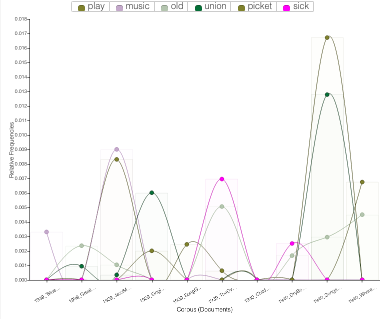
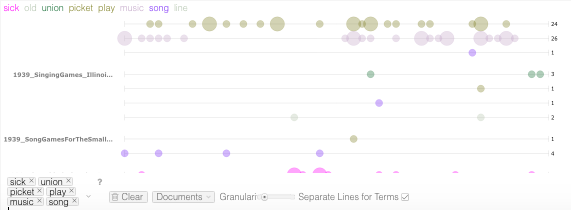
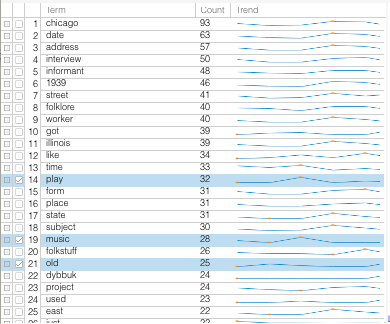
So, having uploaded my own miniature corpus of FWP sources, I began looking up keywords. Some of the suggested terms, ranked by their prevalence throughout the documents provided (and which were not merely derived from the standard headings of each), were: play, union, picket, music, sick, and old. I think that these key words give an interesting summary of the topics, but also of the themes at play in the city. The sources which I compiled covered a variety of subjects, all centered in Depression Era Chicago. From my close readings as I looked deeper into the prevalence of these key words, I learned that during this period, there was a strong push for unionization and workers rights. A surprisingly large percentage of the recorded children’s songs—mostly sung while playing jumprope games or other similar activities in the schoolyard—referenced parents working in factories or organizing picket lines, indicating the reach and social upheaval of the workers’ protests of the time. According to other sources, which recounted the folklore of various pockets of Chicago’s community, illness and disease were also prevalent during this time. In some Jewish communities, it was believed that these illnesses were caused and spread by an entity called a “Dybbuk,” yet it is noted that the Dybbuk only attaches itself to Jewish people, and that the illnesses did spread elsewhere as well. Finally, the last key word that struck me was music. Beyond the song games of Chicago children at the time, there were also multiple sources in this collection which discussed jazz and blues music, suggesting an uptick in their importance and popularity in the city. Especially where the blues genre is concerned, music provided an artistic outlet and an escape from the hardships of daily life, in a context which was not only heavily impacted by the Depression itself, but was also undergoing radical social changes and demonstrations in terms of its industrially-based economic.
Overall, I felt like this tool was incredibly useful in helping me visualize and articulate my exploration of my historical question. The various ways that key word prevalence was displayed helped me find common threads throughout the majority of my compiled sources, and isolate core themes of the time. Ultimately, I was not surprised by what I found through this tool. The commonalities presented through the charts, lists, and graphs were similar to those that I had noticed while converting, compiling, and close-reading my files in Part I, however the tool greatly helped me understand which points called for the most focus, and how things overlapped. It is a great visual tool for those who, like myself, need a visual representation of the information in addition to written notes.
My final note on my historical question is this: The folklore and music of New Deal Era Chicago is home to a wealth of information. These sources provide us with incredible commentary on political issues, community health, and forms of escapism, even in the places we would least expect, such as the children’s jump rope rhymes. Combined together, this collection paints a vivid, albeit austere, portrait of Chicago between 1939-1941, and allows for a more personal view of the state of the city. The interview and observation based sources effectively capture glimpses of daily life, in a way that formal histories may fail, and because of this I will close with the argument that folklore and song serve a vital purpose in shaping our understanding of a culture, from city to civilization.
(Please note: I’m still having trouble figuring out how to make footnotes, but I promise I am trying)
American Life Histories: Manuscripts from the Federal Writers’ Project, 1936-1940 : Digital Collections : Library of Congress.” The Library of Congress, www.loc.gov/collections/federal-writers-project/about-this-collection/.